Mottingham bathroom renovations cost £5,800-£18,500+ in 2026 and take 7-21 working days on site. Planning permission is rarely needed, but many homes here are ex-council, so leaseholders need written landlord consent. An added bathroom lifts value by about 6% (Nationwide), and most Mottingham owners spend £7,800-£11,500 on a full refurbishment in the same layout.
This guide explains the 2026 cost of a bathroom renovation in Mottingham (SE9 4), how long it takes, which consents you need and how much value it adds. Mottingham is a place of two halves. The old village along Mottingham Lane has Victorian and Edwardian villas, while the vast interwar Mottingham estate, built by the London County Council in the 1930s, fills the land to the south and west. Their bathrooms are very different jobs.
Our figures come from Buildaway's south-east London pricing, the ONS, Nationwide, GOV.UK and the HSE, and each one links to its source.
• Cost in 2026: £5,800-£7,800 refresh; £7,800-£11,500 full refurbishment; £11,500-£18,500+ premium bathroom or wet room.
• On site: 7-10, 10-15 and 15-21+ working days, plus two to seven weeks of design and ordering.
• Consent: internal work is not "development", but leaseholders on the estate need their landlord's written permission.
• Value: an extra bathroom adds about 6% (Nationwide). On Greenwich's £713,000 average semi (ONS, July 2026), that is about £42,780.
• Area: Mottingham (SE9 4), mainly in the Royal Borough of Greenwich, bordering Lewisham and Bromley.
How Much Is a Bathroom Renovation in Mottingham in 2026?
A Mottingham bathroom refresh costs £5,800 to £7,800 in 2026. A full refurbishment that keeps the current layout costs £7,800 to £11,500, and a premium bathroom or wet room with a new layout costs £11,500 to £18,500 or more. All three bands include labour, materials and waste disposal (Buildaway, 2026).
These ranges sit close to our Greenwich bathroom fitting cost guide. Most Mottingham bathrooms are compact, and the estate's wide roads make parking and skips simpler than in inner London. Costs rise in the older village houses, where bigger rooms and older fabric add time.
| Scope | Typical total | Time on site | What is usually included |
|---|---|---|---|
| Refresh | £5,800-£7,800 | 7-10 working days | Like-for-like suite, part tiling, new fittings, extractor check |
| Full Refurbishment (most chosen) | £7,800-£11,500 | 10-15 working days | Full strip-out, boarding, tanking, full tiling, lighting, furniture, Part P certificate |
| Premium / Wet Room | £11,500-£18,500+ | 15-21+ working days | New layout, tiled former with linear drain, underfloor heating, premium brassware |
Guide ranges, confirmed by an itemised written quote once we have surveyed the room.
What Changes the Price of a Mottingham Bathroom?
Seven things change the price most: the building's age, the soil stack position, the floor type, how much tanking is needed, the electrics, the tile format and the suite. Two Mottingham bathrooms of the same size can be thousands apart once the survey is done.
- Building age. Estate houses from the 1930s and village villas from the 1880s both predate 2000, and the HSE warns that buildings of that age may contain asbestos. Old bath panels, floor tiles and textured ceilings are the usual places to check.
- Soil stack. Many estate houses have an external stack at the back, and moving the WC away from it adds pipe runs or a pump.
- Floor type. Timber floors may need packing or new boards before a tiled walk-in shower can go down.
- Tanking. Walk-in showers need a bonded waterproof membrane across the floor and the walls.
- Electrics (Part P). Older wiring often needs updating before new lights, a heated mirror or an extractor go in.
- Tile format. Large porcelain on uneven 1930s walls needs more preparation than smaller tiles.
- Suite and brassware. This is about a third of the spend and the simplest line to change.
How the Money Is Spent
People tend to budget for the suite and forget the labour, yet labour is normally the larger share. Checkatrade gives bathroom labour rates of roughly £320-£480 a day in 2026. On a £9,500 Mottingham refurbishment, about half goes on labour, a third on sanitaryware and furniture, a tenth on tiles and tanking, and the rest on waste and paperwork.
Buildaway estimate, not a published statistic. Labour day rates: Checkatrade (2026). The balance shifts with tile area and specification.
For a price on your own room, book a free survey and quote. We check each of these factors in person rather than guessing over the phone.
Why Does Your Mottingham House Type Matter?
Mottingham has three main property types. LCC cottage-estate houses are compact and fairly predictable, older village houses carry more unknowns, and flats bring lease and access rules. In practice, the building decides as much of the price as the size of the bathroom (Buildaway, 2026).
The 1930s LCC Cottage Estate
The London County Council built the Mottingham estate in the mid-1930s as a cottage estate of brick terraces and semis set along green, curving streets. It was designed to give families from crowded inner London a garden and an indoor bathroom, which was still new for many at the time.
Today those original bathrooms are small, often with a separate WC next door, and many have had two or three refits since. Joining the bathroom and WC into one room is the classic upgrade, and it usually costs £7,800 to £11,500. Need a second bathroom? Our Mottingham loft conversion team can plan a shower room in the roof.
Village Houses Along Mottingham Lane
Before the estate, Mottingham was a small village of large houses, and some survive along Mottingham Lane and Court Road. The cricketer W.G. Grace spent his last years at Fairmount on Mottingham Lane. Houses of this era have bigger bathrooms, higher ceilings and older pipework, so the survey matters more.
These homes often suit a freestanding bath and separate shower, and many have room for an en-suite. Expect more preparation work: uneven walls, old lead or iron pipes and joists notched by earlier plumbers are all common.
Flats, Maisonettes and Newer Infill
The estate also includes low-rise flats and maisonettes, and newer infill blocks have appeared near the station and Sidcup Road. Many flats are former council homes now owned on a lease. Depending on which side of the borough boundary you are on, the freeholder may be Greenwich, Lewisham or a housing association, so check your lease to see who must approve the work.
What Permission Does a Mottingham Bathroom Need?
Usually none from the planning department, because internal works are not development. Building regulations still apply, and leaseholders need written consent from the freeholder before any plumbing or structural change (Town and Country Planning Act 1990, s.55).
Is Planning Permission Required in SE9?
Not for internal work. Section 55 of the Town and Country Planning Act 1990 excludes works that only affect the inside of a building. External changes such as a new window, a soil pipe on the front wall or a new flue may need consent.
Listed buildings are the main exception, because internal works can need listed building consent. A few of the older village houses are listed. If your new bathroom needs extra floor space, the extension or loft that creates it will carry its own planning rules.
Ex-Council Leases on the Estate
If you own an ex-council flat or maisonette, you need your freeholder's written consent, usually a licence for alterations, before changing the bathroom. Most leases ban plumbing or structural changes without it, and some require acoustic underlay below tiled floors.
GOV.UK's leasehold guidance confirms that the lease sets what you may change. Ex-council houses bought outright are usually freehold and need no landlord consent. Ask early, because council home ownership teams can take several weeks to reply.
Building Regulations You Will Meet
Four approved documents cover most bathroom work. Part P deals with electrical safety, Part F with extract ventilation, Part G with hot water safety and water efficiency, and Part H with new or moved drainage. A registered electrician can self-certify, and the approved documents on GOV.UK give the detail. Keep each certificate, because a buyer's solicitor will ask to see it.
How Long Does a Mottingham Bathroom Renovation Take?
A full Mottingham bathroom refurbishment takes 10 to 15 working days on site. A refresh takes 7 to 10 days, and a wet room or new layout takes 15 to 21 days or more. Allow two to seven weeks of design and ordering before that (Buildaway, 2026).
| Stage | Working days | What happens |
|---|---|---|
| Protection and strip-out | 1 | Floors protected, old suite and tiles removed, waste cleared |
| First fix | 2-3 | Plumbing, cabling, extract ducting, studwork |
| Boarding and tanking | 1-2 | Boards, levelling, waterproof membrane |
| Tiling | 3-5 | Floor and walls, niches, grout |
| Second fix | 2-3 | Suite, brassware, furniture, lighting |
| Testing and snagging | 1 | Silicone, testing, Part P certificate |
| Total | 10-15 | Full refurbishment on site |
Order bespoke vanities, stone and imported brassware early, as they can take four to eight weeks. Our Greenwich bathroom renovation timeline explains how to cope with one bathroom out of action.
Seven Steps to Plan a Mottingham Bathroom
Plan a Mottingham bathroom in seven steps: identify your freeholder, book a survey, set the scope, fix the design, get a fixed written quote, order long-lead items and book the build. A survey comes before any price because asbestos, the stack and the floor can all change the cost (Buildaway, 2026).
Work through them in sequence. Each step takes a risk off the table before you commit money, which is why careful planning so often decides whether a bathroom finishes on time.
- Identify your freeholder. Check whether you own the freehold, and if not, which council or landlord must give written consent.
- Book a survey. Inspect the floor, the stack, water pressure and any possible asbestos before any figure is agreed.
- Set the scope. Choose a refresh, a full refurbishment or a layout change, and pick the matching budget band.
- Fix the design. Agree layout, tiles, suite and lighting before strip-out, because changes on site cost days.
- Secure a fixed price. Ask for an itemised price with the contingency listed separately.
- Order long-lead items. Order made-to-measure or imported pieces six to eight weeks before the start.
- Book the build. Agree the start date, waste plan and where the household will wash during the work.
Is a Mottingham Bathroom a Good Investment?
An extra bathroom can add around 6% to value, says Nationwide. On Greenwich's £713,000 average semi-detached house, that is about £42,780. A straight replacement has no fixed uplift, but it stops buyers using a tired room to push the price down (ONS, July 2026).
The ONS recorded Greenwich's average price at £463,000 in July 2026, 1.4% lower than a year before (accessed 20 Oct 2026). That average is pulled down by the many flats in the borough, so the semi figure is a better guide for estate houses. The 6% figure is from Nationwide's 2023 analysis.
Values: ONS UK House Price Index, July 2026 (provisional). Uplift: Nationwide. Your real gain depends on the ceiling price of your street.
These are borough-wide figures for the Royal Borough of Greenwich. The ONS does not publish a Mottingham figure, and estate terraces usually sell below the borough's semi average, so check recent sales on your road before setting a budget.
Nationwide's October 2025 research also reported that a loft or extension giving a three-bed, one-bathroom house an extra double bedroom and bathroom can raise its value by up to 24%. Many Mottingham estate houses fit that description. Our Greenwich bathroom cost versus value guide looks at more scenarios.
Accessible Bathrooms and Grants
Ground-floor flats and the estate's level streets make Mottingham well suited to accessible bathrooms. If someone at home is disabled, a Disabled Facilities Grant from your council can pay up to £30,000 in England towards changes such as a level-access shower. Which council depends on your address: most of Mottingham applies to Greenwich, with some streets under Lewisham or Bromley. Grants are means-tested, so apply before you commit.
What Bathroom Design Suits a Mottingham Home?
Mottingham bathrooms are mostly small, so design is about space. Estate houses gain most from merging the bathroom and WC and using wall-hung fittings, while village houses can take a freestanding bath. Local water is hard, so choose finishes that resist limescale (Buildaway, 2026).
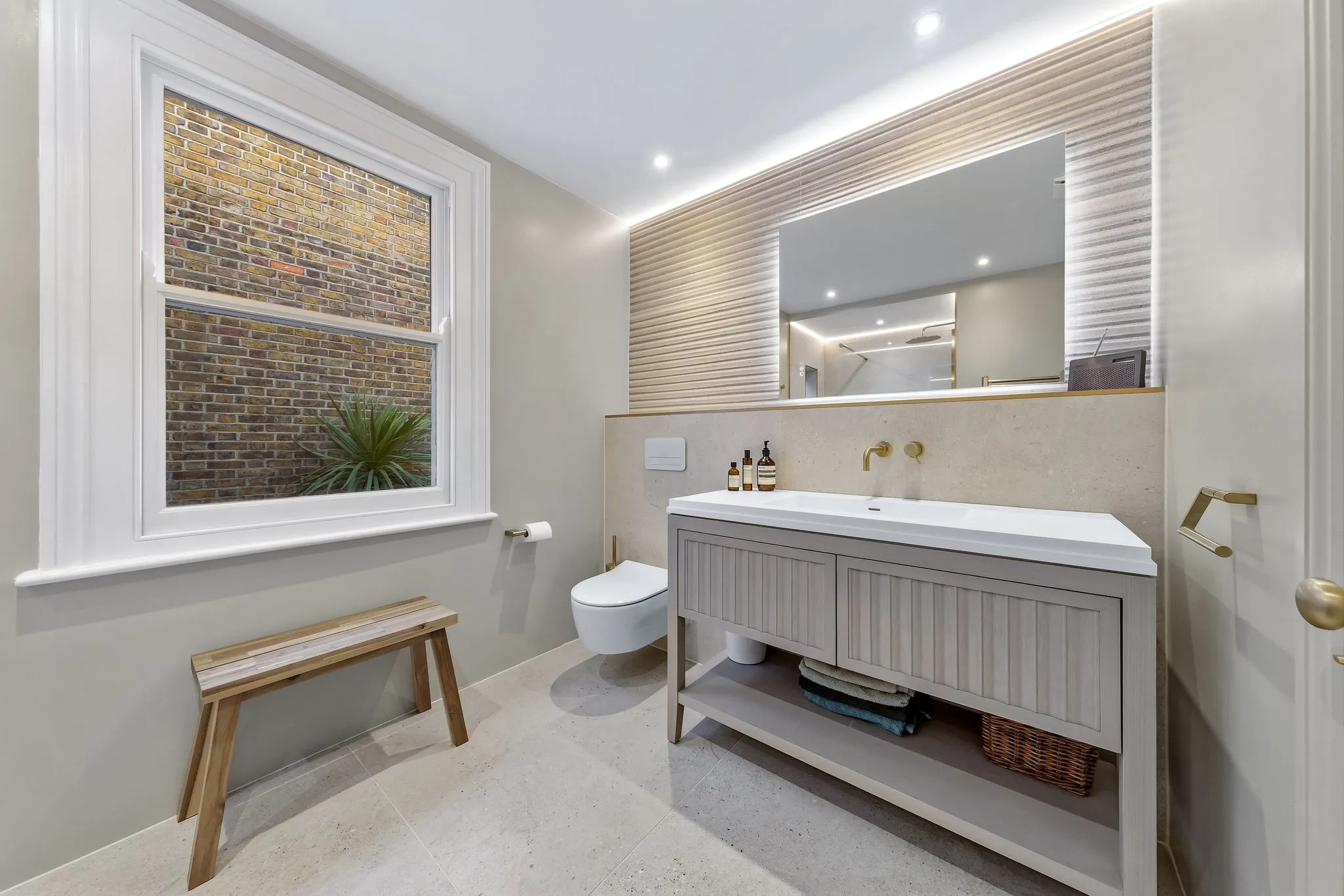
In a compact estate bathroom, a shower over a straight bath with a fixed glass panel saves space without losing a bath. A wall-hung WC and vanity free up floor space, and a mirrored cabinet adds storage without taking any extra room. For more space-saving layouts, see our Greenwich small bathroom ideas.
South-east London water is hard, so check your supplier's postcode report for the figure. Scale soon dulls chrome taps and clear shower glass. Brushed finishes, coated screens and a softener all help.
Small rooms hold steam, and many estate bathrooms have only a small window. A Part F extractor with an overrun timer is essential. Good bathroom remodelling in Mottingham also adds an electric element to the towel rail, so towels dry when the heating is off.
Bathroom Jargon, Explained
A wet room is a fully waterproofed room with a level-access shower and no tray, while tanking is the waterproof membrane bonded to floors and walls before tiling. On Mottingham's ex-council estate, a licence for alterations is the landlord's written approval for bathroom changes.
- Cottage estate
- A low-rise council estate of houses with gardens, built by the London County Council between the wars, like the Mottingham estate.
- Tanking
- Waterproof sheeting or liquid coating applied behind tiles in wet zones.
- Wet room
- A bathroom with a sealed, sloping floor and an open shower area instead of a tray.
- Soil stack
- The large vertical pipe the toilet connects to, usually fixed to the rear wall on estate houses.
- Macerator
- An electric pump unit that lets a WC or basin drain where gravity alone cannot reach the stack.
- Licence for alterations
- The landlord's formal letter of consent that a leaseholder needs before altering a flat.
- Acoustic underlay
- A sound-deadening layer under a hard floor, often required by leases in flats.
- Part P certificate
- The certificate issued by a registered electrician once bathroom wiring is tested and compliant.
Finding Bathroom Fitters You Can Trust in Mottingham
Choose fitters who survey before they price and provide an itemised written quote. Confirm their insurance, trade body and Part P status, and ask which waterproofing system they install and what guarantee it carries. Trusted bathroom fitters will ask about your lease, asbestos and the soil stack first.
Before you sign, ask every firm these six questions:
- Will you issue a Part P electrical certificate?
- Is the quote itemised, with a separate contingency line?
- Which waterproofing system will you use, and is it warranted?
- What public liability cover do you have?
- When are payments due, and for which stages?
- Can I see bathrooms you have recently fitted in south-east London?
We are registered with the Federation of Master Builders, and every job gets a fixed written quote after survey and an 18-month workmanship warranty. Our bathroom fitters in Mottingham cover plumbing, tiling, electrics and wet rooms as one team. See our Mottingham bathroom renovations page for the full service.
Mottingham Bathroom Renovation FAQs
How much does a bathroom renovation cost in Mottingham in 2026?
A refresh costs £5,800 to £7,800, and a full refurbishment in the same layout costs £7,800 to £11,500. A premium bathroom or wet room with a new layout runs from £11,500 to £18,500 or more. These are Buildaway's 2026 guide bands for Mottingham, confirmed by written quote after survey.
How long does a bathroom refit take in Mottingham (SE9 4)?
Most full refurbishments take 10 to 15 working days on site. A refresh takes 7 to 10 days, and a wet room or layout change takes 15 to 21 days or more. Allow two to seven weeks ahead of the start for the survey, design and deliveries.
Do I need planning permission for a new bathroom in Mottingham?
Not for internal work. Under Section 55 of the 1990 Act, changes confined to the inside of a building are not treated as development. Listed buildings can still need listed building consent, external changes such as a new window may need consent, and building regulations always apply.
Can I renovate the bathroom in an ex-council home on the Mottingham estate?
Yes. If you own the house freehold, no landlord consent is needed. If you own a flat or maisonette on a lease, ask the freeholder, often Greenwich or Lewisham council, for a licence for alterations first. Check the lease for rules on flooring, plumbing and working hours.
Does a new bathroom add value to a Mottingham home?
Nationwide's 2023 study estimated that an additional bathroom raises value by roughly 6%. On Greenwich's £713,000 average semi-detached house (ONS, July 2026), that is about £42,780, though Mottingham values vary by street. Simply renewing the existing bathroom has no fixed premium, though it does take away a bargaining point for buyers.
Can I get a grant for an accessible bathroom in Mottingham?
Possibly. A Disabled Facilities Grant of up to £30,000 in England can cover adaptations like a walk-in, step-free shower. The council checks household finances and has an occupational therapist assess the disabled person's needs. Most Mottingham residents apply to Greenwich council, and should wait for a decision before booking work.
Your Mottingham Bathroom in Summary
Set aside £7,800 to £11,500 and 10 to 15 working days on site for a full Mottingham bathroom refurbishment in the existing layout. A refresh costs £5,800 to £7,800, and a wet room or new layout costs £11,500 to £18,500 or more (Buildaway, 2026 guide bands, confirmed by written quote after survey).
Find out who holds your freehold and how old the building is, then fix the design before strip-out. Want to follow the latest looks? Read our Greenwich bathroom design trends. Once you have your answers, book a free survey and fixed written quote.
By Cormac Hegarty, Director & Founder - Buildaway. Cormac Hegarty is the Founder of Buildaway and a residential construction specialist with a deep portfolio of projects across London.