
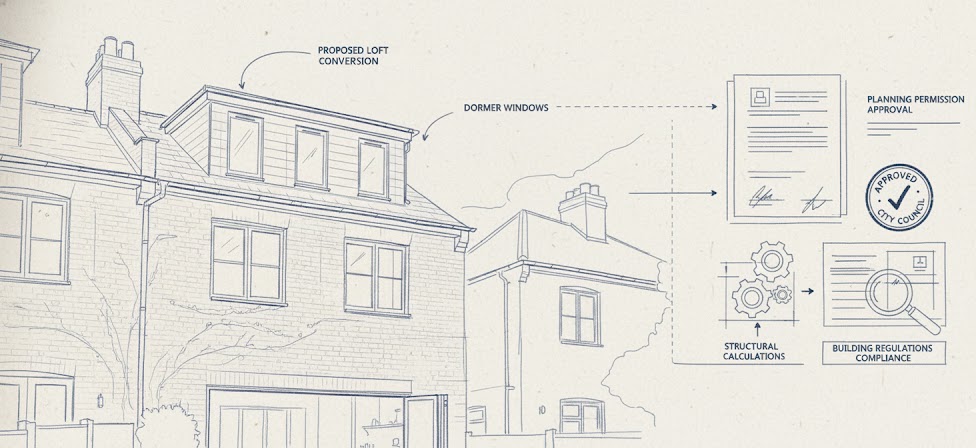
Crystal Palace has a planning quirk found almost nowhere else in London: stand at the top of the hill by the transmitter and you're at the meeting point of five separate boroughs. Walk down one side of Westow Hill and you're in one council's patch; cross the road and you're in another's. For a homeowner thinking about the loft, that fact changes the very first question - before "do I need permission?" comes "whose permission, exactly?"
The good news is that the loft itself is often straightforward: much of SE19's Victorian housing keeps its permitted development rights. The task is getting the paperwork to the right desk. This guide sets it all out: when a Crystal Palace loft is permitted development, which of the five boroughs decides your case, what the 2026 fees are, and how to prove your project is lawful before you build.
Many loft conversions in Crystal Palace are permitted development, because much of SE19 sits outside a conservation area and keeps the right to a rear dormer of up to 40m³ (terrace) or 50m³ (semi/detached). The twist is that Crystal Palace straddles five boroughs - Bromley, Croydon, Lambeth, Lewisham and Southwark - so your application, conservation status and local policies all depend on which council your street falls under. The fee is £548 from 1 April 2026 whichever borough applies. Flats have no permitted development rights.
Does a Crystal Palace Loft Conversion Need Planning Permission?
Often, no - though the answer comes in two parts here. On the permitted development question: because much of Crystal Palace lies outside any conservation area, an unlisted house usually keeps the national rights that let you add a rear dormer without a planning application, within the volume and design limits set out below (Planning Portal).
On the "who decides" question: because SE19 is split between Bromley, Croydon, Lambeth, Lewisham and Southwark, the council that handles any application - or any Lawful Development Certificate - is whichever borough your street belongs to. Conservation-area designations and local policies differ from one side of the hill to the other, so two owners a short walk apart can deal with different authorities entirely. And, as everywhere, a flat rather than a house has no permitted development rights at all.
Because both questions turn on your exact address, our first step is always to confirm your planning authority and your street's status - and where a project is permitted development, we recommend a Lawful Development Certificate from the correct borough as formal proof it's lawful.
The Five-Borough Puzzle: Which Council Rules Your Street?
Crystal Palace's boundaries are a genuine curiosity. Near the top of the hill, the London Boroughs of Bromley, Croydon, Lambeth, Lewisham and Southwark all converge, so the SE19 postcode alone tells you nothing about who your planning authority is. Each borough runs its own local plan, its own conservation-area designations and its own Article 4 directions, and those differ across the boundary.
What stays constant is the national framework: the permitted development volume allowances, the £548 householder fee and the 8-week decision target are the same whichever council applies. What varies is the local overlay - whether your street is in a conservation area, what design guidance the borough uses, and how it treats the hillside's grander villas. The first job on any Crystal Palace loft is simply to pin down which of the five councils you're dealing with, because everything else follows from that.
Permitted Development Rights for Lofts in SE19 - What You Can Build
On an unlisted Crystal Palace house outside a conservation area, permitted development lets you add a roof enlargement of up to 40 cubic metres on a terrace, or 50 cubic metres on a semi-detached or detached house, without a planning application (Planning Portal). The main conditions are that the dormer sits on the rear, doesn't rise above the ridge, uses materials matching the house, and stays 20cm back from the eaves - and they apply identically across all five boroughs.
Permitted Development Roof Allowance, by Property
Maximum roof enlargement without planning permission - England, 2026
Source: General Permitted Development Order 2015, Schedule 2 Part 1 Class B (via Planning Portal). Class B rights are excluded in conservation areas and do not apply to flats. The same national rules apply across all five boroughs.
Two caveats apply whichever council you're in. "Original house" means the property as first built or as it stood in 1948, so a villa that has already been extended may have less volume left than it looks. And rooflight-only conversions fall under a separate rule (Class C) that stays available even in most conservation areas - a useful fallback where a dormer isn't an option. On the hillside terraces of SE19, permitted development is usually the quickest route to a finished loft.
Which Loft Conversions Get Approved in Crystal Palace?
The types that suit the area's Victorian housing come through most smoothly. A loft that adds a bedroom and bathroom can lift a three-bedroom London home's value by up to 24% (Nationwide, 2025), and Crystal Palace's mix of tall terraces and grand hillside villas offers plenty of roof volume for a rear dormer or, on detached and semi-detached homes, a hip-to-gable.
| Conversion type | Planning position in Crystal Palace | Typical London cost* |
|---|---|---|
| Velux / rooflight | Usually no application needed (Class C), even in conservation areas | From ~£17,000 |
| Rear dormer | Permitted development outside a conservation area; full application inside one | £45,000–£100,000 |
| Mansard | Usually a full application; approvable where the street suits it | £65,000–£140,000+ |
| Hip-to-gable | Often PD on Crystal Palace's semi-detached and detached hillside homes | £55,000–£130,000 |
*2026 London ranges from Buildaway's London loft conversion cost guide (linked below). Conservation-area detailing in Crystal Palace sits at the upper end.
Beyond the boundary question, roof shape and tenure guide the design. Crystal Palace's converted villa flats follow the freeholder route rather than permitted development, while the big detached and semi-detached houses on the hill often have the volume for a hip-to-gable. This is where a seasoned loft conversion service pays for itself: identifying the borough, the route and the design in one go.
What About Conservation Areas and Listed Buildings?
Crystal Palace has its share of protected townscape, spread across the five boroughs. The Crystal Palace Park area and stretches of the town-centre Triangle fall within conservation areas, and there are listed structures - most famously the surviving terraces, sphinxes and the Grade I-registered park itself, home to the Victorian dinosaurs. If your home is listed, you'll need listed building consent alongside any planning permission, and any address can be checked on Historic England's National Heritage List.
Two facts hold whichever borough you're in. There's no fee for listed building consent - but unauthorised works to a listed building are a criminal offence. And because each council draws its own conservation-area boundaries, a designation can stop at a borough line, so the same terrace can be protected on one council's side and unrestricted on another's. Confirm both the borough and the conservation status before you plan.
What Does Planning Permission Cost in Crystal Palace in 2026?
Helpfully, the fee doesn't change with the borough - it's set nationally. A householder planning application in England costs £548 from 1 April 2026, up from £528 (GOV.UK fee regulations). A Lawful Development Certificate - which confirms a permitted development loft is lawful - costs £274, half the householder fee, and listed building consent is free.
| Item | 2026 cost | Notes |
|---|---|---|
| Householder planning application | £548 | From 1 April 2026 (was £528); same in all five boroughs |
| Lawful Development Certificate | £274 | Half the householder fee; proves a PD loft is lawful |
| Listed building consent | £0 | No fee, but heritage statement required |
| Measured survey & drawings | ~£1,500–£4,000 | Typical London range, Buildaway project experience |
| Structural & Building Regs drawings | ~£500–£1,500 | Needed even where the loft is permitted development |
Statutory fees: GOV.UK planning fee regulations, 2026. Professional-fee ranges reflect Buildaway's London project experience and vary with property complexity.
Costing the build too? Our full breakdown of loft conversion costs in London covers every conversion type, and if you're weighing a loft against extending, see our guides to home extension costs in Crystal Palace and planning permission for a home extension in Crystal Palace.
How Long Does the Planning Process Take?
Whichever of the five boroughs decides your case, the statutory target is the same: 8 weeks to determine a householder application once it's validated (GOV.UK), or a similar 8 weeks for a Lawful Development Certificate. The one thing that can add delay in Crystal Palace is sending the paperwork to the wrong council, which is exactly why confirming your authority up front pays off.
Crystal Palace Loft Conversion: Pre-Construction Timeline
Typical duration of each stage, in weeks
Statutory 8-week determination target: GOV.UK. Other stage durations: Buildaway London project experience, 2026. Stages can overlap.
All in, allow roughly 3–4 months from first survey to breaking ground for a permitted development scheme, a little longer for a conservation-area application. A permitted development loft can move faster still, since once the borough is confirmed the certificate and the Building Regulations work can run in parallel with the design.
Beyond Planning: Building Regs, Party Walls and Freeholders
Whichever borough you're in, and whether or not you need planning permission, a Crystal Palace loft still has to clear three separate sign-offs:
- Building Regulations approval - required for every loft conversion, permitted development or not, covering structure, fire escape, staircase and insulation (GOV.UK).
- Party wall agreement - two months' written notice to adjoining owners before structural work on shared walls, under the Party Wall etc. Act 1996.
- Freeholder consent - a licence to alter, if you own a flat rather than the freehold.
The Building Regulations point matters most: skip it and, permitted development or not, the new space legally isn't a bedroom.
Then there are the neighbours. Crystal Palace's terraces and semi-detached villas share party walls, so the Party Wall etc. Act 1996 applies even when planning doesn't: two months' notice before steel beams go into shared walls, and a party wall award if a neighbour dissents. And if you own a villa flat, you'll also need your freeholder's consent and usually a licence to alter, because the loft above may not be yours to convert.
Converting a loft in SE19? Buildaway confirms your borough, checks whether it's permitted development, then handles drawings and build as one team, with one fixed quote.
Request a free quote →Frequently Asked Questions
Do I need planning permission for a loft conversion in Crystal Palace?
Often not. Much of Crystal Palace sits outside a conservation area, so permitted development rights still allow a rear dormer within volume limits - 40m³ on a terraced house, 50m³ on a semi-detached or detached one - without a planning application. The twist is that SE19 straddles five boroughs, so any application (or Lawful Development Certificate) goes to whichever council your street falls under - Bromley, Croydon, Lambeth, Lewisham or Southwark. (Planning Portal)
Which council covers Crystal Palace?
It depends on the street. Crystal Palace is famously split between five London boroughs - Bromley, Croydon, Lambeth, Lewisham and Southwark - which meet near the top of the hill. Your loft application, conservation-area status and local policies are all determined by whichever borough your home sits in, so the first step is always to confirm your planning authority. (The five boroughs)
How much does planning permission cost for a Crystal Palace loft conversion in 2026?
The fee is the same whichever of the five boroughs applies, because it is set nationally. A householder planning application in England costs £548 from 1 April 2026 (up from £528). A Lawful Development Certificate, which proves a project is permitted development, costs £274 - half the householder fee. Listed building consent has no application fee. (GOV.UK fee regulations, 2026)
Can I build a rear dormer without planning permission in Crystal Palace?
Often yes, if your home is an unlisted house outside a conservation area. Class B permitted development allows a rear dormer of up to 40 cubic metres on a terraced house, or 50 on a semi-detached or detached one, within the usual limits on height, materials and position. Inside a conservation area - such as Crystal Palace Park or a town-centre area - those rights are removed and a full application is required. (Planning Portal)
Is Crystal Palace a conservation area?
In parts. The Crystal Palace Park area and stretches of the town-centre Triangle fall within conservation areas, designated by the relevant boroughs, while many surrounding Victorian streets sit outside them. Because five councils meet here, conservation designations differ from one side of the hill to the other. (The five boroughs)
How long does a Crystal Palace loft conversion take to approve?
Whichever borough decides it, the statutory target for a householder application is 8 weeks from validation, or roughly 8 weeks for a Lawful Development Certificate. Allow 3–4 months from first survey to start on site once design time, neighbour consultation and any Party Wall Act notices are included. (GOV.UK)
The Bottom Line on Crystal Palace Loft Conversions
Crystal Palace is a friendly place for a loft - once you've sorted out which of its five councils you're actually dealing with.
- Confirm your borough first: SE19 is split between Bromley, Croydon, Lambeth, Lewisham and Southwark, and everything else follows from that. (The five boroughs)
- Then check the good news: much of Crystal Palace is outside a conservation area, so a rear dormer is often permitted development (40m³ terrace / 50m³ semi or detached). (Planning Portal)
- Get it in writing: a £274 Lawful Development Certificate from the correct borough proves a PD loft is lawful and protects you at resale.
- Remember the constants: Building Regulations, party wall notices and - for flats - freeholder consent all apply regardless of which council you're in.
At Buildaway, we pin down your Crystal Palace borough, work out the fastest lawful route, and build the loft under one fixed quote. To find out where your street stands, get in touch or see our loft conversion service in Crystal Palace.