
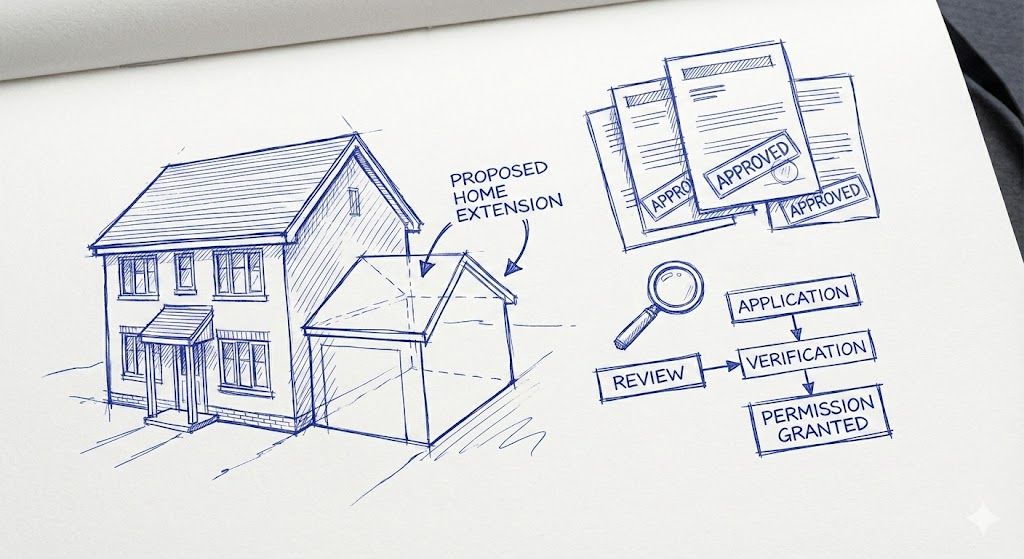
Crystal Palace has a planning quirk found almost nowhere else in London: before you ask whether you need permission for your extension, you have to ask which council you'd be asking. Five boroughs - Bromley, Croydon, Lambeth, Southwark and Lewisham - meet on the ridge around the Triangle, and two neighbours on the same road can answer to different planning departments.
Layer on the heritage: the streets around the Triangle and the flanks of Crystal Palace Park carry conservation area protection for their Victorian villas and shopping parades, while many of the surrounding residential streets keep their permitted development rights in full. The result is a genuinely street-by-street picture.
This guide brings order to it: how to find your borough, when a Crystal Palace extension needs planning permission, what the 2026 fees are, how long decisions take, and how to keep your project on the fastest lawful route.
In Crystal Palace, two checks come first: which borough your house sits in, and whether your street is in a conservation area. Around the Triangle and the park, conservation status removes key permitted development rights - including the larger 6-metre rear extension route. On the surrounding streets, many houses keep full PD rights. Wherever you fall, a householder application costs £548 (from 1 April 2026), the statutory decision target is 8 weeks, and flats have no permitted development rights at all.
Does a Crystal Palace Home Extension Need Planning Permission?
Often the answer is no - but only after the two local checks. On an unlisted house outside a conservation area, a single-storey rear extension of up to 3 metres (4 metres if detached) is permitted development in every one of the five boroughs, and schemes up to 6 metres can run through the national prior approval route. National rules don't change at borough boundaries.
What does change is the protected footprint. Inside a conservation area - as around the Triangle's Victorian parades or the villa streets facing the park - the land is "Article 2(3) designated", which strips out the side-extension, two-storey and larger-rear-extension rights and puts those schemes into a full application. For the national baseline, read our guide to planning permission for UK extensions.
Five Boroughs, One Hilltop: How Crystal Palace Planning Works
The borough lines here are a relic of the parish boundaries that met at the old Palace, and they slice straight through the neighbourhood: the Triangle itself splits between Croydon and Bromley, the park sits in Bromley, and the residential slopes fall away into Lambeth, Southwark and Lewisham. Your application always goes to the borough your house sits in - your postcode alone won't tell you, so check the address on a council-finder before anything else.
Once you know your borough, the picture follows the familiar national split:
| Project type | Crystal Palace streets outside conservation areas | Inside the Triangle / park conservation areas |
|---|---|---|
| Single-storey rear extension | Up to 3m (attached) / 4m (detached) without permission | Possible within the same limits, subject to conditions |
| Larger rear extension (6m / 8m) | Allowed via prior approval (42-day route) | Not available - full application required |
| Two-storey rear extension | Permitted within limits | Planning permission required |
| Side / side-return extension | Permitted within limits | Planning permission required |
| Cladding, render, external finishes | Often permitted | Planning permission required |
| Basement extension | Subject to the relevant borough's policy | Full application under the relevant borough's policy |
| Extension to a flat or maisonette | No PD rights anywhere | No PD rights - full application |
Sources: Planning Portal (GPDO Class A, Article 2(3) land); conservation area designations of the five relevant boroughs. Rules summarised - always confirm against your address.
A Crystal Palace subtlety worth knowing: because the ridge is one of South London's highest points, several boroughs treat rooflines and rear additions on the slopes with extra care for their effect on long views. It rarely blocks a well-designed rear scheme - but it's another reason the discreet option clears faster than the dramatic one.
What Can You Build in Crystal Palace Without Planning Permission?
On an unlisted house outside the conservation areas - true of many streets running down from the ridge - permitted development gives you real scope, whichever borough holds your address. The core national limits are:
- No more than 3 metres beyond the original rear wall for an attached house, or 4 metres for a detached house - extendable to 6m / 8m via the prior approval route
- A maximum height of 4 metres, with eaves no higher than 3 metres if within 2 metres of a boundary
- Materials of a similar appearance to the existing house
- No more than half the land around the original house covered by additions
Two caveats travel across all five boroughs. First, "original house" means the property as it stood in 1948 or when first built - and Crystal Palace's Victorian villas have often gained additions over 150 years. Second, permitted development belongs only to houses: with so many of the area's big villas long since carved into flats, remember that flats have no permitted development rights at all, per the Planning Portal.
Listed Buildings and Basements in Crystal Palace
The area's grandest heritage belongs to the park - the Grade I listed dinosaur sculptures, the Italian terraces of the vanished Palace and the landmark transmitter above them - but listed buildings also stand among the villas and churches around the ridge. If your home is listed, any extension or alteration affecting its character needs listed building consent alongside planning permission - no fee applies, but unauthorised works are a criminal offence. Check your address on the National Heritage List for England.
Basements are comparatively rare on the hill - sloping plots often allow clever lower-ground arrangements instead - but where a dig-down is proposed, the relevant borough's basement or residential design policy applies, and a full application with structural evidence is the rule. On a slope, ground and drainage studies matter even more than usual, so start feasibility early.
How Much Does Planning Permission Cost in Crystal Palace in 2026?
Here's the good news about the five-borough puzzle: the fees are identical everywhere, because they're set nationally. From 1 April 2026, a householder application to extend or alter a single home in England costs £548 (up from £528), under the government's updated fee regulations. A Lawful Development Certificate for a proposed householder project costs half that - £274 - and listed building consent carries no fee.
Application Fees for Crystal Palace Home Extensions, 2026
National fees from 1 April 2026, the same in all five boroughs - GOV.UK
Source: national planning fee schedule effective 1 April 2026 (GOV.UK). Professional fees for drawings and supporting statements are additional.
Professional costs sit on top: drawings and a well-assembled submission typically run to four figures, with conservation area schemes needing a design and heritage case as well. Budget alongside the build itself; our breakdown of single-storey rear extension costs in London shows where the construction money goes.
How Long Does Planning Permission Take in Crystal Palace?
The statutory target for a householder application is 8 weeks from validation in every borough, per GOV.UK, and the prior approval route runs to a fixed 42-day clock. A typical Crystal Palace sequence:
- Borough and boundary check (days) - confirm which council decides, and whether a conservation area covers your street.
- Feasibility and design (2-4 weeks) - planning history, the right route, and a design to suit it.
- Submission and validation (1-2 weeks) - drawings, forms, the fee and any supporting documents to the correct authority.
- Determination (42 days to 8 weeks) - neighbour consultation, then a decision or a certificate.
All in, expect two to four months from first sketch to a green light. Factor in the Party Wall Act too: on the terraced streets off the ridge, most extensions involve serving notice on at least one neighbour - and party wall duties don't care which borough either of you lives in.
Getting a Crystal Palace Extension Approved Smoothly
All five councils consent well-prepared schemes here routinely. What consistently works:
- Confirm the authority first. Applying to the wrong borough wastes weeks; a two-minute check prevents it.
- Design to the PD envelope where you can. Outside the conservation areas, staying within the limits sidesteps the consent question entirely.
- Respect the ridge. Modest rooflines and rear-facing glazing keep the long-view concerns quiet on the upper streets.
- Watch your neighbours' light. On the tight terraces below the Triangle, daylight objections remain the most common snag.
- Use precedent from your own street - and your own borough. An approval across the boundary line carries little weight with a different council.
The payoff is real: Crystal Palace's blend of period stock and village-like centre keeps family demand strong, and a well-built extension repays itself in space and value. For design options, see our guide to home extensions in London.
Planning a home extension in SE19? Get a clear, itemised Buildaway quote - and a straight answer on which council decides your street and what it will approve.
Request a free quote →Frequently Asked Questions
Do I need planning permission for a home extension in Crystal Palace?
It depends on your street. Around the Triangle and the park, conservation areas remove several permitted development rights, so side extensions, two-storey rear extensions and the larger 6-metre route need a planning application. On the surrounding Victorian streets outside those areas, many houses keep their PD rights and modest rear extensions can proceed without full planning. (Planning Portal)
Which council decides planning applications in Crystal Palace?
It depends on your exact address. Crystal Palace sits where five London boroughs meet - Bromley, Croydon, Lambeth, Southwark and Lewisham - so two neighbours on the same road can answer to different councils. Your planning application goes to the borough your house sits in, which you can check on any council's find-my-council tool before starting.
How much does planning permission cost in Crystal Palace in 2026?
A householder planning application in England costs £548 from 1 April 2026 (up from £528), whichever of the five boroughs you fall under - the fee is set nationally. A Lawful Development Certificate costs £274, and listed building consent has no application fee. Professional drawings and any supporting statements are extra. (GOV.UK fee regulations, 2026)
How long does planning permission take in Crystal Palace?
The statutory target for a householder planning application is 8 weeks from validation in every borough, and the prior approval route for larger extensions runs to a 42-day deadline. With design and preparation time added, a realistic Crystal Palace timeline is 2-4 months from first drawings to a decision. (GOV.UK)
Can I extend a flat in Crystal Palace without planning permission?
No. Permitted development rights for extensions apply only to houses - flats and maisonettes have none. Crystal Palace's large Victorian villas have widely been converted into flats, and any extension or external alteration to a flat needs a full planning application, plus usually the freeholder's consent. (Planning Portal)
The Bottom Line on Crystal Palace Planning Permission
In Crystal Palace, answer two questions before anything else - which borough, and which regime - then take the quickest lawful route they allow.
- Five boroughs meet at the Triangle, and your application goes to whichever one holds your address.
- Conservation areas around the Triangle and the park remove the side, two-storey and larger-rear-extension rights; many surrounding streets keep full PD. (Planning Portal)
- Fees and deadlines are national and identical everywhere: £548 for the 2026 householder fee, £274 for a Lawful Development Certificate, 8 weeks to decide.
- Flats have no permitted development rights anywhere, and a realistic overall timeline is 2-4 months from sketch to decision.
Buildaway's home extension service handles the whole journey - the borough check, drawings, the application or certificate, and the build itself. To find out which council your street answers to and what it will approve, get in touch for a free, no-obligation quote.