
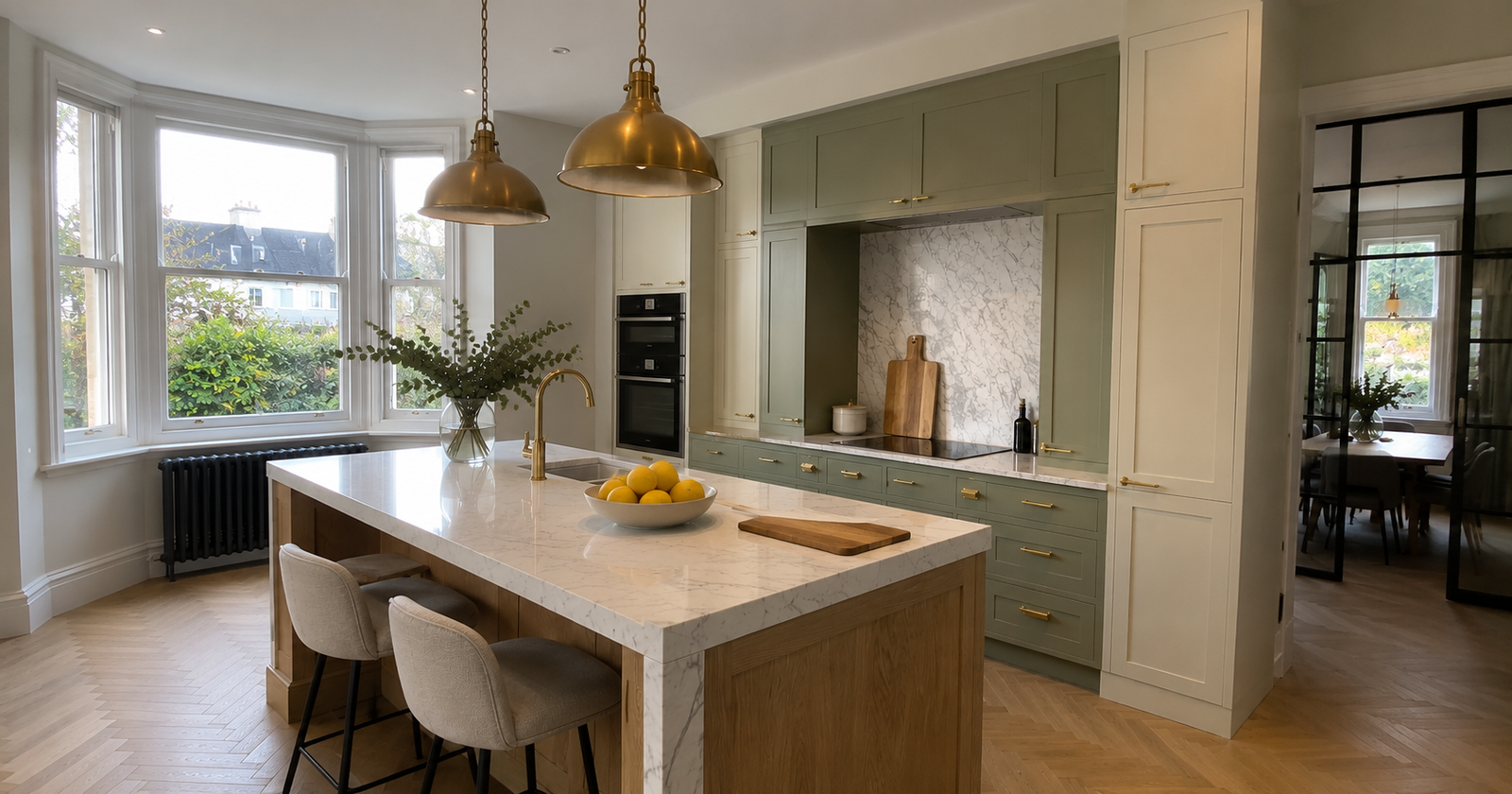
Chelsea doesn't do "flat-pack." Walk from Sloane Square down the King's Road, or along Cheyne Walk beside the Chelsea Embankment, and the housing tells you why: stucco-fronted Georgian and Victorian terraces, red-brick Edwardian mansion flats, and listed townhouses where every alteration has to be considered. So when the latest kitchen design trends land, they can't simply be lifted from a showroom - in SW3 and SW10 they have to be adapted.
This guide covers the eight kitchen design ideas defining 2026, filtered through what actually works in a Chelsea period home - with honest costs, the permissions you'll need, and which choices genuinely add value. Every figure here is drawn from official bodies and current 2026 cost data, not guesswork - and it reflects kitchens we design and fit across Chelsea every week.
In 2026, Chelsea kitchen design has moved away from cold, all-white minimalism toward warm, characterful spaces - natural materials, bold stone worktops, sociable islands, bespoke handleless joinery and heritage detailing adapted to SW3 and SW10 period homes. A mid-range Chelsea kitchen renovation typically runs £5,000-£9,500, with most Chelsea projects landing £14,000-£26,000 and bespoke or structural schemes higher. A new kitchen remains one of the strongest value-adding improvements you can make (Nationwide, 2025).
What Are the Biggest Kitchen Design Trends for 2026?
The headline shift in 2026 is simple: warmth and material honesty are back. The cool, all-white or grey handleless kitchen that dominated the last decade has given way to softer, more tactile schemes built around natural materials, real texture and sociable living. Across our London projects - and consistently among Chelsea enquiries - eight ideas keep coming up:
- Warm minimalism - earthy, layered neutrals and matt finishes replacing stark white and grey.
- Natural materials - timber and oak cabinetry, honed stone and tactile, grained surfaces.
- Sociable kitchen islands - a working, seating and gathering hub in one.
- Broken-plan kitchen-diner living - connected but zoned, not one echoing box.
- Bespoke handleless & Shaker-hybrid joinery - with larder and pantry storage.
- Statement colour & two-tone cabinetry - deep greens, navy and heritage tones.
- Bold stone worktops - quartz, quartzite and marble as the hero surface.
- Smart, energy-efficient tech - induction, boiling taps and concealed appliances.
To put the investment in context, a new kitchen nationally ranges from around £5,000 for a modest refit to £20,000 or more for a high-end, fully bespoke design, according to 2026 cost guides from Checkatrade and MyBuilder. In Chelsea, specialist trades and higher-end specifications typically sit above that - more on real local costs below.
Warm Minimalism & Natural Materials in SW3 Homes
The first two trends belong together. Warm minimalism keeps the clean lines people love but swaps cold white and grey for putty, clay, oat, olive and mushroom tones, then brings in real texture through natural materials. Timber and oak cabinetry - full-height, ribbed or in a reeded detail - reads as warm and timeless, and honed rather than polished stone gives depth without glare. It's the kitchen equivalent of the "quiet luxury" look that has taken over Chelsea's interiors.
This suits Chelsea's stock remarkably well. The high ceilings and generous proportions of a stucco-terrace kitchen off the King's Road flatter large-format stone and tonal, layered neutrals - where a small, low-ceilinged room might feel cold, these spaces feel calm and considered. Even in a compact mansion-flat galley near the Saatchi Gallery, a warm timber run with a single honed-stone worktop feels far richer than another bank of white gloss. The trick is restraint: let one or two natural materials do the talking.
Islands, Broken-Plan Living & Bespoke Joinery
Trends three, four and five are about how a kitchen actually lives. The island remains the single most-requested feature we see in Chelsea - a place to prep, sit, work and gather, ideally with a stone top, integrated storage and a couple of stools. Paired with "broken-plan" thinking - a kitchen that opens to a dining or family zone but keeps a sense of separation through a half-wall, a change in level or a run of crittall-style internal glazing - it gives you sociable, light-filled space without the noise and cooking smells of one big open room.
Underpinning both is bespoke joinery. Handleless and Shaker-hybrid cabinetry, tall larders, integrated pantries and banquette seating let a kitchen work harder in a smaller footprint - which matters enormously in Chelsea. The most common enquiries we field, roughly in order, are: a kitchen island or peninsula, bespoke handleless or in-frame joinery, stone worktops, a broken-plan or open kitchen-diner layout, a boiling or filtered tap, and statement colour cabinetry.
In a period property, though, the detail is everything. Slotting an island into a narrow terrace footprint only works if you keep a clear walkway of around a metre on every side - in a tighter room a slim peninsula or a movable butcher's block is the honest answer. Much of Chelsea's housing around Sloane Square and Cadogan is mansion flats, where a galley or compact L-shape usually beats a forced-in island. And where clients want a true open-plan kitchen-diner, removing a load-bearing wall means structural calculations, a steel beam and Building Regulations sign-off - often alongside lower-ground or basement integration to win the extra space. Get the layout right first, and the trends look after themselves.
Statement Colour, Bold Stone & Heritage Detailing
Trends six and seven are where Chelsea really comes into its own. Colour is firmly back: deep greens, inky navies, clay and heritage tones on cabinetry - often as a two-tone scheme with a paler wall run and a darker island, or "colour-drenched" across a utility or boot room. In a characterful SW3 home, a confident painted in-frame kitchen sits far more happily than another white box, and it photographs beautifully under the tall sash windows of a Cheyne Walk townhouse.
Stone is the other hero. Quartz and quartzite worktops give durability and pattern; honed marble and dramatic veined stone are a long-standing prime-Chelsea favourite for islands and splashbacks, extended up the wall as a single slab for a gallery-like finish. Warm metals - brushed and aged brass, bronze and champagne - have overtaken chrome on taps, handles and lighting, and they sit beautifully in a period setting. The instinct that ties it all together is sympathy: finishes that feel like they belong to the building's era, not fighting it. That matters even more where a property is listed or sits within one of the Royal Borough of Kensington and Chelsea's conservation areas.
Smart, Pro & Energy-Efficient Kitchens
The eighth trend is quiet but growing fast: the kitchen as a low-key smart, efficient space. Induction hobs have all but replaced gas for their speed, safety and control; boiling and filtered taps remove the kettle and save worktop space; and integrated, concealed "hidden" appliances - fridges, dishwashers, even coffee stations behind pocket doors - keep sight-lines calm in a broken-plan room. Add quiet extraction (a downdraft or a recirculating ceiling unit where an external flue would spoil a period elevation), sensor-controlled LED task lighting and a well-planned prep zone, and the kitchen works as hard as it looks.
There's a value angle here too. Efficiency now shows up in the sale price: Rightmove's Greener Homes research found a measurable "green premium", with an improvement from an EPC rating of F to C adding around 15% - almost £56,000 - on top of normal price growth. A kitchen won't move your EPC on its own, but low-energy appliances, LED lighting, better insulation around the work and efficient hot water all feed into a warmer, greener, more valuable home. It's a point worth keeping in mind on any full refurbishment in Chelsea.
How Much Does a Kitchen Design Cost in Chelsea?
Nationally, a new kitchen ranges from around £5,000 for a modest refit to £20,000 or more for a high-end, fully bespoke design, with kitchen fitters charging roughly £250-£350 a day in the UK and £400-plus in prime London (Checkatrade / MyBuilder cost guides, 2026). Chelsea sits at the top of that market: period properties, restricted access, specialist stone and joinery, and the coordination that listed or leasehold homes demand all push costs up.
Based on kitchens we actually renovate in the area, local kitchen fitters work at around £280-£380 a day, and worktops range from roughly £30-£70/m² for laminate to £250-£450/m² for quartz and £350-£600/m² for marble. The table below shows the indicative bands we see in Chelsea - use them for planning, then get an itemised quote for your specific room.
| Spec tier | Indicative cost* | What it typically includes |
|---|---|---|
| Budget refresh | £2,000-£5,000 | New units to the existing layout, fresh worktops and splashback, reused appliances |
| Mid-range renovation | £5,000-£9,500 | Full strip-out, quality units, new worktops and appliances, minor layout change |
| High-end / bespoke | £10,000-£22,000 | Designer or handmade cabinetry, stone worktops, full rewiring, feature lighting |
| Prime Chelsea / structural | £22,000-£45,000+ | Bespoke joinery, marble, wall removal or basement integration, listed or leasehold coordination |
*Indicative Buildaway bands for Chelsea, 2026, blending national cost guides (Checkatrade, MyBuilder) with our own SW3/SW10 project experience. Most family and flat kitchens we renovate in Chelsea fall between £14,000 and £26,000. Actual cost depends on size, spec and access.
Indicative Chelsea Kitchen Cost by Spec Tier (£, midpoint)
Indicative midpoints from Buildaway Chelsea cost bands, 2026. Prime and structural projects vary widely by specification.
Want the detail before you call anyone? Read our full breakdown of kitchen renovation costs in Chelsea for real 2026 price bands by cabinetry, worktop and appliance specification.
Do You Need Permission to Renovate a Kitchen in Chelsea?
For most homeowners, the good news is that a like-for-like internal kitchen refit needs no planning permission. But Chelsea adds three layers you can't ignore:
- Listed Building Consent. Many Georgian and Victorian houses in Chelsea - particularly around Cheyne Walk, the Royal Hospital and the older squares - are listed. Internal alterations to a listed home, including removing walls or altering historic joinery, can require Listed Building Consent from the Royal Borough of Kensington and Chelsea, even for work you'd never need permission for elsewhere.
- Structural sign-off. Opening up a kitchen-diner by removing a load-bearing wall needs structural calculations, the right steel and Building Regulations approval - it is not a job to take on informally.
- Leasehold consent. If you own a mansion flat, your lease will usually require the freeholder's or managing agent's written consent for alterations, especially where you're moving plumbing, waste or extraction.
On top of that, all kitchen work must comply with Building Regulations - covering electrics (Part P), ventilation and extraction (Part F), gas and hot-water safety (Parts J and G) and safe drainage. Conservation-area status mainly affects the exterior, so it rarely blocks an internal kitchen, but a new external flue or extract vent on a visible elevation can need consent. The safe rule in SW3 and SW10: confirm the permissions before you start, not after.
Which Kitchen Design Adds the Most Value in Chelsea?
A new or upgraded kitchen is consistently one of the highest-return improvements a homeowner can make - it's the room buyers judge a home by. Nationwide's 2025 research indicates that kitchen and space-improving work adds roughly 10-15%, with space-adding work overall adding up to about 25%. But Chelsea is a prime market with its own rules. The average home in the Royal Borough of Kensington and Chelsea sold for around £1,273,000 in April 2026, according to the ONS UK House Price Index - so a percentage point here is real money, and buyers are discerning.
How Much Value Kitchen-Related Work Adds (%)
Sources: Nationwide house-price research, 2025 (space and kitchen/space improvement); Rightmove Greener Homes (EPC "green premium"). Figures are national averages and vary by property and area.
At this level, quality and restraint beat trend-chasing. A beautifully built, heritage-sympathetic kitchen in timber and honed stone with warm brass will out-perform an over-personalised, high-gloss statement that dates quickly or breaks the character of the house. Landlords have an angle too: with average private rents in the borough reaching £3,591 a month in May 2026 (ONS), a well-designed kitchen helps a Chelsea rental let faster and hold its value. For the full picture on returns, see our guide to what adds the most value to a London home.
Planning a kitchen in Chelsea? Get a clear, itemised Buildaway quote and honest design advice tailored to your SW3 or SW10 home - from trends to permissions to budget.
Request a free quote →Frequently Asked Questions
What are the latest kitchen design trends in 2026?
The defining shift in 2026 is warm, material-led design replacing cold, all-white and grey minimalism. The leading trends are warm minimalism with earthy palettes, natural materials such as timber and honed stone, sociable kitchen islands and broken-plan kitchen-diner layouts, bespoke handleless and Shaker-hybrid joinery with larder and pantry storage, statement colour and two-tone cabinetry, bold stone worktops in quartz, quartzite or marble, heritage brushed-brass hardware and taps, and smart, energy-efficient tech such as induction hobs, boiling taps and concealed appliances. In Chelsea's SW3 and SW10 period homes, these trends work best when adapted to high-ceilinged stucco terraces and compact mansion-flat galleys rather than copied straight from a showroom.
How much does a new kitchen cost in Chelsea?
In Chelsea, a mid-range kitchen renovation typically costs between £5,000 and £9,500, while a high-end or bespoke kitchen runs from around £10,000 to £22,000, and structural or basement-integration projects reach £22,000 to £45,000 or more. Most family and flat kitchens we renovate in Chelsea fall between £14,000 and £26,000, shaped mainly by cabinetry specification, worktop choice and appliances, and a typical flat kitchen sits between £9,000 and £22,000. Local kitchen fitters work at around £280-£380 a day, and worktops range from roughly £30-£70/m² for laminate up to £350-£600/m² for marble. Always get an itemised, written quote after a survey.
Do I need permission to renovate a kitchen in a Chelsea period home?
A like-for-like internal kitchen refit normally needs no planning permission. However, if your home is a listed building - as many Georgian and Victorian houses in Chelsea are - internal alterations can require Listed Building Consent from the Royal Borough of Kensington and Chelsea. All kitchen work must meet Building Regulations, covering electrics (Part P), ventilation and extraction (Part F), gas and water safety (Parts J and G) and drainage. Removing a load-bearing wall to open up a kitchen-diner needs structural calculations and Building Regulations sign-off. If you own a leasehold mansion flat, you will usually also need written consent from the freeholder or managing agent. Always check before you start.
Does a new kitchen add value to a Chelsea property?
Yes. A new or upgraded kitchen is consistently one of the highest-return home improvements, and Nationwide's 2025 research indicates that kitchen and space-improving work adds roughly 10-15%, with space-adding work overall adding up to about 25%. In a prime market like Chelsea, where the average home sold for around £1,273,000 in April 2026 (ONS), the quality and restraint of the finish often matter more than square footage - buyers reward beautifully built, heritage-sympathetic kitchens over heavily personalised, trend-chasing schemes.
What is the best kitchen layout for a Chelsea mansion flat?
For a Chelsea mansion flat, the best layouts are usually a galley or a compact L-shape that makes full use of height with tall bespoke storage and a larder, integrated appliances to keep sight-lines clean, and carefully planned services routing for water, waste and extraction. An island only works where the footprint genuinely allows a clear metre of walkway around it; in a tighter flat a slim peninsula or breakfast bar is often better. Because these flats are typically leasehold, agree the design, any wall removal and the extraction strategy with the freeholder or managing agent before work begins.
The Bottom Line on Chelsea Kitchen Design in 2026
The best kitchen for a Chelsea home in 2026 is warm, sociable and quietly clever - and, above all, sympathetic to the building it sits in.
- Go warm, not cold: natural materials, timber, honed stone and earthy tones define 2026.
- Adapt to the stock: islands and broken-plan layouts work brilliantly in SW3 and SW10 - but only where the footprint, services and structure genuinely allow.
- Get permissions right: no planning for like-for-like, but Listed Building Consent, structural sign-off and leaseholder consent matter in Chelsea, and Building Regs always apply.
- Value follows quality: a new kitchen and space work add ~10-15% (Nationwide, 2025), and in a £1.27m-average borough (ONS, 2026) craftsmanship and restraint sell.
At Buildaway, we design and fit kitchens around your home, your budget and the return you actually want - not just the latest look. To talk it through, explore our kitchen fitters in Chelsea and kitchen design and fit-out service, or get in touch for a free, no-obligation quote.