Bathroom renovations in Dulwich Village cost £9,000-£30,000+ in 2026 and take 8-25 working days on site. Internal work needs no planning permission, but many homes sit within the Dulwich Estate's scheme of management, the conservation area or a listed building, each with its own rules on external changes. An extra bathroom adds about 6% (Nationwide), and most owners here spend £12,000-£17,500 on a full refurbishment.
Few London neighbourhoods have kept their village character as completely as Dulwich Village. Much of the land still belongs to the Dulwich Estate, the charity founded from Edward Alleyn's 17th-century foundation, which also created Dulwich College. Georgian houses line the Village itself, near England's first purpose-built public art gallery, the Dulwich Picture Gallery, while Victorian villas and 1920s houses fill Court Lane, Calton Avenue and Burbage Road. This guide explains what a bathroom renovation in Dulwich Village (SE21 7) costs in 2026, how long it takes, which consents apply and what it adds in value.
Prices come from Buildaway's higher-specification projects in south London. Market data, value research, regulations and grants are sourced from the ONS, Nationwide, GOV.UK, Historic England and the HSE.
• 2026 costs: £9,000-£12,000 refresh; £12,000-£17,500 full refurbishment; £17,500-£30,000+ luxury or period bathroom, en-suite or wet room.
• On site: 8-12, 12-18 and 18-25+ working days, after four to ten weeks of consents, design and ordering.
• Consents: interior works are not "development", but Dulwich Estate, conservation area and listed building rules can apply to related changes.
• Value: an extra bathroom adds about 6% (Nationwide), around £73,800 on Southwark's £1,230,000 average semi (ONS, July 2026).
• Area: Dulwich Village (SE21 7), London Borough of Southwark.
How Much Does a Dulwich Village Bathroom Renovation Cost?
In 2026, a Dulwich Village bathroom refresh costs £9,000 to £12,000, a full refurbishment in the same layout costs £12,000 to £17,500, and a luxury or period bathroom, en-suite or wet room with a new layout costs £17,500 to £30,000 or more. Each band includes labour, materials and waste removal (Buildaway, 2026).
These figures sit above our general Dulwich bathroom fitting cost guide, because Village homes are larger, older and finished to a higher standard. Period details such as cornicing, original joinery and sash windows need protecting during work, and owners commonly choose marble, cast iron and handmade fittings. Parking is controlled close to the Village, so skips and deliveries need planning.
| Scope | Typical total | Time on site | What is normally included |
|---|---|---|---|
| Refresh | £9,000-£12,000 | 8-12 working days | Existing layout, new suite, part retile, quality fittings, extractor check |
| Full Refurbishment (most common) | £12,000-£17,500 | 12-18 working days | Strip-out, boarding, tanking, full tiling, lighting, bespoke vanity, Part P certificate |
| Luxury / Period / En-Suite / Wet Room | £17,500-£30,000+ | 18-25+ working days | New layout, cast iron or stone bath, marble, underfloor heating, designer or reproduction brassware |
Guide figures. Your fixed price is set out in an itemised written quote after survey.
What Sets the Price of a Dulwich Village Bathroom?
Seven factors set the price: the age and status of the house, drainage routes, floor structure, waterproofing, electrics, tiles and the suite. In Dulwich Village, protecting period features and working within estate or listing rules add time that newer homes do not need.
- Age and status. Homes range from Georgian and early Victorian houses to 1920s and post-war estate houses. Any alteration made before 2000 may contain asbestos, so the HSE's advice is to check before strip-out.
- Drainage routes. Older houses may have stacks on visible elevations, where new external pipework is controlled.
- Floor structure. Cast iron and stone baths are heavy, and old joists often need assessing or strengthening.
- Waterproofing. Marble and walk-in showers need full tanking to protect ceilings below.
- Electrics (Part P). Period houses often need rewiring for bathroom circuits and heating.
- Tiles. Natural marble needs sealing and careful handling; handmade tiles take longer to lay.
- Suite. About a third of the budget, often raised by period or designer pieces.
How a Dulwich Village Budget Breaks Down
Skilled labour remains the largest share even in the most luxurious rooms. Checkatrade gives bathroom labour rates of roughly £320-£480 a day in 2026, and marble work takes longer than standard tiling. On a £15,000 refurbishment in the Village, about half goes on plumbing, tiling and electrics, a third on sanitaryware and furniture, a tenth on tiles and tanking, and the rest on waste, parking and certification.
Estimate based on Buildaway projects, not a national statistic. Labour rates: Checkatrade (2026). Natural marble raises both materials and tiling time.
To find out what your own bathroom would cost, book a free survey and quote. We check the structure, period features and any estate or listing rules before pricing.
How Do Dulwich Village Homes Shape the Bathroom?
Dulwich Village has three main housing types: Georgian and early Victorian houses on and around the Village, Victorian villas and 1920s houses on the surrounding avenues, and post-war Dulwich Estate houses and flats. Each comes with different layout constraints and consents (Buildaway, 2026).
Georgian and Early Victorian Houses
The houses lining Dulwich Village itself, near the Picture Gallery and the old burial ground, include some of the oldest in the area. Many are listed. Bathrooms were added long after they were built, often in a small rear room or a former dressing room, with pipework routed through floors that were never designed for it.
A bathroom in one of these houses needs a careful survey and often listed building consent if historic fabric is affected. You can check a listing on Historic England's National Heritage List. The result can be exceptional: a cast iron bath beneath a sash window, marble floors and joinery that matches the house.
Villas and 1920s Houses on the Avenues
Court Lane, Calton Avenue, Burbage Road and the streets towards Dulwich Park and Belair Park are lined with large Victorian villas and generous 1920s and 1930s family houses. These usually have a main bathroom, an en-suite and sometimes a second family bathroom on the top floor.
Owners here often renovate the principal en-suite and main bathroom together. Need another bathroom in the roof? Our Dulwich Village loft conversion team can plan a top-floor suite.
Post-War Dulwich Estate Homes
After the war, the Dulwich Estate built houses and low-rise flats on parts of its land, many of them now privately owned. Bathrooms here are more compact and straightforward. Flats are usually leasehold, with the Dulwich Estate or a management company as landlord.
Which Consents Apply in Dulwich Village?
Internal bathroom works do not need planning permission, because they are not development. However, the Dulwich Village conservation area, listed status and the Dulwich Estate's scheme of management can all require consent for external changes, and listed buildings can need consent for internal ones (Town and Country Planning Act 1990, s.55).
Planning, Conservation and Listed Buildings
Planning control does not cover purely internal works, as section 55 of the Town and Country Planning Act 1990 makes clear. External changes, such as a new window, an external soil pipe or a flue, may need consent from Southwark Council, and the conservation area tightens those controls.
For listed houses, internal changes that affect historic fabric, such as cutting new pipe routes, removing original features or altering floors, can need listed building consent. We plan pipe and duct routes to avoid sensitive fabric wherever possible.
The Dulwich Estate Scheme of Management
Many freehold homes on Dulwich Estate land are covered by a scheme of management, which gives the Estate a say over external alterations to protect the area's character. Leasehold flat owners on Estate land need the Estate's or their landlord's consent for internal works too.
GOV.UK's leasehold guidance explains how leases control alterations. For Estate homes, contact the Dulwich Estate early, as consent can run in parallel with design work.
Building Regulations
Part P covers electrics, Part F ventilation, Part G hot water safety and water efficiency, and Part H drainage. Large period houses with several bathrooms may need an upgraded hot water system to meet demand. Our electricians are registered to certify their work, and the approved documents on GOV.UK hold the detail. Keep all certificates for your eventual sale.
How Long Does a Dulwich Village Bathroom Take?
A full Dulwich Village refurbishment takes 12 to 18 working days on site, a refresh 8 to 12 and a luxury, period or wet room project 18 to 25 or more. Consents, design and ordering usually take four to ten weeks first, and longer if listed building consent is required (Buildaway, 2026).
| Stage | Working days | What happens |
|---|---|---|
| Protection and strip-out | 1-2 | Floors, stairs, cornices and joinery protected, suite and tiles removed |
| First fix | 3-4 | Pipework, wiring, extract ducting, joist assessment and repairs |
| Boarding and tanking | 2 | Boards, levelling, full waterproofing |
| Tiling | 4-6 | Marble or handmade tiles, sealing, grout |
| Second fix | 2-3 | Suite, brassware, joinery, lighting |
| Testing and handover | 1 | Silicone, tests, Part P certificate |
| Total | 12-18 | Full refurbishment on site |
Cast iron baths, marble and reproduction brassware can take eight to ten weeks to arrive, so order them early. Our Dulwich bathroom renovation timeline covers the stages in more detail.
Planning a Dulwich Village Bathroom in Seven Steps
Plan a Dulwich Village bathroom in seven steps: check estate, conservation and listed status, survey the room, set the scope, fix the design, get a fixed written quote, order long-lead items and book the build. Checking status first matters because it decides what consents run alongside the design (Buildaway, 2026).
Starting consents early means they rarely hold up the build, even in listed houses.
- Check estate and listed status. Find out if your home is listed, in the conservation area or under the Dulwich Estate scheme.
- Survey the room. Assess joists, drainage, hot water, period features and any possible asbestos.
- Set the scope. Choose a refresh, full refurbishment or new layout, and the finish level.
- Fix the design. Agree layout, marble or tiles, suite, joinery and lighting before work starts.
- Receive a detailed quote. Get a fixed, itemised price with contingency listed separately.
- Order long-lead items. Order cast iron baths, marble and brassware eight to ten weeks ahead.
- Book the build. Agree dates, parking arrangements and how period features will be protected.
Does a New Bathroom Add Value in Dulwich Village?
Nationwide estimates an extra bathroom adds about 6% to value. On Southwark's £1,230,000 average semi that is roughly £73,800, and on its £1,740,000 average detached house about £104,400. Buyers at this level expect excellent bathrooms, so a dated one can cost more in negotiation than a new one costs to build (ONS, July 2026).
The ONS put Southwark's average price at £572,000 in July 2026, unchanged on the year, with detached homes up 3.9% (accessed 20 Oct 2026). Dulwich Village houses sit at the top of the borough's market. Nationwide's 6% comes from its 2023 analysis.
Prices: ONS UK House Price Index, July 2026 (provisional). Uplift: Nationwide. Dulwich Village houses often exceed these borough averages.
These are Southwark-wide figures for houses. The ONS does not publish a Dulwich Village figure, and values vary greatly between estate houses and large villas, so speak to a local agent about what buyers at your level expect.
Nationwide's October 2025 research found a loft or extension adding a double bedroom with a bathroom can lift a three-bed, one-bathroom house by up to 24%. In the Village, where external changes are tightly controlled, reorganising space inside the house is often the simpler way to add an en-suite. Our Dulwich bathroom cost versus value guide explores the numbers.
Accessible Bathrooms in Period Homes
Period houses can be adapted for accessibility without losing their character, for example with a level-access shower, a wider door and discreet grab rails. For disabled residents, Southwark Council administers Disabled Facilities Grants of up to £30,000 in England, subject to a means test and an assessment of needs. Listed buildings may also need consent for adaptations.
What Bathroom Design Suits a Dulwich Village Home?
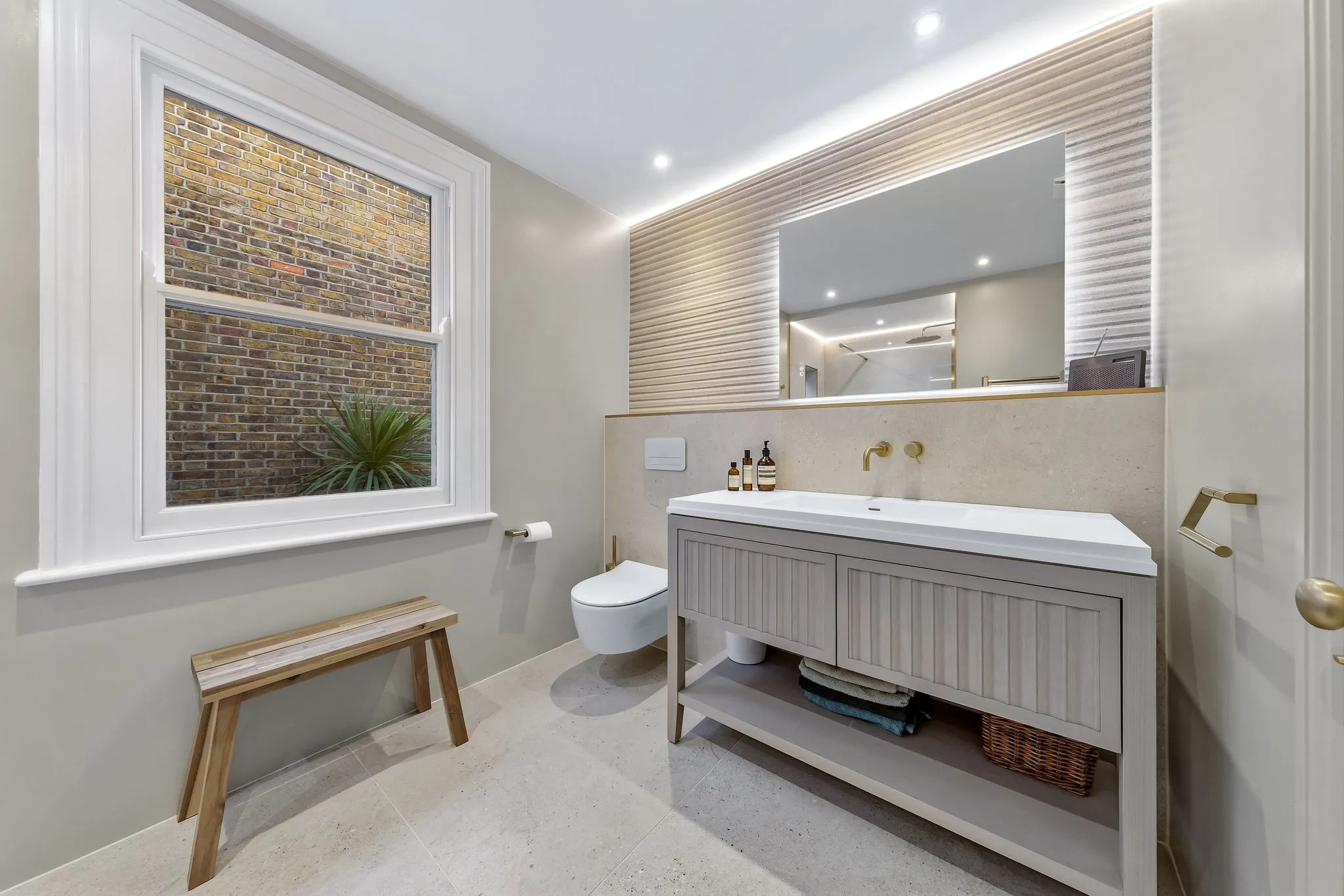
Dulwich Village bathrooms suit timeless, high-quality designs that respect the houses: cast iron or stone baths, marble or encaustic floors, panelled walls, traditional or polished nickel brassware and good joinery. Modern walk-in showers can sit comfortably alongside these. Water here is hard, so plan for limescale (Buildaway, 2026).
In a period principal bathroom, a cast iron bath beneath the sash window, Carrara marble floor tiles and painted panelling create a calm, classic room. A walk-in shower with a slim frame and a marble niche adds modern comfort. For more ideas, see our Dulwich bathroom design trends.
Thames Water supplies hard water to SE21, and its postcode checker gives the reading. Polished nickel, unlacquered brass and coated shower glass cope better than chrome, and a whole-house softener protects every bathroom.
Large period rooms with high ceilings lose heat. Underfloor heating beneath marble, a cast iron radiator and a quiet Part F extractor keep them warm and dry. Expert bathroom remodelling in Dulwich Village hides modern services carefully so the room keeps its period character.
Dulwich Village Bathroom Glossary
The Dulwich Estate is the charitable landowner whose scheme of management covers many local homes. Carrara marble is a white Italian marble often used in period-style bathrooms. Listed building consent is permission for works affecting a listed building's historic character.
- Dulwich Estate
- The charitable foundation that owns much of the land in Dulwich and manages the area's character.
- Scheme of management
- A legal arrangement letting an estate landlord control external changes to freehold homes on its land.
- Carrara marble
- A white or blue-grey Italian marble, widely used for period bathroom floors and walls.
- Polished nickel
- A warm, silvery metal finish common on traditional brassware.
- Cast iron bath
- A heavy, enamelled bath that holds heat well, often needing joist checks before installation.
- Listed building consent
- Permission needed for works, inside or out, that affect a listed building's special interest.
- Tanking
- Waterproofing applied beneath tiles or marble in wet areas.
- Part P
- The building regulation covering electrical safety, including bathroom zones.
Choosing Luxury Bathroom Fitters in Dulwich Village
Choose fitters experienced with period and listed homes, who survey before quoting and give a fixed, itemised price. Check insurance, trade body membership and Part P registration, and ask about their waterproofing and its warranty. A good fitter will raise estate, conservation and listing rules before quoting.
Six questions to put to any fitter:
- Have you worked on listed or Dulwich Estate homes before?
- How will you protect cornicing, joinery and original floors during the work?
- Is the quote itemised, with contingency on a separate line?
- How do you install and seal natural marble?
- Which tanking system do you use, and what is the warranty?
- Will the electrics be certified under Part P?
Buildaway is a member of the Federation of Master Builders. We provide a fixed written quote after survey and an 18-month workmanship warranty. Our luxury bathroom fitters in Dulwich Village handle plumbing, tiling, electrics and joinery as one team, and our Dulwich Village bathroom renovations page explains the service.
Dulwich Village Bathroom FAQs
How much does a bathroom renovation cost in Dulwich Village in 2026?
Buildaway's 2026 bands for Dulwich Village are £9,000 to £12,000 for a refresh, £12,000 to £17,500 for a full refurbishment in the same layout, and £17,500 to £30,000 or more for a luxury or period bathroom, en-suite or wet room. We fix the price in writing after survey.
How long does a Dulwich Village bathroom renovation take?
On site, a full refurbishment takes 12 to 18 working days, a refresh 8 to 12 and a luxury or period project 18 to 25 or more. Allow four to ten weeks beforehand for consents, design and ordering, and longer if listed building consent is needed.
Does the Dulwich Estate need to approve my bathroom renovation?
For a freehold home under the scheme of management, the Estate is mainly concerned with external changes, such as new windows, vents or soil pipes. Purely internal work usually does not need its approval. Leasehold flat owners on Estate land need consent for internal works under their lease.
Can I put a cast iron bath in a period Dulwich house?
Usually, yes, but the floor must be checked first. A filled cast iron bath is very heavy, and older joists may need strengthening. In a listed house, any structural changes to historic floors may need listed building consent, so we assess this during the survey.
Will a new bathroom add value to a Dulwich Village home?
Nationwide's 2023 analysis puts an extra bathroom at about 6%, roughly £73,800 on Southwark's £1,230,000 average semi (ONS, July 2026). Village homes often sell above that. At this level, buyers expect excellent bathrooms, so a dated one can weaken offers.
Is there a grant for an accessible bathroom in Southwark?
Disabled residents may qualify for a Disabled Facilities Grant of up to £30,000 in England from Southwark Council, for adaptations such as a level-access shower. A means test and needs assessment apply, and listed homes may also need consent for the adaptation.
Dulwich Village Bathrooms: Final Word
For a full Dulwich Village bathroom refurbishment in the existing layout, plan on £12,000 to £17,500 and 12 to 18 working days on site. A refresh costs £9,000 to £12,000, and a luxury, period or wet room project costs £17,500 to £30,000 or more (Buildaway, 2026 guide bands, fixed by written quote after survey).
Check estate, conservation and listed status first, then fix the design before strip-out. Want to compare with nearby areas? See our guide to what your Dulwich bathroom fitter should tell you. When you are ready, book a free survey and fixed written quote.
By Cormac Hegarty, Director & Founder - Buildaway. Cormac Hegarty is the Founder of Buildaway and a residential construction specialist with a deep portfolio of projects across London.