
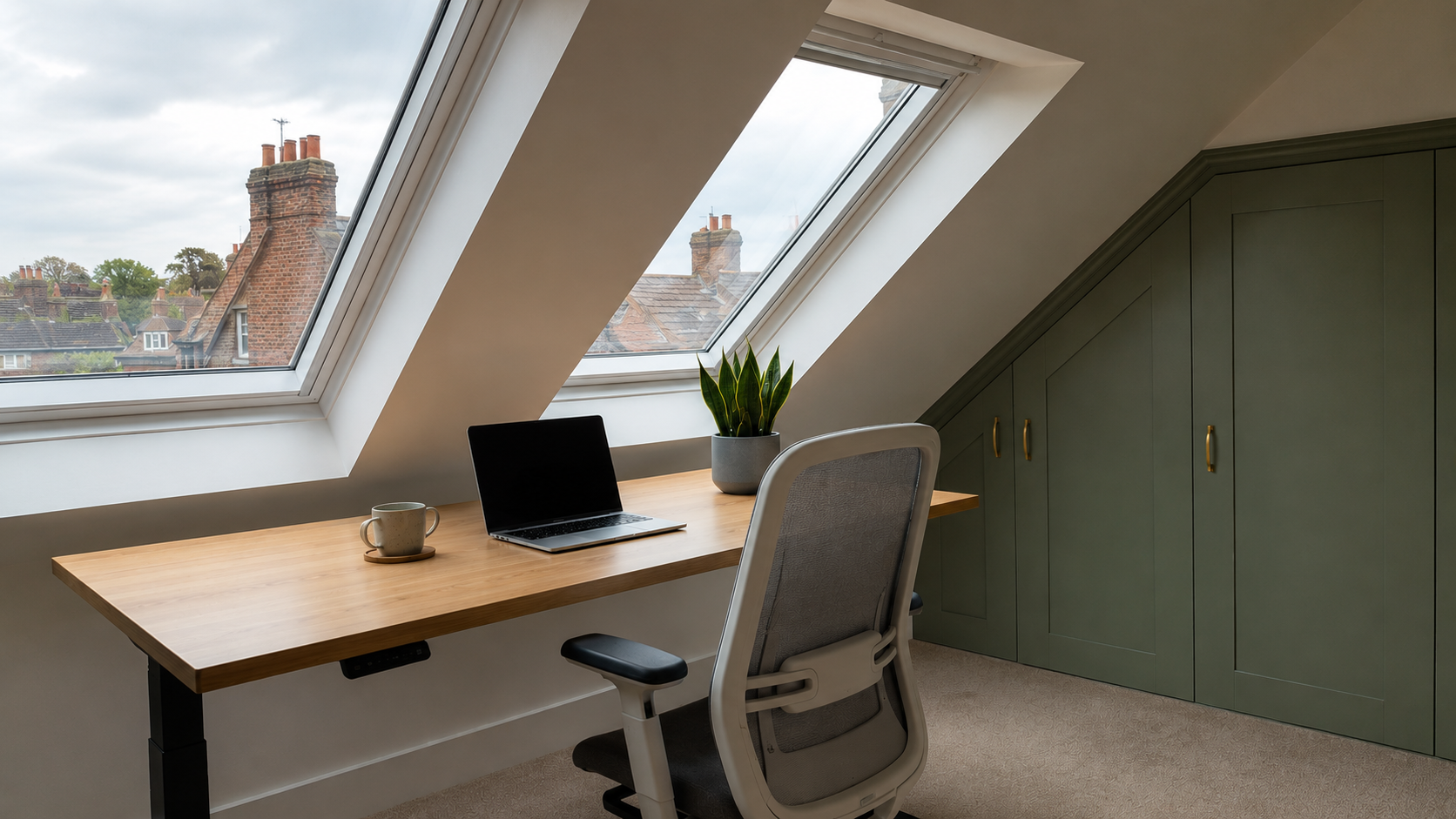
According to the Office for National Statistics, 40% of UK workers now work remotely at least part of the week - and Wimbledon SW19 is one of the best-connected postcodes in South-West London for exactly that arrangement (ONS, 2025). South Western Railway reaches Waterloo in around 15 minutes, the District line connects directly to Westminster, Victoria, and Paddington, and Thameslink runs to City Thameslink, Farringdon, and St Pancras from the same station concourse. For Wimbledon homeowners, the commute has been solved several times over. What hasn't been solved is where the work happens on the days the commute isn't made. The Edwardian semis along Worple Road, the detached homes off The Ridgway, and the Victorian terraces near Wimbledon Chase were designed with everything in mind except a broadband-connected workspace.
The unused loft above the top floor of most SW19 homes is a direct answer to that problem. A loft home office conversion creates a dedicated, separated room without consuming a bedroom, excavating the garden, or triggering a move at a moment when none of those things are particularly appealing. This guide covers the full picture for Wimbledon homeowners: structural suitability across SW19's varied housing stock, how London Borough of Merton's planning rules differ between the Village and the town area, the nine-stage build process, realistic costs in the SW19 market, and what a finished conversion adds to Wimbledon property values.
Want to Know What Your Wimbledon Loft Can Deliver? Buildaway provides free, no-obligation loft assessments across Wimbledon, SW19, and surrounding areas. One survey. One team. One honest outcome.
TL;DR:
Converting an unused loft in Wimbledon into a home office typically costs between £32,000 and £72,000, depending on conversion type and where in SW19 your property sits. It can add up to 20% to your property value, with an ROI of 60–75% (UK Home Improvement Index, 2025). Planning requirements vary significantly across SW19 - Wimbledon Village properties need full Merton consent, while many town-area homes qualify under Permitted Development. The build runs 6–10 weeks from survey to handover once consents are in place.
Is Your Wimbledon Loft Suitable for a Home Office?
SW19's housing stock is more varied than almost any other postcode in this series. Wimbledon Village on the hill above the Common runs to large Victorian and Edwardian detached and semi-detached homes - generous floor plans, high ridge heights, and loft voids that routinely yield 22 square metres or more. The town area around Worple Road, Hartfield Road, and Wimbledon Chase covers a mix of Edwardian semis and Victorian terraces, more compact in footprint but still with the characteristically tall roof pitches of the era. Three structural criteria apply across all property types and must be confirmed before any plans are commissioned.
1. Head Height
The minimum at the ridge is 2.2 metres - the working height at the apex of the roof where the desk and primary workspace will sit. Building Regulations (Approved Document K) require 2.0 metres of clearance above the staircase. Wimbledon's Edwardian and Victorian stock across SW19 regularly produces ridge measurements of 2.4 to 2.7 metres - the larger detached homes near Wimbledon Common and The Ridgway sit toward the upper end of that range. Even the more compact Edwardian terraces near Wimbledon Chase typically clear the 2.2m threshold without intervention. Measure first, but expectations in SW19 are well-set.
2. Floor Joist Capacity
Every pre-1980 property across SW19 - whether Victorian terrace, Edwardian semi, or interwar detached - has ceiling joists in the loft, not structural floor joists. Ceiling joists are sized for a ceiling load, not the live and dead loads of an occupied room. A structural engineer confirms the reinforcement required, and in the vast majority of Wimbledon period homes, new C24 floor joists are installed alongside the originals as a standard element of any Building Regulations-compliant conversion.
3. Staircase Access
Building Regulations require a permanent fixed staircase for any habitable loft room. SW19's larger detached and semi-detached homes near the Village typically have generous first-floor landings that accommodate a conventional staircase without difficulty. The more compact terraced properties near Wimbledon Chase benefit from an alternating-tread design where landing space is tighter, resolving access without meaningful loss of floor area on the level below.
Most Wimbledon loft conversions require floor joist reinforcement, a fixed staircase, and a minimum ridge height of 2.2 metres under Building Regulations (Approved Document K). SW19's Victorian and Edwardian detached and semi-detached homes - across both the Village and the town area - consistently deliver ridge heights above the 2.2m threshold, making Wimbledon one of the strongest structural postcodes in this series for loft home office conversion.
Do You Need Planning Permission for a Loft Home Office in Wimbledon?
Like Battersea in this series, Wimbledon is a postcode where the planning answer depends significantly on which part of SW19 your property occupies. The distinction here maps to Wimbledon's well-understood two-part geography: the Village on the hill and the town area below.
Wimbledon Village and Conservation Area Properties
The Wimbledon Village Conservation Area covers the historic hilltop core - The Ridgway, Parkside, Church Road, Marryat Road, and surrounding streets. London Borough of Merton has applied Article 4 Directions across this designation, removing standard Permitted Development rights for loft alterations. Properties within the Village Conservation Area require a full planning application to London Borough of Merton before any conversion work can begin. The Wimbledon Town Centre Conservation Area, covering parts of the station and High Street vicinity, carries similar restrictions for affected properties.
Town Area and Permitted Development Properties
Properties in the Worple Road corridor, Wimbledon Chase, Hartfield Road, and the streets running toward Raynes Park that fall outside conservation designations can proceed under Permitted Development:
- Terraced houses (Wimbledon Chase area, SW19): up to 40m³ of additional roof volume
- Semi-detached and detached homes (Worple Road, Hartfield Road, SW19): up to 50m³
- External materials must match the existing roof in type and appearance
- The conversion must not raise the ridge above its current height
- Side-facing windows must not overlook a neighbouring garden at a lower level
All Permitted Development rules are published at the Planning Portal (gov.uk). If there is any uncertainty about your SW19 property's conservation area status, request a Lawful Development Certificate from Merton before committing to a contractor. Our guide on loft conversion planning in Wimbledon maps the full boundary detail for both SW19 designations.
The planning approval picture is positive: nationally, 90% of householder applications were approved in Q3 2025 (Ministry of Housing, Communities & Local Government, 2025). London Borough of Merton's conservation area guidelines favour designs that respect the existing roofscape - rear-facing Velux windows that leave the front elevation unchanged are consistently the most straightforward applications to approve in the Village area.
Building Regulations approval is a parallel and entirely separate requirement. Structural performance, fire safety, insulation, and staircase design all fall under Building Regs, applicable regardless of planning outcome. Both must be correctly closed out for the conversion to be mortgageable, insurable, and legally transferable.
SW19 planning divides sharply along Wimbledon's geographic split. Village Conservation Area and Town Centre Conservation Area properties require full London Borough of Merton consent. Town-area homes in the Worple Road corridor and Wimbledon Chase can proceed under Permitted Development. Where planning is needed, 90% of householder applications were approved nationally in Q3 2025 (MHCLG, 2025).
Not Sure Whether Your SW19 Home Needs Full Merton Planning Consent? We establish this at every initial survey before you commit to anything. Talk to Buildaway.
Step-by-Step: How a Wimbledon Loft Home Office Conversion Works
For town-area SW19 properties where Permitted Development applies, the full project from first survey to Building Control handover typically runs 6–10 weeks. For Village Conservation Area properties requiring Merton planning consent, allow 14–20 weeks in total - 8 to 10 weeks for the determination period, followed by the standard 6–10 week construction phase. For a complete week-by-week breakdown, see our guide on how long a loft conversion takes in Wimbledon.
🔧 From a recent Buildaway project in SW19 (Compton Road): We surveyed a 1912 Edwardian semi-detached with 2.58m of usable ridge height - well above the 2.2m minimum. The property sat within the Wimbledon Village Conservation Area, so we prepared a rear-facing Velux application for London Borough of Merton, using drawings that kept the front roofline entirely unchanged. Planning consent came through in nine weeks. New C24 floor joists were installed, two rear south-facing Velux windows fitted, a conventional fixed staircase built off the generous first-floor landing, and a Cat6 ethernet socket run back to the ground-floor router. Survey to Building Control handover: eighteen weeks in total. The homeowner, a barrister commuting to the Strand two days a week by South Western Railway, now has 21 square metres of dedicated workspace above the family floors.
One aspect of Wimbledon conversions that distinguishes this postcode from most others in this series: the sheer scale of what larger SW19 detached homes can yield. The Edwardian and interwar detached homes near Wimbledon Common and along Marryat Road regularly produce 24 to 28 square metres of usable loft floor area following a hip-to-gable and rear dormer combination. That is enough for a fully equipped standing desk setup, a client-facing meeting zone, a separate filing and storage wall, and a professional video-call background - a workspace that genuinely rivals a commercial office in function. The design decisions that determine whether that space is productive or just large are the same five addressed below.
A Wimbledon loft home office conversion follows a nine-stage sequence, with total duration ranging from 6 to 10 weeks (PD-eligible town area) to 14 to 20 weeks (Village Conservation Area). SW19's larger Edwardian and interwar detached homes near Wimbledon Common can yield 24 to 28 square metres of converted workspace - among the largest finished lofts in this series - making early design decisions especially consequential.
How Much Does a Loft Home Office Cost in Wimbledon?
Costs across SW19 sit 15–20% above the national average, consistent with Wimbledon's inner South-West London location and the premium labour market it draws from. The Village Conservation Area adds modest professional fees to the planning stage for affected properties but does not change the construction cost itself. Wimbledon's larger-than-average detached housing stock means hip-to-gable conversions are more commonly specified here than in any previous postcode in this series. For a full breakdown, see our loft conversion cost in Wimbledon guide.
| Conversion Type | Typical Wimbledon Cost | Best For |
|---|---|---|
| Velux / Rooflight | £32,000–£46,000 | Edwardian terraces near Wimbledon Chase and Victorian semis in the town area (SW19). Rear-facing for conservation area properties. Clearest route to Merton consent where planning is required. |
| Dormer | £46,000–£63,000 | Edwardian semis along Worple Road and Hartfield Road. Adds full standing headroom and usable floor width across the whole room. |
| Hip-to-Gable | £55,000–£72,000 | Detached and end-of-terrace homes near Wimbledon Common, Marryat Road, and Compton Road. Maximum floor space. Typically paired with a rear dormer. The most common conversion type for SW19's larger detached stock. |
Source: Checkatrade market data, 2025. Figures reflect SW19 labour, materials, and planning fees where applicable.
Wimbledon's return on investment case sits at the top of the range in this series. A completed conversion adds up to 20% to property value in South-West London (UK Home Improvement Index, 2025). SW19 Edwardian semis regularly transact above £1 million and detached Village homes frequently exceed £2 million - meaning a 20% uplift on a £1.1 million property represents a potential increase of £220,000 against a build cost of £50,000 to £65,000. Finish quality and market timing both influence the real figure, but the underlying ratio at Wimbledon's property values makes the financial case among the most compelling of any location in this guide.
Loft home office conversions in Wimbledon SW19 typically cost between £32,000 (Velux, town-area terrace) and £72,000 (Hip-to-Gable, detached Village-area home), with a 15–20% inner London premium. On SW19's property values, the potential 20% uplift produces some of the strongest absolute ROI figures in this entire series (UK Home Improvement Index, 2025; Checkatrade, 2025).
Designing a Loft Home Office That Actually Works
SW19's larger loft voids - particularly in the detached homes around Wimbledon Common - reward thorough design thinking more than compact terraces do. When the finished space is 24 square metres rather than 16, the decisions about how it is divided and equipped have a proportionally larger effect on whether it is genuinely productive or simply large. The same five elements apply across every SW19 property type.
Natural Light Direction
South- and east-facing Velux windows are the practical target across SW19. For Village Conservation Area properties, rear-facing windows are both the Merton consent preference and typically the most productive light source - Village streets often face north-south, giving rear slopes that face east or west. An east-facing rear Velux delivers excellent morning working light well-matched to the start of a professional day. West-facing glazing creates the afternoon glare problem that appears in every period postcode in this series - low sun at monitor height with no effective blind solution at a sensible price.
Temperature Management
Victorian and Edwardian solid brickwork across SW19 gains and loses heat faster than modern cavity-wall construction. 100mm+ PIR rigid board in a warm roof build-up is the correct specification - it manages both summer overheating and winter cold in a single system without the condensation risk that thinner insulation layers introduce in period stock. For Wimbledon's larger detached homes where the loft volume is greater, a properly zoned dedicated heating circuit becomes even more important - the distance from the boiler and the increased air volume both work against running the loft off a shared thermostat.
Acoustics
In SW19's semis and terraces, the loft typically sits above the master bedroom. In the larger detached homes, the arrangement varies - sometimes a landing, sometimes a spare room. Regardless, a floating floor with acoustic underlay is the considered specification. In a space that may serve as both a primary workspace and an occasional client-meeting room, acoustic separation from the floors below is a functional requirement rather than a comfort feature.
Connectivity
Wimbledon's Victorian and Edwardian solid brickwork, internal chimney stacks, and - in the larger detached homes - greater distance from the ground-floor router, all work against reliable WiFi at loft height. A Cat6 ethernet cable routed during the build while walls and ceilings are accessible costs very little relative to the overall project and delivers dependable bandwidth for calls, uploads, and cloud sync regardless of household WiFi performance. In a larger SW19 detached home where the router may be at the opposite end of the ground floor, this cable run is longer and more complex to retrofit through finished surfaces than in a terrace - making the timing of specification even more consequential.
💡 Our observation across Wimbledon loft projects: SW19's larger detached homes present a design challenge that doesn't appear in the narrower terraces of previous posts in this series - the risk of underspecifying a large space. A 25 square metre loft that is thermally uncomfortable, WiFi-dependent, and acoustically open to the floors below doesn't become a productive workspace simply because it is spacious. In every Wimbledon project where all five design elements were specified from the outset, homeowners reported using the room consistently within a week of handover. In those where temperature control or connectivity were left to be resolved post-completion, the room took months to become a genuine daily workspace.
Does a Loft Home Office Add Value to a Wimbledon Home?
In the SW19 market the answer is emphatically yes - and the buyer profile here makes the magnitude of that uplift unusually reliable. Wimbledon attracts a buyer cohort that is simultaneously demanding on space, demanding on transport, and demanding on finish quality. South Western Railway to Waterloo in 15 minutes, the District line for the West End, Thameslink for the City and St Pancras - the transport credentials are established. Wimbledon Common, the Village character, and the school catchment profile complete the picture for family buyers who are choosing SW19 on every dimension. For this buyer, a properly converted top-floor workspace on a completely separate floor from the main family living areas is a feature that shows up in offers, not just viewings.
A completed loft adds up to 20% to property value in South-West London (UK Home Improvement Index, 2025). Over 35% of UK homeowners planning upgrades in 2025 cited WFH needs as their primary motivation (Houzz UK, 2025). And 62% of UK employees report performing better working from home (CIPD, 2025) - the demand for well-equipped home workspaces is now a standard expectation rather than a buyer preference among SW19's professional household base.
For Wimbledon specifically, the workspace question is becoming increasingly central to what buyers expect from a property at this price point. A house in the Village at £1.5 million that has no clear answer to where two professional adults work from home on their non-commuting days faces questions in viewings that a well-executed loft conversion answers definitively and permanently.
The prerequisite for any value uplift to be recognised: Building Regulations sign-off from London Borough of Merton Building Control must be in place for the room to count as habitable floor area in any mortgage survey or RICS valuation. Conversions completed without BCO approval create complications during conveyancing that can delay or reduce a sale. Buildaway closes out full compliance on every SW19 project. For the detailed financial case, see our guide on whether a loft conversion is still a smart investment in 2026 in Wimbledon.
The Bottom Line for Wimbledon Homeowners
A Wimbledon loft home office is one of the strongest entries in this series on almost every measure - large structural starting points, compelling ROI at SW19 values, excellent transport credentials, and a buyer market that actively weighs workspace quality in purchase decisions. The planning variable is real but manageable - establish your Village or town-area status before commissioning drawings, and the rest follows a well-defined process. In order of priority:
- Establish Conservation Area Status First: Determine whether your SW19 street requires full Merton planning consent or qualifies under PD - before any architect is engaged.
- Velux, Dormer, or Hip-to-Gable: Match the conversion type to ridge height, floor area goal, and property footprint (2.2m ridge minimum throughout).
- Warm Roof Insulation: 100mm+ PIR rigid board - essential in Victorian and Edwardian solid-brick stock across SW19.
- Cat6 Ethernet: Routed during the build. In larger SW19 detached homes, the cable run is longer and more complex to retrofit post-completion.
- Acoustic Flooring: Floating floor with acoustic underlay - wherever a bedroom or family room sits directly below the loft.
Budget £32,000–£46,000 for a Velux, £46,000–£63,000 for a dormer, or £55,000–£72,000 for a hip-to-gable. Allow 8 to 10 additional weeks for Merton planning consent where the Village Conservation Area applies. Confirm Building Regulations compliance with London Borough of Merton Building Control (Civic Centre, London Road, Morden, SM4 5DX) before work begins.