
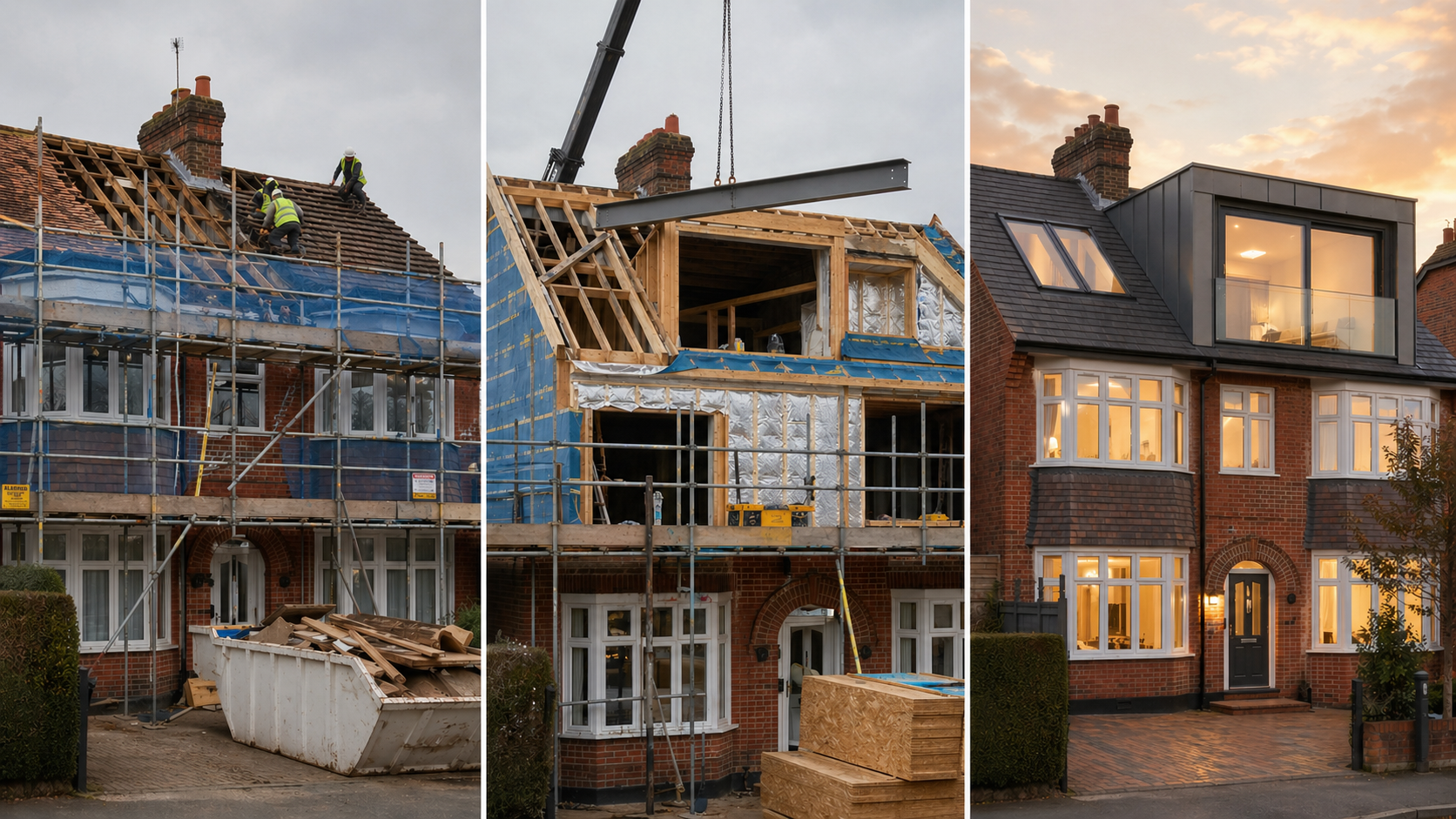
You've noticed scaffolding going up on a house near Wimbledon Common or on one of the long Edwardian roads off Raynes Park, and the first question that crosses your mind is: how long is this going to take when it's my turn? It's the question every Wimbledon homeowner asks and one that's almost always answered incorrectly by someone who's guessing.
On-site, most loft conversions in Wimbledon take 6–10 weeks to build. But the total project, from your first survey appointment through to receiving the completion certificate, runs closer to 3–5 months once you include design, Merton Council approvals, and building regulations sign-off. The frustration almost never comes from the build itself it comes from the weeks before a single scaffold pole is erected, which nobody properly explains.
This guide does exactly that. Whether you're in a late-Victorian terrace in SW19 or an Edwardian semi in SW20, here's a clear, phase-by-phase account of what happens and when.
How much does a loft conversion cost in Wimbledon? → Full cost guide
TL;DR: A standard dormer loft conversion in Wimbledon takes 6–8 weeks on-site. Velux conversions can finish in around 4 weeks. Mansard builds run 10–14 weeks. Add 8–16 weeks upfront for design, Merton Council decisions, and building regulations, and the full timeline lands between 3 and 5 months. (Sources: Merton Council Planning Portal, Nationwide House Price Index, 2025)
How Long Does a Loft Conversion Take in Wimbledon? The Realistic Breakdown
On-site build time for a loft conversion in Wimbledon ranges from 4 to 14 weeks, depending on the type of conversion and the specific characteristics of your property. Demand for loft conversions across South West London has increased sharply a 2024 Checkatrade Home Improvement Report noted a 25%-plus rise in loft conversion enquiries across the South East and with that growth has come far more scrutiny from homeowners about what a realistic schedule actually looks like.
Here's how the main conversion types compare for Wimbledon properties:
The most common conversion on Wimbledon's Victorian terraces in SW19 the rear dormer falls in the 6–8 week on-site window. If you're in an Edwardian semi in Raynes Park or West Wimbledon (SW20) and considering a hip-to-gable, plan for 8–10 weeks on-site.
What this chart doesn't show is the pre-build phase. That's where the real calendar impact happens.
Why the Total Timeline Is Longer Than the Build: The Pre-Build Phase
Here's what catches most people out: the construction phase is actually the shorter half. Before a single joist is strengthened or a scaffold board placed, you'll work through design, planning, and building regulations a pre-build phase that typically takes 6–16 weeks, depending on your property type and exact location within the London Borough of Merton.
Here's how it breaks down:
Design and structural survey (weeks 1–3): An architect or specialist surveys your loft, takes measurements, and produces drawings. Structural calculations follow. This typically takes 2–4 weeks.
Permitted Development or full planning permission? Most loft conversions in Wimbledon proceed under Permitted Development rights. The volume allowances are 40m³ for terraced homes and 50m³ for semi-detached and detached properties (gov.uk Planning Portal, 2025). Even where PD applies, obtaining a Lawful Development Certificate (LDC) from Merton Council is strongly advised it takes 6–8 weeks and is an essential document when you eventually sell.
If you do need full planning permission, Merton Council typically takes 8 weeks to decide, with complex or disputed applications taking longer.
Important for Wimbledon homeowners: The London Borough of Merton contains numerous designated conservation areas, including the Wimbledon Village Conservation Area, which covers much of the historic hilltop village around Church Road and Wimbledon High Street. If your property sits within a conservation area, full planning permission is required regardless of the conversion size. Merton has also issued Article 4 Directions in certain zones, removing specific Permitted Development rights for roof alterations always verify your address at merton.gov.uk/planning before assuming PD applies to your home.
Building regulations: Your builder submits a Full Plans application to Merton Council's Building Control team or an approved private inspector. Initial review takes 3–5 weeks (merton.gov.uk, 2025). Building Control runs alongside the build inspectors visit at key structural and fire-safety milestones.
Planning permission for a loft conversion in Wimbledon → Full planning guide
Week 1: Pre-Build Preparation (It Looks Quiet It Isn't)
Week 1 looks deceptively quiet from the street. But a lot is happening. Scaffolding goes up usually on Day 1 or 2 and it changes how the road feels immediately. Materials are delivered and staged: structural steels, timber, insulation boards.
Your builder will form a controlled access point in the roof a small opening that allows materials and workers to move between inside and outside without traipsing through your home. At this stage, all work is external or within the roof void. Your living space below is essentially untouched.
What to handle before Week 1 begins:
- Clear your loft completely boxes, old furniture, loose insulation all need to go before the crew arrives
- Protect furniture in the room directly below the works with dust sheets
- Confirm materials delivery windows with your contractor
- Let your immediate neighbours know work is starting on tightly packed SW19 terraces near Wimbledon Park station, a heads-up goes a long way
Weeks 2–4: Structural & Shell Work (The Loud Phase)
This is the noisiest stage. Structural steels go in, the existing floor is strengthened, and for dormer conversions the dormer box begins to take shape. It's loud and dusty, but it's contained to the upper levels of the house.
Week 2 Structural work:
- Existing floor joists strengthened or a new structural floor installed as required
- RSJ steel beams placed to manage load transfer (late-Victorian properties in SW19 frequently need more supplementary steelwork than later builds, due to thinner original joists)
- Roof structure partially opened where the dormer will sit
Week 3 Dormer shell:
- Timber dormer frame constructed and set
- Flat or pitched dormer roof formed
- Roof made temporarily weatherproof each evening good practice with Wimbledon's autumn and winter weather
Week 4 Weatherproofing and glazing:
- Dormer cladding applied zinc, tiles, or render (render and heritage-matching tiles are frequently specified on Wimbledon Village-adjacent properties to meet conservation expectations)
- Windows and Velux units fitted and fully sealed
- Roof made permanently watertight this milestone triggers the next Building Control visit
Edwardian semi note: If you're in an SW20 property with a hip-end roof and choosing a hip-to-gable conversion, allow roughly 1–2 additional weeks during the structural phase compared with a standard rear dormer. Removing the hip and constructing a new gable is more involved. Budget Weeks 2–5 for structural work rather than 2–4.
What's it actually like living through a loft conversion in Wimbledon?
Weeks 5–6: First Fix The Build Moves Inside
Once the shell is watertight, work shifts inside. This is a quieter phase for the household most activity is contained to the loft space above.
What happens in first fix:
- Insulation fitted to roof, walls and floor (must meet Building Regulations Part L thermal performance standards tightened under 2025 updates)
- Internal stud partition walls formed
- First fix electrics: cables routed and run before boarding
- First fix plumbing if your conversion includes an en-suite (adds approximately 3–5 days to this phase)
- Fire separation work mains-wired interlinked smoke alarms required throughout the house under Part B of the Building Regulations
Building Control inspection: Merton's Building Control team carries out a mid-build inspection at first fix stage. Have your structural drawings to hand. Merton Council, like most London boroughs, now accepts video inspections for lower-risk elements such as insulation and joist spacing, which reduces on-site visit delays and keeps your schedule moving (merton.gov.uk Building Control, 2025).
Weeks 7–9: Staircase, Plastering and Second Fix
The most exciting week for the household: the staircase goes in. This is also the most disruptive single day of the build the ceiling on your existing landing is opened up and the new staircase is lowered in and tied in. Access to your first-floor landing will be limited for most of that day.
After the staircase, the rest of second fix moves quickly:
Week 7–8 Plastering:
Plasterboard is fixed to walls and ceiling. A skim coat follows and the space suddenly
looks like a room. Allow 3–5 days drying time before decoration begins. Don't rush this.
Decorating onto wet plaster causes cracking.
Week 8–9 Second fix:
- Sockets, light fittings and switches wired and connected
- En-suite fixtures fitted if included
- Floor covering laid let Buildaway know your preference (carpet, engineered wood, LVT) before second fix week, not after
- Joinery: skirtings, door frames, any fitted wardrobes or eaves storage
It's worth noting: second fix for an en-suite bathroom adds 3–5 working days. If your Wimbledon loft includes a bathroom and most do, given that Nationwide's 2025 research found adding a bedroom and bathroom can increase a property's value by up to 24% (Nationwide House Price Index, 2025) build that into the schedule from day one.
Week 9–10: Final Inspection and Your Completion Certificate
The final Building Control inspection is the last formal hurdle before your new room is legally habitable. In Wimbledon, this is carried out by either Merton Council's Building Control team or a private approved inspector Buildaway coordinates this on your behalf.
What the inspector checks:
- Structural integrity of the new floor and roof
- Fire safety: door specifications, smoke alarm positions, fire separation
- Staircase compliance (head height, rise, going, handrail)
- Insulation values (Part L)
- Electrical installation test certificate (from your Part P registered electrician)
Once satisfied, the inspector issues a completion certificate. Keep this document. It's not optional conveyancers require it when you sell, and your mortgage lender may ask for it if you remortgage after the conversion.
After sign-off comes the part everyone looks forward to: moving in. Most homeowners decorate after handover, either themselves or through a decorator. Buildaway can recommend trusted local decorators if needed.
Ready to get a realistic timeline for your specific
Wimbledon property?
Buildaway offers a free, no-obligation loft survey across Wimbledon, Raynes Park, and
the surrounding SW19 and SW20 postcodes. One quote. One point of contact. One clear
process. Book your free loft survey →
Can You Stay in Your Home During a Loft Conversion in Wimbledon?
Yes in the vast majority of cases. Loft conversions are designed to be live-in builds. The structural phase (Weeks 2–4) is the loudest, but it's confined to above the ceiling line. The one day that causes the most disruption is staircase installation day, when your existing landing ceiling is opened up. That's typically a single working day.
The key is preparation. Clear the loft before Week 1, protect furniture in the rooms below with dust sheets, and discuss working hours with your contractor upfront. Most Wimbledon builders start at 8am and finish by 5pm on weekdays, with limited or no weekend working in residential areas.
The Key Takeaways for Wimbledon Homeowners
Planning a loft conversion in Wimbledon isn't complicated but it does require realistic expectations. A few things to carry with you:
- The build itself is 6–10 weeks for most property types in SW19 and SW20. The full timeline, including the pre-build phase, is 3–5 months.
- The pre-build phase is where projects stall not because of incompetence, but because planning approvals and building regulations have fixed timescales. Start the process earlier than you think you need to.
- Conservation areas and Article 4 Directions are real Wimbledon-specific considerations check before you assume Permitted Development applies to your address.
- Adding an en-suite makes financial sense. Nationwide's 2025 data confirms that a bedroom-and-bathroom loft conversion adds up to 24% property value uplift the extra 3–5 days in the build schedule pays back many times over.
- The completion certificate matters. Don't treat the final inspection as a formality it's the document your conveyancer will ask for when you sell.
Ready to understand what the timeline looks like for your specific property? Buildaway's free loft survey covers all of Wimbledon's SW19 and SW20 postcodes including Wimbledon Village, Raynes Park, South Wimbledon and Colliers Wood.