
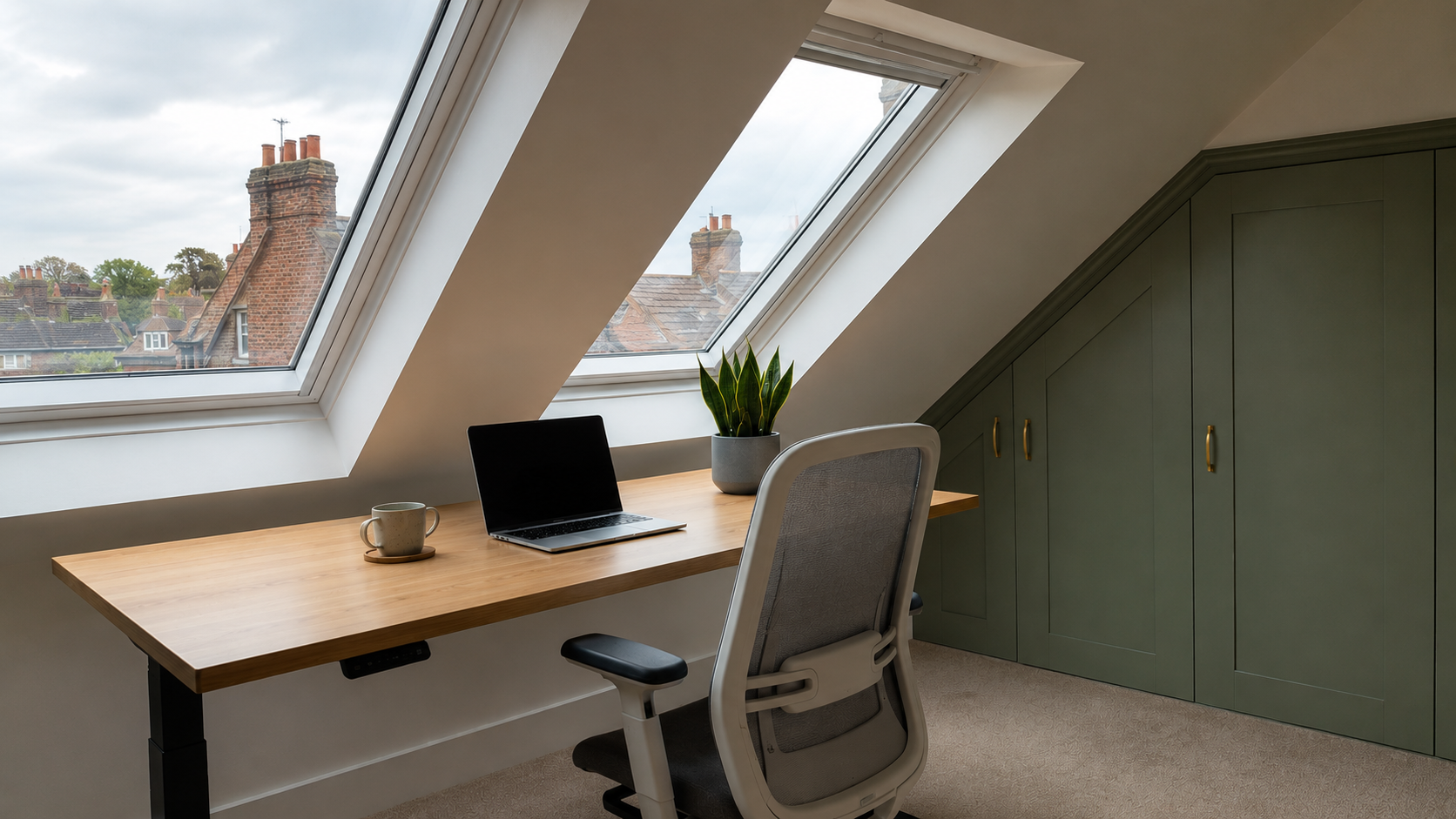
According to the Office for National Statistics, 40% of UK workers now work remotely at least part of the week - and Dartford sits squarely at the centre of that shift (ONS, 2025). With Southeastern services reaching London Bridge in around 30 minutes and Thameslink connections running directly to Farringdon and St Pancras, DA1 and DA2 homeowners have been among the most active adopters of hybrid working across the wider South-East commuter belt. The commute works. The workspace is a different matter entirely. Most Dartford homes - whether 1930s semis in Wilmington, interwar terraces off Priory Hill, or larger detached homes in Stone and Bean - were never designed with a dedicated office in mind.
The solution is often directly overhead. Dartford's housing stock carries generous loft voids that the majority of homeowners have never seriously considered converting. A loft home office gives you a proper, separated workspace without moving a single piece of furniture out of a bedroom, building into the garden, or factoring in the cost and disruption of relocating. This guide covers everything: structural suitability, what Dartford Borough Council's planning rules mean in practice for DA1 and DA2 properties, the full build sequence, realistic costs specific to the Kent commuter market, and the effect on your property's resale value.
Want to Find Out What Your Dartford Loft Can Do? Buildaway provides free, no-obligation loft assessments across Dartford, DA1, DA2, and surrounding areas. One visit. One team. One straightforward answer.
TL;DR:
Converting an unused loft in Dartford into a home office typically costs between £24,000 and £55,000, depending on conversion type. It can add up to 20% to your property value, with an ROI of 60–75% (UK Home Improvement Index, 2025). Most DA1 and DA2 homes qualify for Permitted Development under Dartford Borough Council - no formal planning permission required. The build runs 6–10 weeks from first survey to handover.
Is Your Dartford Loft Suitable for a Home Office?
Dartford's DA1 and DA2 housing stock is more varied than many of the London postcodes in this series. The 1930s semis concentrated in Wilmington and along Shepherds Lane and Princes Road in DA1 dominate the residential picture, sitting alongside Victorian and Edwardian terraces closer to the town centre and a good number of larger detached homes across the DA2 villages of Stone, Darenth, and Bean. Most have workable roof pitches - but three structural criteria must be confirmed before any work is planned. Assumptions made without checking these three things reliably lead to wasted money on architectural drawings for a space that can't legally be used.
1. Head Height
The minimum at the ridge - the highest usable point of the roof where a desk and main working area will sit - is 2.2 metres. Building Regulations (Approved Document K) set 2.0 metres as the minimum above the staircase. Dartford's 1930s semis generally sit comfortably at or above the 2.2m threshold, a product of the generous roof pitches typical of that building era. The larger detached homes in Stone and Bean (DA2) tend to clear it with room to spare. Compact Victorian terraces near the town centre in DA1 should be measured individually before drawing any conclusions.
2. Floor Joist Capacity
Pre-1980 homes across DA1 and DA2 - whether 1930s semis, Edwardian terraces, or interwar detached homes - have ceiling joists in the loft void rather than structural floor joists. Ceiling joists are sized to carry a ceiling below, not the live and dead loads of an occupied room. A structural engineer assesses the existing timbers and specifies what reinforcement is needed. In the majority of Dartford properties, new C24 timber joists are fitted alongside the originals. This is routine Building Regulations compliance, not an exceptional structural intervention.
3. Staircase Access
Building Regulations require a permanent fixed staircase for any habitable loft room - a retractable ladder or loft hatch does not satisfy the requirement. Dartford's 1930s semis typically have enough first-floor landing space for a compact conventional staircase or, where the layout is tighter, an alternating-tread design that resolves access without significantly reducing the floor area below.
Most Dartford loft conversions require floor joist reinforcement, a fixed staircase, and a minimum ridge height of 2.2 metres to comply with Building Regulations (Approved Document K). The 1930s semis across DA1 - along Shepherds Lane, Princes Road, and around Wilmington - and the larger detached homes in DA2's Stone and Bean villages typically meet or exceed the headroom threshold, making them strong structural candidates for a loft home office.
Do You Need Planning Permission for a Loft Home Office in Dartford?
For the majority of Dartford homeowners in DA1 and DA2, the answer is no - and this is where the picture here differs positively from many of the London postcodes in this series. Dartford Borough Council administers planning under the standard national Permitted Development framework, without the extensive Article 4 Directions that restrict PD across large portions of London's inner boroughs. Most DA1 and DA2 homes outside the town centre conservation area can proceed with a standard loft conversion without a formal planning application.
Permitted Development Limits for Dartford Homes
- Terraced houses (town centre streets, DA1): up to 40m³ of additional roof volume
- Semi-detached and detached homes (Wilmington, Stone, Bean, DA1–DA2): up to 50m³
- External materials must match the existing roof in type and appearance
- The conversion cannot raise the ridge above its current height
- Side-facing windows must not overlook a neighbouring garden at a lower level
These rules are published in full at the Planning Portal (gov.uk) - the definitive reference for all Permitted Development queries. If there is any uncertainty about your property's status, request a Lawful Development Certificate from Dartford Borough Council before a contractor is engaged. For a full breakdown of local requirements, see our guide on loft conversion planning in Dartford.
Conservation area note: The Dartford Town Centre Conservation Area covers streets around the High Street, Hythe Street, and Lowfield Street. Properties within this boundary, and any home subject to an Article 4 Direction, will need a full planning application rather than relying on PD. Nationally, 90% of householder applications were approved in Q3 2025 (Ministry of Housing, Communities & Local Government, 2025) - this is rarely a meaningful obstacle when the design is prepared properly.
One point worth making clearly: Building Regulations approval is an entirely separate requirement from planning permission, and it applies regardless of whether planning consent is needed. Structural performance, fire safety, insulation specification, and staircase design all sit under Building Regs, administered by Dartford Borough Council's Building Control team. Both processes must be correctly signed off for the finished room to be mortgageable, insurable, and legally transferable on resale.
Most DA1 and DA2 Dartford homeowners can proceed under Permitted Development - 40m³ for terraced properties, 50m³ for semi-detached and detached. Dartford Borough Council's planning framework is less encumbered by Article 4 Directions than inner London boroughs, making PD the realistic route for the majority of DA1 and DA2 conversions. Where planning permission is required, 90% of householder applications were approved nationally in Q3 2025 (MHCLG, 2025).
Not Sure Whether Your DA1 or DA2 Property Qualifies Under PD? Our team confirms planning status as part of every initial assessment. Talk to Dartford.
Step-by-Step: How a Dartford Loft Home Office Conversion Works
With a single experienced team coordinating design, structural work, and build, a Dartford loft home office conversion typically completes in 6–10 weeks from feasibility survey to Building Control handover. The nine-stage sequence below sets out each phase clearly - and identifies where delays develop when trades aren't properly managed together. For a week-by-week breakdown, see our guide on how long a loft conversion takes in Dartford.
🔧 From a recent Buildaway project in DA1 (Shepherds Lane, Wilmington): We surveyed a 1937 semi-detached with 2.35m of usable ridge height - above the 2.2m minimum. The existing ceiling joists needed full replacement with C24 floor joists installed alongside the originals. The conversion included two south-facing Velux windows, a conventional fixed staircase off the first-floor landing, and a Cat6 ethernet point wired back to the ground-floor router location. No planning application was required under Permitted Development. Survey to Building Control handover: seven weeks. The homeowner, a data analyst commuting to Farringdon by Thameslink two days a week, now works from a 17 square metre dedicated room that the rest of the household has no reason to enter.
One thing that consistently catches Dartford homeowners off guard is how straightforward the process becomes when Permitted Development applies and there is no conservation area in the picture. Seven to eight weeks from survey to handover is genuinely achievable in DA1 and DA2 - shorter than most comparable projects in inner-London postcodes where planning queues and additional consent layers add months to the front end. That speed advantage is one of the practical benefits of working with a non-London local authority like Dartford Borough Council.
A Dartford loft home office conversion follows a nine-stage sequence from feasibility survey to Building Control handover, typically completing in 6 to 10 weeks. Where Permitted Development applies - which covers the majority of DA1 and DA2 residential streets - the absence of a planning queue makes Dartford one of the faster postcodes in this series for total project delivery time.
How Much Does a Loft Home Office Cost in Dartford?
Costs in DA1 and DA2 sit 5–10% above the national average - the most modest premium in this series, reflecting Dartford's position on the outer edge of the London commuter belt rather than within Greater London itself. Labour rates are elevated relative to the wider South-East by proximity to London, but not to the degree seen in inner-south postcodes. Here's an honest breakdown by conversion type, mapped to Dartford's actual housing stock. For a complete pricing guide, see our loft conversion cost in Dartford page.
| Conversion Type | Typical Dartford Cost | Best For |
|---|---|---|
| Velux / Rooflight | £24,000–£36,000 | 1930s terraces and semis in DA1 - Wilmington, Shepherds Lane, Princes Road. Good existing headroom. No external change to roofline. Lowest cost and fastest route under PD. |
| Dormer | £36,000–£50,000 | 1930s and interwar semis across DA1 and DA2. Adds full standing headroom and usable floor width. Best for properties where ridge height clears 2.2m but usable floor area is limited by the roof pitch angle. |
| Hip-to-Gable | £44,000–£55,000 | Detached homes in Stone, Bean, and Darenth (DA2). Maximises usable floor space. Often combined with a rear dormer for full-width coverage across the loft. |
Source: Checkatrade market data, 2025. Figures reflect Dartford (DA1–DA2) labour and materials rates.
Dartford's value proposition within this series is distinctive. DA1 and DA2 offer the lowest build costs in this guide - and the ROI case remains strong relative to local property values. A completed conversion adds up to 20% to property value (UK Home Improvement Index, 2025). On a typical Dartford semi-detached valued at around £420,000, that represents a potential uplift of £84,000 against a Velux build cost of £24,000 to £32,000. These ratios compare favourably with conversions in higher-cost London postcodes where build costs rise faster than property values do.
Loft home office conversions in Dartford's DA1 and DA2 postcodes typically cost between £24,000 (Velux, 1930s semi) and £55,000 (Hip-to-Gable, detached DA2 village home), with a commuter belt premium of 5–10% over the national baseline. Combined with a potential 20% value uplift and an ROI of 60–75%, Dartford represents the most cost-accessible entry point in this series (UK Home Improvement Index, 2025; Checkatrade, 2025).
Designing a Loft Home Office That Actually Works
Dartford's 1930s semis are practical loft candidates - decent ridge heights, manageable floor plans, and cavity brickwork that handles WiFi signal noticeably better than Victorian solid-brick alternatives. But the same five design decisions that determine usability in any postcode apply with equal force here, and two of them carry particular relevance to DA1 and DA2's housing profile.
Natural Light Direction
South- and east-facing Velux windows are the practical target across DA1 and DA2. Dartford's 1930s semis were built in conventional suburban grid patterns, so the rear slope of your roof may face any direction depending on which street you're on. Check the orientation before finalising window positions - a south-facing rear slope means excellent year-round working light, while a north-facing one benefits from a dormer design that captures light from both sides. West-facing glazing creates afternoon glare problems on calls that outlast any blind you fit at that price point.
Temperature Management
1930s cavity-wall construction in DA1 and DA2 performs better thermally than Victorian solid brick - but loft rooms still overheat quickly through summer and cool fast in winter without proper insulation. 100mm+ PIR rigid board in a warm roof configuration is the standard to insist on. It manages both temperature extremes in a single system and avoids the condensation risk that thinner insulation layers introduce at ceiling level. Add a dedicated heating zone as well - running the loft off the main household thermostat produces consistent temperature mismatches that make the room frustrating to work in at either extreme of the year.
Acoustics
In Dartford's 1930s semis, the room below the loft is frequently a double bedroom. A floating floor with acoustic underlay is the practical barrier between your working hours and anyone sleeping below. It's a relatively modest addition at build stage and one that homeowners across DA1 and DA2 consistently cite as worth including when we follow up after completion.
Connectivity
Dartford's 1930s cavity brickwork performs meaningfully better for WiFi signal propagation than the solid Victorian masonry found in inner-London postcodes. That said, multi-floor homes with internal chimney stacks and party walls still produce signal drop-off at loft height in a significant number of DA1 and DA2 properties. A Cat6 ethernet cable run during the build costs little and removes the problem entirely - considerably cheaper than retrofitting through finished walls and floors once the project is closed out.
💡 Our observation across Dartford loft projects: DA1 and DA2 projects consistently complete faster and with fewer planning complications than equivalent conversions in the London postcodes in this series. The combination of Permitted Development applying to most residential streets and Dartford Borough Council's straightforward Building Control process means the gap between survey and handover in Dartford is genuinely shorter. Homeowners who plan the five design decisions above from the outset - light direction, insulation spec, acoustics, ethernet, and heating zone - find the finished room is productive from day one rather than requiring modifications six months later.
Does a Loft Home Office Add Value to a Dartford Home?
The answer is yes - and Dartford's buyer market makes the timing particularly relevant. DA1 and DA2 attract a substantial proportion of buyers who have made a deliberate calculation: trading inner-London property values for more space, a garden, and a manageable mortgage, while relying on Southeastern and Thameslink services to keep City and Canary Wharf jobs within reach. For these buyers, a properly converted top-floor workspace answers the one remaining practical objection to the move - that working from home in a suburban semi means occupying the kitchen table or the spare bedroom indefinitely.
A completed loft adds up to 20% to property value across the South-East commuter belt (UK Home Improvement Index, 2025). Over 35% of UK homeowners planning upgrades in 2025 cited WFH needs as their primary motivation (Houzz UK, 2025). And 62% of UK employees say they perform better working from home (CIPD, 2025) - the demand for built-in workspace is now a standard buyer expectation rather than a discretionary extra.
For Dartford specifically, a finished and fully connected loft office on a separate floor from the main living areas addresses something that viewings increasingly surface: buyers want to see where working from home actually happens before they make an offer. A well-executed conversion provides a clear, compelling answer.
One requirement that must be in place before any value uplift is recognised: Building Regulations sign-off from Dartford Borough Council Building Control is necessary for the room to count as habitable floor area in a mortgage valuation or RICS survey. Conversions completed without BCO approval - whether for a planning or a Building Regs reason - create complications during conveyancing that can delay a sale or reduce the achievable price. Buildaway closes out full compliance on every DA1 and DA2 project. For the full financial breakdown, see our guide on whether a loft conversion is still a smart investment in 2026 in Dartford.
The Bottom Line for Dartford Homeowners
A Dartford loft home office is one of the most financially accessible and procedurally straightforward conversions in this entire series. The planning picture is cleaner than most London postcodes, the build costs are lower, and the housing stock - particularly the 1930s semis across DA1 - is structurally well-suited. In order of importance:
- Velux or Dormer Conversion: Match the type to your ridge height and usable floor area target (2.2m ridge minimum required throughout).
- Fixed Staircase: Conventional where the landing permits; alternating-tread in tighter semi-detached layouts.
- Warm Roof Insulation: 100mm+ PIR rigid board - the non-negotiable for year-round comfort.
- Cat6 Ethernet: Routed from the ground-floor router to the loft during the build. Don't plan to retrofit it.
- Acoustic Flooring: Floating floor with acoustic underlay where a bedroom sits directly below the loft void.
Budget £24,000–£36,000 for a Velux or £36,000–£50,000 for a dormer, and expect a meaningful return through added property value. If your property is near the Dartford Town Centre Conservation Area, confirm your planning position with Dartford Borough Council Building Control (Civic Centre, Home Gardens, Dartford, DA1 1DR) before work starts.