
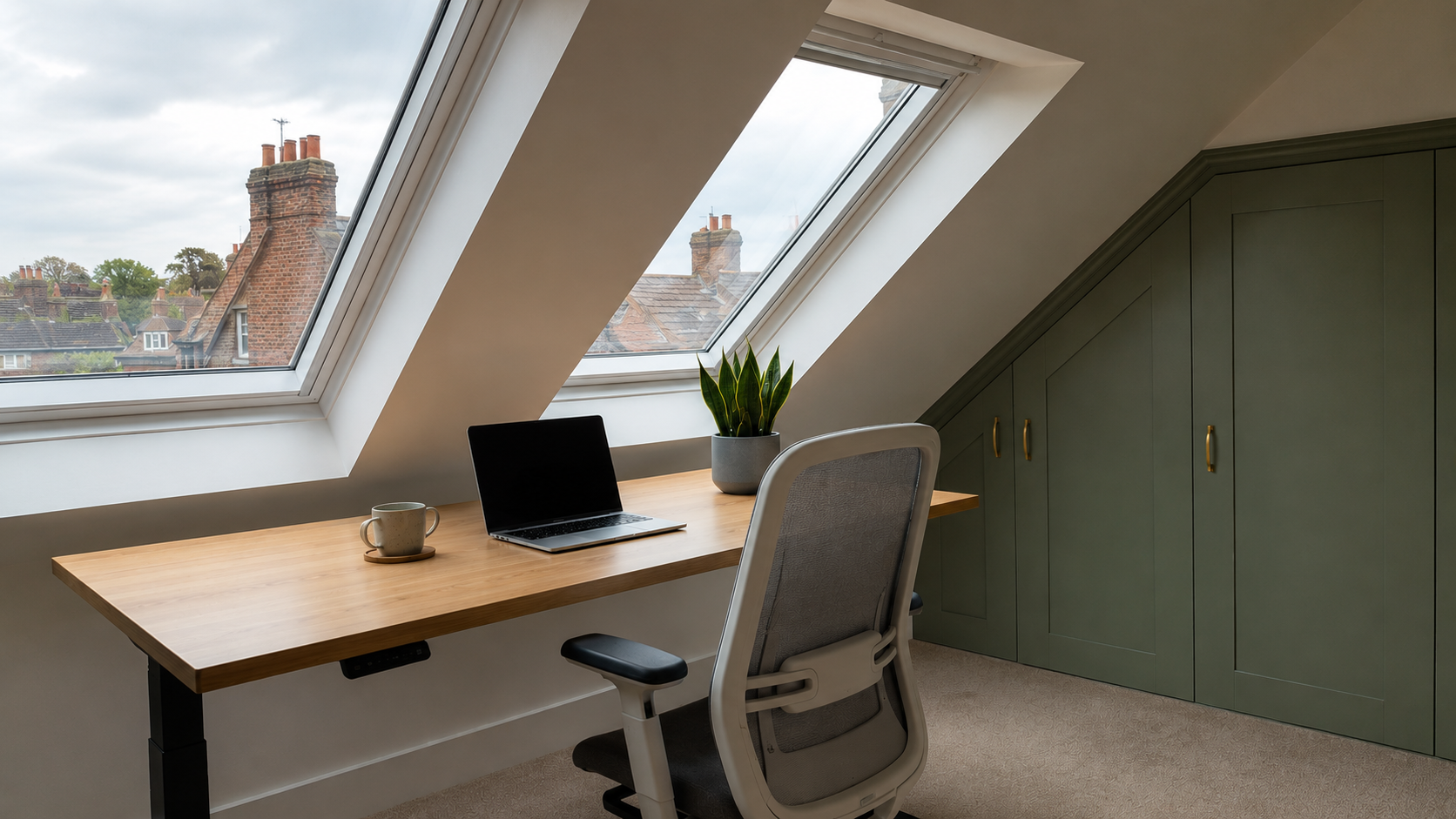
According to the Office for National Statistics, 40% of UK workers now work remotely at least part of the week - and in Blackheath, where the Southeastern service puts London Bridge just 15 minutes away, hybrid working is close to universal among professional households (ONS, 2025). The irony is that Blackheath's Victorian and Edwardian terraces - some of the most generously proportioned period homes in South-East London - were built with large loft voids that most owners have never seriously considered using. While the dining table gets pressed into service each morning, a quiet room with a proper desk sits unused directly above.
A loft home office conversion changes that calculation entirely. It gives you a dedicated, acoustically separated workspace on its own floor without reconfiguring a single bedroom, building outward, or relocating. For SE3 homeowners, there is one planning consideration that sits differently here than in surrounding postcodes - and this guide addresses it head on. It covers structural suitability, Blackheath's Conservation Area planning rules and what they mean in practice, the full build sequence, realistic costs, and the effect on your property value.
Want to Know What Your Blackheath Loft Can Do? Buildaway provides free, no-obligation loft assessments across Blackheath, SE3, and surrounding areas. One survey. One team. One honest outcome.
TL;DR:
Converting an unused loft in Blackheath into a home office typically costs between £30,000 and £65,000, depending on conversion type. It can add up to 20% to your property value, with an ROI of 60–75% (UK Home Improvement Index, 2025). Most SE3 homes sit within the Blackheath Conservation Area and require full Royal Borough of Greenwich planning consent - but 90% of householder applications are approved, making the process manageable with the right preparation. Build time runs 6–10 weeks from survey to handover once consent is in place.
Is Your Blackheath Loft Suitable for a Home Office?
Blackheath's SE3 housing stock is dominated by Victorian and Edwardian terraced and semi-detached homes - particularly along Lee Road, Morden Road, Tranquil Vale, and the roads fringing Blackheath Park. These properties were built to a generous specification: high ceilings, substantial roof pitches, and wide floor plans that create loft voids considerably more usable than the 1930s semis found in neighbouring postcodes. Three structural criteria still need to be confirmed before any plans are drawn, but Blackheath's period homes pass them more routinely than most.
1. Head Height
2.2 metres at the ridge point is the minimum needed - the working height at the apex of the roof where a desk will typically sit. Building Regulations (Approved Document K) require 2.0 metres of clearance above the staircase. Blackheath's tall Victorian terraces along Lee Road and the wide-fronted Edwardian semis near Blackheath Park routinely measure 2.4 metres or above at the ridge - well above the threshold. Measure first, but expectations in SE3 are reasonably set.
2. Floor Joist Capacity
Victorian and Edwardian properties across SE3 have ceiling joists in the loft void, not floor joists. This is standard for the era - the timbers were sized to carry plasterboard, not a working room with furniture and live loads. A structural engineer confirms what reinforcement is needed, and in the majority of Blackheath period homes, new C24 floor joists are installed alongside the originals. It's a routine step in any Building Regulations-compliant conversion, not an exceptional one.
3. Staircase Access
Building Regulations require a permanent fixed staircase for any habitable loft room - a retractable ladder doesn't satisfy the requirement. Blackheath's larger Victorian terraces typically have enough landing space for a conventional staircase without significant disruption to the floor below. In narrower terrace formats closer to Lewisham Road, an alternating-tread design often provides a practical solution.
Most Blackheath loft conversions require floor joist reinforcement, a fixed staircase, and a minimum ridge height of 2.2 metres to comply with Building Regulations (Approved Document K). The Victorian and Edwardian terraces across SE3 - along Lee Road, Morden Road, and Blackheath Park - typically exceed the headroom threshold by a meaningful margin, making them structurally well-suited to conversion.
Do You Need Planning Permission for a Loft Home Office in Blackheath?
Here Blackheath differs from every other postcode in this series, and it's important to be direct about it. The Blackheath Conservation Area is one of the most extensive in South-East London, covering the vast majority of SE3's residential streets around the Heath, the village, and the surrounding roads. The Royal Borough of Greenwich has applied an Article 4 Direction across the Conservation Area, which removes the standard Permitted Development rights that homeowners in designated areas rely on for loft conversions.
In plain terms: most Blackheath homeowners in SE3 will need full planning permission from the Royal Borough of Greenwich before a loft conversion can proceed. This is not a niche edge case - it applies to the majority of the postcode.
What This Means in Practice
The requirement for full planning consent adds time and a modest additional cost to the front end of a project - typically 8 to 10 weeks for the determination period, plus the cost of a planning application and architectural drawings prepared to Conservation Area standards. What it does not do is make a conversion impossible or even especially difficult. Royal Borough of Greenwich's Conservation Area guidelines favour designs that are sympathetic to the existing roofline and streetscape - which for most Blackheath terraces means rear or concealed Velux windows are the most straightforward route to consent.
For properties that sit on the boundary of the Conservation Area, or on roads where the designation is less clear, request a Lawful Development Certificate from Royal Borough of Greenwich to confirm your status before work is commissioned. Our guide on [loft conversion planning in Blackheath](loft-conversion-planning-blackheath.html) covers the Conservation Area guidelines in full.
The approval rate is reassuring: nationally, 90% of householder applications were approved in Q3 2025 (Ministry of Housing, Communities & Local Government, 2025). A well-prepared application, using rear-facing Velux windows that don't alter the front roofline, sails through in the great majority of cases. Refusal is genuinely rare when the design is handled competently.
As always, Building Regulations approval is a separate requirement operating in parallel. Fire safety, structural performance, insulation specification, and staircase compliance all fall under Building Regs - which apply regardless of the planning outcome. Both must be correctly completed for the finished conversion to be mortgageable, insurable, and legally transferable.
Most SE3 homes in Blackheath sit within the Conservation Area under an Article 4 Direction, meaning full Royal Borough of Greenwich planning consent is required for loft conversions. This adds 8 to 10 weeks to the project timeline but is not a barrier - 90% of householder applications were approved in Q3 2025 (MHCLG, 2025), and sympathetic rear-facing designs rarely face objection.
Not Sure Whether Your SE3 Home Needs Full Planning Consent? We confirm this as part of every initial survey - before you spend anything. Talk to Buildaway.
Step-by-Step: How a Blackheath Loft Home Office Conversion Works
With a single experienced team handling design, planning, and construction, a Blackheath loft home office conversion typically runs 14–20 weeks from feasibility survey to Building Control handover - the longer window reflects the Conservation Area planning determination period that precedes the build. The construction phase itself, once consent is secured, runs to the standard 6–10 weeks. For a week-by-week breakdown, see our guide on how long a loft conversion takes in Blackheath.
🔧 From a recent Buildaway project in SE3 (Lee Road): We surveyed a 1897 Victorian mid-terrace with 2.5m of ridge height - well above the 2.2m requirement. The ceiling joists were replaced with new C24 floor joists throughout. We submitted a Velux-only planning application to Royal Borough of Greenwich with two rear-facing roof windows, keeping the front roofline completely unchanged. Consent came through in nine weeks. Survey to Building Control handover: seventeen weeks in total. The homeowner, a finance professional commuting to London Bridge two days a week, now has 19 square metres of workspace at the top of the house that no one else ever needs to enter.
One element of Blackheath loft conversions that often surprises people: the character of the space itself. Victorian lofts in SE3 are different from 1930s lofts elsewhere. The roof pitches are steeper, the ridge heights greater, and the floor area - once the joists are in - tends to be more generous than the footprint of the house below suggests. The design decisions that make the space work year-round are the same ones that apply everywhere, but here the baseline material is noticeably better.
A Blackheath loft home office conversion follows a nine-stage process, with a Conservation Area planning application adding 8 to 10 weeks ahead of the standard 6 to 10 week construction phase. Well-prepared applications using rear-facing Velux windows consistently achieve consent - and the Victorian loft voids in SE3 regularly deliver 18 to 22 square metres of finished workspace once converted.
How Much Does a Loft Home Office Cost in Blackheath?
Costs in SE3 run 15–20% above the national average - at the higher end of the London premium, reflecting both the inner-London location and the additional professional fees associated with Conservation Area planning applications. Blackheath's Victorian and Edwardian stock means Velux and dormer conversions are the most common types here; hip-to-gable work appears on the larger semi-detached homes near Blackheath Park and Morden Road. For a complete pricing guide, see our loft conversion cost in Blackheath page.
| Conversion Type | Typical Blackheath Cost | Best For |
|---|---|---|
| Velux / Rooflight | £30,000–£42,000 | Victorian and Edwardian terraces along Lee Road and Tranquil Vale (SE3). Rear-facing only to satisfy Conservation Area consent. Easiest route to planning approval. |
| Dormer | £42,000–£58,000 | Wider Victorian semis and larger terraces near Blackheath Park. Rear dormer only. Adds full standing headroom across the entire room width. |
| Hip-to-Gable | £50,000–£65,000 | Edwardian semi-detached homes near Morden Road and Blackheath Village. Maximum usable floor area. Requires sympathetic design to satisfy Conservation Area guidelines. |
Source: Checkatrade market data, 2025. Figures reflect SE3 labour, materials, and planning fees.
Where Blackheath distinguishes itself is on the return side of the equation. A completed loft conversion adds up to 20% to property value in South-East London suburbs (UK Home Improvement Index, 2025). On a Victorian terrace in SE3 valued at £900,000, 20% represents a potential uplift of £180,000 - against a build cost of £35,000 to £45,000. The maths in Blackheath are more compelling than in almost any other postcode in this series. Finish quality and buyer profile both influence the outcome, but the underlying figures are hard to argue with.
Loft home office conversions in Blackheath SE3 typically cost between £30,000 (Velux terrace) and £65,000 (Hip-to-Gable semi), reflecting an inner-London premium of 15–20% over national rates. On SE3's higher property values, the ROI case is among the strongest of any outer-South-East London postcode - a finished conversion adding up to 20% to value against a relatively modest build cost (UK Home Improvement Index, 2025; Checkatrade, 2025).
Designing a Loft Home Office That Actually Works
Blackheath's Victorian loft voids are excellent raw material. The steeper roof pitches create rooms that feel substantial rather than cramped. But the same five design decisions that determine usability in any other postcode apply equally here - and two of them carry extra weight in SE3's period properties.
Natural Light Direction
Rear-facing roof windows are both the planning preference and, in most cases, the best practical choice. Victorian terraces along Lee Road and Morden Road typically have rear slopes that face south or south-east - which means the light quality in a rear Velux conversion is genuinely good. You get the best natural light, you avoid front-elevation planning complications, and you sidestep the afternoon glare that west-facing windows create on video calls.
Temperature Management
Victorian loft voids lose heat through original roofing materials far faster than their modern equivalents. 100mm+ PIR rigid board in a warm roof build-up is the correct specification - it handles both winter cold and summer overheating, and avoids the interstitial condensation risk that thinner or partial insulation solutions introduce in period properties. Fit a dedicated heating zone too. Period homes in SE3 have heating systems that weren't designed to heat a room two floors above the boiler efficiently.
Acoustics
In Blackheath's Victorian terraces, the loft typically sits above the master bedroom. A floating floor with acoustic underlay is the practical solution to keeping the two uses separated. It's consistently one of the items that homeowners are most glad they included when asked six months after completion.
Connectivity
Victorian masonry in SE3 - solid brick, dense internal walls, tall chimney stacks - absorbs WiFi signal at loft height more aggressively than the cavity brickwork found in 1930s properties. A Cat6 ethernet cable run during the build resolves this permanently. The cable route through a Victorian terrace isn't always straightforward, which makes doing it while walls are open significantly cheaper and less disruptive than attempting it through finished plasterwork.
💡 Our observation across Blackheath loft projects: Every SE3 homeowner who specified wired ethernet during the build has reported zero connectivity issues in the finished space. Among those who didn't, the pattern is consistent: WiFi signal through Victorian solid brickwork at loft height is unreliable enough to affect call quality on most setups. In a property where the conversion cost and the property value both sit at the higher end of the range, this is not the place to save £200 during the build.
Does a Loft Home Office Add Value to a Blackheath Home?
In Blackheath's SE3 market, the answer is a clear yes - and the numbers are more pronounced than in most surrounding postcodes. Blackheath attracts buyers who are specifically searching for period homes with modern functionality: fast rail links, good schools, and increasingly, a working-from-home setup that doesn't compromise the family floor plan.
A finished loft adds up to 20% to property value in South-East London suburbs (UK Home Improvement Index, 2025). Over 35% of UK homeowners planning upgrades in 2025 cited WFH needs as their primary motivation (Houzz UK, 2025). And 62% of UK employees say they work better from home (CIPD, 2025) - demand for properly designed home workspaces isn't a trend that's reversing.
For Blackheath buyers in particular - many of them professionals who commute to London Bridge in under 20 minutes and work from home three or more days a fortnight - a finished top-floor office is a genuine feature rather than a footnote. It appears in search criteria, it features in viewings, and it holds up in offers. In a market where period character and modern usability are both expected, a converted loft delivers both simultaneously.
One thing that must be in place before sale: Building Regulations sign-off from Royal Borough of Greenwich Building Control. Without it, the room cannot be included as habitable floor area in any mortgage survey or RICS valuation - and the absence of BCO approval will surface during conveyancing. Buildaway manages full sign-off on every SE3 project. For the complete financial case, see our guide on whether a loft conversion is still a smart investment in 2026 in Blackheath.
The Bottom Line for Blackheath Homeowners
A Blackheath loft conversion is a different proposition from many others in this series - primarily because the Conservation Area planning requirement adds a stage to the front of the project. But it is not a barrier, and the underlying property case is stronger here than almost anywhere else in South-East London. In order of importance:
- Velux or Rear Dormer: Rear-facing designs are both planning-friendly and, in most SE3 properties, the best-lit option.
- Fixed Staircase: Conventional staircase in wider Victorian formats; alternating-tread in narrower terrace layouts.
- Warm Roof Insulation: 100mm+ PIR rigid board is essential in Victorian period stock to manage both temperature extremes.
- Cat6 Ethernet: Specify during the build - solid Victorian brickwork makes post-completion retrofits especially costly.
- Acoustic Flooring: Floating floor with acoustic underlay where a bedroom sits directly below the loft void.
Budget £30,000–£42,000 for a Velux or £42,000–£58,000 for a rear dormer, and factor in 8 to 10 weeks for planning consent before the build begins. Confirm your Conservation Area obligations with Royal Borough of Greenwich Building Control (Woolwich Centre, 35 Wellington Street, SE18 6HQ) at the outset.