
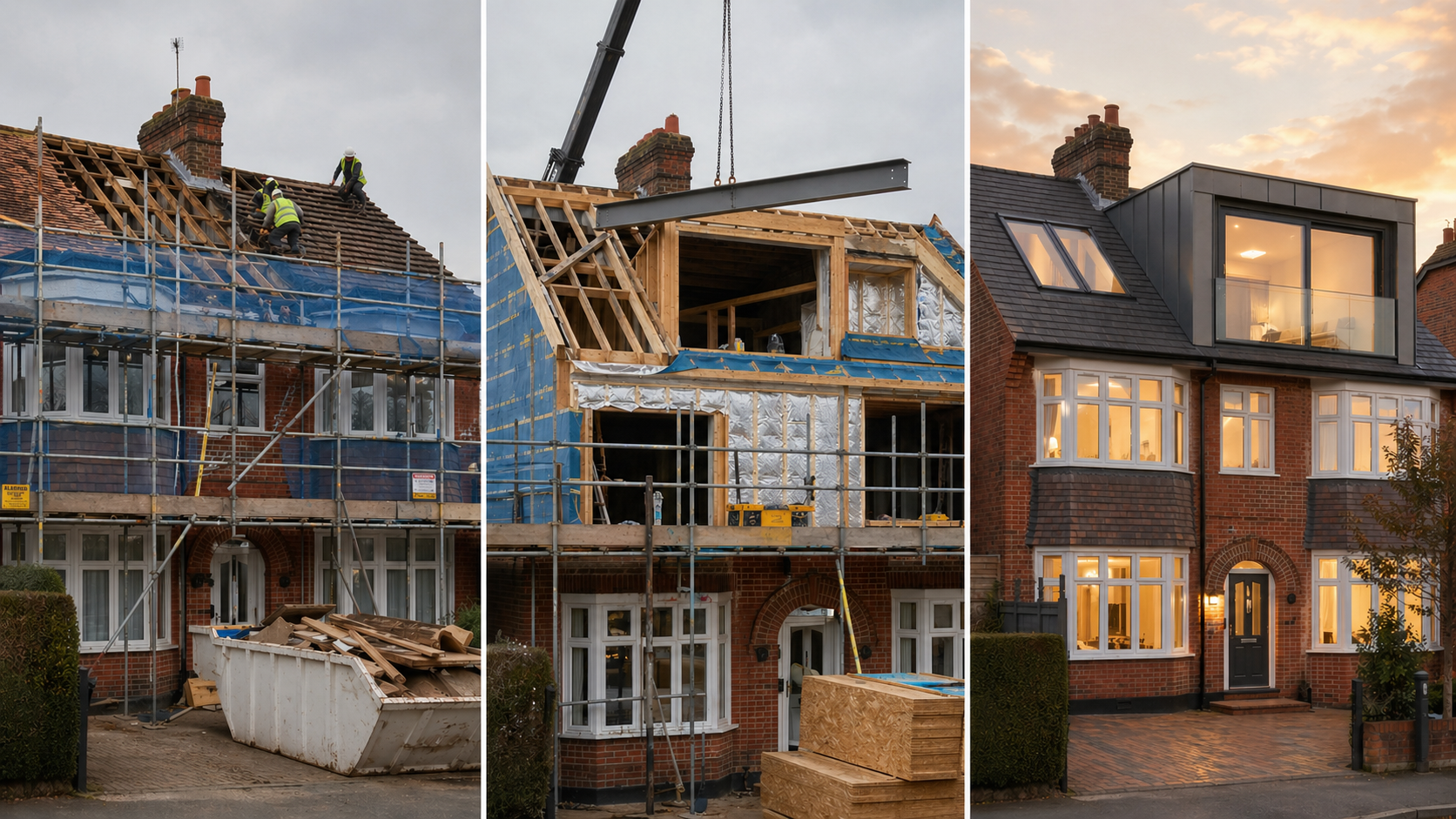
You've noticed scaffolding go up on a terrace just off Blackheath Village or along one of the roads backing onto the heath, and you've started wondering how long all that disruption actually lasts. It's the question we hear most from Blackheath homeowners - and the honest answer is almost always longer than people expect, but not for the reasons they assume.
Most on-site loft conversions in Blackheath take 6–10 weeks to build. But if you're measuring from your first conversation with a contractor to the moment you hold a completion certificate, the full project runs closer to 3–5 months. The difference is the pre-build phase - design, council approvals, and building regulations - which chews through calendar time before a single beam is lifted.
That pre-build gap is where most homeowner frustration lives. Not because anything is wrong, but because no one explains it at the start.
This guide does. Whether your property is a Victorian terrace in SE3 or an Edwardian semi near Lee Green, here's a clear account of every stage, week by week.
How much does a loft conversion cost in Blackheath? → Full cost guide
TL;DR: A standard dormer loft conversion in Blackheath takes 6–8 weeks on-site. Velux conversions can wrap up in 4–5 weeks. Mansard builds run 10–14 weeks. Factor in 8–16 weeks upfront for design, Greenwich or Lewisham Council decisions, and building regulations, and the end-to-end timeline is 3–5 months. (Sources: Royal Borough of Greenwich Planning Portal, London Borough of Lewisham Planning, Nationwide House Price Index, 2026)
How Long Does a Loft Conversion Take in Blackheath? The Realistic Numbers
The on-site build for a Blackheath loft conversion runs anywhere from 4 to 14 weeks, depending on which conversion type suits your roof. A 2025 Checkatrade Home Improvement Survey found that loft conversion enquiries across South East London rose by over 28% year-on-year - demand that's brought with it a much sharper awareness of what realistic timescales actually look like.
Here's how the main conversion types compare for Blackheath's predominantly Victorian and Edwardian housing stock:
The rear dormer remains the most popular choice for Blackheath's Victorian terraces - and it sits firmly in the 6–8 week range. If you're in an Edwardian semi closer to Kidbrooke or Lee and you're weighing up a hip-to-gable, plan for 8–10 weeks on-site.
What the chart above doesn't capture is the pre-build phase. That's where your calendar really gets used up.
Why the Total Timeline Is Longer Than the Build: The Pre-Build Phase
Here's what catches most Blackheath homeowners off guard: the build is actually the shorter half of the story. Before a single joist is touched, you'll work through design, planning approval, and building regulations - a pre-build phase that typically takes 6–16 weeks, depending on where exactly your property sits and which approvals apply.
Here's how that phase breaks down:
Design and structural survey (weeks 1–3): An architect or specialist surveys your loft, takes measurements, and produces working drawings. Structural calculations are produced separately. Budget 2–4 weeks for this stage.
Permitted Development or full planning permission? Many Blackheath loft conversions qualify under Permitted Development rights, which allows you to proceed without a formal planning application. The volume thresholds are 40m³ for terraced properties and 50m³ for semi-detached and detached homes (gov.uk Planning Portal, 2026). Even when PD applies, a Lawful Development Certificate (LDC) is strongly advised - it protects your position at sale and takes 6–8 weeks from your local authority.
If a full planning application is needed, both Royal Borough of Greenwich and London Borough of Lewisham operate on an 8-week statutory decision window, with complex or neighbour-disputed applications taking longer.
Important for Blackheath homeowners:
Blackheath itself straddles two London boroughs - the western side of the village falls
under Lewisham, and the eastern side under Greenwich.
Your council isn't just a bureaucratic detail; it determines who processes your
application, what planning policies apply, and which conservation area rules govern your
roof. Check your postcode before assuming either.
Blackheath is extensively
covered by conservation area designations. Greenwich's Blackheath Conservation
Area and Lewisham's Blackheath Conservation Area together
cover a large proportion of the SE3 postcode - including the streets most immediately
surrounding the heath itself. Properties within these designations always
require full planning permission for roof alterations, regardless of
conversion size or PD volume thresholds. Check your address at royalgreenwich.gov.uk or lewisham.gov.uk before any assumptions are made.
Building regulations: Your contractor submits a Full Plans application to your borough's Building Control team or an approved private inspector. The initial plans review takes 3–5 weeks. Building Control runs throughout the build - inspectors visit at structural and fire-safety milestones, not just at the end.
Week 1: Pre-Build Preparation - Quiet on the Surface, Busy Underneath
From the outside, Week 1 looks uneventful. From the inside, it's all logistics. Scaffolding goes up within the first two days - and if you're on one of the tightly parked roads near the village or close to Blackheath Standard, your contractor will need to arrange a scaffold licence and parking suspension with the relevant borough council in advance. It's not complicated, but it needs to be planned.
Materials arrive and are staged: structural steels, timber, insulation, and fixings. Your contractor will create a controlled roof-access point so that materials and trades can move in and out without traipsing through your living space. Everything at this stage is external or within the loft void itself. Your home below remains essentially untouched.
What you should sort before Week 1 begins:
- Clear the loft completely - boxes, old furniture, loose insulation rolls
- Protect furniture in the rooms directly below the build zone with dust sheets
- Confirm skip and delivery logistics with your contractor - some SE3 roads have permit restrictions on skips
- Let your neighbours know. On terraced streets near the heath, this goes a long way
Weeks 2–4: Structural and Shell Work - The Loud Phase
Weeks two to four are when the project becomes audible. Structural steels go in, floor joists are reinforced or replaced, and the dormer shell begins to take form. It's the noisiest phase - but it's entirely confined to the upper structure. Your living spaces below aren't directly affected.
Week 2 - Structural work:
- Floor joists strengthened or a new structural floor installed
- Steel RSJ beams inserted where load redistribution is required - Victorian properties in SE3 often need additional steelwork due to the age and condition of existing joists
- Roof opened for dormer builds; temporary weatherproofing applied at the end of each working day
Week 3 - Dormer shell:
- Timber dormer frame constructed and set
- Flat or pitched dormer roof formed above it
- Roof made temporarily watertight each evening - Blackheath's exposed position on high ground means it catches weather earlier and harder than lower-lying parts of South London
Week 4 - Weatherproofing and glazing:
- Dormer clad in tiles, zinc or render - render and matching stock brick details are common in Blackheath's conservation areas to satisfy planning conditions
- Windows and Velux units installed and sealed
- Roof brought to fully watertight status - this milestone triggers the next Building Control inspection
Edwardian semi note: Properties near Lee Green or Kidbrooke with hipped roofs going hip-to-gable will find the structural phase runs one to two weeks longer than a straightforward rear dormer. The hip end is removed and a new gable wall constructed - it's more involved structurally and requires additional steelwork and brickwork. Budget Weeks 2–5 for the structural phase on these properties.
Weeks 5–6: First Fix - The Build Moves Indoors
Once the shell is watertight, the focus shifts entirely inside the new space. This is noticeably quieter for the household - activity is contained to the loft above the ceiling line, and the disruptive noise of structural work is behind you.
What happens in first fix:
- Insulation fitted to roof slopes, walls, and floor (must comply with Building Regulations Part L - thermal performance requirements were updated in 2026)
- Internal stud partition walls framed out
- First fix electrics: all cabling routed and run before boarding begins
- First fix plumbing if an en-suite is included - adds approximately 3–5 days to this phase
- Fire safety separation: mains-wired interlinked smoke alarms required throughout the property under Part B of the Building Regulations
Building Control inspection: Your Building Control officer carries out a mid-build inspection at first fix stage. Have your structural drawings to hand. Both Greenwich and Lewisham Building Control now offer remote video inspections for lower-risk elements such as insulation checks and joist spacing reviews, which can reduce scheduling delays on-site.
Weeks 7–9: Staircase, Plastering and Second Fix
The staircase going in is the moment the new space starts to feel real - and it's also the single most disruptive day of the entire build. Your existing landing ceiling is opened up, and the new staircase is lowered through and fixed in position. Access to your first-floor landing is restricted for most of that working day. It's worth being out of the house if you can manage it.
Once the staircase is in, second fix moves along quickly:
Weeks 7–8 - Plastering:
Plasterboard is fixed to walls and ceilings. A skim coat follows. The room takes shape
remarkably fast at this point - going from a bare timber frame to something that looks
finished happens in a matter of days. Allow 3–5 days drying time before any decoration
starts. Decorating onto damp plaster cracks. It's not worth rushing.
Weeks 8–9 - Second fix:
- Sockets, switches, and light fittings wired and connected
- En-suite bathroom fixtures installed if included in your spec
- Floor covering fitted - carpets, engineered timber, or LVT. Let us know your choice before second fix week begins, not after
- Joinery completed: skirtings, door architraves, fitted wardrobes or eaves storage units
An en-suite adds 3–5 working days to the second fix phase. Worth noting: Nationwide's 2026 research found that converting a three-bedroom home with a new bedroom and bathroom can push property value up by as much as 24% (Nationwide House Price Index, 2026). In Blackheath - where SE3 property values consistently run above the South London average - that uplift is meaningful. Build the bathroom in from day one, not as an afterthought.
Week 9–10: Final Inspection and Your Completion Certificate
The final Building Control inspection is the last formal checkpoint before your new room is legally habitable. Depending on your address, this is carried out by either Greenwich or Lewisham Building Control - or by an approved private inspector if that route was chosen at the start of the project. Buildaway coordinates this on your behalf.
What the inspector checks:
- Structural integrity of the new floor, roof, and dormer framing
- Fire safety: fire-rated door specifications, smoke alarm positions and interconnection, fire separation between floors
- Staircase compliance - head height, rise, going, and handrail specification
- Insulation values meeting Part L (2026 standards)
- Electrical installation certificate from your Part P registered electrician
On sign-off, the inspector issues a completion certificate. Keep it somewhere safe and accessible. Your conveyancer will request it when you sell, and if you remortgage post-conversion, your lender may ask for it then too. Losing it means applying to the council for a copy - possible, but time-consuming.
After handover comes the part everyone's been waiting for: the new room is yours. Most Blackheath homeowners decorate after practical completion, either personally or through a local decorator. We're happy to pass on recommendations if useful.
Want to know what the timeline looks like for your
specific Blackheath property?
Buildaway offers a free, no-obligation loft survey across SE3, SE10, and the surrounding
streets from Lee to Kidbrooke. One quote. One point of contact. One clear process from
day one. Book your free loft survey →
Can You Stay in Your Home During a Loft Conversion in Blackheath?
In almost every case, yes. Loft conversions are built to work around occupied households - that's part of what makes them such a practical choice compared to moving or extending. The structural phase in Weeks 2–4 is the loudest, but all of that noise stays above the ceiling line. Your living spaces aren't directly involved.
The one day that causes the most noticeable disruption is staircase installation day - when your landing ceiling is opened up and the new stairs are dropped in. That's typically a single working day, and being out of the house makes it easier on everyone.
The practical rules are straightforward. Clear the loft before Week 1, cover furniture below the build zone with dust sheets, discuss working hours with your contractor upfront. Most Blackheath builders operate 8am to 5pm on weekdays. Weekend working in residential conservation areas is generally kept to a minimum - worth confirming before you sign.
Key Takeaways for Blackheath Homeowners
A loft conversion in Blackheath is one of the best-value home improvements available in SE3 - but getting the expectations right at the start makes the whole experience smoother.
A few things worth holding onto from this guide:
- The on-site build runs 6–10 weeks for most Blackheath property types. The full project, including the pre-build phase, is 3–5 months.
- The pre-build is where timelines slip - not through mistakes, but because planning approvals have statutory timeframes that no one can rush. The earlier you start, the better.
- Conservation area coverage in Blackheath is extensive - and your property may fall under Greenwich or Lewisham rules, not both. Check before making any assumptions about Permitted Development.
- The straddle-borough reality matters. Knowing which council governs your application before you begin saves time and avoids mid-process surprises.
- Include the en-suite. Nationwide's 2026 data confirms a bedroom-plus-bathroom loft conversion can add up to 24% property value. The extra few days in the build schedule is money well spent.
- Your completion certificate is a legal document. Don't lose it, and don't skip the final inspection. Your buyer's solicitor will ask for it.
Ready to find out what the timeline looks like for your specific SE3 address? Buildaway surveys across Blackheath, Lee Green, Kidbrooke, Charlton, and the surrounding SE3 and SE10 postcodes.