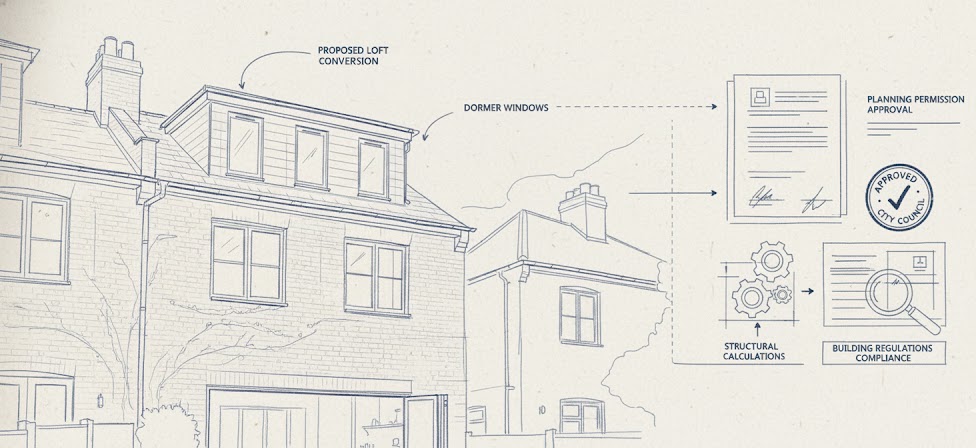
Islington is a borough of two answers. Turn onto Thornhill Square or the elegant sweep of Canonbury and you're in some of London's most closely protected Georgian townscape, where almost nothing happens to a roof without the council's say-so. Walk ten minutes to a plainer Victorian terrace off the Holloway Road and the picture changes entirely - there, a loft can often be built with no planning application at all.
That patchwork is the whole story in N1. Whether your loft needs permission comes down, more than in almost any borough, to which exact street you live on. This guide maps the two worlds: when an Islington loft is permitted development, when it needs a full application to Islington Council, what the 2026 fees are, and how to be certain which side of the line your home sits before you commit.
Whether an Islington loft needs planning permission depends on the street. The borough's roughly 40 conservation areas - Barnsbury, Canonbury, Duncan Terrace and many more - remove roof permitted development rights, so a dormer there needs a full application (£548 from 1 April 2026). On unprotected streets an unlisted house can still add a rear dormer under permitted development. Flats, common across Islington, have no permitted development rights at all.
Does an Islington Loft Conversion Need Planning Permission?
The honest answer is: it depends where you live. On a street outside a conservation area, an unlisted Islington house usually keeps the national permitted development rights that let you add a rear dormer without a planning application, within the volume and design limits below (Planning Portal).
Two things commonly move an Islington home into the "full application" column. The first is a conservation area: the borough has around 40 of them, and they blanket most of Islington's best-known Georgian and early-Victorian streets, removing roof permitted development rights wherever they apply. The second is tenure - Islington has an unusually high proportion of flats and maisonettes, and flats carry no permitted development rights at all, so any loft above one needs planning permission and the freeholder's agreement.
Because the position turns on the exact address, we always confirm it before quoting - and where a project is permitted development, we recommend a Lawful Development Certificate from the council. It's formal proof the loft is lawful, and it's exactly what an Islington buyer's solicitor will ask for when you sell.
Islington's Patchwork: Conservation Areas and Article 4 Directions
Knowing the map matters more in Islington than most places. The council has designated around 40 conservation areas, covering a great deal of the borough - the garden squares of Barnsbury and Canonbury, the graceful terraces of Duncan Terrace and Colebrooke Row, Gibson Square, Thornhill, and the streets around Upper Street and Highbury Fields.
Inside any of these, conservation-area status removes the roof permitted development rights that apply on unprotected streets, so even a modest rear dormer needs a full application. Islington publishes a design guide and appraisal for each area, and its officers are known for defending the borough's intact Georgian rooflines rigorously - the garden-square terraces in particular are judged on close design terms.
Islington has also used Article 4 directions to remove further permitted development rights on some streets, so even outside a conservation area it's worth checking. The safe assumption in N1: if your street looks Georgian and orderly, expect a full application; if it's a plainer Victorian terrace, permitted development may well be open to you.
Permitted Development Rights for Lofts in N1 - What You Can Build
On an unlisted Islington house outside a conservation area, permitted development lets you add a roof enlargement of up to 40 cubic metres on a terrace, or 50 cubic metres on a semi-detached or detached house, without a planning application (Planning Portal). The main conditions are that the dormer sits on the rear, doesn't rise above the ridge, uses materials matching the house, and stays 20cm back from the eaves.
Permitted Development Roof Allowance, by Property
Maximum roof enlargement without planning permission - England, 2026
Source: General Permitted Development Order 2015, Schedule 2 Part 1 Class B (via Planning Portal). Class B rights are excluded in conservation areas and do not apply to flats.
Two caveats bite hard in Islington. "Original house" means the property as first built or as it stood in 1948, and a great many N1 houses have long since been divided into flats or already extended - either of which can wipe out the allowance. And rooflight-only conversions fall under a separate rule (Class C) that stays available even in most conservation areas, which is often the only unrestricted option on a protected Georgian street.
Which Loft Conversions Get Approved in Islington?
Whether by certificate or application, the types that suit N1's housing get through. A loft that adds a bedroom and bathroom can lift a three-bedroom London home's value by up to 24% (Nationwide, 2025), and Islington's tall, narrow Georgian and Victorian terraces are natural candidates for a rear dormer or a mansard where the street already carries them.
| Conversion type | Planning position in Islington | Typical London cost* |
|---|---|---|
| Velux / rooflight | Usually no application needed (Class C), even in conservation areas | From ~£19,000 |
| Rear dormer | Permitted development outside a conservation area; full application inside one | £52,000–£115,000 |
| Mansard | Full application; approvable where mansards are the street's character | £75,000–£160,000+ |
| Hip-to-gable | Occasional; rare in N1's mostly terraced Georgian stock | £62,000–£145,000 |
*2026 London ranges from Buildaway's London loft conversion cost guide (linked below). Conservation-area and listed detailing in Islington sits at the upper end.
Away from the squares, roof shape and tenure drive the design. Islington's canalside warehouse conversions and mansion flats follow the freeholder route rather than permitted development, while the plainer terraces off the main roads often take a straightforward rear dormer. This is where a seasoned loft conversion service pays for itself: reading which route - certificate or application - gets you built fastest.
What About Listed Buildings in Islington?
Islington has one of inner London's densest concentrations of listed houses, clustered in the Georgian squares and terraces of Barnsbury, Canonbury and Duncan Terrace. If your home is listed, you'll need listed building consent alongside any planning permission, covering anything that affects the building's special interest - internal work such as a new staircase included. Any address can be checked on Historic England's National Heritage List.
Two facts catch owners out. There's no application fee for listed building consent - but carrying out unauthorised works to a listed building is a criminal offence, not merely something the council can ask you to reverse. Lofts in listed Islington houses do get consented, but only where the scheme respects the historic fabric and the heritage statement is prepared properly.
What Does Planning Permission Cost in Islington in 2026?
Where you do need to apply, the fees are set nationally, not by the council. A householder planning application in England costs £548 from 1 April 2026, up from £528 (GOV.UK fee regulations). A Lawful Development Certificate - which confirms a permitted development loft is lawful - costs £274, half the householder fee, and listed building consent is free.
| Item | 2026 cost | Notes |
|---|---|---|
| Householder planning application | £548 | From 1 April 2026 (was £528); for conservation-area schemes |
| Lawful Development Certificate | £274 | Half the householder fee; proves a PD loft is lawful |
| Listed building consent | £0 | No fee, but heritage statement required |
| Measured survey & drawings | ~£1,500–£4,000 | Typical London range, Buildaway project experience |
| Structural & Building Regs drawings | ~£500–£1,500 | Needed even where the loft is permitted development |
Statutory fees: GOV.UK planning fee regulations, 2026. Professional-fee ranges reflect Buildaway's London project experience and vary with property complexity.
Costing the build too? Our full breakdown of loft conversion costs in London covers every conversion type, and if you're weighing a loft against extending, see our guides to home extension costs in Islington and planning permission for a home extension in Islington.
How Long Does Islington Council Take?
Where a full application is needed, Islington works to the statutory 8-week target for deciding a householder application once it's validated (GOV.UK), and a similar 8 weeks for a Lawful Development Certificate. But the application is only one stretch of the journey, and it's rarely the longest.
Islington Loft Conversion: Pre-Construction Timeline
Typical duration of each stage, in weeks
Statutory 8-week determination target: GOV.UK. Other stage durations: Buildaway London project experience, 2026. Stages can overlap.
All in, allow roughly 3–5 months from first survey to breaking ground on a conservation-area scheme, and a little less for a permitted development loft, where the certificate and the Building Regulations work can run in parallel while design is finalised. On a listed garden-square house, budget longer still.
Beyond Planning: Building Regs, Party Walls and Freeholders
Whether or not you need planning permission, an Islington loft still has to clear three separate sign-offs:
- Building Regulations approval - required for every loft conversion, permitted development or not, covering structure, fire escape, staircase and insulation (GOV.UK).
- Party wall agreement - two months' written notice to adjoining owners before structural work on shared walls, under the Party Wall etc. Act 1996.
- Freeholder consent - a licence to alter, if you own a flat rather than the freehold.
The Building Regulations point matters most: skip it and, permitted development or not, the new space legally isn't a bedroom.
The freeholder question looms especially large in Islington. Its tightly packed Georgian terraces share party walls, so the Party Wall etc. Act 1996 applies even when planning doesn't: two months' notice before steel beams go into shared walls, and a party wall award if a neighbour dissents. And because so many N1 homes are flats, a great many owners here will also need their freeholder's consent and a licence to alter, since the loft above may not be theirs to convert.
Converting a loft in N1? Buildaway confirms whether it's permitted development or needs a full application, then handles drawings and build as one team, with one fixed quote.
Request a free quote →Frequently Asked Questions
Do I need planning permission for a loft conversion in Islington?
It depends on your street. Islington is a patchwork: its many conservation areas - Barnsbury, Canonbury, Duncan Terrace and others - remove roof permitted development rights, so a dormer there needs a full application. On unprotected streets, an unlisted house can still add a rear dormer under permitted development within volume limits. Flats have no permitted development rights anywhere. Always confirm your address first. (Islington Council; Planning Portal)
Is Islington a conservation area?
In large part, yes. Islington has around 40 conservation areas, and they cover a great deal of the borough's best-known Georgian and Victorian streets - Barnsbury, Canonbury, Duncan Terrace and Colebrooke Row, Gibson Square, Thornhill and the streets around Upper Street and Highbury Fields. Plenty of other roads sit outside them, so conservation controls apply street by street. (Islington Council)
How much does planning permission cost for an Islington loft conversion in 2026?
A householder planning application in England costs £548 from 1 April 2026 (up from £528). A Lawful Development Certificate, which proves a project is permitted development, costs £274 - half the householder fee. Listed building consent has no application fee. Measured surveys, drawings and any heritage statements are charged separately. (GOV.UK fee regulations, 2026)
Can I build a rear dormer without planning permission in Islington?
Only if your home is an unlisted house on a street outside a conservation area. There, Class B permitted development allows a rear dormer of up to 40 cubic metres on a terraced house within the usual limits. In Islington's many conservation areas those rights are removed and a full application is required, and flats have no permitted development rights at all. (Planning Portal; Islington Council)
Can I convert the loft of a flat in Islington?
Only with a full application and your freeholder's agreement. Permitted development rights apply only to houses, so Islington's many converted-flat and maisonette homes have none. A loft in the top flat needs planning permission, a licence to alter from the freeholder, and usually the airspace to be yours to build in. (Planning Portal)
How long does Islington Council take to approve a loft conversion?
Islington works to the statutory 8-week target for deciding a householder application once it is validated, or roughly 8 weeks to issue a Lawful Development Certificate. Allow 3–5 months from first survey to start on site once design time, neighbour consultation and any Party Wall Act notices are included. (GOV.UK; Islington Council)
The Bottom Line on Islington Loft Conversions
In Islington, the only safe starting point is your own street - because the borough runs the full range from untouchable Georgian square to unrestricted Victorian terrace.
- Check the map first: around 40 conservation areas cover much of N1's Georgian and Victorian core, removing roof permitted development rights. (Islington Council)
- Off the protected streets, an unlisted house can often add a rear dormer as permitted development (40m³ terrace / 50m³ semi or detached). (Planning Portal)
- Mind your tenure: flats have no permitted development rights, and much of Islington is flats.
- Budget £548 for a 2026 application or £274 for a Lawful Development Certificate, and remember Building Regulations, party wall notices and freeholder consent all apply regardless. (GOV.UK)
At Buildaway, we work out exactly where your Islington home sits and build the loft under one fixed quote. To find out which side of the line your street is on, get in touch or see our loft conversion service in Islington.