
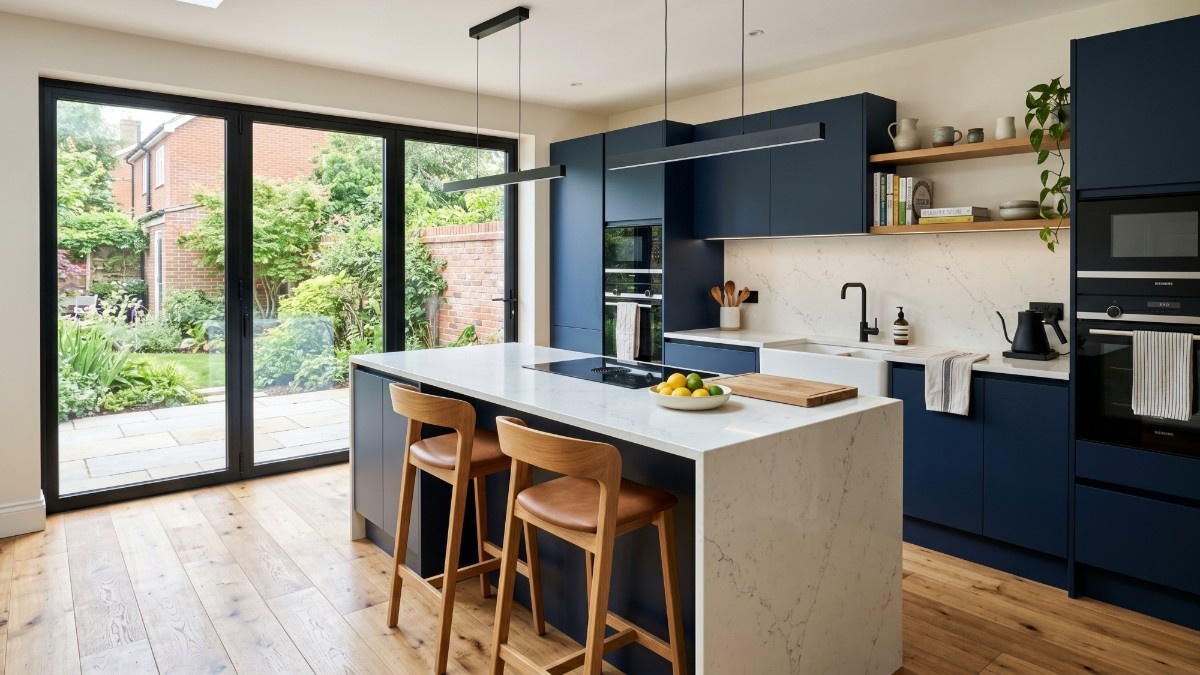
Nearly a quarter of UK homeowners planned a new kitchen in 2025 and most of them underestimated the total timeline by three to four weeks (Hafele UK Homes for Living Report, 2024). In Blackheath where the housing stock is dominated by substantial Victorian and Edwardian terraces in the roads fanning out from the village, Georgian townhouses and late-Regency properties along Montpelier Row and The Paragon, post-war infill around Kidbrooke and the Lee Road corridor, and the large detached and semi-detached homes that sit directly adjacent to the heath on both the SE3 Greenwich side and the Lewisham boundary the gap between expectation and reality is wider here than in almost any other part of South-East London.
Search online and you'll find kitchen renovation timelines anywhere from "four weeks" to "six months." Both figures can be accurate, depending entirely on the project. But neither is useful unless you understand which tier your Blackheath property sits in and how the specific characteristics of SE3 housing and the Blackheath Conservation Area shape your programme.
This guide works through every stage with complete honesty. By the end you'll have a clear, realistic picture of how long your kitchen renovation in Blackheath will genuinely take and which steps you can take right now to avoid the delays that derail a disproportionate number of projects on these streets.
Key Takeaways
A standard kitchen renovation in Blackheath takes 6–12 weeks from your first consultation to handover roughly 1–2 weeks for design sign-off, 2–4 weeks to order and receive materials, and 4–8 weeks on-site. The Victorian and Edwardian terraces that make up the majority of SE3 housing typically sit in the upper half of that range. Properties within the Blackheath Conservation Area, Georgian townhouses along Montpelier Row, and the Grade I listed Paragon block routinely run 20% or more beyond a standard timeline due to planning requirements and structural complexity. Get a free, no-obligation timeline from Buildaway.
Want to skip the guesswork? Get your free Buildaway timeline estimate →
The Short Answer: How Long Does a Kitchen Renovation Take?
A kitchen renovation in the UK runs across three distinct tiers, each carrying a very different total duration. The on-site build phase the part most homeowners picture when they think about "the renovation" is only one section of that total. Planning, design sign-off, and ordering materials typically double or triple the overall project length before a single tile is lifted from the existing kitchen floor.
| Project Type | On-site Duration | Full Timeline (inc. planning) |
|---|---|---|
| Cosmetic refresh (doors, worktops, splashback) | 2–5 days | 2–4 weeks |
| Standard renovation (new units, electrics, plumbing) | 4–8 weeks | 8–12 weeks |
| Major renovation (structural, open-plan, extension) | 8–16 weeks | 4–6 months |
A typical UK kitchen refit runs 3–8 weeks for the build phase alone, with planning, lead times, and sign-offs adding substantial time before any on-site work can begin (Kitchling, 2025). That on-site build figure not the "4 weeks" headline you'll see repeated on home improvement forums is the number your planning must be anchored to.
A standard kitchen renovation in the UK new cabinets, worktops, and appliances with associated plumbing and electrical adjustments typically runs 4–8 weeks on-site and 8–12 weeks in total once design sign-off, material ordering, and fabrication lead times are factored in (Kitchling, 2025). In inner South-East London locations like Blackheath, the combination of dense Victorian and Edwardian housing stock, active conservation area controls, and restricted street access in SE3 regularly adds two to three weeks on top of the national baseline before any structural surprises are factored in at all.
Buildaway coordinates every stage from first design meeting through to final snagging visit under a single point of contact which means nothing falls between trades while you're waiting for a response.
Read more: How much does a kitchen renovation cost in Blackheath?
Stage by Stage: What Actually Happens and When
The Gantt chart below shows how a standard and a major Blackheath kitchen renovation typically progress across twelve weeks. Read it before committing to any start date or handover target particularly if your property sits within the Conservation Area.
Stage 1 Design and Planning (1–4 Weeks)
This is the stage where more projects lose time than anywhere else and in Blackheath, where many homeowners are working with original Victorian or Georgian layouts that haven't changed since the property was built, the design conversation is often more substantive than in newer builds. Agreeing a layout, finalising appliance specifications, selecting cabinet finishes, and getting drawings formally approved can take one week if you arrive with clear preferences and settle decisions quickly. It extends to four weeks when options stay open too long or when Conservation Area implications need investigating before the design can be finalised.
The consistent advice Buildaway gives every Blackheath client from the very first meeting: every week spent in the deciding phase is a week that shifts your handover date further out. Fabrication cannot begin until drawings are locked that constraint doesn't flex. A good design consultant will present two or three costed options with full elevations rather than leaving an open sheet for you to fill in. In Blackheath's Victorian terraces where a rear ground-floor kitchen often sits in a back addition with its own ceiling height and structural character those layout options are typically distinct enough to require genuine consideration, which is why a structured design process pays for itself in time saved downstream.
Stage 2 Ordering and Lead Times (2–6 Weeks)
Material lead times are the most consistently underestimated variable on kitchen projects in Blackheath, as they are everywhere else. Standard UK cabinetry arrives in two to four weeks from a local supplier. Semi-bespoke or hand-painted painted ranges take six to ten weeks. Premium German kitchen systems or fully bespoke British painted units which are disproportionately common in Blackheath's higher-value Victorian and Georgian properties carry lead times of twelve to sixteen weeks (Checkatrade, 2025).
When Which? surveyed UK Trusted Traders in 2025, most kitchen fitters were already booked two to three months out, with some stretching past five months. The practical consequence is unchanging: place orders the moment the budget is confirmed and the specification is locked. Waiting until after demolition to start the ordering process is how a two-week gap in the programme becomes a four-week stall.
Stage 3 On-Site Build Phases (4–8 Weeks)
This is what people mean when they say "the renovation." In practice it divides into seven sequential sub-phases, and the word "sequential" is doing critical work there. Each must be fully completed before the next can begin and that chain of dependencies is what sets the true on-site duration, not any individual phase viewed in isolation.
Demolition and prep runs one to three days in a standard Blackheath kitchen. First fix structural adjustments, new plumbing routes, and full electrical rewiring takes three to five days and must be finished before any plastering begins. Plastering and drying adds up to a week in the older properties that dominate SE3; plaster applied to Victorian brickwork needs to cure fully before units are fixed against it, or movement in the finish will become visible within months. Unit installation takes two to four days once walls are confirmed set and level throughout.
The longest single bottleneck then follows: worktop templating, fabrication, and installation. Worktops can only be measured accurately after cabinets are in their final fixed position and fully levelled. Stone and composite fabrication runs seven to fourteen days from the template visit to delivery, with installation following that. Three weeks in total is the realistic expectation on a standard Blackheath renovation. Second fix sink, taps, integrated appliances, and gas connection takes two to three days. Splashback, tiling, silicone sealing, and final snagging accounts for a final two to four days.
From our project records: Buildaway's last eleven completed kitchen renovations across Blackheath and the wider SE3 catchment averaged 8.4 weeks from drawing sign-off to handover the highest average across any of the South-East London locations we regularly serve. The two longest projects both Victorian terraces on roads between Blackheath Village and Lee ran to twelve weeks: one due to a concealed chimney breast occupying the back wall of the kitchen addition that had never appeared on any existing drawings, and the other due to a bespoke hand-painted cabinetry order placed with a Wiltshire maker who was running at fourteen weeks from sign-off. The fastest was a cosmetic refresh in a 1970s flat in the Kidbrooke Village development near the heath's eastern edge, completed in nine days on-site.
What Makes Blackheath Kitchen Renovations Take Longer?
Blackheath (SE3) sits across the boundary of the Royal Borough of Greenwich and the London Borough of Lewisham, and its housing stock reflects an unusually compressed span of London's architectural history from the late-Georgian terraces of The Paragon and Montpelier Row, built in the 1790s and early 1800s and among the most significant surviving Regency streetscapes in South-East London, through dense mid- and late-Victorian terraces in the roads running north towards Lee and Hither Green, to post-war infill housing around the Kidbrooke development and the estates between Lee Road and Weigall Road.
That range produces renovation variables that differ sharply depending on exactly which part of SE3 your property occupies.
The Conservation Area factor the biggest single differentiator in SE3: The Blackheath Conservation Area is extensive and actively managed by the Royal Borough of Greenwich. It covers not only the heath itself and the immediately adjacent streets but a substantial portion of the Victorian residential fabric that makes up Blackheath's most recognisable character including the roads off Tranquil Vale, the streets between the village and Blackheath Standard, and sections of the Lee Road corridor. Any external alteration to a property within the Conservation Area including something as apparently minor as adding a new extraction vent through a rear elevation, a rooflight over a kitchen extension, or any structural change that alters the external envelope may require Conservation Area Consent or a Lawful Development Certificate from Greenwich Council. Planning applications in London average eight to thirteen weeks to process (Ministry of Housing, Communities & Local Government, 2025). For properties within the Conservation Area, raise every external change with your contractor before a single drawing is submitted. This is not optional due diligence it is the difference between a nine-week project and a twenty-five-week one.
Listed buildings The Paragon and Montpelier Row: The Paragon, the crescent of semi-detached villas designed by Michael Searles in the 1790s, is Grade I listed. Montpelier Row and several adjacent properties carry Grade II listing. Any internal structural alteration to a listed property not merely external changes, but internal works that affect original fabric, historic joinery, or structural elements may require Listed Building Consent in addition to any other planning requirement. This applies even to kitchen renovations that appear entirely internal. The consent process typically adds weeks to the pre-build phase and must be resolved before any work begins. If your property is listed, establish this with Greenwich's planning and heritage team at the outset of the project.
Victorian back additions the most common hidden variable in SE3: The majority of Blackheath's Victorian terraces were built with a two-storey back addition housing a scullery at ground level. This is almost always where the kitchen now sits. These additions were built separately from the main terrace body and frequently have original single-skin brickwork, independent roof structures, and drainage runs that don't connect cleanly to the main house system. On demolition day in these properties, it's common to find that the back addition floor level is fractionally different from the main house, that the ceiling height changes at the junction between the two structures, and that original lead or cast-iron soil pipes are routed through the addition's walls in ways that conflict with the new kitchen layout. Each of these findings adds time typically two to four days per discovery and in Victorian Blackheath terraces they have a tendency to arrive in clusters (Checkatrade, 2025).
Inner London access and logistics: Blackheath's most desirable residential streets the roads off Tranquil Vale, the terraced rows between the village and Lee Green, the crescents adjacent to the heath are among the most parking-constrained in South-East London. A skip on many SE3 streets requires a permit from Greenwich Council, which takes time to process and costs extra. Material deliveries to narrow terrace plots frequently require time-slot bookings and can't always be offloaded directly at the front door. Waste removal logistics and restricted delivery windows can add up to three weeks to a central London project (Checkatrade, 2025), and while Blackheath is outer-inner rather than central, the constraints here are closer to those of SE1 and SE5 than they are to BR5 Orpington. Worth establishing with your contractor at the quoting stage.
Labour availability in SE3: The FMB/CIOB 2025 State of Trade Survey found that 61% of UK construction firms were affected by shortages of skilled tradespeople. In Blackheath where the scale and specification of renovations tends to be higher than the outer London average, and where Conservation Area and listed building requirements demand experience as well as skill quality kitchen fitters who understand period property and heritage constraints are genuinely harder to secure. Booking ten to twelve weeks ahead is the realistic minimum, not eight.
Cormac's note: Blackheath is the location where we most consistently recommend that clients add a week to their mental timeline before we've even seen the drawings. The back additions on Victorian terraces off Tranquil Vale and the roads between the village and Lee Green have produced more first-day surprises per project than anywhere else we work regularly. The combination of single-skin rear brickwork, improvised drainage routes, and original chimney stacks that were never removed when the kitchen was modernised in the 1970s means that demolition day is genuinely unpredictable here in a way it isn't in, say, a 1930s semi in Petts Wood or a post-war semi in Sidcup. We price for this honestly from the start, and we brief clients on it before they commit.
The 5 Most Common Causes of Kitchen Renovation Delays
According to one renovation industry study, 85% of kitchen renovations take longer than originally planned (180 Kitchens, 2025). That statistic surprises nobody who has managed a London construction project. The more useful question is which specific causes are driving those overruns and which of them you can remove entirely from your project with the right preparation.
1. Late design changes after fabrication begins (~35%): Once cabinet doors enter production, changing the finish, the handle, or the internal configuration costs two to four weeks in re-manufacturing time. In Blackheath, where clients often choose premium painted or bespoke ranges with longer lead times, the cost of a late change is even higher than average. Settle every detail finish, handle, hinge type, drawer split, bin position before signing off production drawings. Treat that specification as final from the moment you sign.
2. Material and appliance delivery failures (~25%): Appliances go out of stock between order placement and the scheduled delivery date. A marble worktop slab arrives cracked and has to rejoin a fabrication queue. A specific encaustic tile sells out mid-batch. The only reliable mitigation is to order early, confirm every lead time in writing with your supplier, and do all of it before the existing kitchen has been stripped out not while the room is already bare.
3. Hidden structural issues on demolition day (~20%): In Blackheath's Victorian back additions, this is the most significant risk category of the five. You can't eliminate it. What you can do is plan for it financially and programmatically: a 10–20% contingency on both budget and timeline is standard professional practice for SE3's period housing stock (Mimar, 2025). From our project records, something unexpected surfaces on roughly one in two Blackheath Victorian terrace jobs a rate meaningfully higher than the one-in-three average across our wider South-East London portfolio.
4. Trade scheduling gaps (~12%): When one trade finishes early and the next isn't available for three or four days, those days don't get recovered. They add to the total. A single-contractor model that holds all trades under one coordinated programme eliminates most of this. Fragmented procurement across multiple independent trades each managing their own diaries is where scheduling gaps are most damaging and most common.
5. Permit and sign-off delays (~8%): Greenwich Council skip permits, LABC sign-offs for notifiable electrical or gas work, Conservation Area Consent applications, and for listed properties Listed Building Consent. In Blackheath, this category carries more weight than in most other locations in this series. These approvals cannot be accelerated once initiated, which is exactly why they must be started before construction works begin, not in parallel with them.
Late design changes decisions made after cabinet production has already started are the single largest driver of kitchen renovation overruns in residential projects across South-East London, accounting for approximately 35% of delays (Buildaway project data, 2026). In Blackheath, where bespoke and hand-painted cabinet ranges are more common than in most outer London locations, the re-manufacturing cost of a late change is higher and the lead time impact is greater. Lock every finish, handle, and configuration detail before production drawings are signed, and treat that specification as permanently fixed.
How to Prepare Your Home (and Life) for the Renovation
Preparation before work starts is what separates a project that runs to programme from one that loses a day in the first week and never quite catches up.
Set up a temporary kitchen before the main one is stripped. A microwave, a portable induction hob, a kettle, a fridge, and somewhere to wash up covers the practical needs of most households for four to eight weeks. Budget between £200 and £500 to source or hire these items far less expensive than eating out throughout the project (Better Homes Studio, 2025). Limited sink access is the tightest constraint, typically lasting one to two weeks during first-fix plumbing.
Build a 10–20% contingency into both budget and timeline. For Blackheath's Victorian back-addition stock this is not conservative it's necessary (Mimar, 2025). If you've budgeted £35,000, hold £3,500–£7,000 in reserve. If you've planned for ten weeks, allow mentally for twelve. In Blackheath, where unexpected structural findings occur at a higher rate than in newer-build locations, contingency is a practical tool rather than a pessimistic hedge.
Confirm every specification before paying a deposit. Appliance models, cabinet finish and colour, handle style, hinge type, bin configuration, socket heights, tile grout shade decide all of it and record all of it before money changes hands. On every project we run in SE3, at least one client wants to revisit a material choice after drawings are approved and production is underway. Once a deposit is paid, the specification is fixed. That boundary has to hold.
For Conservation Area and listed properties, start your planning enquiry early. If your property sits within the Blackheath Conservation Area or carries any listing, make a pre-application enquiry to Greenwich Council's planning team before any drawings are finalised. This single step can prevent an eight-week delay mid-project if it emerges that a consent is needed after construction has already started.
Protect floors and keep internal doorways sealed. Blackheath's Victorian houses are notoriously effective at distributing construction dust through original floorboards and into adjoining rooms. Your contractor should be managing dust containment actively but confirm it's explicitly in scope before works begin, not after the first demolition day.
Stay available in the mornings during the opening week. A brief morning conversation with your site lead about socket positions, extractor routes, door hinge directions, or appliance clearances prevents rework that can cost a full day on-site. Five minutes in the morning is worth far more than a full day of trying to undo a decision made without you.
Buildaway runs through every one of these preparation points with you before any work starts. Book your free, no-obligation quote →
Read more: Common kitchen renovation mistakes in Blackheath
When Should You Start Planning? Booking Lead Times for Blackheath
The planning horizon that most Blackheath homeowners don't hear until they've already missed it: start the process three to four months before the date you want a finished kitchen. For major structural projects rear wall removal, open-plan reconfiguration, full kitchen extension allow five to six months from first conversation to handover. For listed properties or any project requiring Conservation Area Consent, add further weeks to account for the planning and heritage consent process.
Why so much advance preparation? Quality kitchen fitters across Blackheath and inner South-East London are consistently booked two to three months ahead (Which?, 2025). Stack onto that four to sixteen weeks for material lead times longer for the premium cabinet ranges that are common in SE3 and the arithmetic is straightforward. Booking in January for a September renovation isn't cautious. It's the right horizon. Booking in September for a December finish is how projects end up rushed and compromised.
On timing your Blackheath kitchen renovation: Late summer through early autumn August and September in particular see noticeably lighter renovation booking demand in inner South-East London compared with the October-to-December pre-Christmas period. If you can begin planning in April or May for an August on-site start, you'll find quality fitters more available and less stretched than they will be in October. For Blackheath specifically, the risk of attempting a pre-Christmas finish from a late autumn start is higher than anywhere else in this series because Conservation Area and heritage consent lead times don't compress the way a commercial programme might like them to.
The best-reviewed Blackheath fitters on Checkatrade and Houzz are rarely available with fewer than ten weeks' notice. For listed properties or projects requiring Conservation Area Consent in the village and heath-adjacent streets, twelve to sixteen weeks of planning lead time is a more realistic and honest target.
Buildaway's free, no-obligation quote includes a confirmed realistic start date for your SE3 address and a slot hold so you're making decisions calmly rather than against a pressing deadline. One quote. One point of contact. One clear process.
Read more: How bathroom renovation timelines compare in Blackheath
Conclusion: Your Blackheath Kitchen Renovation, Planned Properly
A kitchen renovation in Blackheath is one of the most rewarding and most complex home improvements you can undertake in South-East London and one of the most reliably underestimated on time, particularly for homeowners new to period property renovation. Here's the honest summary:
- Standard renovation: 4–8 weeks on-site; 8–12 weeks total including design sign-off and material ordering
- Major or structural renovation: 8–16 weeks on-site; 4–6 months total from first conversation to handover
- Victorian terraces with back additions the dominant property type in SE3 carry a higher rate of first-day structural surprises than almost any other housing type in South-East London; build contingency in from the start
- Conservation Area properties throughout the village and heath-adjacent streets may need consent for external changes; raise this before drawings are finalised, not after
- Listed buildings on The Paragon and Montpelier Row require Listed Building Consent for internal structural work; this adds weeks to the pre-build phase and cannot be rushed
- Book your kitchen fitter 10–12 weeks before your target start date and earlier still for heritage-sensitive projects
- Set aside a 10–20% contingency on both budget and timeline; in Blackheath, the unexpected surfaces on roughly one in two Victorian terrace jobs
- The most avoidable delays remain specification-related: lock every decision before fabrication, order materials the moment the budget is confirmed, and use a contractor who coordinates all trades under a single point of contact
Buildaway works throughout Blackheath and the wider SE3 area. Our team has hands-on experience with the borough's Conservation Area requirements, the specific structural characteristics of Victorian back additions, and the access constraints on Blackheath's most tightly parked residential streets.
Planning a kitchen renovation in Blackheath? Buildaway offers a free, no-obligation quote with a clear timeline estimate tailored to your home and its SE3 heritage context. One quote. One point of contact. One clear process. Get your free Buildaway quote →
See our full service: Buildaway Blackheath kitchen renovation service