
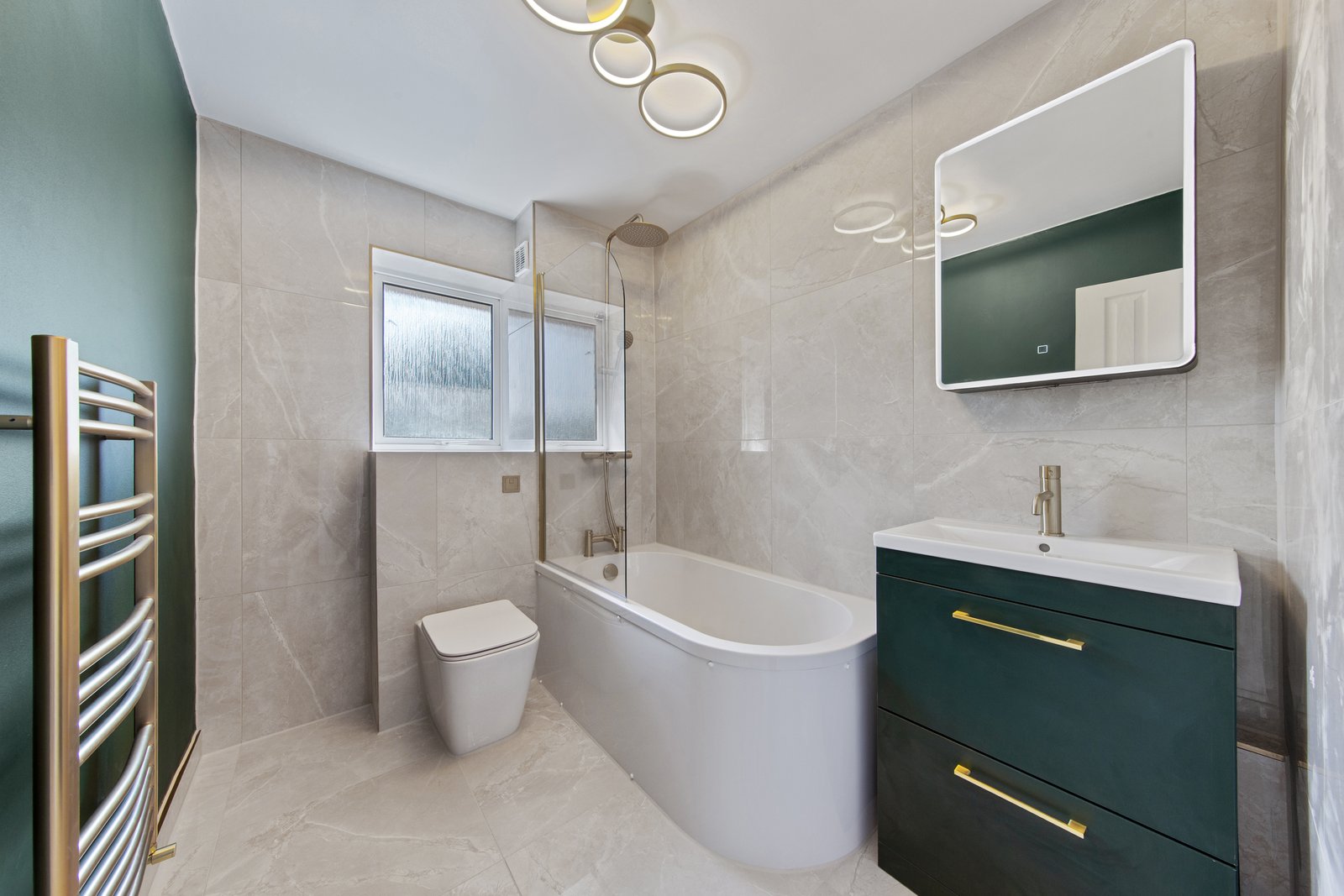
The City of London is one of the hardest places in the capital to price a bathroom over the phone. Behind the office towers is a small but distinctive residential city: a listed Barbican flat, a Golden Lane maisonette, a mansion apartment near Smithfield and a glass-tower flat above the river. Four homes, four consent routes, four very different numbers.
This guide gives the real 2026 figures for a bathroom renovation in the City of London. It covers the timelines behind them, the Corporation and listed-estate consents most quotes ignore, and an honest read on the return. Every figure is published by Buildaway or sourced from the City of London Corporation, the ONS or GOV.UK.
• Bathroom renovation cost in the City of London (2026): £8,000-£12,000 essentials refresh, £12,000-£19,000 complete refurbishment, £19,000-£32,000+ premium wet room.
• Time on site: 7-11, 11-15 and 15-22+ working days respectively.
• Consent lead time: allow four to eight weeks or more for a Corporation or freeholder licence to alter and any listed building consent.
• Listed estates: the Barbican and Golden Lane are listed and held on long leases from the City of London Corporation; internal works can need consent.
• ROI: an extra bathroom adds about 6% to a home's value (Nationwide) - roughly £46,800 on the £780,000 average City flat (ONS, June 2026). Postcodes covered: EC1 to EC4.
How Much Does a Bathroom Renovation Cost in City of London in 2026?
Bathroom renovation cost City of London 2026, at a glance: most homeowners spend £12,000 to £19,000 on a complete refurbishment that keeps the existing layout. Below that, £8,000-£12,000 buys a like-for-like refresh; above it, £19,000-£32,000 and beyond covers a reconfigured wet room or a listed-estate specification.
Those ranges sit at the top of the national picture, and not only because of specification. Across the UK a full refit typically lands between £4,000 and £15,000. Labour takes 45-60% of that, and London rates run roughly 15-20% above average (Checkatrade, 2026). The City adds two multipliers on top: restricted access and parking in a dense, secured district, and the consent regime on its listed estates.
| Scope | Typical total | Best for | What is usually included |
|---|---|---|---|
| Essentials Refresh | £8,000-£12,000 | A tired but sound bathroom | Suite replacement, minor plumbing, partial tiling, making good |
| Complete Refurbishment (most popular) |
£12,000-£19,000 | Full strip-out, existing layout retained | Re-boarding, tanking, full tiling, lighting, extraction, furniture, Part P certification |
| Premium Wet Room / Layout Change | £19,000-£32,000+ | Layout change, second bathroom, period finish | Tiled former with linear drain, full tanking, underfloor heating, niches, premium brassware, joinery |
Ranges include labour, preparation, materials and waste. Guide figures, confirmed by written quotation after survey.
What Drives Bathroom Cost in City of London Up or Down?
Seven variables account for most of the spread between a modest refit and a premium one:
- Layout change. Keeping the suite where it stands is the cheapest route. Move the WC or take out a partition for a walk-in shower and the price steps up.
- Soil stack position. The WC is the least forgiving fixture. If the stack sits on the opposite wall you are pricing gradient, boxing and possibly a macerator.
- Floor build-up. Barbican and Golden Lane flats sit on concrete slabs that limit drainage fall and service routes; mansion blocks and towers have fixed risers that shape where a bathroom can go.
- Tanking scope. A tiled walk-in former needs a fully bonded waterproof system across floor and walls - labour, not just material.
- Electrical scope (Part P). Downlights, a demisting mirror, a towel rail and an inline extractor are a far bigger first fix than a single ceiling light.
- Tile format. 600 x 600 porcelain is quick to set; 1200 x 600 large format across an uneven City of London wall is not.
- Sanitaryware and brassware. Around a third of spend, and the easiest place to move a budget either way.
Where the Budget Actually Goes
On a typical £15,000 City of London refurbishment, labour takes 45-60% and tiling is the largest single line. Sanitaryware and furniture take around a third. The rest is tiles, adhesive, tanking and substrate - the quiet line that decides whether the room still looks right in ten years.
Labour share from Checkatrade (2026); the remaining split is indicative and moves with tile area and specification.
Our bathroom cost calculator works through the same variables. The London bathroom renovation guide covers six projects with published costs.
What Does a Bathroom Cost by City of London Property Type?
The City's residential stock falls into three groups, and which one your home belongs to tells you more about the final figure than the room's size.
The Barbican and Golden Lane Listed Estates (EC1, EC2)
The Barbican and Golden Lane estates are the City's residential heart - and both are listed. Bathrooms here are usually £19,000-£32,000 and up, for reasons unrelated to luxury: concrete slabs limit drainage fall, service routes are fixed, and every project needs the Corporation's consent as freeholder plus, potentially, listed building consent. Access is through secured podiums with booked lifts.
Mansion Blocks and the Temple
Around Smithfield, Barbican's fringes and the Inns of Court sit older mansion blocks and a handful of period homes. Physically mid-range at £12,000-£19,000, the variable is the lease: a layout change needs the freeholder's licence, and shared risers and communal pipework must stay accessible.
New-Build Towers and Riverside Apartments
The glass towers and riverside flats are the opposite of the Barbican: modern services, sound substrates, fixed risers. The construction is straightforward, but managing-agent rules on working hours, goods-lift bookings and waste - strict in a City tower - shape the programme more than the build does.
Do You Need Permission for a Bathroom Renovation in City of London?
Three separate approvals can apply here, and they are not alternatives. On the City's listed estates, two of them bite at once.
The City of London Approvals Matrix
Most City consent comes from your lease - frequently the Corporation's - and from listing and conservation designation. The City of London Corporation is also the planning authority. This is what a bathroom can trigger:
| Approval | When it applies | Who administers | Typical lead time |
|---|---|---|---|
| Building Regulations (Part P/F/G/H) | Every bathroom - electrics, extract, hot water, drainage | Building control / registered installer | Certified on completion |
| Licence to alter (Corporation or freeholder) | Leasehold flats changing layout - most City homes | City of London Corporation / freeholder | 4-8 weeks+ |
| Listed building consent | Barbican and Golden Lane - internal changes too | City of London Corporation | ~8 weeks |
| Conservation-area consent | External change only (vents, flues, windows) | City of London Corporation | ~8 weeks |
| Party Wall Act notice | Works affecting a shared wall or structure | Served on the adjoining owner | 2 months' notice |
On the listed estates the licence to alter and listed building consent run together, and both should be started before drawings are finalised, not once a fitter is booked. A Party Wall Act notice is a separate two-month clock where a shared structure is affected.
Building Regulations: Part P, Part F and Part G
Building regulations apply to every City of London bathroom regardless of tenure. The approved documents on GOV.UK set out the detail; in practice four parts matter:
- Part P (electrical safety): zones, IP ratings, bonding and RCD protection. Certification is issued on completion, and buyers ask for it.
- Part F (ventilation): extract must be adequate and ducted outside. In solid-wall City of London terraces the duct route is the harder half.
- Part G and Part H: hot water safety and scald risk. Drainage changes may need building control notification.
Conservation and Listing: What They Do and Don't Control
The City is dense with conservation areas and listed buildings, the Barbican and Golden Lane among them. Here is the part that gets misreported: conservation-area status does not control your internal bathroom works. No planning permission is needed to re-tile, re-plumb or reconfigure inside the envelope. Designation controls external change. Listing is the stricter test: on a listed estate, internal alterations can also need consent, so confirm your home's status with the City of London Corporation before you specify.
How Long Does a Bathroom Renovation Take in City of London?
The bathroom renovation timeline in City of London:
- Essentials Refresh: 7-11 working days
- Complete Refurbishment: 11-15 working days
- Premium wet room or layout change: 15-22+ working days
| Stage | Typical duration | What happens |
|---|---|---|
| Protection and strip-out | 1-2 days | Protection, suite and tiling removed, waste taken away |
| First fix | 2-3 days | Plumbing, cabling, extract ducting, partition work |
| Substrate and tanking | 1-2 days | Boarding, levelling, waterproof membrane |
| Tiling | 3-5 days | Floor and walls, cuts and niches, grouting |
| Second fix | 2-3 days | Sanitaryware, brassware, furniture, lighting |
| Finishing, testing and snagging | 1-2 days | Silicone, decoration, testing, Part P certification |
The Lead Time Nobody Budgets For
The fortnight on site is what everyone plans for. In the City it is the consent and access in front of it that derail projects: the Corporation's licence to alter, listed building consent on the Barbican or Golden Lane, and booked goods-lift access through a secured estate. Start the paperwork before drawings are final. A like-for-like refit is quicker, but still runs through the lease.
Logistics: Parking, Access and Waste in EC1-EC4
The City is a secured, congested district with strict controls on vehicle access, loading and working hours, and goods lifts on estates and in towers must be booked. The Barbican's podium access and the Square Mile's parking rules catch teams out. Skips are rarely straightforward; waste is usually removed by arrangement. A team new to the EC postcodes discovers all of this on day one, not at survey.
What Is the Bathroom ROI in City of London?
Bathroom ROI behaves differently depending on whether you are adding a bathroom or improving one.
Adding a bathroom has a measurable effect. Nationwide puts an additional bathroom at around 6%. Applied to the average City of London flat price of £780,000 recorded by the ONS for June 2026, that is roughly £46,800. In a larger Barbican flat or mansion apartment, a second bathroom or en-suite is one of the few City projects that can pay for itself.
Improving an existing bathroom carries no headline percentage, and anyone quoting one is guessing. What it reliably does is remove a price-chip. At City price levels, a dated bathroom invites a larger negotiation than a refurbishment costs.
A 6% uplift for an extra bathroom is worth roughly £46,800 on the average flat and £50,400 on the City average.
The rental case is often strong. City flats let quickly to professionals, with average rents near £2,700 a month in 2026. A second bathroom turns a two-bed into a viable sharer let at a premium.
Weighing a bathroom against other work? Our guide to what adds the most value to a London home ranks projects by return per pound. For a comparison across the river, see Canary Wharf bathroom costs.
City of London Bathroom Design: What Works in EC1-EC4 Homes
Good bathroom design in the City starts from the building, not a trend list. Three approaches cover most of what we install.
Listed Estate Flats: Restraint Against Modernist Fabric
In a Barbican or Golden Lane flat the architecture already carries the room. A restrained palette - warm porcelain, a tanked walk-in former, minimal brassware - respects the listed interiors, and fittings must work within fixed service routes rather than against them. Underfloor heating earns its build-up on cold concrete floors.
Mansion Flats: Making a Compact Room Work Harder
In an older mansion block the win is volume. Wall-hung sanitaryware frees visible floor, and a low-profile former replaces a bath nobody uses. Keep the freeholder's requirement for accessible communal risers in view: boxing and panels must still come off.
Towers and Riverside Flats: A Precise, Durable Room
In a modern tower the room is sound but plain. The win is a precise, hard-wearing bathroom: large-format tile, integrated storage, a demisting mirror and quiet, effective extraction ducted through the building's existing route.
How Do You Choose Luxury Bathroom Fitters in City of London?
Choosing between fitters comes down to eight questions. Trusted bathroom fitters answer them all without hesitating:
- Are your electricians Part P registered, and will I get certification? It is a legal document you need at sale.
- Have you worked with a freeholder or managing agent on a licence to alter? Worth more than a low day rate on a leasehold flat.
- Is the quotation itemised? One figure on one line is an opening bid.
- What waterproofing system do you use, and is it warranted? Tanking fails first when skimped.
- What is your public liability cover? Freeholders ask before granting a licence.
- How do you handle parking, access and waste? A team that asks at survey has worked in streets like yours.
- What are the payment stages? Staged payments against milestones.
- Can I see recent work nearby? EC1-EC4 references mean the same kind of homes.
Buildaway is the team of luxury bathroom fitters City of London homeowners call for period homes and modern flats alike. We handle complete City of London bathroom renovations, and full property refurbishment where the bathroom is one room of several. The bathroom service page sets out what is included.
Frequently Asked Questions
How much does a bathroom cost in the City of London in 2026?
An essentials refresh is typically £8,000-£12,000. A complete refurbishment in the existing layout is £12,000-£19,000. A premium wet room or listed-estate specification is £19,000-£32,000 or more. Labour is 45-60% of the budget, City access and parking restrictions push it higher, and London rates sit 15-20% above the national average (Checkatrade, 2026). Guide ranges, confirmed by written quotation after survey.
Do I need consent for a bathroom in the Barbican or Golden Lane?
Almost certainly. Both the Barbican and Golden Lane estates are listed and held on long leases from the City of London Corporation. A layout change needs the Corporation's licence to alter as freeholder, and because the estates are listed, internal alterations can also need listed building consent. A like-for-like refit is simpler, but still governed by the lease.
How long does a bathroom renovation take in the City of London?
Allow 7-11 working days for an essentials refresh, 11-15 for a complete refurbishment and 15-22 or more where the layout changes. Add consent time separately: a Corporation or freeholder licence to alter, and any listed building consent, should be allowed for four to eight weeks or more before work starts.
Does a new bathroom add value to a City of London flat?
An additional bathroom adds around 6% to the value of an average home (Nationwide). Applied to the £780,000 average City of London flat recorded by the ONS for June 2026, that is roughly £46,800. Replacing a tired bathroom adds no fixed percentage, but it removes a price-chip at survey and supports a strong rental yield.
Do conservation-area rules affect my City of London bathroom?
The City contains numerous conservation areas, and the City of London Corporation is the planning authority. Conservation status controls external change - windows, flues and vent terminations through a visible elevation - not your internal re-tiling or re-plumbing. On listed estates like the Barbican, however, internal works can need listed building consent.
What building regulations apply to a bathroom refit?
Part P covers bathroom electrics: zones, IP ratings, bonding and RCD protection, with certification on completion. Part F covers mechanical extract and its duct route. Part G covers hot water safety and scald risk. Part H applies where drainage is significantly altered.
Which City of London postcodes does Buildaway cover?
The residential City across EC1 to EC4 - the Barbican, Golden Lane, Smithfield and the Temple - plus the immediate borders. We also work across Holborn, Angel and Islington. Call 020 8108 0388 to arrange a survey.
The Bottom Line on Bathroom Renovation in City of London
Budget £12,000-£19,000 for a complete City of London bathroom and about a fortnight on site. Allow £19,000-£32,000 if the layout changes or the home is on a listed estate. Drop to £8,000-£12,000 if the room only needs updating.
Then add the two things specific to the City. The consent: confirm whether your home is listed and secure the Corporation's or freeholder's licence to alter - and any listed building consent - before drawings are final. And the access: a City refit lives or dies on booked lifts, working-hours rules and waste logistics.
Want an itemised quotation for the EC postcodes? Call 020 8108 0388.
By Cormac Hegarty, Director & Founder - Buildaway. Cormac Hegarty is the Founder of Buildaway and a residential construction specialist with a deep portfolio of projects across London.