

A full property refurbishment in London is a complete structural and cosmetic overhaul of a home covering rewiring, replumbing, a new heating system, kitchen and bathroom renovation, plastering, redecorating, and often layout changes. In London, costs run £800–£3,500 per m² in 2026, making a typical 3-bed house project £80,000–£250,000 depending on spec.
London's average house price hit £554,000 in January 2026 (GOV.UK HPI, 2026). Stamp duty now lands on 80% of London first-time buyers (Housing Market News, 2025). Those two numbers explain why more homeowners in Clapham, Chislehurst, Hackney, and dozens of boroughs in between are staying put and refurbishing instead of upsizing.
But a full property refurbishment is genuinely complicated. Costs vary more than most guides admit. Timelines slip. Structural surprises sit behind plaster walls, waiting. And finding a contractor who actually picks up the phone mid-project? Harder than it should be.
This guide covers what a full refurbishment actually involves, what it costs in London in 2026, how long it takes, when planning permission enters the picture, and what separates a contractor you can trust from one who'll cost you more than just money.
For more information, read about Buildaway's full refurbishment services.
- Full property refurbishment in London costs £800–£3,500 per m² in 2026. A typical 3-bed house at 110 m² runs £80,000 to over £250,000.
- London runs 25–40% more expensive than the UK average. Labour rates, scaffold permits, and borough planning rules all push that number up.
- Most internal refurbishment work new kitchen, bathroom, replumb, rewire doesn't need planning permission. Extensions, structural changes, conservation areas, and listed buildings do.
- Done well, a full refurbishment adds 9–25% to a London property's value. Loft conversions tend to move that number highest (Nationwide via Squared Money, 2025).
What Does a Full Property Refurbishment Actually Include?
A full property refurbishment isn't a new kitchen and some fresh paint. It's the structural and cosmetic overhaul of an entire home rewiring, replumbing, a new heating system, kitchen and bathroom renovation, plastering, redecorating, and often structural changes to the layout. Sometimes a loft conversion or rear extension sits within it too.
Most projects fall into one of three categories:
Cosmetic refurbishment is the lightest spec. New flooring, redecorating, a bathroom suite change, updated kitchen fronts. No structural work. Quickest and cheapest and sometimes exactly what a property needs.
Mid-range refurbishment covers most of what people mean when they say "full house renovation." New wiring, new plumbing, a boiler replacement, full kitchen and bathroom fitouts, plastering throughout. In a pre-1970s London property, this is almost always what's needed once the walls open. Mid-range in London runs £1,200–£1,800 per m².
Structural gut renovation goes further wall removals, load-bearing changes, open-plan conversions, foundations work. This is where project timelines stretch to 6–9 months and where contingency budgets actually get used.
The thing about scope is that it has a way of expanding once the walls come off. Outdated wiring that can't be partially upgraded. A party wall with movement that needs attention. Damp that only shows up once the plasterboard is stripped. Good contractors tell you this upfront rather than presenting it as a surprise invoice three weeks in.
Buildaway's four core services bathroom renovation and fitting, kitchen renovation, loft conversion, and home extension each slot into the wider picture of a full refurbishment. The bathroom gets stripped and fitted during first and second fix. The kitchen goes in once plastering is done. The loft or extension, if included, runs as a parallel project managed under the same team.
How Much Does a Full Property Refurbishment Cost in London in 2026?
Full property refurbishment in London costs £800–£3,500 per m² in 2026, depending on spec and the condition of the property going in. For a typical 3-bed house at 110 m², that's £80,000 at the light end to over £250,000 at premium spec. Most mid-range projects the ones that cover rewiring, replumbing, a new boiler, kitchen, bathrooms, and full redecoration land between £132,000 and £198,000.
London carries a 25–40% premium over UK national averages. That premium has several drivers:
- Labour rates: Skilled tradespeople in London charge more. There's no shortcut around this.
- Site access: Scaffold permits, parking suspensions, and skip licences all cost money in London that they don't in rural areas.
- Planning: Borough planning requirements add time and sometimes professional fees.
- Material logistics: Deliveries to narrow Victorian terraces with no off-street access add cost and friction.
One figure that doesn't appear in enough cost guides: budget 10–15% contingency on top of any quoted price. Not because contractors can't estimate but because London's older housing stock reliably produces surprises: asbestos in artex ceilings (common pre-1985), party wall movement that needs attention, wiring that was partially upgraded and now can't pass inspection. The contingency isn't pessimism, it's math.
Room-by-Room Cost Breakdown for London Refurbishments
Not all rooms cost the same to refurbish, and the gaps are wider than most homeowners expect. Bathroom renovation was the top priority for 29% of UK homeowners who renovated in 2023 (Houzz via Hillarys, 2024). Kitchen renovation median spend rose 34% to £17,500 in 2024 (UK Houzz Kitchen Trends Study, 2025). Both figures point to the same thing: these two rooms carry the most weight for most homeowners and they also carry the most risk if they're done wrong.
Here's what London costs look like per trade in 2026:
A few things worth saying clearly:
Loft conversions and extensions are the two project types that can genuinely move property values, not just the selling price. They're also the most regulated, most design-intensive, and most likely to need planning permission. Budget more time not just more money.
Full rewire and replumb are the less glamorous parts of a refurbishment that often can't be avoided in pre-1970s properties. The wiring in a 1930s semi that's been "updated" once or twice is rarely certifiable without full replacement. Same goes for lead pipes, which still show up in London properties more often than people expect.
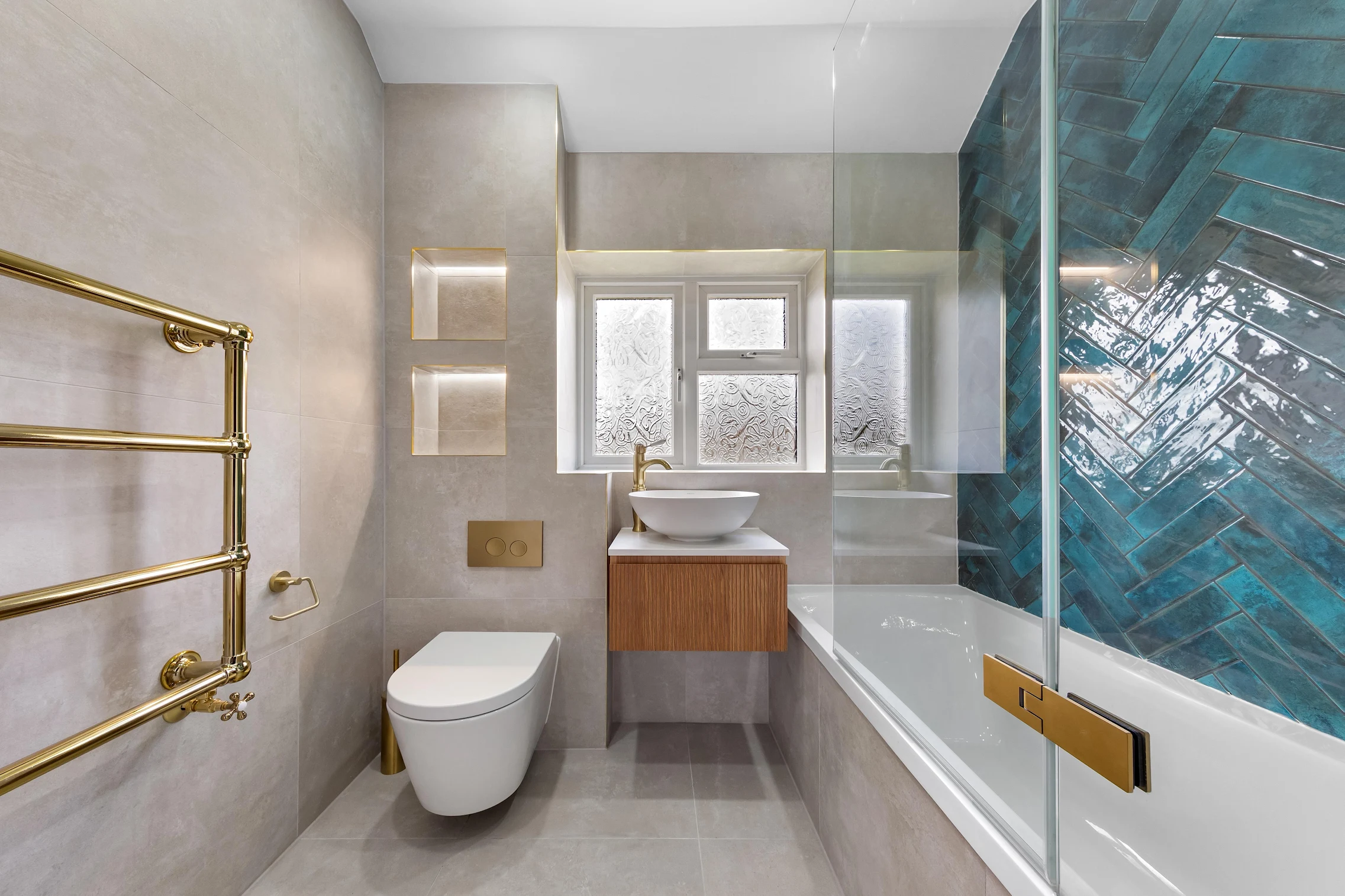
Kitchens carry the biggest cost variance of any single room. A flat-pack fit with standard appliances comes in around £10,000–£15,000. A bespoke handmade kitchen with high-end integrated appliances in a Wandsworth townhouse will reach £35,000–£40,000 and beyond. Both are "kitchen renovations." The spec is everything.
For more on loft conversions, see our London loft conversion cost guide. For extensions, see our home extension cost guide.
How Long Does a Full Property Refurbishment Take in London?
A full property refurbishment in London typically takes 3–9 months. That's a wide range, and both ends are real.
A cosmetic-only project on a 2-bed flat new bathroom, kitchen refit, redecorating can wrap in 6–10 weeks if trades are well-sequenced and materials are on site before work starts. A structural gut renovation of a 4-bed Victorian terrace, with a rear extension and loft conversion, can run 6–9 months or longer when planning is factored in.
The phases in order are: strip-out → structural work → first fix (electrical, plumbing, heating rough-in) → plastering → second fix (sockets, switches, radiators, sanitaryware) → fit-out (kitchen, bathroom, joinery) → decoration → snagging.
Where time actually gets lost:
- Planning decisions: Applications take 8 weeks for householder planning permission. Getting the documents wrong adds another 8. Planning delays more often come from incomplete application packs than slow councils (Planning Portal, 2026).
- Structural discoveries: The moment the walls open and something unexpected appears. A good project manager accounts for this in the schedule. An optimistic one doesn't.
- Material lead times: Bespoke kitchens and certain floor tiles can run 6–10 weeks on order. If these aren't specified and ordered before work starts, they'll sit in the critical path.
- Trade sequencing: Plumber can't finish until the plasterer is done. Plasterer can't come until first fix is signed off. One delayed trade ripples through the rest.
Learn more about our project management approach.
Do You Need Planning Permission for a Full Refurbishment in London?
Most internal refurbishments don't need planning permission. Rewiring, replumbing, a new boiler, a new kitchen, new bathrooms, plastering, and redecorating are all within your rights as a homeowner. No application needed.
Where it gets more complicated is structural changes, anything that alters the external appearance of the building, extensions, and properties in conservation areas or on the listed buildings register.
Permitted development covers a reasonable range:
- Single-storey rear extensions up to 4m deep for detached houses, 3m for terraced and semi-detached
- Loft conversions within cubic metre limits (40 m³ for terraced, 50 m³ for detached and semi)
- Internal layout reconfigurations including load-bearing walls (though building regulations still apply)
Full planning permission is required when:
- An extension exceeds permitted development dimensions
- The property is in a conservation area and external changes are involved
- The property is listed (almost all external and many internal changes)
- The property is a flat or maisonette (external changes almost always need consent)
Then there are Article 4 Directions and this is where London gets specific in ways that generic renovation guides simply don't cover. Several boroughs have used Article 4 Directions to remove permitted development rights that apply everywhere else. In parts of Islington, homeowners may need planning permission to change external doors, windows, or even paint brickwork changes that are freely permitted development in most of the country (Islington Council, 2026). Waltham Forest has similar restrictions in certain areas. Check your specific borough before assuming any external work is PD.
Building regulations are separate from planning, and they apply to almost all structural work regardless of planning status. Rewiring, new heating, replumbing, load-bearing wall changes all need to be signed off by a Building Control inspector or via an Approved Inspector scheme.
According to the Planning Portal, London's planning system processes over 120,000 applications per year and the most common reason for delays and refusals in householder applications isn't objections from neighbours, it's incomplete or inaccurate supporting documents. Get the application right the first time.
How Much Value Does a Full Refurbishment Add to a London Property?
A full refurbishment typically adds 9–25% to a London property's value, depending on what's included and what the local comparables look like. The average UK renovation adds around 9% roughly £24,000 on a typical house with an overall return of around 50p for every pound spent (Squared Money, 2025).
Space-adding projects push that figure substantially higher:
- Loft conversion: up to 25% value increase (Nationwide via Squared Money, 2025)
- Adding a bedroom via extension: roughly 15% (Nationwide, 2025)
- New kitchen: faster sale, but rarely adds more than it costs unless the original was genuinely unusable
- New bathroom: similar pattern accelerates sale, rarely adds disproportionate value
The "improve not move" calculation has shifted noticeably in 2026. With the average London house price at £554,000 (GOV.UK HPI, 2026) and stamp duty now hitting 80% of London first-time buyers, upsizing isn't always the obvious move it once was. A loft conversion that adds a bedroom and a bathroom costs a fraction of what buying a larger property in the same postcode costs with no stamp duty, no estate agent fees, and no chain.
That maths doesn't work for every household in every situation. But it's worth running the numbers before assuming that moving is the only option.
What to Look for in a London Property Refurbishment Company
Most refurbishment problems trace back to the contractor, not the design. Vague quotes, contractors you can't reach mid-project, trades arriving out of sequence, a project manager who doesn't know the last decision that was made these are where projects stall and where "I thought it was included" becomes an expensive conversation.
A few things to look for before signing anything:
Red flags:
- A quote that lists room names but not specific scope "bathroom refurbishment" without a clear materials and labour breakdown
- No single named contact for the project
- Subcontractors you haven't had a chance to vet
- Vague timelines ("roughly 8–12 weeks depending on how it goes")
Green flags:
- Real Google and Checkatrade reviews that include responses the response matters as much as the rating
- A fixed-price quote with scope defined in writing
- A named project manager who can answer specific questions about your job, not just the company's general approach
- A workmanship warranty that's stated clearly not implied
There's also a practical question about design and build vs. running your own architect separately. For most homeowners doing a full refurbishment without significant structural reconfigurations, a design and build contractor who handles coordination and specification is more straightforward fewer handoffs, one point of accountability. For complex projects or conservation area properties, bringing an architect in early is genuinely worth the fee.
Location-Specific Considerations for London Refurbishments
London is not one housing market. It's 33 planning authorities, five or six distinct periods of housing stock, and dozens of micro-markets where property types, structural conditions, and planning constraints are different enough to matter.
Advice that applies cleanly in Sidcup doesn't necessarily apply in Blackheath. Here's what actually varies:
Conservation areas Blackheath, Dulwich Village, parts of Greenwich, much of Chelsea carry stricter external controls. Material matching requirements, longer planning timelines, and in some cases restrictions on permitted development that would be standard elsewhere. If your property sits within one, find that out before finalising your design or your budget.
Victorian and Edwardian terraces Clapham, Hackney, Lewisham, Peckham are the most common London refurbishment subject and the most likely to produce structural surprises. Cracked or moving party walls. Shallow foundations. Lead pipework that's been partially but not fully replaced. Wiring that's been added to rather than upgraded. None of these are unusual; they're the expected reality of refurbishing houses built 100–130 years ago.
1930s semis Sidcup, Eltham, Bromley, Orpington tend to be more forgiving on planning, often have better structural bones than Victorian stock, and typically offer more straightforward site access. Not simple, but less complex than the city's older terraces.
Flats and modern apartment buildings Isle of Dogs, Battersea, Southwark operate under different rules again. Leasehold means you'll need permission from the freeholder or Residents Management Company for most structural and external work. The planning rules for flats are tighter; check what your lease actually permits before commissioning a design.
Frequently Asked Questions
What's the difference between a refurbishment and a renovation in London?
In practice, most London contractors use these terms interchangeably. "Refurbishment" tends to imply restoring a property to good condition; "renovation" can suggest structural change. What actually matters is the scope and getting that scope defined in writing, with costs attached, before anyone starts. The terminology matters less than the detail in the quote.
Do I need to move out during a full property refurbishment?
For a full gut renovation involving structural work, yes it's safer and faster. Living in a property being actively rewired, replumbed, and stripped isn't practical and slows down trades that need clear access. For smaller scopes a bathroom refit with no structural work, a kitchen swap some families stay. Your contractor should give you a clear recommendation based on your specific project, not a vague "it depends."
How do I budget for hidden costs in a London refurbishment?
Set aside 10–15% contingency on top of the quoted price. The things that come up in London properties include: party wall agreements (legally required when work affects a shared wall, and not cheap to get wrong), asbestos in artex ceilings and floor tiles (common pre-1985), and electrical or plumbing work that only becomes visible once the walls open.
Is refurbishing better than moving house in London in 2026?
With the average London house price at £554,000 (GOV.UK HPI, January 2026) and stamp duty now hitting 80% of London first-time buyers (Housing Market News, 2025), staying and refurbishing often makes more financial sense than upsizing particularly if a loft conversion or rear extension can add the extra bedroom needed.
What building regulations apply to a full London refurbishment?
Building regulations apply to all structural work, rewiring, replumbing, new heating systems, and any changes to load-bearing walls regardless of whether planning permission is needed. All work in these categories must be signed off by a Building Control inspector or via an Approved Inspector scheme. These aren't optional.
Does a full refurbishment need an architect?
Not always. Many full refurbishments particularly those without major structural reconfigurations can be handled on a design-and-build basis by a contractor with enough experience to spec the work clearly. For complex projects or conservation area properties, bringing an architect in early is worth the cost. They'll also help you navigate planning if the project needs consent.
Can Buildaway manage the whole project from start to finish?
Yes. Buildaway's model is one quote, one contact, one process across bathroom, kitchen, loft conversion, home extension, or the full combined package. One team handles coordination. One person knows the full scope. From first survey to clean handover, ready for living or letting.
How do I check if my London property is in a conservation area?
Your local borough council's planning portal will show conservation area boundaries search your borough name plus "conservation area map." You can also use the national Planning Portal or contact your borough planning department directly. Do this before finalising any design that involves external changes.
Conclusion
The numbers: £80,000–£250,000+ for a 110 m² 3-bed London house, depending on spec. Three to nine months on site. Nine to 25% value added when done well, with loft conversions and extensions at the higher end of that range.
The case for refurbishing rather than moving is stronger in 2026 than it's been for years. Average London house prices at £554,000, stamp duty biting 80% of buyers the cost of upsizing often doesn't make sense when a loft conversion adds a bedroom and a bathroom without any of those transaction costs. This isn't an argument for every household in every situation. But it's worth running the numbers.
The part most guides skip: getting the contractor right isn't just one decision in a long list. It's the project. A clear scope, a fixed price, a named contact who actually knows your job, a workmanship warranty that means something this is what the difference between a smooth refurbishment and a miserable one usually comes down to.
Buildaway covers bathroom renovation, kitchen refurbishment, loft conversion London, and home extension London, plus the full combined package under one team, one quote, one process. The workmanship warranty applies across the board. The free, no-obligation quote is a real conversation scope, cost, and timeline laid out before any commitment is made.