
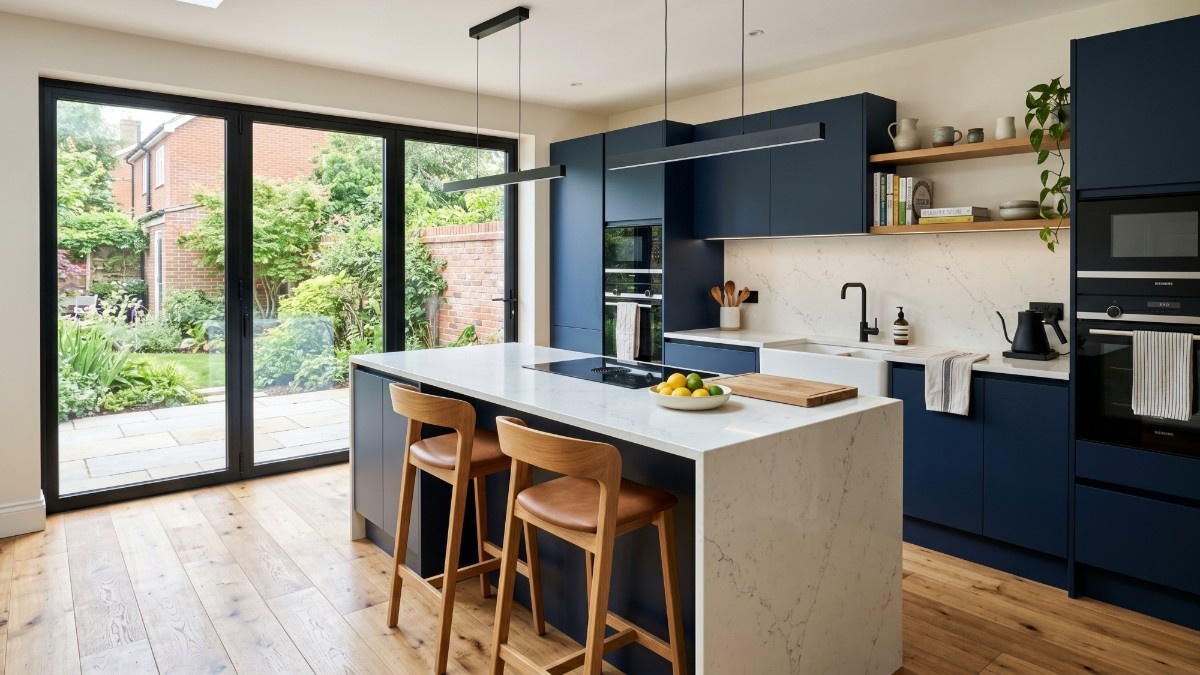
Most Hackney kitchens were never built to carry the demands that modern households routinely place on them. Victorian terraces radiating off Mare Street and the converted houses lining the streets around London Fields were constructed at a point in history when the kitchen occupied the least considered corner of the home a room defined purely by utility, positioned at the rear, and kept well apart from any room where people actually spent time. Jump to 2026 and those exact same spaces are now expected to handle morning routines for an entire household, daily meal preparation, video calls from the kitchen counter, after-school snacks, and weekend dinner parties, all without the floor area those demands collectively require.
The limitation is almost never what the square metreage figure actually says. It's that the layout, storage system, and lighting have never been properly revisited since the property was first built or converted. UK homeowners spent a median of £17,500 on kitchen renovations in 2024 a 34% increase year-on-year (Houzz UK Kitchen Trends Study, 2025). A bigger budget doesn't automatically solve the problem. Identifying the changes that genuinely match what the specific property needs, and making them in the right sequence, delivers results that uncritical spending alone cannot.
These 8 makeover ideas have been selected with Hackney's particular housing mix in mind from the tightly packed Victorian terraces running off Mare Street and Well Street, to the larger conversions and Edwardian houses that line the streets bordering London Fields, Victoria Park, and the quieter residential roads of Homerton and Hackney Wick in E8 and E9.
TL;DR:
A cramped, poorly configured kitchen is among the most common frustrations for Hackney homeowners across E8 and E9 from Victorian terrace rear rooms to flat conversions in larger period houses. Addressing the layout, building genuine vertical storage, and adding a properly layered lighting scheme can make even the narrowest kitchen perform well frequently without any structural work at all. A well-planned kitchen renovation adds 5–15% to a Hackney home's value on a local average of £584k, that return is well worth pursuing (RICS, 2025; Plumplot, April 2026).
1. Start With the Layout Before You Touch Anything Else
The change that delivers the most measurable functional improvement in a small kitchen doesn't involve any money at all. It is the discipline of genuinely questioning whether the current layout is the right one before a single unit is selected, ordered, or positioned anywhere in the room.
Hackney carries an unusually concentrated stock of narrow Victorian rear kitchens a direct consequence of the tight plot widths that shaped the speculative terrace construction spreading across E8 and E9 between the 1860s and 1900. In those rooms, the transition from a single-run arrangement to an L-shape layout can double the usable worktop without touching a pipe, a socket, or an appliance position. That one reconfiguration restructures the room's daily function more completely than any cosmetic upgrade, new surface finish, or premium appliance specification ever could.
The three layouts that perform best in kitchens under 10m²:
- Galley (single or double run): The correct choice for Hackney's tightest Victorian rear kitchens. A double-run galley cabinet runs on both facing walls maximises the available storage and sets up a logical, contained cooking workflow. A minimum clearance of 100cm between the two runs is essential to keep the layout comfortable in daily use.
- L-shape: The stronger option for the larger conversions and Edwardian houses near London Fields and De Beauvoir Town where the rear kitchen has a wider footprint. Opens a corner zone that can hold a small breakfast bar, a compact peninsula, or secondary appliance housing without obstructing the main working run.
- U-shape: Best suited to the more generously proportioned kitchens in Hackney's full Victorian houses and larger lateral flat conversions. Delivers the most overall storage of the three layouts but needs a minimum of 120cm of unobstructed central floor to function properly on a daily basis.
From the Buildaway team: "What we see repeatedly in Hackney terraces particularly in the grid of streets between Mare Street, Well Street, and London Fields is a kitchen where every unit is pushed against one wall and the wall directly opposite is completely bare. That's half the kitchen's potential storage sitting entirely unused. Installing a single run of wall units on the facing wall changes how that kitchen works every single day of the week."
Where the kitchen leads onto the rear garden as it does in a large proportion of the Victorian terraces running south of Well Street and around the edges of London Fields a bi-fold or stable door installation brings a meaningful uplift in natural light and establishes a visual connection to the outside that makes a tight kitchen feel considerably less contained, without requiring any structural intervention.
Considering a complete kitchen overhaul? Read our guide on 10 things that go wrong in Hackney kitchen renovations before any decisions are finalised.
2. Go Vertical: Use Every Inch From Floor to Ceiling
In a compact Hackney kitchen, the gap above the existing wall cabinets is the most consistently overlooked storage resource in the entire room. Across the majority of E8 and E9 properties, standard wall units stop 30–40cm short of the ceiling leaving a strip that gathers airborne grease and dust while contributing nothing at all to the kitchen's practical function.
Replacing those units with floor-to-ceiling cabinets changes the situation on two levels at once. The storage gain is immediate and significant, and the visual effect the eye drawn upward to the full ceiling height makes the room read as taller and more open than it actually measures. Hackney's Victorian terrace stock benefits particularly strongly from this: properties on streets across E8 from the conservation grid around De Beauvoir Town to the terraces running north off Well Street regularly carry ceiling heights above 2.7m, a vertical resource that no new-build apartment in the same area can offer.
The vertical storage additions that deliver most effectively in Hackney kitchens:
- Full-height larder columns positioned alongside the oven or fridge a single tall larder consistently provides more accessible food storage than two standard 600mm wall units placed side by side
- Open shelving installed within chimney breast alcoves, making productive use of the recess without incurring the structural and financial cost of removing the breast itself
- Wall-mounted magnetic knife strips and horizontal utensil rail systems that permanently lift the most clutter-generating items off the worktop surface
- High-level cabinetry positioned directly above the fridge a storage zone that the vast majority of kitchen installations in Hackney leave completely empty
UK kitchen design guidance updated throughout 2025 consistently points to floor-to-ceiling cabinetry, open shelving, and wall-mounted storage systems as the most effective tools for addressing compact kitchen constraints reclaiming worktop surfaces for actual cooking rather than allowing them to function as permanent storage overflow. In homes where the ceiling height reaches 2.4m or more, floor-to-ceiling units can deliver up to 65% more usable cabinet volume than conventional 720mm-high wall units.
3. Match Your Approach to Your Home's Era
Hackney's small kitchens do not share a single problem. A Victorian terrace on Navarino Road in E8 presents a completely different set of constraints from an Edwardian house near Victoria Park in E9 and approaching them with identical solutions produces avoidable mistakes and wasted budget in both cases.
Our observation across Hackney projects: E8's core housing stock is heavily concentrated in Victorian terraced properties narrow rear-facing kitchens, a single sash window looking toward the garden, and a chimney breast cutting into the most productive section of the available back wall. The wider E8 and E9 area also contains a substantial volume of Victorian houses converted into flats, where kitchen space has frequently been further reduced by the conversion geometry. The larger Edwardian semis and detached houses near London Fields, Victoria Park, and the De Beauvoir conservation area offer noticeably wider kitchen footprints, genuine side-return potential, and layout flexibility that the Victorian terrace grid in central Hackney simply cannot match (Postcodearea.co.uk, 2024 census data). Different constraints require genuinely different solutions.
For E8 Victorian terraces (Mare Street, Well Street, Navarino Road, Queensbridge Road area):
- Single-run galley kitchens respond most strongly to double-run conversion and the full use of available vertical storage height
- Chimney breast alcoves can be fitted with larder units or open shelving to add meaningful storage without structural demolition
- Opening through the wall between the rear kitchen and the back reception room to create a kitchen-diner is the most transformative structural option available for this property type a project Buildaway regularly undertakes in streets between London Fields and Well Street
- Victorian ceiling heights of 2.7m or more make floor-to-ceiling cabinetry both highly effective in storage terms and visually striking
For Edwardian and larger period properties in E8 and E9 (London Fields, De Beauvoir Town, Victoria Park, Homerton):
- Wider rear footprints make L-shape layouts and peninsula configurations genuinely achievable rather than aspirational for these properties
- Side-return extensions can add 2–3m² of kitchen floor area without reducing the rear garden at all
- South and south-west rear aspects more common in the Edwardian and larger period stock near Victoria Park and Homerton produce measurably better natural kitchen light than the typical rear-facing Victorian terrace orientation
- Standard 2.4–2.5m ceiling heights in Edwardian properties still accommodate tall cabinetry well, even without the dramatic vertical dimension of the earlier Victorian houses
The streets immediately around London Fields and the larger period houses bordering Victoria Park in E9 offer the widest kitchen footprints and the strongest grounds for premium renovation investment in the area. The tightest rear kitchens are concentrated in the dense Victorian terrace grid between Mare Street, Well Street, and Queensbridge Road rooms that call for the sharpest and most inventive spatial thinking to perform well.
4. Conceal the Clutter With Smart Storage
Worktop clutter is the single most reliable way to make any kitchen feel smaller and more oppressive than its actual floor area would warrant. A carefully considered layout cannot rescue a room where every accessible surface is permanently occupied by appliances, stacked post, and the steady overflow from cupboards that were never intended to hold what a modern household owns.
Purposeful concealed storage resolves the problem directly putting everything out of sight and behind doors without producing a kitchen that feels sterile, overly styled, or impractical to live and cook in on a daily basis.
Storage approaches that consistently deliver results in Hackney kitchens:
- Handleless cabinets Without protruding handles interrupting the horizontal line, the eye reads an unbroken surface plane rather than a sequence of individual unit fronts. The kitchen reads as wider, and the flat surface is significantly faster to wipe clean than a traditional handle arrangement.
- Pull-out larder columns A 300mm pull-out larder delivers more accessible food storage than a 600mm standard base cabinet, because every shelf is visible and within easy reach without kneeling or reaching to the back. Nothing slides away and gets permanently forgotten.
- Corner carousel units Dead corner cabinet space is among the most reliably squandered volume in any small kitchen. A well-specified carousel or pull-out corner unit retrieves that storage completely and puts the full volume to productive use.
- Integrated appliances Housing the fridge, dishwasher, and oven behind matching panel doors eliminates the visual interruption of exposed appliance fronts and produces a noticeably calmer, more considered kitchen aesthetic.
- Appliance garages A cabinet bay with a lift-up or tambour door keeps the toaster, kettle, and coffee machine fully accessible but completely concealed whenever the worktop needs to be clear for cooking or presentation.
Kitchen designs built around handleless cabinetry and fully integrated concealed storage are consistently rated as the highest-performing approach for compact kitchen environments in 2025 professional research. The measurable benefit operates on two levels reducing the visual complexity of a room changes how spacious it is perceived to be, and in any busy household kitchen, minimal exposed surfaces translates directly into substantially less daily cleaning effort.
Ready to reclaim your Hackney kitchen? Buildaway's team works across E8 and E9 - free, no-obligation assessments available. Get your free kitchen quote →
5. Use Light and Colour to Fool the Eye
Not a single wall needs to move for a compact Hackney kitchen to feel considerably more spacious. Pairing the right colour palette with considered surface finishes and a properly layered lighting scheme can shift the perceived dimensions of a room meaningfully and across most renovation budgets, it delivers an outstanding return per pound compared with structural alternatives.
Colour selection carries far more spatial influence than most homeowners appreciate. Warm whites, muted creams, and restrained sage or grey-green tones scatter light across the room and push the walls back visually. Deeper cabinet finishes pull light inward and contract perceived space. That doesn't automatically rule darker tones out but in any kitchen under 9m², choosing them creates a genuine obligation on the lighting scheme to make up for what they remove from the room's brightness and apparent scale.
Three lighting layers that work hardest in a Hackney kitchen:
- Under-cabinet LED strips Targeted directly at the worktop surface where food preparation actually takes place. In north-facing rear kitchens a common orientation for the Victorian terrace grid between Mare Street and Queensbridge Road warm-toned LEDs provide essential light compensation throughout the darker months of the year.
- Toe-kick lighting LED strips recessed into the base unit plinth create a visual floating effect that makes the floor line read as wider than the room's actual dimensions confirm.
- Recessed ceiling downlights Swapping a single central pendant for a spread of recessed downlights distributes light evenly across the entire ceiling plane, removing the deep shadows that cause compact rooms to feel enclosed and low-ceilinged at any time of day.
Surface finish either amplifies or undermines the lighting strategy. Gloss and semi-gloss cabinet fronts multiply the effect of every light source present in the room. A mirror splashback can effectively double the perceived depth of a narrow galley kitchen at relatively modest cost. Lighter engineered quartz worktops carry the same reflective benefit and the specification is now widely expected: 42% of UK kitchen renovators chose engineered quartz in 2024, making it the dominant worktop material by a substantial margin (Houzz UK Kitchen Trends Study, 2025).
6. Think Multi-Function: Islands, Peninsulas and Drop-Leaf Surfaces
When the available worktop genuinely can't support the way the household cooks, the answer is to create more surface deliberately, and in a way that preserves the floor clearance needed to move safely and work comfortably.
A full kitchen island demands a minimum of 90–100cm of unobstructed floor on every working side. In a 9m² kitchen, that rarely works out. A peninsula projecting from an existing unit run, or a wall-fixed drop-leaf that folds completely flat when not deployed, can deliver real, usable prep surface to almost any Hackney kitchen without creating an obstruction that compromises the room's ability to function.
Practical multi-function surface options for Hackney homes:
- Peninsula: Extends outward from the end of an L-shape run and functions as a casual eating bar when bar stools are placed on the far side. Works best in the larger conversions and Edwardian properties around London Fields and De Beauvoir Town where the rear kitchen footprint provides enough width to accommodate it without narrowing the main route through.
- Portable butcher block island: Moves clear when floor space is needed for cooking or entertaining. Adds a supplementary working surface and a drawer or two of accessible storage. A practical and proportionate response for E8 Victorian terraces where the fixed floor area during cooking is genuinely limited.
- Wall-mounted drop-leaf: Folds completely flat against the wall when not in use and occupies no meaningful floor space in that stored position. Delivers a proper working surface extension when deployed. One of the most cost-effective single additions to any single-run galley kitchen in Hackney.
- Built-in island with under-counter storage: For Hackney kitchens typically the larger Edwardian houses near Victoria Park and the full Victorian houses with wide rear rooms that genuinely have enough floor clearance, a fixed island with drawer storage underneath adds both working surface and cabinet volume in a single integrated piece.
7. Budget Refresh vs Full Makeover Which Is Right for Your Hackney Home?
Stripping a kitchen entirely is rarely the most financially rational starting point. A precisely targeted refresh replacement door fronts, an updated worktop, a purpose-built lighting scheme can frequently deliver the bulk of the visual and functional improvement at a fraction of the full renovation cost, with far less disruption to the household during the work.
Here's a practical framework for deciding which approach your kitchen actually requires:
Budget refresh (£1,500–£4,000):
The right approach when the layout and underlying structure are adequate but the finish has visibly dated or become inconsistent. New cabinet door fronts and drawer faces, a replacement worktop in laminate or entry-level engineered quartz, a contemporary tap, a fresh splashback, and under-cabinet LED lighting can collectively transform a kitchen's appearance over a single working weekend. Vinyl door wraps available across a broad range of matte, gloss, and convincing woodgrain finishes provide a still lower-cost route where the existing carcasses are structurally sound and full unit replacement isn't warranted.
Mid-range makeover (£8,000–£18,000):
New cabinet carcasses throughout, integrated appliances, quality engineered quartz worktops (selected by 42% of UK renovators in 2024), and genuine layout reconfiguration. This is the tier at which properly restructuring the kitchen becomes financially viable and it represents the core of Buildaway's Hackney kitchen renovation pipeline.
Full renovation (£18,000–£35,000+):
Structural work removing walls, adding a rear extension to unlock a proper kitchen-diner, full electrical rewiring, or replumbing that resolves the fundamental space constraint at its root. The right investment in a property where the values justify the outlay. In Hackney, homes on the streets around London Fields, in the De Beauvoir conservation area, and the larger period houses near Victoria Park support premium renovation specifications comfortably. The denser Victorian terrace grid between Mare Street and Queensbridge Road is more price-sensitive and requires careful budget calibration to avoid over-capitalising for the street.
UK kitchen renovation spend reached a median of £17,500 in 2024, a 34% year-on-year increase according to the Houzz UK Kitchen Trends Study (2025). Large-scale kitchen projects averaged £20,000 across the year. Despite sustained upward cost pressure, the right kitchen renovation makeover continues to deliver strong returns in East London markets, where updated kitchens rank consistently as a top purchase driver for buyers.
Want a full breakdown of costs by property type? See our detailed guide to kitchen renovation cost and planning in Hackney for pricing and expectations across all renovation tiers.
8. Does a Small Kitchen Makeover Add Value in Hackney?
Yes and the size of the return depends directly on how well the renovation spec fits both the property and the street it sits on.
A well-executed kitchen renovation can add 5–15% to a Hackney home's value (RICS, 2025). Hackney's average house price sits at approximately £584,000, making it one of the most dynamic residential markets in East London (Plumplot, April 2026). Apply that RICS range to the local average and the potential uplift is £29,200 to £87,600 a meaningful number in any market.
More precisely, homes with a newly renovated kitchen regularly achieve 5–10% above the local average on the open market, according to RICS-accredited valuers. Even a kitchen refresh not a full gut renovation delivers a 60–100% return on investment in the right property (Lynch Brother Homes, 2026).
One important caveat: over-specifying for your road is a genuine risk in Hackney. A £40,000 bespoke kitchen with high-end appliances will add less in relative value on a street where comparable properties sell for £350,000 than it will on a road where period houses or lateral conversions regularly transact above £1.2 million. A brief conversation with a local estate agent who knows E8 and E9 well is worth every minute before committing to a top-end budget.
What buyers in 2026 are prioritising:
- Move-in-ready condition buyers in Hackney's market are increasingly unwilling to pay full asking price for properties requiring immediate work
- Clear functional zones dedicated areas for prep, cooking, and cleaning, rather than one undifferentiated run
- Integrated appliances and streamlined concealed storage throughout
- Natural light or well-designed artificial lighting that compensates for darker aspects
- Quartz or stone worktops laminate is increasingly viewed as a downgrade signal in Hackney's buyer market
A new kitchen can add approximately 4–15% to a property's value in the UK, with renovated kitchens in London and South East markets achieving 5–10% above area averages at sale on a consistent basis. In Hackney, where the average home is worth approximately £584,000 (Plumplot, April 2026), a well-matched kitchen makeover represents one of the highest-return improvements available to homeowners preparing to sell or looking to maximise long-term value.
Final Thoughts: Small Kitchen, Smarter Choices
Hackney's housing stock wasn't designed for modern kitchen life. But that doesn't mean you're locked into what was built in 1880 or 1910. Whether it's rethinking the layout in a narrow Victorian rear kitchen off Mare Street, going fully vertical in a high-ceilinged period terrace near London Fields, or simply fitting proper layered lighting into a dark galley space the right changes make a real difference without necessarily requiring a full gut renovation.
Key takeaways:
- Layout is everything even adding one opposite run of units in a galley kitchen transforms the room's function
- Go vertical in period properties Hackney's Victorian ceiling heights make floor-to-ceiling units exceptionally effective, delivering up to 65% more storage
- Colour and lighting are your cheapest tools for perceived space use them early
- Match your renovation budget to your street and property type the London Fields and Victoria Park sides support a higher spec than the denser terraced streets off Mare Street
- A well-planned makeover adds 5–15% to a Hackney home's value (RICS, 2025)
Buildaway's kitchen team works across Hackney from London Fields to Hackney Wick, and every E8 and E9 street in between. One quote. One point of contact. One clear process. All work carries our workmanship warranty.
Get your free, no-obligation kitchen assessment → We'll assess your space, recommend the right approach for your property type, and give you a clear, honest quote. No sales pressure. Contact Buildaway today