
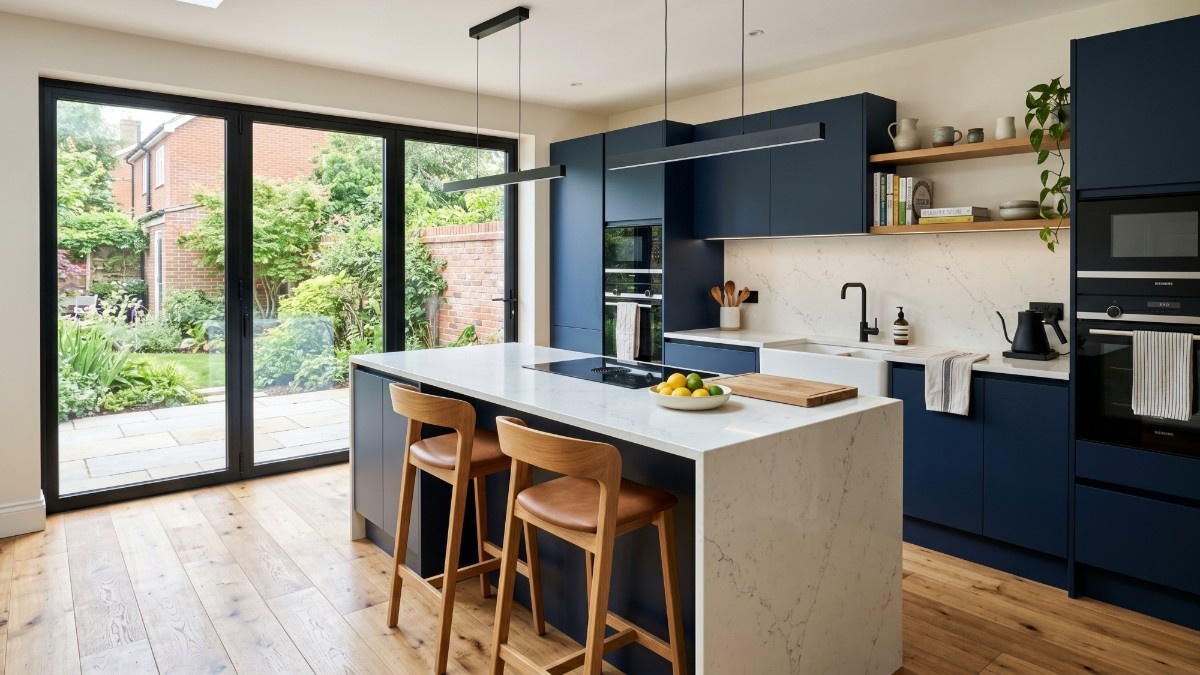
Most Bromley kitchens were never built for the way we cook today. Victorian terraces off the High Street and 1930s semis in Bickley and Shortlands were designed when the kitchen was a utility room at the back of the house - somewhere to boil things quietly, out of sight. Fast-forward to 2026, and those same rooms are expected to handle meal prep, morning coffee, homework, and the odd dinner party.
The problem isn't square footage. It's that the space hasn't been rethought. UK homeowners spent a median of £17,500 on kitchen renovations in 2024 - up 34% year-on-year (Houzz UK Kitchen Trends Study, 2025). But spending more doesn't automatically mean getting more. The right ideas, matched to your specific property type, matter far more than budget alone.
These 8 makeover ideas are chosen specifically for the homes you'll find across BR1 and BR2 - from terraced houses near The Glades shopping centre to semis around Norman Park and the Shortlands area.
TL;DR:
Small kitchens are one of the most common frustrations in Bromley's Victorian terraces and 1930s semis across BR1 and BR2. The right layout, vertical storage, and lighting changes can transform under 10m² into a high-functioning space. A well-planned kitchen renovation adds 5–15% to a Bromley home's value - on a £574k borough average, that's a real return (RICS, 2025; Plumplot, April 2026).
1. Start With the Layout - Before You Touch Anything Else
The single most impactful change in a small kitchen costs nothing. It's reconsidering the layout entirely before committing to any new units or appliances.
For Bromley's galley-style terraced kitchens - common in BR1 streets near Bromley High Street and the town centre conservation area - a shift from a single-run layout to an L-shape can effectively double usable worktop space without moving one water pipe. That alone can make a kitchen feel like a different room.
The three layouts that work best in under-10m² spaces are:
- Galley (single or double run): Ideal for narrow rear kitchens in Victorian terraces. Two parallel runs facing each other maximise storage and workflow. Needs at least 100cm between runs for comfortable movement.
- L-shape: Works well in BR2 semis with a wider footprint. Frees up a corner for a small table or peninsula.
- U-shape: Best for slightly larger square kitchens. Offers the most storage but requires at least 120cm of open floor space in the centre.
From the Buildaway team: "The most common mistake we see in Bromley terraces - especially streets closer to Bromley South station - is a single run of units along one wall, with the opposite wall completely bare. You're leaving half your storage potential on the table. Even adding one run of wall units on the opposite side transforms the kitchen's function entirely."
If your kitchen backs directly onto the rear garden - as most BR2 semi-detached homes in Shortlands and Bickley do - a bi-fold door or stable door addition can visually open the space and bring in light without any structural changes.
Planning a complete overhaul? Read our guide on 10 things that go wrong in Bromley kitchen renovations to avoid common layout mistakes.
2. Go Vertical: Use Every Inch From Floor to Ceiling
In a small Bromley kitchen, the ceiling is your biggest untapped asset. Most homes in BR1 and BR2 have standard-height wall units that stop 30–40cm below the ceiling - leaving a dusty gap that stores nothing but air.
Tall floor-to-ceiling cabinets change that completely. They provide dramatically more storage than standard-height units and, visually, they draw the eye upward and make the room feel taller. In older Victorian properties around Bromley's conservation area near Market Square and Church Road (BR2 0EG), ceiling heights regularly exceed 2.7m - giving you even more vertical potential than a modern new-build.
What works well in the vertical zone:
- Full-height larder units beside the oven or fridge
- Open shelves on chimney breast walls (where removing the breast would be costly or structurally complex)
- Wall-mounted magnetic knife strips and rail systems for utensils
- High cabinets above the fridge - often wasted in standard kitchens
According to UK kitchen design guidance published in 2025, tall cabinets, open shelving, and wall-mounted racks are the most effective approach for compact kitchens - freeing up worktop surfaces for actual food preparation rather than storage overflow. In homes with ceiling heights of 2.4m or more, floor-to-ceiling units can provide up to 65% more usable cabinet volume than standard 720mm-high wall units.
3. Match Your Approach to Your Home's Era
Not all small Bromley kitchens have the same problem. A Victorian terrace in BR1 has a fundamentally different starting point from a 1930s semi in BR2 - and treating them the same way leads to expensive mistakes.
Our observation across Bromley projects: BR1's housing stock is 31.3% terraced houses - typically with narrow, rear-facing kitchens, one sash window, and a chimney breast that eats into the back wall. BR2 is 31.3% semi-detached, with wider kitchen footprints and frequent side-access opportunities that BR1 terraces simply don't offer (Postcodearea.co.uk, 2024 census data). These aren't the same problem. They need different solutions.
For BR1 Victorian terraces (Bromley town centre, Downham, Mottingham):
- Narrow kitchen runs benefit most from galley optimisation and vertical storage
- Chimney breasts can become alcove storage with fitted shelving or a larder unit
- Knocking through to the rear reception room is common here - it creates a kitchen-diner and solves the space problem structurally
- Original ceiling heights of 2.7m+ make floor-to-ceiling units highly effective
For BR2 1930s semis (Bickley, Shortlands, Hayes):
- Wider footprints mean L-shape and peninsula options are more viable
- Side return infills can add 2–3m² without extending into the garden
- Rear-facing kitchens here often get better south-west light than their Victorian terrace equivalents
- Lower ceiling heights (typically 2.4m) still support tall units but without the extra vertical drama
Homes around Hayes in BR2 and Petts Wood tend to have the widest rear-facing kitchens in the borough. Streets nearer to Bromley South and the Market Square conservation area have the narrowest - and need the most creative approach.
4. Conceal the Clutter With Smart Storage
Visible clutter is the enemy of a small kitchen. It doesn't matter how well-designed the layout is - if your worktops are covered with appliances, spice racks, and stray mail, the room will feel cramped regardless of its size.
The solution is concealed storage that puts everything away without making the kitchen feel like a showroom.
What works:
- Handleless cabinets - No protruding handles means the eye reads a flat, continuous surface instead of individual units. Visually, this adds perceived width.
- Pull-out larder units - A 300mm-wide pull-out can store more than a 600mm standard cabinet because everything is reachable. No forgotten tins at the back.
- Corner carousel units - Dead corners are one of the biggest wastes of space in a small kitchen. A carousel or pull-out corner unit recovers that volume.
- Integrated appliances - A built-in fridge, dishwasher, and oven behind matching cabinet doors removes visual noise and creates a unified appearance.
- Appliance garages - A cabinet section with a lift-up or tambour door keeps the toaster, kettle, and coffee machine out of sight but instantly accessible.
Clutter-free, streamlined kitchen designs with handleless cabinets and concealed storage are consistently identified as the highest-performing approach for compact kitchens in 2025. Beyond aesthetics, minimising visual complexity has a measurable effect on how spacious a room feels - and reduces cleaning time significantly in high-traffic family kitchens.
Ready to reclaim your Bromley kitchen? Buildaway's team works across BR1 and BR2 - free, no-obligation assessments available. Get your free kitchen quote →
5. Use Light and Colour to Fool the Eye
You don't need to move a single wall to make a small kitchen feel bigger. The right combination of colour, surface finish, and lighting can transform the perceived size of a room - and it's often the cheapest part of a full makeover.
Colour choices matter more than people think. Light neutrals - warm whites, soft creams, pale sage - reflect light around the room and make the walls feel further apart. Dark cabinet colours absorb light and pull the room inward. That doesn't mean you can't use dark tones, but in a kitchen under 9m², they need to be balanced carefully with excellent lighting.
Lighting layers to add:
- Under-cabinet LED strips - Illuminate the worktop surface directly, where you actually need light to work. In north-facing rear kitchens - common in some BR1 streets near Downham - warm-toned LEDs compensate for limited natural daylight.
- Toe-kick lighting - LED strips at floor level create a floating effect that makes the room look wider.
- Pendant or recessed ceiling lights - Replace a single central pendant with recessed downlights spread across the ceiling. Even light distribution removes shadows that make small rooms feel smaller.
Surfaces matter too. A gloss or semi-gloss cabinet finish bounces light. A mirror splashback can almost double the visual depth of a small kitchen. Engineered quartz worktops in lighter tones do the same - and 42% of UK kitchen renovators chose engineered quartz in 2024, making it the most popular worktop material by far (Houzz UK Kitchen Trends Study, 2025).
6. Think Multi-Function: Islands, Peninsulas and Drop-Leaf Surfaces
What do you do when there's simply not enough worktop? You add more - but cleverly.
A full kitchen island only works if you have at least 90–100cm of clear floor space on each working side. In a 9m² kitchen, that's usually not realistic. But a peninsula - a counter that extends from an existing unit - or a drop-leaf worktop extension attached to the wall can add usable surface without blocking movement.
Options for small Bromley kitchens:
- Peninsula: Extends from an L-shape configuration, doubles as a breakfast bar with stools on the far side. Works well in BR2 semis with enough width.
- Portable butcher block island: Can be moved aside when not needed. Adds worktop and a drawer or two of storage. Suits Victorian terraces where floor space is tight during cooking.
- Wall-mounted drop-leaf: Folds flat against the wall when not in use. Takes up virtually no space when stored. Ideal addition to a galley run.
- Built-in island with drawers: For kitchens that have the clearance, built-in storage under an island recovers significant volume.
7. Budget Refresh vs Full Makeover - Which Is Right for Your Bromley Home?
Not every small kitchen needs ripping out. Sometimes a targeted refresh - new doors, fresh worktop, better lighting - does most of the work for a fraction of the cost.
Here's how to think about it:
Budget refresh (£1,500–£4,000):
Best when the layout works but the aesthetics are dated. New cabinet doors and drawer
fronts, a fresh worktop (laminate or budget quartz), a tap upgrade, a new splashback, and
under-cabinet LEDs can transform a kitchen's appearance over a single weekend. Vinyl wraps
on existing cabinet doors are another cost-effective option - they come in a wide range of
finishes including matte, gloss, and woodgrain.
Mid-range makeover (£8,000–£18,000):
New units, integrated appliances, quality worktops (engineered quartz being the most popular
at 42% of UK projects), and proper layout improvements. This is the range where layout
changes become viable - and where Buildaway does most of its Bromley kitchen work.
Full renovation (£18,000–£35,000+):
Structural changes - removing walls, adding a rear extension to create a kitchen-diner, full
rewiring or replumbing. Worth it in the right property. In Bromley, homes in BR2 (Bickley,
Shortlands, Hayes) tend to support higher renovation budgets given stronger local property
values. The upper end of BR1 - closer to Bromley town centre and The Glades - is more
budget-sensitive.
UK kitchen renovation spend reached a median of £17,500 in 2024, representing a 34% year-on-year increase, according to the Houzz UK Kitchen Trends Study (2025). Major large-kitchen renovations averaged £20,000. Despite rising costs, the right kitchen makeover continues to deliver strong returns in South East London property markets, where buyers consistently rate updated kitchens as a top purchase factor.
Curious about the full details? Check our breakdown of how much a kitchen renovation costs in Bromley for an in-depth look at pricing.
8. Does a Small Kitchen Makeover Add Value in Bromley?
Yes - but the return depends on how well the spec matches the property and the street.
A well-planned kitchen renovation can add 5–15% to a Bromley home's value (RICS, 2025). Bromley's average house price sits at approximately £574,000, making it the 11th most expensive postcode area in England and Wales (Plumplot, April 2026). Apply the RICS range to that figure and you're looking at a potential value uplift of £28,700 to £86,100.
More granularly, homes with a newly renovated kitchen regularly achieve 5–10% above the area average at sale, according to RICS-accredited valuers. A kitchen refresh - not even a full gut renovation - delivers a 60–100% return on investment in the right market (Lynch Brother Homes, 2026).
One important caveat: over-improving for your street is a real risk. A £30,000 German kitchen with Miele appliances adds less value in parts of Downham (BR1, average ~£344k) than it would in Bickley or Shortlands (BR2, where prices regularly exceed £600k). The spec should be matched to what comparable properties on your street are selling for - a 15-minute call with a local estate agent is worth doing before committing to the top end of any budget.
What buyers look for in 2026:
- Move-in-ready condition - buyers increasingly won't pay full price for a property that needs work
- Efficient layouts with defined zones for prep, cooking, and cleaning
- Integrated appliances and concealed storage
- Natural light or well-designed artificial lighting
- Quartz or stone worktops rather than laminate
A new kitchen can add approximately 4–15% to a property's value in the UK, with renovated kitchens in London and South East markets regularly achieving 5–10% above area averages at sale. In Bromley, where the average home is worth approximately £574,000 (Plumplot, April 2026), a well-planned kitchen makeover represents one of the highest-return improvements a homeowner can make before selling.
Final Thoughts: Small Kitchen, Smarter Choices
Bromley's housing stock wasn't built for modern kitchens. But that doesn't mean you're stuck with what you've got. The right approach - whether it's rethinking the layout in a BR1 Victorian terrace, going vertical in a Bickley semi, or simply adding proper lighting to a dark north-facing galley - can make a meaningful difference without a complete gut renovation.
Key takeaways:
- Layout is everything - even small changes like adding an opposite run of units transform function
- Go vertical in period properties with high ceilings - floor-to-ceiling units offer up to 65% more storage
- Light and colour are your cheapest tools for perceived space
- Match your renovation budget to your street - Bickley and Shortlands support higher specs than Downham
- A well-planned makeover adds 5–15% to a Bromley home's value (RICS, 2025)
Buildaway's kitchen team works across Bromley - from Hayes to Shortlands, BR1 to BR2. One quote. One point of contact. One clear process. All work comes with our workmanship warranty.
Get your free, no-obligation kitchen assessment → We'll assess your space, suggest the right approach for your property type, and give you a clear, honest quote. No sales pressure. Contact Buildaway today