
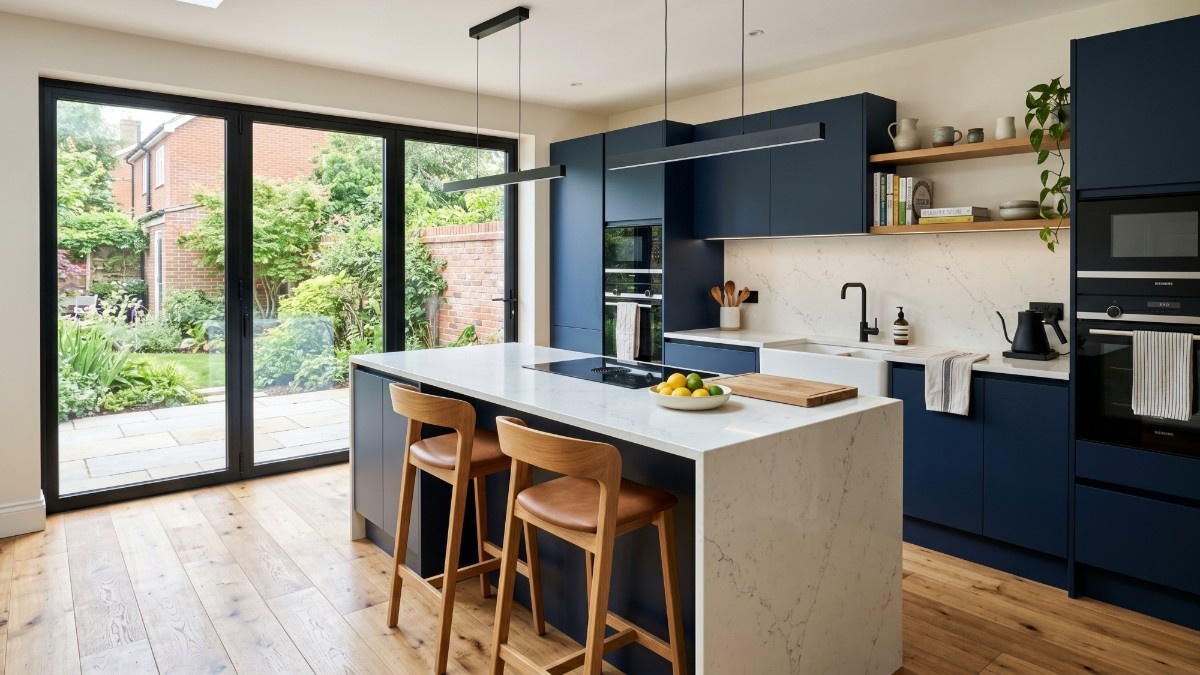
Most Bexley kitchens were never conceived with modern life in mind. Victorian cottages and terraces tucked off Bexley High Street, and the interwar semis that fan out across Joydens Wood and North Cray, were put up when the kitchen existed solely to serve the household quietly and out of sight. Wind forward to 2026 and those same back rooms are now expected to absorb the full weight of daily life breakfast prep at 7am, a working lunch at noon, the kids' homework at the kitchen table by 4pm, and a proper dinner by 7.
The problem, more often than not, isn't the floor area. It's that nobody has looked at the room with fresh eyes since it was fitted. UK homeowners spent a median of £17,500 on kitchen renovations in 2024 up 34% year-on-year (Houzz UK Kitchen Trends Study, 2025). Pouring in more budget, though, doesn't automatically generate more function. The quality of the thinking behind a renovation matters considerably more than the size of the spend.
The 8 ideas below are selected with Bexley's actual housing stock in mind from Victorian cottages lining the roads near Hall Place and the River Cray to the broader-footprint semis of Joydens Wood and Foots Cray in DA5 and DA14.
TL;DR:
Undersized kitchens are among the most commonly cited frustrations in Bexley's Victorian terraces and 1930s semis across DA5 and DA14. Getting the layout right, using vertical storage properly, and layering the lighting can turn a room under 10m² into one that genuinely works often without touching a single structural wall. A well-planned kitchen renovation adds 5–15% to a Bexley property's value; on an average of £487k, that's a meaningful number (RICS, 2025; Plumplot, April 2026).
1. Start With the Layout Before You Touch Anything Else
The single highest-impact change in a small kitchen is free. It costs nothing to stand in the doorway and question every decision the original builders made before you spend a penny on new units or appliances.
Bexley Village and the older streets of DA5 carry a noticeable share of Victorian terraces many of them with narrow, rear-facing single-run kitchens that were clearly an afterthought in the original design. Shifting that arrangement to an L-shape can double the usable worktop length without redirecting a single pipe. The kitchen doesn't get bigger. It just finally starts working the way a kitchen should.
The three layouts that deliver the most in under-10m² kitchens are:
- Galley (single or double run): The strongest option for Bexley Village's narrowest rear kitchens. Opposing runs on each wall maximise storage on both sides and create a clear, logical workflow. A minimum of 100cm between the two runs is needed to move and cook comfortably.
- L-shape: Better suited to the slightly wider kitchen footprints found in DA14 semis around North Cray and Foots Cray. A freed-up corner creates space for a small table, a peninsula, or a compact breakfast bar.
- U-shape: The highest-storage option of the three, but it demands at least 120cm of unobstructed floor in the centre. Works well in more generously proportioned rear extensions and knocked-through spaces.
From the Buildaway team: "The pattern we see repeatedly in Bexley particularly in the older Victorian and Edwardian terraces around Bexley Village station and the roads that run down toward the River Cray is a single run of units along one wall with the facing wall left completely bare. It's the most common waste of potential we encounter. A second run of wall units on the opposite wall changes the daily experience of that kitchen entirely."
If the kitchen in question backs directly onto a rear garden as many DA5 semis in Joydens Wood and the quieter residential streets off the A2 do a bi-fold or split stable door can pull in light and give a visual sense of extra depth without any structural work being needed at all.
Planning something more comprehensive? Read our guide on 10 things that go wrong in Bexley kitchen renovations before you finalise any layout decisions.
2. Go Vertical: Use Every Inch From Floor to Ceiling
In a tight Bexley kitchen, the zone above eye level is the most consistently ignored asset in the room. Across DA5 and DA14, standard wall cabinets routinely finish 30–40cm below the ceiling leaving a gap that collects grime and contributes nothing to storage capacity.
Running cabinets all the way to the ceiling resolves both problems at once. The additional storage volume is substantial, and the visual effect the eye pulled upward to the top of the cabinet makes the room feel meaningfully taller and less enclosed. Victorian and Edwardian properties throughout Bexley Village and the streets surrounding Hall Place regularly have ceiling heights well above 2.7m, which gives you considerably more vertical range to work with than a modern property of equivalent floor area would offer.
The vertical zone works hard when you use it for:
- Full-height larder units flanking the oven or refrigerator a single tall larder often outperforms two standard wall units for accessible storage
- Open shelving within chimney breast alcoves, which avoids the structural complexity and expense of breast removal
- Wall-mounted magnetic knife strips and hanging rail systems that clear worktops of the clutter that usually accumulates on them
- High-level cabinets directly above the fridge a storage zone that most kitchen installations simply leave empty
UK kitchen design guidance published in 2025 consistently identifies tall cabinets, open shelving, and wall-mounted storage systems as the highest-performing interventions in compact kitchen environments. The core benefit is worktop clearance surfaces freed from storage overflow are surfaces you can actually cook on. In homes with ceiling heights of 2.4m or above, floor-to-ceiling units can yield up to 65% more usable cabinet volume than conventional 720mm wall units installed at standard height.
3. Match Your Approach to Your Home's Era
Bexley isn't a homogeneous housing area. A Victorian cottage in DA5 poses a very different set of constraints from a 1930s semi in DA14 and applying the same solution to both wastes money and misses opportunities that are specific to each property type.
Our observation across Bexley projects: DA5 carries a meaningful share of Victorian and Edwardian terraced stock characteristically narrow rear-facing kitchens with one sash window and a chimney breast eating into the usable wall space. The DA14 area around North Cray, Foots Cray, and the Sidcup borders leans noticeably more semi-detached, offering wider kitchen widths and side-return access corridors that terraced properties in DA5 rarely have (Postcodearea.co.uk, 2024 census data). Different constraints. Different solutions.
For DA5 Victorian and Edwardian terraces (Bexley Village, Old Bexley Lane, High Street area):
- Narrow single-run layouts gain the most from galley reconfiguration and a systematic vertical storage upgrade
- Chimney breast alcoves a persistent feature in older DA5 homes can be converted into deep fitted larder storage without requiring the breast to come out
- Opening through to the rear reception room to form a kitchen-diner is a well-established move in these streets and addresses the space constraint structurally rather than cosmetically
- Period ceiling heights consistently above 2.7m make the case for full-height cabinets especially compelling
For DA14 interwar semis (North Cray, Foots Cray, Sidcup border roads):
- Broader kitchen widths make L-shape layouts and peninsula additions genuinely viable rather than a squeeze
- Side-return infill projects can add 2–3m² of usable floor area without encroaching on the rear garden at all
- South-west-facing rear elevations more common in the semi-detached stock receive better afternoon light than many of the Victorian terraces in DA5
- Standard 2.4m ceiling heights accommodate tall units effectively, though without the dramatic floor-to-ceiling range available in older period homes
Properties around Hall Place, the River Cray meadows, and the quieter lanes of Joydens Wood tend to have the most generous rear kitchen footprints in the area. Tighter Victorian terraces concentrated around Bexley Village station and the Old Bexley Lane conservation zone present the most constrained starting points and therefore demand the most inventive spatial thinking.
4. Conceal the Clutter With Smart Storage
Surface clutter is fatal to a small kitchen. A well-considered layout and a fresh coat of paint count for very little if every worktop is occupied by appliances, stacked post, and the overflow from cupboards that were never planned adequately. The room will feel small regardless of what the tape measure says.
The answer is concealed, intelligent storage a system that puts everything away efficiently without turning the kitchen into a space that feels impossible to live in.
The solutions that consistently perform best:
- Handleless cabinets Removing protruding handles eliminates the visual breaks between individual units. The eye reads one continuous surface, and the room immediately feels wider as a result.
- Pull-out larder columns A 300mm pull-out larder stores more accessible food than a 600mm standard cabinet because every shelf is fully visible and reachable. Nothing disappears to the back of the cupboard and gets forgotten.
- Corner carousel units Corner space is consistently the most wasted zone in a compact kitchen. A properly specified carousel or pull-out corner unit brings that dead volume back into full use.
- Integrated appliances A fridge, dishwasher, and oven all concealed behind matching cabinet doors eliminates the visual noise of exposed appliance finishes and gives the kitchen a calmer, more coherent appearance.
- Appliance garages A dedicated cabinet bay with a tambour or lift-up door keeps the everyday items toaster, kettle, coffee machine off the worktop and out of sight when they're not in use.
Handleless cabinet designs and fully integrated storage systems continue to lead performance rankings for compact kitchen environments in 2025 research. The practical case is strong: reducing visual complexity genuinely changes how spacious a kitchen feels to spend time in, and fewer exposed surfaces translates directly into less daily cleaning time in a busy family kitchen.
Ready to reclaim your Bexley kitchen? Buildaway's team works across DA5 and DA14 free, no-obligation assessments available. Get your free kitchen quote →
5. Use Light and Colour to Fool the Eye
Moving walls is expensive. Changing what the eye perceives through colour, reflective surfaces, and layered light costs a fraction of that and can be just as effective in a kitchen that already has a reasonable layout but feels darker and smaller than it should.
Colour is doing more work than most homeowners give it credit for. Warm whites, chalky off-whites, and muted greens push walls back visually by bouncing light around the room. Darker cabinet tones however fashionable absorb light and contract the space. In a kitchen under 9m², they require a lighting scheme that's genuinely up to the compensatory task, or the room will feel claustrophobic whatever the trend boards say.
Lighting layers that make a real difference:
- Under-cabinet LED strips Task lighting directed at the worktop surface where you're actually cutting, chopping, and assembling food. In north-facing rear kitchens which appear regularly in DA5 Victorian terraces where the rear elevation faces away from the sun warm-white LED strips do a great deal to compensate for the shortfall in natural daylight.
- Toe-kick LEDs A strip of low-level lighting running along the base of the cabinets creates a floating visual effect that reads the floor as wider and the kitchen as larger than it actually is.
- Recessed ceiling downlights A single pendant hung in the centre of a small kitchen creates shadows in every corner. Replacing it with a spread of recessed downlights distributes light even across the ceiling, removing the shadow-pools that make compact rooms feel oppressive.
Material choices compound the effect. Gloss and semi-gloss cabinet finishes reflect light back into the room. A mirrored splashback can nearly double the apparent depth of a narrow kitchen. Engineered quartz worktops in pale or mid-tone colourways reinforce that sense of space and they're increasingly the expected standard: 42% of UK kitchen renovators chose engineered quartz in 2024, making it the dominant worktop choice for the fourth consecutive year (Houzz UK Kitchen Trends Study, 2025).
6. Think Multi-Function: Islands, Peninsulas and Drop-Leaf Surfaces
When there isn't enough worktop to cook on, the answer isn't despair it's adding surface cleverly, in a way that doesn't block the movement you need to actually use the kitchen.
A full kitchen island is only realistic when there's 90–100cm of clear floor available on every operational side. In a 9m² kitchen, that clearance simply isn't there. A peninsula extending from an existing run, or a wall-mounted drop-leaf worktop, can deliver genuine prep surface without sacrificing the floor space you need to move around.
Practical multi-function options for Bexley kitchens:
- Peninsula: A counter projecting from the end of an L-shape configuration that doubles as a breakfast bar when stools are added. Works well in DA14 semis in North Cray and Foots Cray where the kitchen width can accommodate it without pinching the room.
- Portable butcher block island: Rolls out of the way when you need clear floor space and provides a solid additional worktop when you need the surface. A practical and cost-effective solution for DA5 Victorian terraces where a fixed island simply won't fit.
- Wall-mounted drop-leaf: Folds completely flat and takes up no effective floor space when not deployed. When folded down, it provides a proper worktop extension at the right working height. An elegant and affordable addition to almost any galley layout.
- Built-in island with under-counter storage: For kitchens with genuine floor clearance, a fixed island with drawers and shelving below recovers storage volume that a portable unit can't match.
7. Budget Refresh vs Full Makeover Which Is Right for Your Bexley Home?
There's a real case to be made that most small kitchens don't need a complete strip-out. A targeted, well-executed refresh replacing the doors, updating the worktop, fitting proper lighting frequently achieves the majority of what a full renovation would at a fraction of the disruption and cost.
Here's how to assess where your kitchen currently stands:
Budget refresh (£1,500–£4,000):
The right path when the bones of the kitchen the layout, the carcasses, the plumbing positions
still make sense, but the finish has dated badly or was never particularly good to begin with.
Replacement cabinet doors and drawer fronts, a new worktop in laminate or entry-level quartz, a
tap replacement, a new splashback, and properly installed under-cabinet LEDs can transform a
kitchen's appearance over a single working weekend. Vinyl door wraps across an existing set of
carcasses are an even lower-cost route available in matte, gloss, and convincing woodgrain
finishes that avoid the expense of new boxes entirely.
Mid-range makeover (£8,000–£18,000):
New carcasses, integrated appliances, a quality engineered quartz worktop (the preference of 42%
of UK renovators in 2024), and genuine layout reconfiguration where it's needed. This is the budget
tier at which addressing the kitchen's fundamental spatial problems becomes viable and where the
bulk of Buildaway's Bexley kitchen work sits.
Full renovation (£18,000–£35,000+):
Structural work removing walls, adding a rear extension, full electrical rewiring or replumbing
that resolves the space problem at source rather than working around it. Worth the investment in
the right property. In Bexley, homes around the Hall Place conservation area, Joydens Wood, and the
more desirable streets of Bexley Village command prices that support this level of spend. Streets
closer to the DA14 boundary with Sidcup call for proportionate budgeting rather than a top-spec
kitchen that the comparable sale prices won't recover.
The UK median kitchen renovation spend reached £17,500 in 2024 a 34% year-on-year increase per the Houzz UK Kitchen Trends Study (2025). Major large-kitchen projects averaged £20,000 across the country. Despite the sustained upward cost pressure, the right kitchen makeover continues to generate strong returns in South East London markets, where buyers place consistently high weight on move-in-ready kitchens when assessing competing properties.
Want the full pricing picture? Our in-depth guide on how much a kitchen renovation costs in Bexley breaks down the numbers by project type and specification level.
8. Does a Small Kitchen Makeover Add Value in Bexley?
Yes though how much depends on how closely the project's specification is calibrated to what the property and the street around it will actually support.
A well-planned kitchen renovation can add 5–15% to the value of a Bexley property (RICS, 2025). Bexley's average house price sits at approximately £487,000 (Plumplot, April 2026) and applying the RICS range to that baseline puts the potential value uplift at £24,350 to £73,050. That spread makes accurate budget planning considerably more important than picking an arbitrary figure.
RICS-qualified valuers report that properties with a newly renovated kitchen sell for an average of 5–10% more than comparable unmodernised properties in the same neighborhood. Even a basic refresh delivers 60–100% return on investment in the right market (Lynch Brother Homes, 2026).
One important caveat: over-specifying for your road is a genuine risk in Bexley. A £35,000 bespoke kitchen with high-end German appliances will add less in value on a road where comparable homes sell for £400,000 than it will on a street where detached properties regularly transact above £750,000. Before committing to the top of any budget, a 15-minute conversation with a local estate agent who knows DA5 and DA14 well is worth every minute.
What Bexley buyers are prioritising in 2026:
- Move-in-ready condition buyers in DA5's competitive market are increasingly reluctant to discount for properties requiring immediate kitchen work
- Defined functional zones clear separation between prep, cooking, and cleaning areas rather than one undifferentiated run of worktop
- Integrated appliances and concealed storage throughout
- Good natural light or well-designed artificial lighting that makes the kitchen feel welcoming regardless of aspect
- Quartz or stone worktops laminate is increasingly read as a downgrade signal even in Bexley's mid-market
A new kitchen can add approximately 4–15% to a UK property's value, with renovated kitchens in London and South East markets regularly achieving 5–10% above area averages at sale. In Bexley, where the average home is worth approximately £487,000 (Plumplot, April 2026), a well-matched kitchen makeover represents one of the most cost-effective value improvements available to homeowners preparing to sell or letting.
Final Thoughts: Small Kitchen, Smarter Choices
Bexley's housing stock wasn't designed for modern kitchen life. But that doesn't mean you're locked into what was built in 1895 or 1934. Whether it's rethinking the layout in a narrow Victorian rear kitchen off Old Bexley Lane, going fully vertical in a high-ceilinged Victorian property near Bexley Village, or simply fitting proper layered lighting into a dark galley space the right changes make a real difference without necessarily requiring a full gut renovation.
Key takeaways:
- Layout is everything even adding one opposite run of units in a galley kitchen transforms the room's function
- Go vertical in period properties Bexley's Victorian and Edwardian ceiling heights make floor-to-ceiling units exceptionally effective, delivering up to 65% more storage
- Colour and lighting are your cheapest tools for perceived space use them early
- Match your renovation budget to your street and property type the Joydens Wood or Bexley Village side supports a higher spec than North Cray's border roads
- A well-planned makeover adds 5–15% to a Bexley home's value (RICS, 2025)
Buildaway's kitchen team works across Bexley from Joydens Wood to Bexley Village, and every DA5 and DA14 street in between. One quote. One point of contact. One clear process. All work carries our workmanship warranty.
Get your free, no-obligation kitchen assessment → We'll assess your space, recommend the right approach for your property type, and give you a clear, honest quote. No sales pressure. Contact Buildaway today