
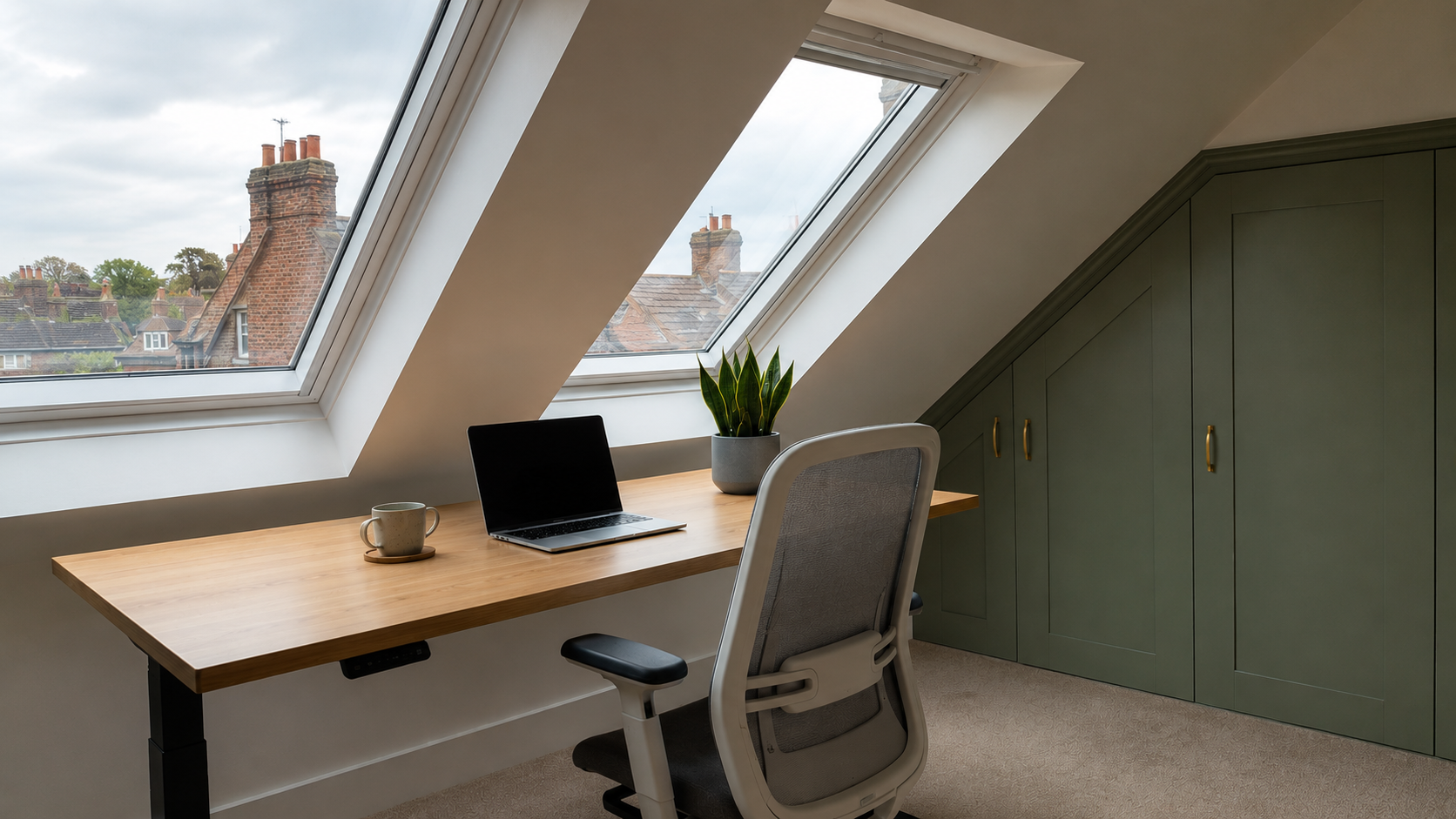
According to the Office for National Statistics, 40% of UK workers now work remotely at least part of the week – yet the densely terraced streets running back from Peckham Rye and Bellenden Road were built to house Victorian families, not hybrid workers with a laptop and a Zoom call every other hour (ONS, 2025). If you're an SE15 homeowner catching the train from Peckham Rye or Queens Road Peckham into London Bridge or Victoria two or three days a week, the tension at home is real. The kitchen table gets taken over. The living room doubles as a meeting room. And the second bedroom, if it exists at all, is already in use.
The space most Peckham homeowners haven't seriously considered is immediately above them. A loft home office conversion turns an unused roof void into a self-contained workspace on a separate floor – without reclaiming a bedroom, encroaching on the garden, or forcing a move. This guide covers everything relevant to SE15: how to assess whether your loft is structurally viable, what Southwark's planning rules mean for Peckham properties, how the conversion works from first survey to final handover, what it realistically costs in an inner South London postcode, and what it does to your home's value.
Ready to Explore Your Loft's Potential? Buildaway offers free, no-obligation loft quotes across Peckham and the wider SE15 area. One quote. One contact. One clear process.
TL;DR:
Converting an unused loft in Peckham into a home office typically costs between £28,000 and £58,000, depending on conversion type. It can add up to 20% to your property value, with an ROI of 60–75% (UK Home Improvement Index, 2025). Several SE15 conservation areas – including Bellenden and Ivydale – restrict Permitted Development rights, so a planning check is essential before committing to a design. The work typically takes 6–10 weeks on site from survey to handover.
Is Your Peckham Loft Suitable for a Home Office?
Peckham's Victorian terraced stock is among the best-suited residential housing for loft conversion in inner South London – steeply pitched rooflines, generous ridge heights, and consistent bay-fronted proportions all work in a homeowner's favour. But three structural criteria need confirming before any drawing or planning work begins. Skipping this stage is the most reliably avoidable way to waste money on a project that stalls.
1. Head Height
The minimum that makes a loft office workable is 2.2 metres at the ridge point – the central zone where you'll be standing, moving between a desk and shelving, and spending most of your working hours. Building Regulations (Approved Document K) require at least 2.0 metres over the staircase. The classic two-storey Victorian terrace common throughout Bellenden, Nunhead, and the streets off Peckham Rye Park typically carries a ridge height well in excess of this – one of SE15's structural advantages over newer suburban stock. Measure directly rather than estimating from the roofline; the two don't always correlate.
2. Floor Joist Capacity
Victorian ceiling joists in SE15 properties were engineered to hold up a plastered ceiling and light domestic storage – not the sustained loading of a habitable room with furniture, equipment, and daily occupancy. A structural engineer must assess whether the existing timbers can carry the additional load. In the majority of Peckham Victorian terraces, new C24 timber or steel reinforcement is fitted alongside the originals before any floor deck is laid. This is a Building Regulations requirement without discretionary flexibility – no completion certificate is issued without it.
3. Staircase Access
A retractable loft ladder is not a compliant means of access for a habitable room under Building Regulations, regardless of how the space will function day to day. A fixed permanent staircase is required. In the narrower hallway plans typical of SE15 terraced properties, particularly around Queens Road and Ivydale Road, alternating-tread stair designs offer a code-compliant footprint that can be accommodated without breaking into a bedroom or restructuring the landing.
Most Peckham loft conversions require floor joist reinforcement, a fixed staircase, and a minimum ridge height of 2.2 metres to satisfy Building Regulations (Approved Document K). The Victorian terraced housing that dominates SE15 tends to have steep, well-proportioned rooflines that naturally support conversion – the structural picture in Peckham is generally more straightforward than the planning picture, which requires a specific check for this postcode.
Do You Need Planning Permission for a Loft Home Office in Peckham?
Peckham sits in the London Borough of Southwark, and SE15 has a patchwork of conservation area designations that directly affect whether a homeowner can rely on Permitted Development rights or needs to submit a formal planning application. Understanding this before the design stage saves time, money, and misdirected expectations.
Where Permitted Development Applies in SE15
Outside designated conservation areas, standard PD rules are in effect for Peckham properties:
- Terraced houses (streets east of Rye Lane, parts of Nunhead, SE15): up to 40m³ of additional roof volume
- Semi-detached and detached homes: up to 50m³
- External materials must match or complement the existing roof finish
- The conversion must not extend above the current ridge height
- Side-facing windows cannot overlook a neighbouring garden at a lower level
Where a Planning Application Is Required
Several parts of SE15 carry conservation area designations with Article 4 Directions that remove Permitted Development rights. The main areas to check before assuming PD applies are the Bellenden Conservation Area, the Ivydale Conservation Area, the Meeting House Lane Conservation Area, and the Peckham Rye Conservation Area. If your property falls within any of these boundaries, a full planning application to the London Borough of Southwark will be required before any work can begin. For a detailed breakdown of what Southwark's planning rules cover structurally, see our guide on loft conversion planning in Peckham.
All PD parameters are published on the Planning Portal (gov.uk). If there is any doubt about your property's status, a Lawful Development Certificate from Southwark Planning provides formal confirmation and protects the conversion on resale. The key reassurance: nationally, 90% of householder applications were approved in Q3 2025 (Ministry of Housing, Communities & Local Government, 2025). Conservation area designation adds process, not necessarily refusal.
One point that applies regardless of planning status: Building Regulations approval is a completely separate process from planning permission and is required in every case. Structural loading, fire safety, thermal insulation, and staircase specification all fall under Building Regs rather than the planning system. Both must be fully completed for the finished conversion to be mortgageable, insurable, and legally transferable at sale.
Many SE15 properties outside conservation areas qualify under Permitted Development – 40m³ for terraced homes, 50m³ for semi-detached and detached. Properties within the Bellenden, Ivydale, Meeting House Lane, or Peckham Rye Conservation Areas require a full planning application to the London Borough of Southwark. Where planning permission is needed, 90% of householder applications in England were approved in Q3 2025 (Ministry of Housing, Communities & Local Government, 2025) – conservation area status adds a step, not a barrier.
Not Sure of Your Planning Position in SE15? Our team can advise on conservation area boundaries, Permitted Development status, and Building Regulations before you commit to any design spend. Talk to Buildaway.
Step-by-Step: How a Peckham Loft Home Office Conversion Works
A loft home office conversion in Peckham typically takes 6–10 weeks on site from feasibility survey to handover when a single experienced team manages the project from end to end. Where a planning application is required, that determination window – approximately 8 weeks – runs before the on-site sequence begins. Here's the complete picture. For a week-by-week breakdown, see our guide on how long a loft conversion takes in Peckham.
🔧 From a recent Buildaway project in SE15 (Peckham): We surveyed a 1895 Victorian mid-terrace off Bellenden Road and measured 2.51m of usable ridge height – one of the stronger readings we record in inner South London. The property sat within the Bellenden Conservation Area, so a planning application to London Borough of Southwark was submitted ahead of any site work. Consent came through in six weeks. Joist reinforcement followed using new C24 timber alongside the original ceiling joists. The full project – a Velux conversion with two rear-facing south-east roof windows, a compact fixed staircase, and a hardwired ethernet point – completed on site in eight weeks from the planning grant date. The homeowner, a documentary editor working from home three days a week, now has a top-floor edit suite that doesn't share walls with anyone else in the house.
One thing that comes up on almost every inner South London loft project: wireless connectivity planning. Victorian solid-brick construction in SE15 is not friendly to WiFi signals travelling three floors. A mesh node in the hallway is not a professional data solution for a loft office. A Cat6 ethernet cable run from the router position to the loft room during the build is the only reliable answer – and at build stage, running cable costs a fraction of what a post-plaster retrofit involves. Every homeowner who specifies it thanks themselves within the first fortnight.
A loft home office conversion in Peckham follows a structured 9-stage process – from feasibility survey to final finishing – typically completed on site in 6 to 10 weeks. Where conservation area planning applies, the determination period adds approximately 8 weeks before site work begins. Joist reinforcement, staircase design, and wired data infrastructure are all fixed during the design phase and cannot be changed economically once the walls are boarded.
How Much Does a Loft Home Office Cost in Peckham?
Costs across SE15 sit 15–20% above the national average for loft conversion work – reflecting inner London labour rates, the logistical constraints of working in a densely terraced urban area, and the design quality expectations that Southwark's conservation areas tend to bring with them. Here's a clear breakdown by conversion type, matched to the housing stock across Peckham. For a full pricing breakdown, read our guide on loft conversion cost in Peckham.
| Conversion Type | Typical Peckham Cost | Best For |
|---|---|---|
| Velux / Rooflight | £28,000–£40,000 | Victorian terraces throughout SE15 with sufficient existing headroom. Preserves the roofline character favoured in Southwark conservation area applications. Least disruptive. |
| Dormer | £42,000–£58,000 | Deeper Victorian and Edwardian terraces off Peckham Rye and Nunhead. Rear dormers are preferred in conservation area applications. Adds full standing headroom across the floor area. |
| Hip-to-Gable | £50,000–£68,000 | End-of-terrace and semi-detached homes in SE15. Maximum usable floor space; requires careful design in conservation-sensitive streets. |
Source: Checkatrade market data, 2025. Figures reflect Peckham (SE15) inner London labour and materials rates.
The return on investment picture for SE15 is compelling. A completed loft conversion adds up to 20% to property value in inner South London, with an overall ROI of 60–75% (UK Home Improvement Index, 2025). On a Peckham Victorian terrace valued at around £580,000, that's a potential £116,000 uplift against a spend of £42,000–£50,000. Peckham's property market has matured considerably over the past decade – proximity to the City, Overground connections via Peckham Rye, and genuine scarcity of larger Victorian stock all underpin the value of a properly converted, signed-off loft in a way that more peripheral postcodes cannot fully match.
Loft home office conversions in Peckham's SE15 postcode typically cost between £28,000 (Velux, Victorian terrace) and £68,000 (Hip-to-Gable, end-of-terrace), reflecting an inner London premium of 15–20% above the national baseline. A completed conversion adds up to 20% to property value with an ROI of 60–75%, supported by Peckham's strong underlying demand and transport connections (UK Home Improvement Index, 2025; Checkatrade market data, 2025).
Designing a Loft Home Office That Actually Works
The conversion creates the footprint. Five design decisions made before boarding begins determine whether the finished room genuinely functions as a productive workspace or collects regrets alongside the storage boxes it replaced.
Natural Light Direction
South- and east-facing Velux windows are the practical choice for desk work in London's dull autumn and winter months. The classic SE15 Victorian terrace runs parallel to the street, which means the rear slope typically faces south-east – a naturally good orientation for working light throughout the morning and midday period. West-facing rooflights produce the familiar afternoon problem: direct low sun into screens during the hours when most meetings and focused work take place. Confirming the roof orientation on the drawings costs nothing and avoids years of blackout blind dependency.
Temperature Management
A top-floor room in a Victorian terrace sits at the building's thermal extremes – hottest in summer, coldest in winter. A warm roof insulation system using 100mm+ PIR rigid board is the current standard and the practical dividing line between a year-round workspace and a seasonal one. A dedicated heating zone with its own thermostat is the complementary element: the ground-floor programmer cannot adequately serve a loft room, and the temperature compromise that results is a consistent source of frustration.
Acoustics
In the Victorian terraces that dominate SE15, the floor beneath the loft is almost always a bedroom. A floating floor system with acoustic underlay at build stage substantially reduces the transmission of impact noise – footsteps, shifting chairs, dropped items – from the loft to the room below. In a household where quiet matters on both floors at overlapping times, this is a modest line item with a disproportionately positive effect on daily life.
Connectivity
The instruction is consistent across every project: run Cat6 ethernet from the router to the loft room during the build, while the walls are still open. Not via a powerline kit. Not via a WiFi repeater mounted to a joist. Victorian solid-brick party walls in SE15 reliably degrade wireless signal across three floor levels in a way that no modern mesh system fully compensates for. A wired data point costs nearly nothing during the build and costs a significant amount to retrofit through finished surfaces. Include it on the original spec.
💡 Our observation across Peckham loft projects: Across our SE15 builds over the past two years, we've yet to meet a homeowner who regretted specifying wired ethernet during the build. We've met several who wished they had. The pattern is consistent across inner London Victorian stock – solid walls, multiple floors, and a router on the ground floor create conditions where wireless performance at loft level is genuinely unreliable. The solution takes one line on the specification sheet.
Does a Loft Home Office Add Value to a Peckham Home?
Yes – and the SE15 buyer profile makes a loft office a particularly effective selling point. Peckham attracts a high proportion of buyers who work in creative industries, media, and professional services – sectors where remote working is deeply embedded and a proper home workspace is a material factor in purchase decisions, not an afterthought.
A loft conversion adds up to 20% to property value in inner South London (UK Home Improvement Index, 2025). Over 35% of UK homeowners planning upgrades in 2025 cited hybrid working as their primary driver (Houzz UK survey, 2025). A CIPD study found that 62% of UK employees perform better working from home – confirming that the demand for dedicated home offices is structural and long-term rather than a post-pandemic residue (CIPD, 2025).
For SE15 buyers specifically, many of whom commute into London Bridge, Victoria, or the City via Peckham Rye or Queens Road Peckham on a hybrid basis, a quiet top-floor office separated from the household below is a genuine differentiator. It removes the bedroom compromise that puts buyers off otherwise desirable Victorian terraces, and it adds a habitable floor that directly increases the functional size of the home without changing its footprint on paper.
The condition that applies to all of this: the loft must carry a Building Regulations completion certificate from London Borough of Southwark Building Control to count in a property valuation, be included in habitable floor area for mortgage purposes, and remain covered under buildings insurance. Conversions without BCO sign-off surface as a problem at conveyancing and can delay or reduce a sale. Buildaway manages full Building Control sign-off on every Peckham project from first submission to final certificate. For a detailed analysis of return on investment, see our guide on whether a loft conversion is still a smart investment in 2026 in Peckham.
The Bottom Line for Peckham Homeowners
A 15 to 20 square metre loft office in Peckham – well within reach of most SE15 Victorian terraces given their natural ridge height – works entirely within the existing building without disturbing the floor plan below or the garden beyond the back door. In priority order:
- Check Planning First: Confirm whether your property falls within the Bellenden, Ivydale, Meeting House Lane, or Peckham Rye Conservation Areas before any design spend. This step takes a day and prevents wasted investment.
- Velux or Dormer Conversion: Match to your ridge clearance (2.2m minimum) and floor area requirement. Rear dormers are the preferred option in Southwark conservation area applications.
- Dedicated Access: A fixed staircase is mandatory – alternating-tread designs accommodate the narrower Victorian terrace hallway plan.
- Warm Roof Insulation: Specify 100mm+ PIR rigid board for year-round comfortable working conditions.
- Wired Connectivity: Install Cat6 ethernet during the build. Victorian brick kills wireless across three floors.
- Acoustic Protection: Fit a floating floor with acoustic underlay where a bedroom sits directly below the loft.
Budget £28,000–£40,000 for a Velux conversion or £42,000–£58,000 for a dormer, and factor in approximately 8 weeks for planning determination if your property requires a full application. Confirm your conservation area status and planning position with the London Borough of Southwark Planning Service (PO Box 64529, London SE1P 5LX) before committing to a design.