
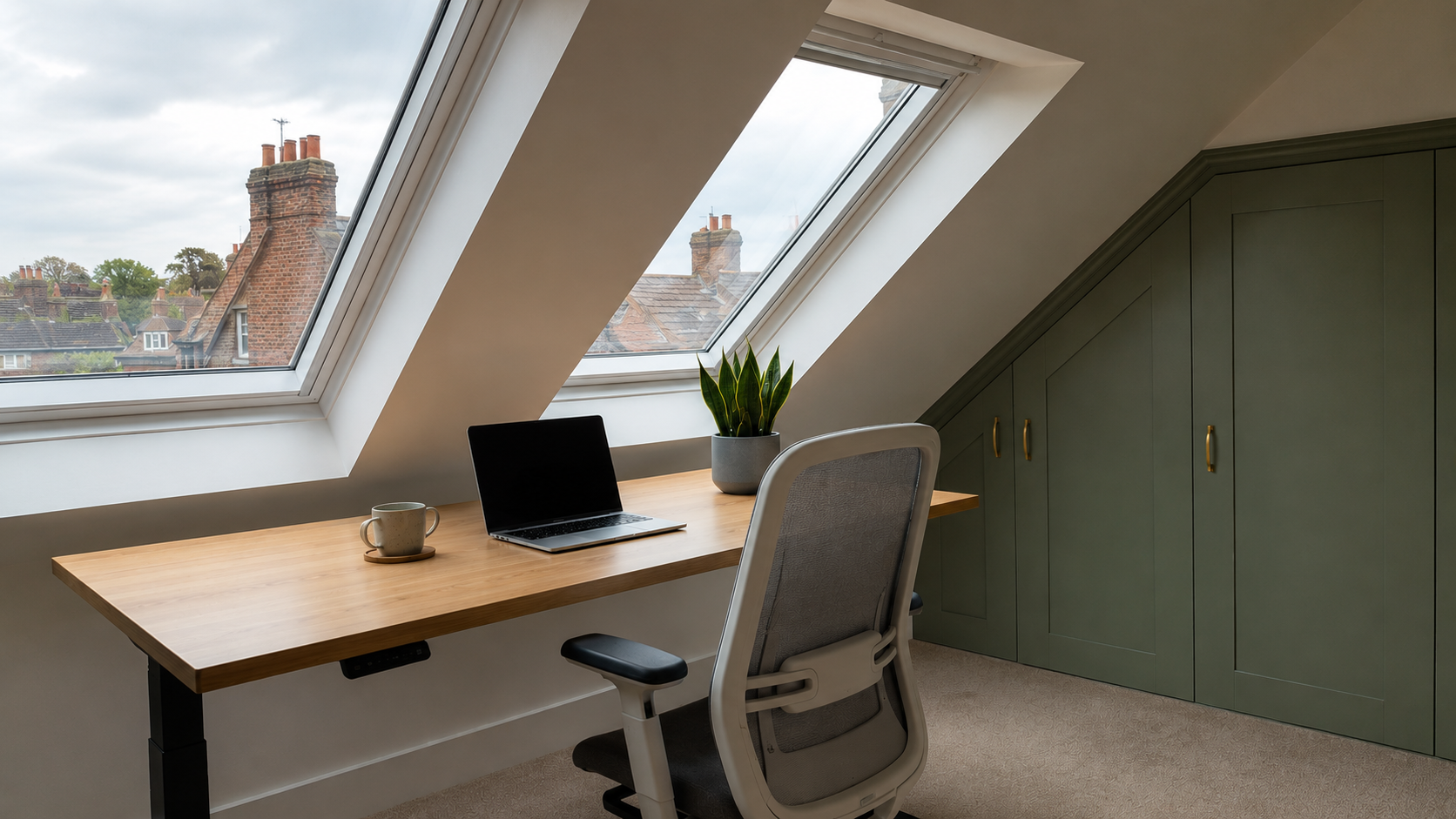
According to the Office for National Statistics, 40% of UK workers now work remotely at least part of the week - and for Leyton E10 homeowners, the maths of hybrid working are unusually favourable (ONS, 2025). The Central line from Leyton station reaches Liverpool Street in around 15 minutes and Oxford Circus in 20 - putting the City, Shoreditch, and the West End all within straightforward commuting range for two or three days a week. What the Victorian terraces lining Francis Road, Oliver Road, and Murchison Road were never equipped to handle is the other two or three days. The kitchen table is occupied. The spare bedroom is not a real workspace. And E10's late-Victorian loft voids, which are among the best-proportioned in inner East London, are sitting empty.
A loft home office conversion turns the space above the top floor into a dedicated, acoustically separated room without disrupting a bedroom, encroaching on the garden, or triggering a move. This guide covers the full picture for Leyton E10 homeowners: whether your loft qualifies structurally, what London Borough of Waltham Forest's planning rules mean in practice, how the build unfolds stage by stage, realistic costs in the E10 market, and what a finished conversion adds to your property's value.
Want to Know What Your Leyton Loft Can Become? Buildaway provides free, no-obligation loft assessments across Leyton, E10, and surrounding areas. One survey. One team. One clear process.
TL;DR:
Converting an unused loft in Leyton into a home office typically costs between £26,000 and £58,000, depending on conversion type. It can add up to 20% to your property value, with an ROI of 60–75% (UK Home Improvement Index, 2025). Most E10 homes outside the Leyton Conservation Area qualify for Permitted Development - no formal planning permission required. The build runs 6–10 weeks from first survey to Building Control handover.
Is Your Leyton Loft Suitable for a Home Office?
Leyton's E10 housing stock is built almost entirely on late-Victorian and Edwardian terraces - the rows of two-storey and two-and-a-half-storey homes that cover the streets between Leyton High Road and Leytonstone Road. These properties were constructed between roughly 1880 and 1910 to a consistent and generous specification: steep roof pitches, substantial ridge heights, and brick-built party walls that give the loft void a usable shape far more accessible than the roof geometry suggests from street level. Three structural criteria need to be confirmed before any drawings are produced.
1. Head Height
2.2 metres at the ridge point is the minimum required - the central highest point of the roof where the desk, monitor, and primary working area will sit. Building Regulations (Approved Document K) set 2.0 metres as the minimum above the staircase. Leyton's late-Victorian stock consistently delivers ridge heights between 2.3 and 2.5 metres in surveyed properties - a direct consequence of the steeper pitch common to terraces built in this era across East London. This is one of the more reliable structural starting points in the series.
2. Floor Joist Capacity
Late-Victorian properties in E10 - like every period home in this guide - have ceiling joists in the loft void, not structural floor joists. Ceiling joists carry the plasterboard below, not the loads of a working room with furniture and regular occupation. A structural engineer inspects the existing timbers and specifies the reinforcement required. In the vast majority of Leyton's period terraces, new C24 floor joists are installed alongside the originals. This is a standard step in any Building Regulations-compliant conversion, not an exceptional complication.
3. Staircase Access
Building Regulations require a permanent fixed staircase for any habitable loft room - a retractable ladder does not satisfy the requirement. Leyton's E10 mid-terrace layouts are characteristically narrow, and the first-floor landing in most properties is compact. An alternating-tread staircase is the most practical solution in the majority of cases, providing safe and compliant access without eating significantly into the floor plan below.
Most Leyton loft conversions require floor joist reinforcement, a fixed staircase, and a minimum ridge height of 2.2 metres under Building Regulations (Approved Document K). The late-Victorian terraces across E10 - along Francis Road, Oliver Road, and Murchison Road - consistently deliver ridge heights above the 2.2m threshold, making them structurally strong candidates for a loft home office conversion.
Do You Need Planning Permission for a Loft Home Office in Leyton?
For the majority of Leyton E10 homeowners, the answer is no. London Borough of Waltham Forest's conservation area designations are less extensive across E10 than those seen in the South London and South-West London postcodes earlier in this series - meaning standard Permitted Development applies to a larger proportion of residential streets here than in postcodes like Battersea, Blackheath, or Dulwich.
Permitted Development Limits for Leyton Homes
- Terraced houses (the majority of E10's residential streets): up to 40m³ of additional roof volume
- Semi-detached and detached homes (Leyton fringe areas): up to 50m³
- External materials must match the existing roof in type and appearance
- The conversion cannot raise the ridge above its current height
- Side-facing windows must not overlook a neighbouring garden at a lower level
The definitive reference for all PD rules is the Planning Portal (gov.uk). If there is any uncertainty about your E10 property's status, request a Lawful Development Certificate from London Borough of Waltham Forest before any work is commissioned. For a detailed breakdown of local planning requirements, see our guide on loft conversion planning in Leyton.
Leyton Conservation Area note: The Leyton Conservation Area covers streets around the High Road and Church Lane. Properties within this boundary will require a full Waltham Forest planning application rather than relying on PD. As with every conservation area in this series, the national approval rate provides reassurance: 90% of householder applications were approved in Q3 2025 (Ministry of Housing, Communities & Local Government, 2025). A rear-facing Velux design that leaves the front roofline unchanged is consistently the most straightforward route to Waltham Forest consent.
Building Regulations approval is a separate and parallel requirement covering structural performance, fire safety, insulation specification, and staircase compliance. It applies whether or not planning consent is needed, and must be correctly signed off for the conversion to be mortgageable, insurable, and legally transferable at sale.
Most E10 Leyton homeowners can proceed under Permitted Development - 40m³ for terraced houses, 50m³ for semi-detached and detached. Waltham Forest's conservation area designations are less extensive across E10 than in many comparable inner-London postcodes, meaning PD is the realistic route for the majority of Leyton conversions. Where planning is needed, 90% of householder applications were approved nationally in Q3 2025 (MHCLG, 2025).
Not Sure Whether Your E10 Property Qualifies Under PD? Our team confirms this at every initial survey before you commit to anything. Talk to Buildaway.
Step-by-Step: How a Leyton Loft Home Office Conversion Works
With a single experienced team coordinating all nine stages, a Leyton loft home office conversion typically completes in 6–10 weeks from feasibility survey to Building Control handover. The sequence below sets out what happens at each point - and where project timelines slip when coordination between trades breaks down. For a full week-by-week breakdown, see our guide on how long a loft conversion takes in Leyton.
🔧 From a recent Buildaway project in E10 (Murchison Road): We surveyed a 1898 Victorian mid-terrace with 2.41m of usable ridge height. The ceiling joists needed full replacement with C24 floor joists throughout. We confirmed Permitted Development applied - the property sat well outside the Leyton Conservation Area boundary - and proceeded without a planning application. An alternating-tread staircase was fitted off the narrow first-floor landing, along with two south-facing Velux windows and a Cat6 ethernet socket wired back to the ground-floor router. Survey to Building Control handover: seven weeks. The homeowner, a software engineer working for a Shoreditch tech company three days from home, now has a dedicated 17 square metre workspace at the top of the house that nobody else needs to cross.
One structural characteristic of Leyton's E10 mid-terraces that shapes every conversion project: the narrowness of the floor plan. These properties are typically 5 to 5.5 metres wide internally, which means the loft floor area - once the joists are in and the eaves storage is accounted for - sits comfortably between 15 and 19 square metres. That is enough for a standing desk, a second screen, and built-in storage, but it does require the staircase to be positioned carefully to avoid losing the usable centre of the room. This decision, made at the design stage, has a disproportionate effect on how functional the finished space feels.
A Leyton loft home office conversion follows a nine-stage sequence from feasibility to Building Control handover, typically completing in 6 to 10 weeks. In E10's characteristically narrow Victorian mid-terrace layouts, the staircase position and joist specification are the two design decisions with the greatest impact on how much usable working space the finished room delivers.
How Much Does a Loft Home Office Cost in Leyton?
Costs in E10 sit 10–12% above the national average - a modest inner-East London premium, similar to Lewisham SE13, reflecting proximity to Central London without the elevated inner-city rates seen in SW11 or SE3. Leyton's Victorian terrace stock means Velux conversions are the most common type in this postcode; dormers are well-suited to the occasional wider semi found near Leytonstone Road. For a complete breakdown, see our loft conversion cost in Leyton guide.
| Conversion Type | Typical Leyton Cost | Best For |
|---|---|---|
| Velux / Rooflight | £26,000–£38,000 | Late-Victorian terraces along Francis Road, Oliver Road, and Murchison Road (E10) with good existing headroom. No external roofline change. Fastest route under PD. |
| Dormer | £38,000–£52,000 | Wider Victorian and Edwardian semis near Leyton Green Road and the Leytonstone border. Adds full standing headroom and usable floor width. |
| Hip-to-Gable | £45,000–£58,000 | End-of-terrace and detached homes in E10. Maximises usable floor area. Often paired with a rear dormer for full-width working space. |
Source: Checkatrade market data, 2025. Figures reflect E10 labour and materials rates.
Leyton's financial case within this series sits at a genuinely compelling intersection. E10 offers accessible build costs combined with strong upward property value momentum - Leyton has been one of the more consistently rising East London postcodes over the past decade as buyers priced out of Hackney and Walthamstow have moved further east along the Central line. A completed conversion adds up to 20% to property value (UK Home Improvement Index, 2025). On an E10 Victorian terrace valued at around £580,000, that represents a potential £116,000 uplift against a Velux build cost of £26,000 to £35,000 - one of the strongest ratios in the inner-London entries in this series.
Loft home office conversions in Leyton E10 typically cost between £26,000 (Velux, Victorian terrace) and £58,000 (Hip-to-Gable, end-of-terrace or detached), with a 10–12% inner East London premium. Combined with strong upward property value momentum in E10 and a potential 20% uplift, Leyton offers one of the more attractive ROI cases among the inner-London entries in this series (UK Home Improvement Index, 2025; Checkatrade, 2025).
Designing a Loft Home Office That Actually Works
Leyton's Victorian terrace loft voids are productive but not expansive. The ridge heights are good, the structural quality consistent, but the floor area - in a property typically 5 to 5.5 metres wide - rewards precise design decisions more than larger-footprint postcodes do. The five elements below apply everywhere in this series, but in E10's narrow layouts they carry a proportionally higher impact on the finished result.
Natural Light Direction
South- and east-facing Velux windows are the practical target. E10's street grid runs in different orientations across the postcode, so the direction your rear slope faces depends on the specific road. Francis Road runs roughly north-south, giving most of its terraces a rear slope facing either east or west - east-facing is preferable for morning working light. Murchison Road runs east-west, giving rear slopes that typically face south or north. A south-facing rear Velux delivers excellent year-round natural light. Avoid west-facing glazing: the afternoon sun angle during autumn and winter creates glare at exactly the height of a monitor, and no standard blind resolves this at a sensible price without blocking daylight at the same time.
Temperature Management
Late-Victorian solid brickwork in E10 shares the same thermal characteristics as Victorian stock across every inner-London postcode in this series: it gains heat quickly in summer and loses it fast in winter. 100mm+ PIR rigid board in a warm roof configuration is the correct insulation specification - managing both extremes in a single system without the condensation risk that partial insulation approaches introduce in solid-brick construction. A dedicated heating zone for the loft is equally important: a period terrace boiler running a shared thermostat cannot heat a room two floors above the ground floor without making every other room in the house uncomfortable.
Acoustics
In E10's mid-terrace layout, the loft sits directly above the master bedroom in the overwhelming majority of cases. A floating floor with acoustic underlay is the practical barrier that keeps your working day from disturbing anyone below. In a narrow terrace where the floors are close together and party walls transmit sound laterally, this is not a premium addition - it is a functional necessity that homeowners consistently say they are glad they included.
Connectivity
Late-Victorian solid brick and internal chimney stacks in E10 terraces create the same WiFi dead-zone problem at loft height seen in every period postcode in this series. A Cat6 ethernet cable routed during the build - before partition walls and ceilings are plastered - costs little and permanently resolves bandwidth issues for calls, file uploads, and cloud sync. In a narrow E10 mid-terrace where the cable needs to travel from the ground floor through a chimney-breast-flanked hallway and up two floors, routing it afterwards through finished surfaces is genuinely expensive and disruptive.
💡 Our observation across Leyton loft projects: E10's narrow Victorian mid-terrace layouts consistently reward careful staircase positioning more than any other single design decision. In projects where the alternating-tread staircase was positioned toward the eave rather than the centre of the loft, homeowners retained 15 to 18 square metres of clear working floor. In projects where the staircase position wasn't resolved at design stage, the usable area dropped by 20% or more. This decision costs nothing to get right at drawing stage and a great deal to correct once construction is underway.
Does a Loft Home Office Add Value to a Leyton Home?
The answer is yes - and the buyer profile arriving in Leyton's E10 market makes the timing particularly relevant. The demographic that has driven E10's decade of consistent price growth is precisely the group most likely to value a finished top-floor workspace: younger professional households, frequently couples where both partners work in the City, Shoreditch, or Old Street, who have chosen Leyton for the Central line connection and the period character at a price point that Hackney and Walthamstow can no longer offer. For this buyer, a dedicated workspace on a separate floor from the living areas answers a practical question that arises in every viewing.
A completed loft adds up to 20% to property value across inner East London (UK Home Improvement Index, 2025). Over 35% of UK homeowners planning upgrades in 2025 cited WFH requirements as their primary motivation (Houzz UK, 2025). And 62% of UK employees say they perform better working from home (CIPD, 2025) - the demand for genuinely usable home workspaces is now baked into how E10's buyer pool evaluates a property before making an offer.
For Leyton specifically, the workspace question has become more pressing as E10 has attracted buyers who previously lived in flats - often without any dedicated workspace at all - and are purchasing a terrace specifically for the extra rooms and the outdoor space. A finished, acoustically separated loft office answers the first practical question that follows that purchase decision: where does working from home actually happen?
The prerequisite before any uplift is realised: Building Regulations sign-off from London Borough of Waltham Forest Building Control must be in place for the room to count as habitable floor area in any mortgage survey or RICS valuation. Conversions done without BCO approval create complications at conveyancing that are difficult and costly to resolve at the point of sale. Buildaway closes out full compliance on every E10 project. For the detailed financial picture, see our guide on whether a loft conversion is still a smart investment in 2026 in Leyton.
The Bottom Line for Leyton Homeowners
A Leyton loft home office is one of the most accessible and structurally consistent conversions in the inner-London section of this series. The planning picture is cleaner than most South London postcodes, the Victorian loft stock is reliable, and the buyer market that has been arriving in E10 for a decade is exactly the demographic that values a finished workspace most. The five decisions to get right from the start:
- Velux or Dormer Conversion: Match to your ridge height and usable floor area goal (2.2m ridge minimum). In E10's narrow terraces, Velux is the most common and most cost-effective type.
- Staircase Position First: In narrow E10 mid-terraces, the alternating-tread staircase position determines how much clear working floor area remains. Resolve this at design stage.
- Warm Roof Insulation: 100mm+ PIR rigid board - essential in late-Victorian solid-brick stock for year-round comfort.
- Cat6 Ethernet: Routed during the build, from ground-floor router to loft. Post-completion routing through Victorian plasterwork is expensive.
- Acoustic Flooring: Floating floor with acoustic underlay where the master bedroom sits directly below.
Budget £26,000–£38,000 for a Velux or £38,000–£52,000 for a dormer. If your E10 property sits within the Leyton Conservation Area, confirm your planning position with London Borough of Waltham Forest Building Control (Sycamore House, Forest Road, London E17 4JF) before work starts.