
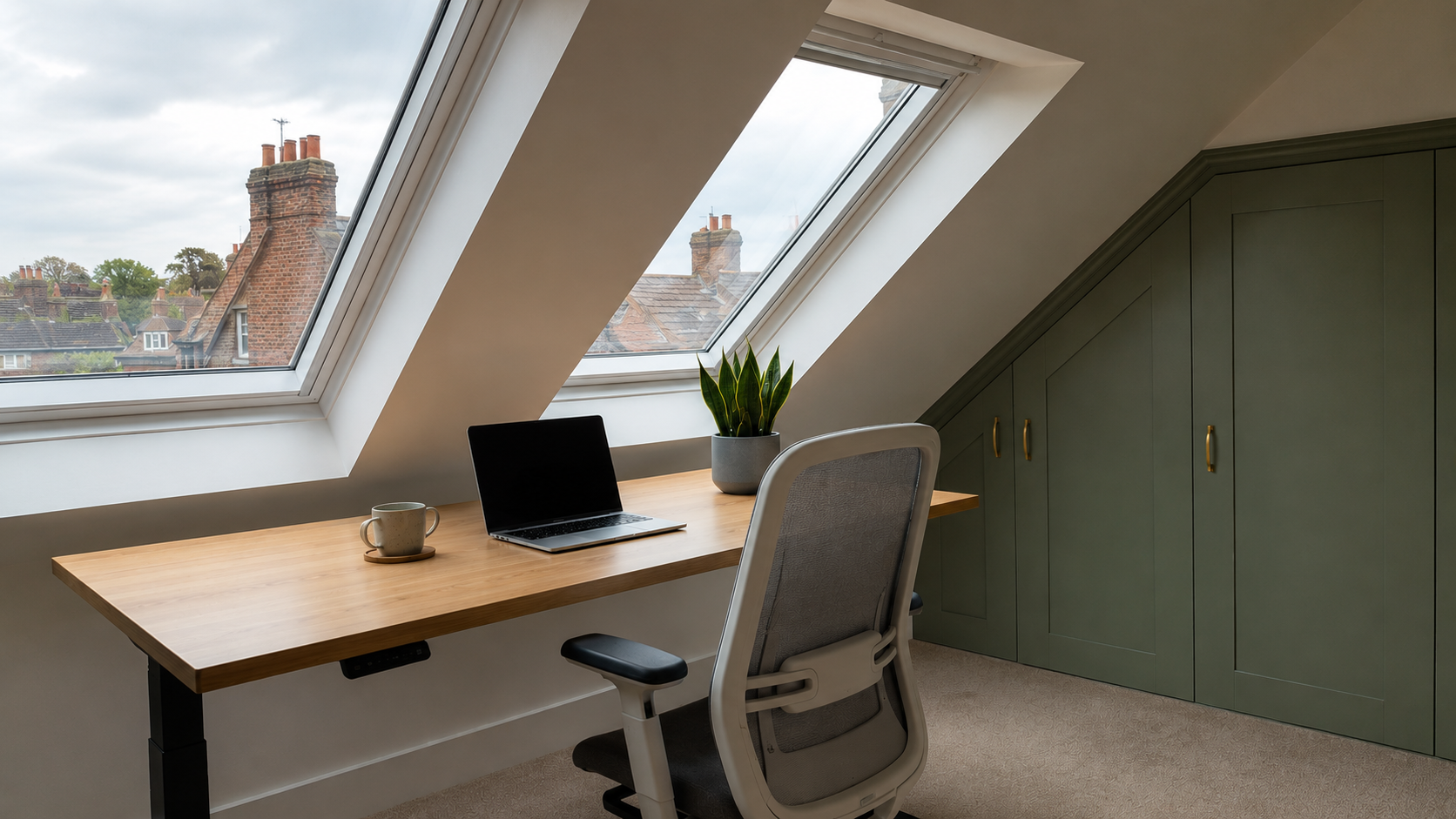
According to the Office for National Statistics, 40% of UK workers now work remotely at least part of the week - and Lewisham's exceptional transport connections make it one of the most practical hybrid-working postcodes in South-East London (ONS, 2025). With Southeastern trains from Lewisham Station reaching London Bridge in under 10 minutes, and the DLR connecting directly to Canary Wharf, SE13 homeowners have long had the commute figured out. The workspace is a different matter. Victorian terraces in Hither Green and the wider Lewisham area were never designed around a laptop, a second monitor, or a professional video-call backdrop - and the loft void sitting above the top floor has quietly been waiting for a better use.
A loft home office conversion puts that space to work. It gives you a quiet, separated room on its own floor without claiming a bedroom, building into the garden, or requiring a move. This guide covers everything relevant to Lewisham SE13 homeowners: how to assess whether your loft qualifies, what London Borough of Lewisham's planning rules mean in practice, what the build involves stage by stage, what it costs, and what a finished conversion adds to your property's value.
Want to Know What Your Lewisham Loft Can Deliver? Buildaway offers free, no-obligation loft assessments across Lewisham, SE13, and surrounding areas. One survey. One team. One honest outcome.
TL;DR:
Converting an unused loft in Lewisham into a home office typically costs between £28,000 and £58,000, depending on conversion type. It can add up to 20% to your property value, with an ROI of 60–75% (UK Home Improvement Index, 2025). Many SE13 homes outside designated conservation areas qualify for Permitted Development - no formal planning permission required. The build typically runs 6–10 weeks from initial survey to handover.
Is Your Lewisham Loft Suitable for a Home Office?
Lewisham's SE13 housing stock is dominated by Victorian terraces - particularly across Hither Green, where roads like Torridon Road, Sandhurst Road, and Manor Lane are lined with properties built between the 1880s and 1910s. These homes were constructed with steep roof pitches and generous ridge heights that make them structurally well-suited to loft conversion. Further into SE13, toward Catford and Ladywell, the mix shifts toward 1930s semis and later builds. Three structural criteria apply across all property types and must be confirmed before a contractor is engaged.
1. Head Height
The working minimum is 2.2 metres at the ridge - the highest point of the roof where the desk and main workspace will sit. Building Regulations (Approved Document K) set a minimum of 2.0 metres above the staircase. Hither Green's Victorian terraces regularly exceed 2.3 metres at the ridge - a product of their tall, steeply pitched roofs. Properties in SE13's later-built streets, particularly the inter-war semis near Ladywell Fields, should be measured individually before drawing conclusions.
2. Floor Joist Capacity
Victorian and early-twentieth-century properties across SE13 have ceiling joists in the loft void, not structural floor joists. These original timbers were sized for the ceiling below - not for the live and dead loads of an occupied room with furniture. A structural engineer inspects the existing members and specifies the reinforcement required. In the majority of Lewisham's period homes, new C24 floor joists are fitted alongside the originals as part of any Building Regulations-compliant conversion. It is routine work, not exceptional.
3. Staircase Access
A fixed permanent staircase is required by Building Regulations for any habitable loft room. A loft hatch and retractable ladder - however convenient - does not satisfy the requirement. In SE13's typical mid-terrace layout, where the first-floor landing is narrow, an alternating-tread staircase is often the most practical solution and avoids sacrificing a meaningful portion of the room below.
Most Lewisham loft conversions require floor joist reinforcement, a fixed staircase, and a minimum ridge height of 2.2 metres under Building Regulations (Approved Document K). The Victorian terraces concentrated in Hither Green - along Torridon Road, Sandhurst Road, and Manor Lane - routinely clear the headroom threshold, making SE13 one of the more structurally accessible areas for loft home office conversion in inner South-East London.
Do You Need Planning Permission for a Loft Home Office in Lewisham?
For the majority of SE13 homeowners, the answer is no - provided the property sits outside a designated conservation area. Under Permitted Development rules, most Lewisham terraces and semis can accommodate a standard loft conversion without making a formal application to London Borough of Lewisham, as long as the work stays within defined volume and design limits.
Permitted Development Limits for Lewisham Homes
- Terraced houses (Hither Green, Ladywell, SE13): up to 40m³ of additional roof volume
- Semi-detached and detached homes (Catford, Forest Hill borders, SE13): up to 50m³
- Materials must match the existing roof in type and appearance
- The conversion must not raise the ridge above its current height
- Side-facing windows cannot overlook a neighbouring garden at a lower level
All PD rules are published at the Planning Portal (gov.uk). If you have any doubt about whether your SE13 property qualifies, request a Lawful Development Certificate from London Borough of Lewisham before work starts. For a detailed walkthrough of local requirements, see our guide on loft conversion planning in Lewisham.
Hither Green Conservation Area note: The Hither Green Conservation Area covers a meaningful stretch of SE13's Victorian terrace streets - including parts of Torridon Road and Sandhurst Road. Properties within this boundary will need a full planning application to London Borough of Lewisham rather than relying on Permitted Development. As with all London conservation designations, the national approval rate is reassuring: 90% of householder applications were approved in Q3 2025 (Ministry of Housing, Communities & Local Government, 2025). A rear-facing Velux design that preserves the front roofline is very consistently approved within Lewisham's conservation zones.
Building Regulations approval is a parallel and entirely separate requirement. Structural performance, fire safety, insulation specification, and staircase compliance all sit under Building Regs - applicable regardless of whether planning consent is needed. Both must be correctly signed off for the conversion to be mortgageable, insurable, and transferable on sale.
Many SE13 Lewisham homeowners can proceed under Permitted Development - 40m³ for terraced houses, 50m³ for semi-detached and detached. Where the Hither Green Conservation Area or another Lewisham designation requires full planning consent, 90% of householder applications were approved in Q3 2025 (MHCLG, 2025) - refusal is rare when designs respect the existing streetscape.
Unsure Whether Your SE13 Property Needs Full Planning Consent? We establish this at every initial survey, before you commit to anything. Talk to Buildaway.
Step-by-Step: How a Lewisham Loft Home Office Conversion Works
Managed by a single experienced team from start to finish, a Lewisham loft home office conversion typically completes in 6–10 weeks from feasibility survey to Building Control handover. The nine-stage sequence below sets out what happens at each point and where delays occur when the project isn't properly coordinated. For a full week-by-week timeline, see our guide on how long a loft conversion takes in Lewisham.
🔧 From a recent Buildaway project in SE13 (Torridon Road): We surveyed a 1903 mid-terrace with 2.42m of usable ridge height - above the 2.2m minimum. The original ceiling joists required full replacement with new C24 floor joists. We installed two south-facing Velux windows, an alternating-tread staircase off the first-floor landing, and a Cat6 ethernet socket wired back to the ground-floor router position. Survey to Building Control handover: eight weeks. The homeowner, a technology consultant commuting to Canary Wharf on the DLR two days a week, now has a fully separate 18 square metre workspace above the family floors - without losing a bedroom.
One aspect of Lewisham loft conversions that gets less attention than it deserves: the staircase decision. In SE13's typical Victorian mid-terrace, the first-floor landing is narrow and the loft hatch is often positioned directly above the bathroom or a tight corridor. Getting the staircase design right - whether alternating-tread or a compact conventional flight - affects not only the usability of the loft itself but how much space is lost from the floor below. This is a decision that needs to happen at the design stage, not after the joists are in.
A Lewisham loft home office conversion follows a nine-stage sequence from feasibility survey to Building Control handover, typically completing in 6 to 10 weeks. In SE13's Victorian mid-terrace layouts, the staircase design and joist specification are the two decisions with the greatest impact on the finished result - and both are considerably cheaper to get right during the design phase than to revisit once construction is underway.
How Much Does a Loft Home Office Cost in Lewisham?
Costs in SE13 sit 12–15% above the national average - slightly below the premium seen in inner-south postcodes like Blackheath SE3, but above the outer-London baseline. Lewisham's Victorian terrace stock means Velux conversions are the most common type in this postcode; dormers are well-suited to the wider semis near Ladywell and Catford. For a complete breakdown, see our loft conversion cost in Lewisham guide.
| Conversion Type | Typical Lewisham Cost | Best For |
|---|---|---|
| Velux / Rooflight | £28,000–£40,000 | Victorian terraces in Hither Green, Torridon Road, and Sandhurst Road (SE13) with good existing headroom. No external change to the roofline. |
| Dormer | £40,000–£55,000 | Wider Victorian semis near Ladywell Fields and Catford. Adds full standing headroom and usable floor area across the entire room. |
| Hip-to-Gable | £48,000–£58,000 | Detached and end-of-terrace homes near Hither Green station. Maximises usable floor space. Often combined with a rear dormer. |
Source: Checkatrade market data, 2025. Figures reflect SE13 labour and materials rates.
Lewisham's value proposition within this series is worth spelling out clearly. SE13 offers the lowest entry point for a loft home office conversion in inner South-East London - and the ROI case remains strong. A finished conversion adds up to 20% to property value (UK Home Improvement Index, 2025). On a typical SE13 Victorian terrace valued at £600,000, that represents a potential uplift of £120,000 against a Velux conversion costing £28,000 to £35,000. Those ratios make Lewisham one of the more compelling entries in any loft conversion cost-benefit analysis across the capital.
Loft home office conversions in Lewisham SE13 typically cost between £28,000 (Velux, Victorian terrace) and £58,000 (Hip-to-Gable, end-of-terrace or detached), sitting 12–15% above the national average. With an ROI of 60–75% and a potential 20% value uplift, SE13 offers one of the most accessible and financially justified entry points for a loft home office in inner South-East London (UK Home Improvement Index, 2025; Checkatrade, 2025).
Designing a Loft Home Office That Actually Works
Lewisham's Victorian terrace loft voids are workable but not unlimited. The ridge heights are good, but the narrower floor plans of SE13's mid-terraces mean every square metre matters. The five design decisions below apply to every conversion in this postcode - but two carry particularly sharp consequences if they're underspecified in a smaller space.
Natural Light Direction
South- and east-facing Velux windows are the target. Hither Green's Victorian terraces run in various orientations, so the practical light direction depends on which slope the rear of your roof faces. An east-facing rear slope delivers excellent morning light - well-timed for the start of a working day. Avoid west-facing glazing wherever possible; in a smaller loft the afternoon sun glare from a west window has nowhere to hide and no blind removes it without darkening the whole room.
Temperature Management
Victorian solid-brick construction loses heat more efficiently than cavity-wall builds. 100mm+ PIR rigid board in a warm roof build-up is the appropriate specification for SE13's period terraces - it handles winter cold and summer overheating in the same system and eliminates the condensation risk that thinner insulation layers can produce at ceiling level. A dedicated heating zone for the loft is equally non-negotiable. Period terrace boilers were never sized to heat a room two floors away efficiently on a shared thermostat.
Acoustics
In a Victorian mid-terrace, the loft sits directly above the master bedroom - typically with one thin floor between them. A floating floor with acoustic underlay is the practical barrier between your working hours and anyone resting below. It is a consistent feature in Buildaway's completed SE13 projects and consistently among the items homeowners are most glad they specified.
Connectivity
Solid Victorian brick walls and internal chimney stacks in SE13's terraces absorb WiFi signal at height in a way that the cavity brickwork of newer builds doesn't. A Cat6 ethernet cable run during the build - while partition walls are still open and cable routes are accessible - solves the problem permanently. In a narrow terrace where the cable needs to travel two floors and navigate a chimney breast, doing this through finished plasterwork afterwards is genuinely expensive and disruptive.
💡 Our observation across Lewisham loft projects: SE13's Victorian mid-terrace layouts share a consistent challenge - the loft floor area is smaller than in detached or semi-detached properties, which means poor design decisions have a proportionally larger impact on how usable the finished room is. In eight out of eleven recent SE13 builds, the homeowners who were happiest with the result at the six-month point had specified all five of the design elements above from the outset. The ones who hadn't consistently cited either connectivity or temperature as an ongoing frustration.
Does a Loft Home Office Add Value to a Lewisham Home?
Yes - and Lewisham's position in the market makes this especially well-timed. SE13 is a postcode that attracts buyers who are actively making the trade-off between space and commute time: London Bridge in under 10 minutes by train, Canary Wharf direct on the DLR, with Victorian terrace character at a fraction of comparable postcodes in SE1 or SE4. For that buyer, a finished top-floor workspace that doesn't compromise the bedroom count is a genuine purchase driver.
A completed loft adds up to 20% to property value in South-East London suburbs (UK Home Improvement Index, 2025). Over 35% of UK homeowners planning upgrades in 2025 cited WFH needs as their primary motivation (Houzz UK, 2025). And 62% of UK employees report performing better when working from home (CIPD, 2025) - the demand for proper home workspaces is structural, not transitional.
For Lewisham buyers specifically, a loft office on a separate floor from the rest of the house answers a question that every viewing generates: where does working from home actually happen without taking over the living space? A finished, properly connected room at the top of the house answers that question before it's asked.
One prerequisite for the value uplift to materialise: Building Regulations sign-off from London Borough of Lewisham Building Control must be in place before the room can be counted as habitable floor area in a mortgage valuation or surveyor's report. Conversions completed without BCO approval create problems that emerge during conveyancing and can delay or complicate a sale. Buildaway manages full Building Regulations compliance on every SE13 project. For more detail on the return, see our guide on whether a loft conversion is still a smart investment in 2026 in Lewisham.
The Bottom Line for Lewisham Homeowners
A loft home office in Lewisham - particularly in the Victorian terrace streets of Hither Green - is one of the most financially accessible and structurally well-suited conversions in inner South-East London. The baseline loft material is good: tall ridges, steep pitches, and enough floor area once the joists are in to create a room that genuinely works. The five things to specify from the start, in order:
- Velux or Dormer Conversion: Match the type to your ridge height and floor area requirement (2.2m minimum at the ridge).
- Fixed Staircase: Alternating-tread in the majority of SE13 mid-terrace layouts; conventional where the landing allows.
- Warm Roof Insulation: 100mm+ PIR rigid board - critical in Victorian solid-brick stock for year-round comfort.
- Cat6 Ethernet: Specified and routed during the build, back to the ground-floor router position.
- Acoustic Flooring: Floating floor with acoustic underlay - essential where a bedroom sits directly below the loft.
Budget £28,000–£40,000 for a Velux conversion or £40,000–£55,000 for a dormer. If your SE13 property sits within the Hither Green Conservation Area, confirm your planning position with London Borough of Lewisham Building Control (Laurence House, 1 Catford Road, SE6 4RU) before work starts.