
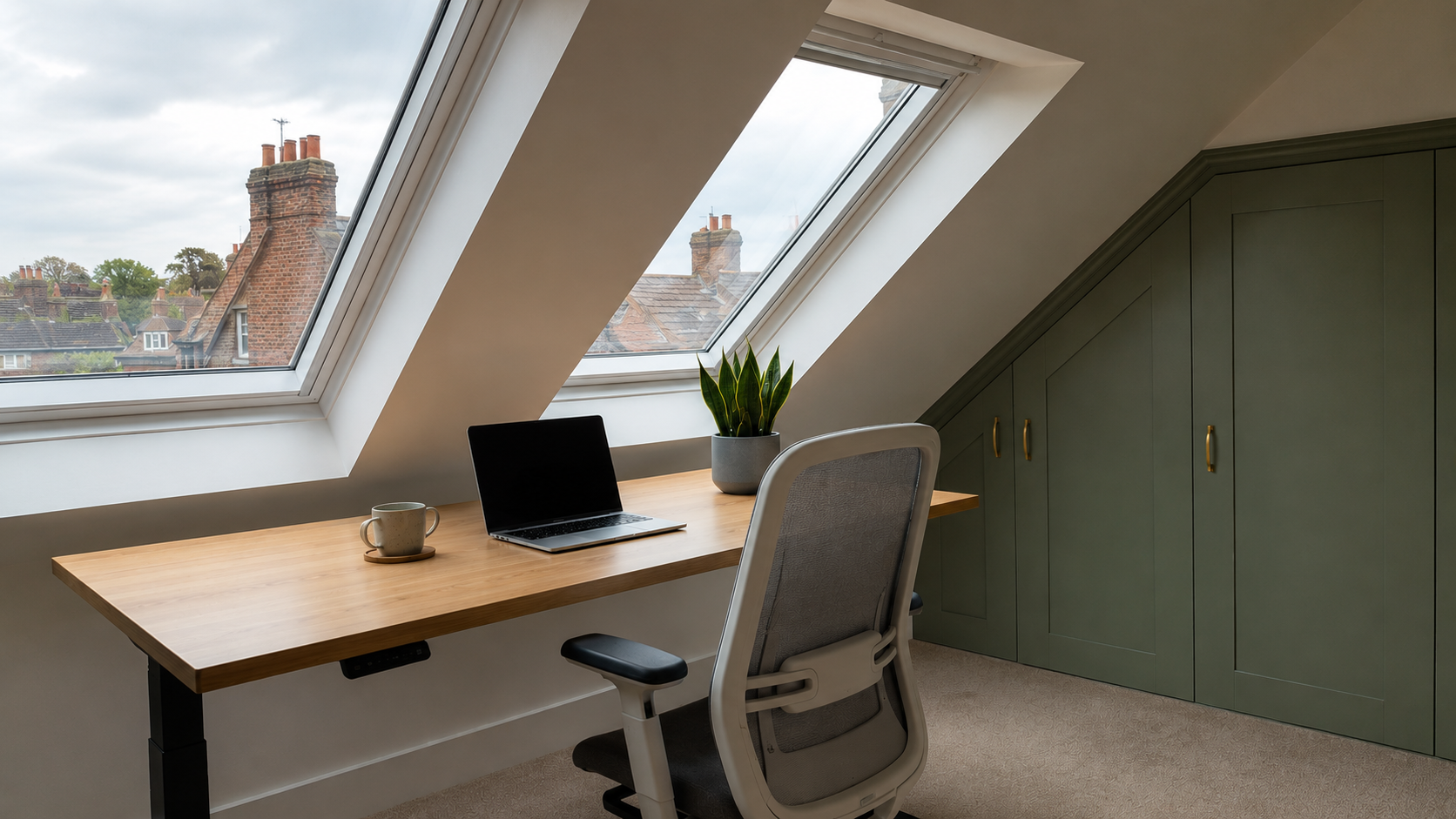
According to the Office for National Statistics, 40% of UK workers now work remotely at least part of the week – and on the Isle of Dogs, that statistic lands with particular force (ONS, 2025). This is a peninsula where Canary Wharf towers dominate the skyline and many residents work in financial services, professional services, or technology sectors where hybrid schedules are now the operating norm. But south of the Jubilee line and east of the glasswork towers, there is a quieter Isle of Dogs that most people outside E14 don't know well: the Victorian and Edwardian terraces of Cubitt Town and Millwall, where families have lived for generations and where some of the most underused loft space in inner East London sits above the top landing.
This guide is written for that part of the island – for terrace homeowners on streets like Manchester Road, Cahir Street, and Saunders Ness Road who commute two or three days a week to Canary Wharf, the City, or further afield via the DLR or Jubilee line, and who want a proper workspace at home without giving up a bedroom. It covers everything: structural suitability, what Tower Hamlets' planning rules mean for E14 terrace properties, how the build works stage by stage, what it costs, and what a completed conversion does to your home's value.
Ready to Explore Your Loft's Potential? Buildaway offers free, no-obligation loft quotes across the Isle of Dogs and the wider E14 area. One quote. One contact. One clear process.
TL;DR:
Converting an unused loft in an Isle of Dogs Victorian terrace into a home office typically costs between £28,000 and £58,000, depending on conversion type. It can add up to 20% to your property value, with an ROI of 60–75% (UK Home Improvement Index, 2025). The Cubitt Town and Millwall Conservation Areas restrict Permitted Development rights for many E14 terrace properties – a planning check is essential before committing to a design. The work typically takes 6–10 weeks on site from survey to handover.
Is Your Isle of Dogs Loft Suitable for a Home Office?
A note on property type first. This guide applies specifically to the Victorian and Edwardian terraced houses in Cubitt Town and Millwall. If you live in a Canary Wharf apartment or a modern flat development in E14, loft conversion is not applicable to your property type. The advice below is for terrace homeowners on the residential streets south of the commercial core.
For those properties, the structural picture is generally encouraging. The Victorian terraces built across Cubitt Town in the 1870s and 1880s and the Edwardian stock around Millwall share the steeply pitched rooflines and generous ridge heights common to inner East London Victorian housing. But three structural conditions need to be confirmed before any design or planning work begins.
1. Head Height
The working minimum is 2.2 metres at the ridge point – the zone where you'll be standing, moving between a desk and storage, and spending the productive hours of your working day. Building Regulations (Approved Document K) set the over-stair clearance at 2.0 metres. The Victorian terraces around Manchester Road and the streets running down towards Island Gardens typically carry ridge heights that comfortably clear this threshold. A direct measurement is still necessary – the ridge height visible from the street is not the same as the usable internal height at the ridge point.
2. Floor Joist Capacity
Pre-1980 ceiling joists in the Isle of Dogs' Victorian properties were sized to carry a plastered ceiling and minimal storage loads – not a desk, bookshelves, and continuous daily occupancy. A structural engineer must assess the existing timbers, and in the large majority of E14 Victorian terraces new C24 timber or steel reinforcement is installed alongside the original joists before any floor deck is laid. This is not an optional upgrade; it is a Building Regulations requirement, and no completion certificate is issued without it.
3. Staircase Access
A fold-down loft ladder does not satisfy Building Regulations for a habitable room regardless of how the space will be used. A permanent fixed staircase is mandatory. In the compact floor plans typical of Cubitt Town's Victorian terrace stock – where hallways are often narrower than in wider-plan Edwardian properties – alternating-tread stair designs provide a compliant, compact solution without requiring a full landing restructure or the loss of an existing doorway.
Most Isle of Dogs loft conversions in Cubitt Town and Millwall require floor joist reinforcement, a fixed staircase, and a minimum ridge height of 2.2 metres to satisfy Building Regulations (Approved Document K). The Victorian terrace stock in these areas typically clears the headroom threshold with room to spare – the structural picture is strong, while the planning picture requires a conservation area check specific to this part of E14.
Do You Need Planning Permission for a Loft Home Office on the Isle of Dogs?
The Isle of Dogs falls within the London Borough of Tower Hamlets, and the residential areas of Cubitt Town and Millwall carry conservation area designations that directly affect whether a terrace homeowner can rely on Permitted Development rights. This check needs to happen before any other step.
Where Permitted Development Applies in E14
For terrace properties that fall outside conservation area boundaries, standard PD rules apply:
- Terraced houses (parts of Cubitt Town and Millwall outside conservation areas, E14): up to 40m³ of additional roof volume
- Semi-detached and detached homes (rare in this part of E14 but applicable): up to 50m³
- External materials must match or closely complement the existing roof covering
- The conversion must not project above the current ridge height
- Side-facing windows cannot overlook a neighbouring garden from a lower level
Where a Planning Application Is Required
The Cubitt Town Conservation Area and the Millwall Conservation Area both carry restrictions that limit or remove Permitted Development rights for terrace properties within their boundaries. If your home on Manchester Road, Cahir Street, Glengall Grove, or the surrounding streets falls within either of these designated areas, a full planning application to the London Borough of Tower Hamlets will be required before any build work begins. For a full breakdown of the regulatory framework, see our guide on loft conversion planning on the Isle of Dogs.
All PD parameters are published on the Planning Portal (gov.uk). A Lawful Development Certificate from Tower Hamlets Planning before committing to a design provides formal legal confirmation of your permitted development status and protects the conversion at resale. Nationally, 90% of householder applications were approved in Q3 2025 (Ministry of Housing, Communities & Local Government, 2025) – a conservation area designation adds a process requirement, not a presumption of refusal for a well-designed conversion.
One point that applies regardless of planning status: Building Regulations approval is a separate and parallel process from planning permission and is required in every case. Structural loading, fire safety, thermal insulation performance, and staircase specification all fall under Building Regs rather than the planning system. Both must be correctly completed for the finished conversion to be mortgageable, insured, and legally sound at resale.
Terrace homeowners in Cubitt Town and Millwall who fall outside conservation area boundaries can proceed under Permitted Development – 40m³ of additional roof volume for terraced properties. Those within the Cubitt Town or Millwall Conservation Areas require a full planning application to the London Borough of Tower Hamlets. Where planning is needed, 90% of householder applications in England were approved in Q3 2025 (Ministry of Housing, Communities & Local Government, 2025) – conservation area status adds a step, not a wall.
Not Sure of Your Planning Position in E14? Our team can advise on conservation area boundaries, Permitted Development eligibility, and Building Regulations for your specific Isle of Dogs property before any design spend is committed. Talk to Buildaway.
Step-by-Step: How an Isle of Dogs Loft Home Office Conversion Works
A loft home office conversion on the Isle of Dogs typically takes 6–10 weeks on site from feasibility survey to handover when a single experienced team manages the project end to end. Where planning permission is required, the Tower Hamlets determination window of approximately 8 weeks runs before the on-site sequence begins. Here's the complete sequence. For a week-by-week breakdown, see our guide on how long a loft conversion takes on the Isle of Dogs.
🔧 From a recent Buildaway project in E14 (Isle of Dogs): We surveyed a 1882 Victorian terrace on Cahir Street in Cubitt Town and measured 2.44m of usable ridge height – above the 2.2m minimum. The property fell within the Cubitt Town Conservation Area, so a planning application to the London Borough of Tower Hamlets was submitted ahead of the build. Consent came through in six weeks. Ceiling joists were reinforced with new C24 timber fixed alongside the originals. The completed project – a Velux conversion with two south-facing roof windows, an alternating-tread fixed staircase, and a dedicated Cat6 ethernet point – ran from planning grant to handover in nine weeks. The homeowner, a derivatives analyst who works from home three days a week and reaches Canary Wharf on foot on the other two, now has a fully separated top-floor workspace with no background household noise and no shared surfaces with anyone else in the building.
The one infrastructure decision that consistently comes up on Isle of Dogs projects: in Victorian terrace properties on the island, the router is invariably on the ground floor and the loft is three solid-brick floors above it. A WiFi booster is not a dependable solution for financial services work, video calls, or VPN connections. A Cat6 ethernet cable run during the open-wall stage of the build is the correct answer – reliable, fast, and permanent. At build stage it costs almost nothing. As a retrofit through finished plaster and brick it costs considerably more and requires significant disruption to a recently completed room.
An Isle of Dogs loft home office conversion follows a structured 9-stage process from feasibility survey to final finishing – typically completed on site in 6 to 10 weeks. Where conservation area planning applies, the determination period adds approximately 8 weeks before the on-site sequence begins. Structural reinforcement, staircase design, and wired data infrastructure are all fixed at the design stage; none can be added economically through finished walls and ceilings.
How Much Does a Loft Home Office Cost on the Isle of Dogs?
Costs across the residential terrace areas of E14 sit 15–20% above the national average for loft conversion work – consistent with inner East London labour rates, the logistical specifics of working on a peninsula with limited road access, and the materials standards that Tower Hamlets conservation area applications require. Here's a straightforward breakdown by conversion type, mapped to the terrace housing stock in Cubitt Town and Millwall. For a full pricing guide, read our article on loft conversion cost on the Isle of Dogs.
| Conversion Type | Typical Isle of Dogs Cost | Best For |
|---|---|---|
| Velux / Rooflight | £28,000–£40,000 | Victorian terraces in Cubitt Town and Millwall with sufficient existing headroom. Preserves the roofline character favoured in Tower Hamlets conservation area applications. Least disruptive to the household during the build. |
| Dormer | £42,000–£58,000 | Deeper Victorian and Edwardian terraces off Manchester Road and Glengall Grove. Rear dormers are preferred in conservation area applications. Adds full standing headroom across the usable floor area. |
| Hip-to-Gable | £50,000–£68,000 | End-of-terrace homes in Cubitt Town and Millwall. Maximum usable floor space; requires careful design in conservation-sensitive streets to satisfy Tower Hamlets' character requirements. |
Source: Checkatrade market data, 2025. Figures reflect Isle of Dogs (E14) inner East London labour and materials rates.
The return on investment picture for Cubitt Town and Millwall terrace properties is compelling precisely because Victorian houses on the island are genuinely scarce. A completed loft conversion adds up to 20% to property value in inner East London, with a typical ROI of 60–75% (UK Home Improvement Index, 2025). On a Cubitt Town Victorian terrace valued at around £650,000, that represents a potential £130,000 uplift against a project spend of £42,000–£52,000. Unlike Canary Wharf apartment stock – which is abundant, easily comparable, and primarily valued on specification rather than scarcity – the Victorian terrace housing in E14 is in genuinely limited supply. A properly converted, fully signed-off loft office adds functional floor space to a property type that buyers cannot simply find elsewhere on the island.
Loft home office conversions on the Isle of Dogs typically cost between £28,000 (Velux, Victorian terrace) and £68,000 (Hip-to-Gable, end-of-terrace), reflecting an inner East London premium of 15–20% above the national baseline. A completed conversion adds up to 20% to property value with an ROI of 60–75%, supported by the genuine scarcity of Victorian terrace housing in E14 (UK Home Improvement Index, 2025; Checkatrade market data, 2025).
Designing a Loft Home Office That Actually Works
The conversion creates the floor area. Whether the finished room performs as a productive workspace or gradually becomes an overspill storage area depends on five design decisions that are inexpensive to get right before boarding begins and expensive to address afterwards.
Natural Light Direction
South- and east-facing Velux windows deliver the most useful working light across the long grey months of the London year. The Victorian terraces in Cubitt Town run in consistent street orientations, placing many rear slopes in a south or south-east aspect – a practical advantage that makes rear-facing Velux windows a natural choice for morning and midday working light. West-facing rooflights create the predictable afternoon problem: direct low-angle sun into screens at the hours when most calls and focused work occur. Checking the roof orientation during the design phase takes minutes and avoids daily blind management for the life of the room.
Temperature Management
A top-floor room in a Victorian terrace sits at the building's thermal extremes. It heats fastest in summer and cools quickest on cold nights. A warm roof insulation system using 100mm+ PIR rigid board is the current standard for a reason – it is the practical dividing line between a workspace that is comfortable through every month of the year and one that demands seasonal compromise. A dedicated heating zone with its own thermostat is the essential companion: tying the loft to the household programmer produces an irreconcilable conflict between the temperature the ground floor requires and the temperature the loft needs that no single setting resolves.
Acoustics
In the Victorian terrace format common throughout Cubitt Town, a bedroom almost always sits directly beneath the loft floor. A floating floor system with acoustic underlay at build stage significantly reduces the transmission of impact noise – footsteps, chair movement, items being set down – from the office to the room below. In a household where standard business hours and other schedules coexist on overlapping floors, this is a low-cost addition at build stage that pays dividends in domestic harmony on every working day.
Connectivity
The instruction is the same across every inner London Victorian loft project: run Cat6 ethernet from the router to the loft room during the build, while walls are open and cable can be routed cleanly before boarding. On the Isle of Dogs, where many residents work in financial services and technology roles that demand VPN stability and consistent upload bandwidth, wireless workarounds are a professional liability. Victorian solid-brick construction across three floors is the reliable adversary of wireless performance. A hardwired connection is the only solution that works consistently – and at build stage it costs nearly nothing.
💡 Our observation across Isle of Dogs loft projects: In every E14 terrace loft build we have completed, the most specific piece of feedback at the six-month mark relates to connectivity. Homeowners in financial services and technology roles in particular notice WiFi instability at loft level almost immediately. Those who specified wired ethernet during the build have never raised it again. Those who didn't have come back for a retrofit. The cost and disruption differential is significant. Include it on the specification from the start.
Does a Loft Home Office Add Value to an Isle of Dogs Home?
For Victorian terrace homeowners in Cubitt Town and Millwall, the answer is yes – and the specific conditions of the E14 property market make it more emphatic than in many other postcodes. The island has a bifurcated property market: abundant modern apartment stock on one side, genuinely scarce Victorian terrace housing on the other. A completed loft office adds measurable, habitable floor area to a property type that buyers cannot simply find in larger supply nearby.
A loft conversion adds up to 20% to property value in inner East London (UK Home Improvement Index, 2025). Over 35% of UK homeowners planning upgrades in 2025 cited WFH requirements as their primary driver (Houzz UK survey, 2025). A CIPD study confirmed that 62% of UK employees perform better working from home – a finding that reflects a durable structural shift in how professionals relate to their domestic space (CIPD, 2025).
For buyers looking at Cubitt Town and Millwall terraces – many of whom work in Canary Wharf, the City, or in technology and professional services roles that operate on a hybrid model – a quiet top-floor workspace separated from the household below is a specific feature that resolves a real problem. It removes the bedroom compromise that prevents many three-bedroom Victorian terraces from functioning practically for a household where at least one person works from home regularly. That distinction matters in the E14 sales market in a way that no kitchen update or bathroom renovation can replicate.
The condition that governs all of this: the loft must carry a Building Regulations completion certificate from the London Borough of Tower Hamlets Building Control to count in a property valuation, be included in mortgageable habitable floor area, and be covered under buildings insurance. A conversion without BCO sign-off creates a conveyancing liability at point of sale. Buildaway manages full Building Control sign-off on every Isle of Dogs project from first submission through to final certificate. For a detailed investment analysis, see our guide on whether a loft conversion is still a smart investment in 2026 on the Isle of Dogs.
The Bottom Line for Isle of Dogs Homeowners
A 15 to 20 square metre loft office in a Cubitt Town or Millwall terrace – straightforwardly achievable within the steep rooflines of most E14 Victorian stock – adds a habitable floor without disturbing the layout below or the garden beyond the back gate. In priority order:
- Confirm Property Type First: This guide applies to Victorian and Edwardian terrace homeowners in Cubitt Town and Millwall. Apartment and flat owners in E14 cannot convert lofts.
- Check Planning Before Design: Confirm whether your property falls within the Cubitt Town or Millwall Conservation Areas before any design fees are committed. This is the step that protects the entire project budget.
- Velux or Dormer Conversion: Match to your ridge clearance (2.2m minimum) and floor area requirement. Rear dormers are preferred in Tower Hamlets conservation area applications.
- Dedicated Access: A fixed staircase is mandatory – alternating-tread designs suit the compact Victorian terrace hallway plan.
- Warm Roof Insulation: Specify 100mm+ PIR rigid board for year-round comfort in a thermally exposed top floor.
- Wired Connectivity: Install Cat6 ethernet during the build. For financial services and technology professionals, wireless is not a professional solution across three Victorian brick floors.
- Acoustic Protection: Fit a floating floor with acoustic underlay where a bedroom sits directly beneath the loft.
Budget £28,000–£40,000 for a Velux conversion or £42,000–£58,000 for a dormer, and factor in approximately 8 weeks for planning determination where a full application is required. Confirm your conservation area status and planning position with the London Borough of Tower Hamlets Planning Service (Mulberry Place, 5 Clove Crescent, E14 2BG) before committing to any design spend.