
According to the Office for National Statistics, 40% of UK workers now work remotely at least part of the week – yet the Victorian terraces running back from the Thames and the Edwardian streets around Westcombe Park were constructed a century before anyone needed a reliable broadband connection at the top of the house (ONS, 2025). If you're a SE10 homeowner commuting from Greenwich or Maze Hill into London Bridge, Cannon Street, or Canary Wharf two or three days a week, the home workspace problem is a familiar one. A Victorian front room with a laptop on the table is not a professional office. The spare bedroom – if you have one – likely already serves another purpose. And the DLR commute, short as it is, doesn't make the problem go away on the days you're at home.
The solution that most Greenwich homeowners haven't fully investigated is directly overhead. A loft home office conversion delivers a properly built workspace on a separate floor, without reconfiguring the rooms your household already depends on. This guide covers everything specific to SE10: how to assess whether your loft qualifies, what Greenwich's notably complex planning rules mean in practice, how the build works stage by stage, what it costs in a World Heritage Site borough, and what the return looks like on resale.
Ready to Explore Your Loft's Potential? Buildaway offers free, no-obligation loft quotes across Greenwich and the wider SE10 area. One quote. One contact. One clear process.
TL;DR:
Converting an unused loft in Greenwich into a home office typically costs between £28,000 and £58,000, depending on conversion type. It can add up to 20% to your property value, with an ROI of 60–75% (UK Home Improvement Index, 2025). Planning checks in SE10 require more care than most London postcodes due to the World Heritage Site designation and wide Article 4 Direction coverage – but the majority of well-designed conversions are approved. The work typically takes 6–10 weeks on site from survey to handover.
Is Your Greenwich Loft Suitable for a Home Office?
SE10's Victorian and Edwardian terraces are among the best-proportioned residential buildings for loft conversions in South East London – but three structural conditions need to be confirmed before any design investment is made. Getting this wrong costs money on drawings for a loft that can't legally become a habitable room.
1. Head Height
The minimum working requirement is 2.2 metres at the ridge point – the central zone where you'll be on your feet and at a desk throughout the working day. Building Regulations (Approved Document K) set the over-stair clearance at 2.0 metres. The tall, steep-pitched rooflines on the Victorian terraces around Maze Hill and the Edwardian stock near Westcombe Park station are naturally well-suited to meeting this threshold. It's still worth a direct measurement rather than a visual assumption – roof pitch and internal ridge height don't always match what a roofline suggests from the street.
2. Floor Joist Capacity
Pre-1980 ceiling joists in Greenwich properties were specified to carry plasterboard and modest storage loads – not the continuous occupancy loading of a habitable room with furniture, shelving, and daily foot traffic. A structural engineer must assess whether the existing timbers are adequate and, in the large majority of SE10 Victorian and Edwardian homes, new C24 timber or steel reinforcement is installed alongside the originals. This is a mandatory element under Building Regulations, not a discretionary upgrade, and no completion certificate is issued without it.
3. Staircase Access
A fold-down loft ladder is not a compliant means of access for a habitable room under Building Regulations. A permanent fixed staircase is required. In the tighter floor plans common to SE10 terraced properties around East Greenwich and Westcombe Park, alternating-tread stair designs provide a code-compliant solution within a compact footprint – without absorbing a full landing or closing off a bedroom doorway.
Most Greenwich loft conversions require floor joist reinforcement, a fixed staircase, and a minimum ridge height of 2.2 metres to satisfy Building Regulations (Approved Document K). The Victorian and Edwardian terraced stock that defines much of SE10 tends to have generously pitched rooflines that naturally support conversion, making the structural suitability picture more favourable than the planning picture – which requires closer attention in this postcode.
Do You Need Planning Permission for a Loft Home Office in Greenwich?
Greenwich is the postcode in this series where planning deserves the most careful attention before work starts. SE10 is different from the other London suburbs covered in this guide – and understanding why matters before committing to a design.
The World Heritage Site Factor
The Maritime Greenwich UNESCO World Heritage Site designation, and the Buffer Zone that surrounds it, place extensive Article 4 Directions across a significant portion of SE10. An Article 4 Direction removes Permitted Development rights, meaning that works which would proceed without a planning application in most London postcodes require a formal application to the Royal Borough of Greenwich in SE10. This applies to a wider area than most homeowners realise – it is not limited to the immediate park and town centre zone.
Where Permitted Development Still Applies
Outside the World Heritage Site Buffer Zone and Article 4 Direction areas, standard PD rules apply:
- Terraced houses: up to 40m³ of additional roof volume
- Semi-detached and detached homes: up to 50m³
- External materials must match the existing roof
- The conversion cannot exceed the current ridge height
- No side-facing windows must not overlook a neighbouring garden at a lower level
All PD parameters are published on the Planning Portal (gov.uk). Given the complexity of SE10's Article 4 coverage, a Lawful Development Certificate from the Royal Borough of Greenwich is strongly recommended before any work is committed. For a full breakdown of what Greenwich's planning framework covers, see our guide on loft conversion planning in Greenwich.
The practical reality: A significant proportion of SE10 properties will need a full planning application. The important counterbalance is that nationally 90% of householder applications were approved in Q3 2025 (Ministry of Housing, Communities & Local Government, 2025). A well-designed conversion that respects the character of the street and uses sympathetic materials is routinely approved, even within conservation areas. The planning requirement adds approximately 8 weeks to the pre-build timeline – not an insurmountable obstacle.
As always, Building Regulations approval is a separate and parallel process from planning, required regardless of PD status. Fire safety, structural integrity, insulation, and staircase specification all fall under Building Regs. Both processes must reach completion for the finished conversion to be mortgageable, insured, and legally sound at resale.
Planning checks in SE10 require more care than in most London postcodes. The World Heritage Site Buffer Zone and widespread Article 4 Directions mean that many Greenwich properties cannot rely on Permitted Development rights and will need a full application to the Royal Borough of Greenwich. Where planning is required, 90% of householder applications in England were approved in Q3 2025 (Ministry of Housing, Communities & Local Government, 2025) – a well-designed conversion in keeping with local character is routinely granted.
Not Sure of Your Planning Position in SE10? Greenwich's Article 4 coverage makes a pre-application check essential. Our team can advise on World Heritage Site implications, Permitted Development status, and Building Regulations before you commit to anything. Talk to Buildaway.
Step-by-Step: How a Greenwich Loft Home Office Conversion Works
A loft home office conversion in Greenwich typically takes 6–10 weeks on site from feasibility survey to handover when a single experienced team manages the project end to end. Where a planning application is required – which is common in SE10 – that 8-week determination window sits before the build begins. Here's the full sequence. For a week-by-week timeline, see our guide on how long a loft conversion takes in Greenwich.
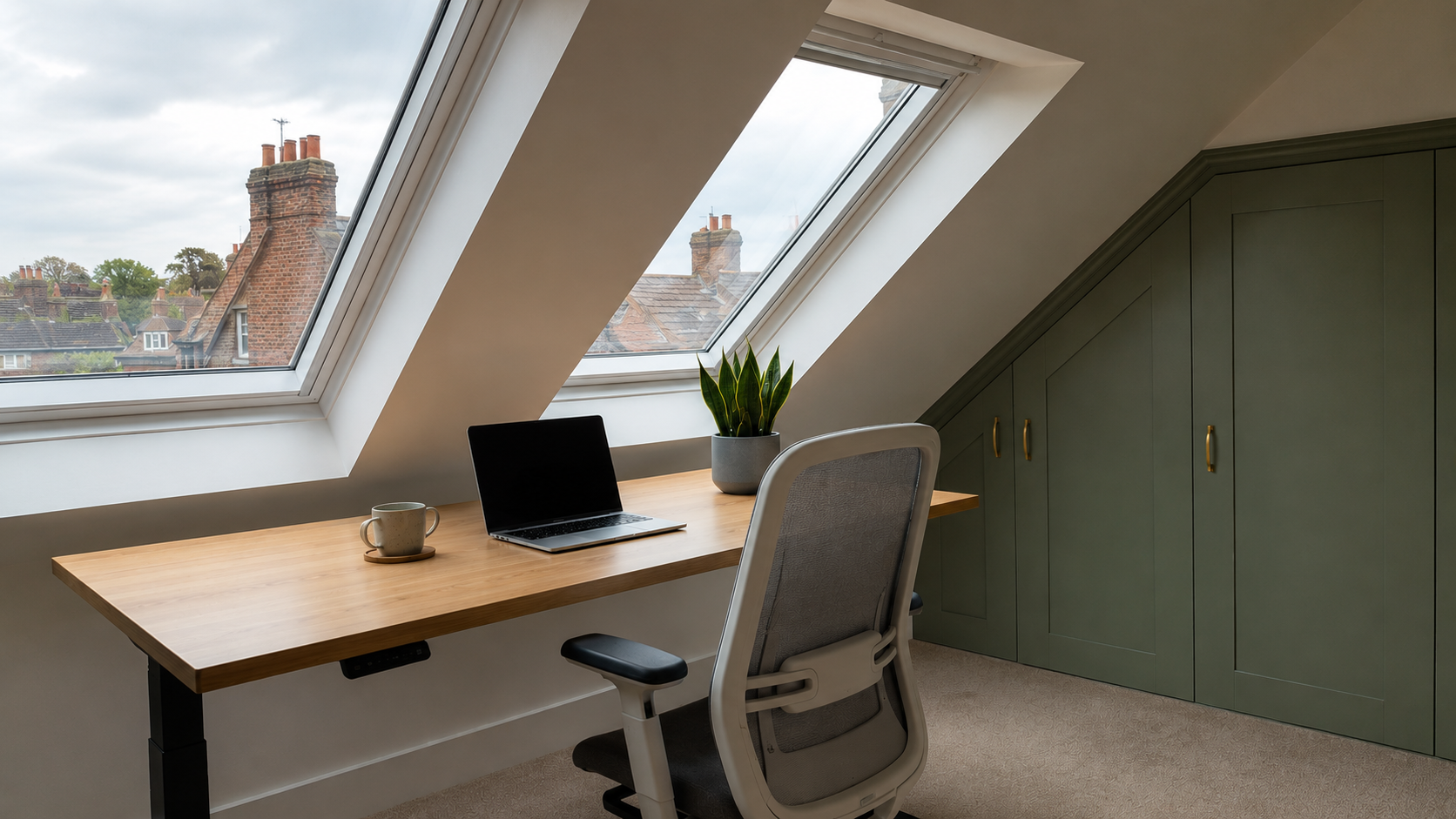
🔧 From a recent Buildaway project in SE10 (Greenwich): We surveyed a 1901 Victorian mid-terrace off Westcombe Park Road and measured 2.47m of usable ridge height – well above the 2.2m threshold. The property fell within an Article 4 Direction area, so a planning application to the Royal Borough of Greenwich was submitted before any site work began. Approval came through in seven weeks. Ceiling joists were then reinforced with new C24 timber alongside the originals. The completed project – a Velux conversion with two south-facing roof windows, a fixed staircase, and a wired ethernet point – handed over ten weeks after the planning consent was granted. The homeowner, a civil engineer commuting to Canary Wharf two days a week, now has a quiet top-floor office with a view of rooftops and no competition for desk space.
The infrastructure point that consistently comes up in Greenwich projects: older Victorian and Edwardian properties in SE10 have thick solid-brick party walls and multiple floor levels – a combination that reliably degrades wireless signal from the ground floor to the loft. Don't plan around a WiFi extender as a permanent solution. A wired Cat6 ethernet cable run back to the router during the build costs very little at that stage. After the walls are boarded and plastered, retrofitting it becomes a significant job. Specify it from the start and the problem never exists.
A loft home office conversion in Greenwich follows a structured 9-stage process from feasibility survey to final finishing – typically completed on site in 6 to 10 weeks. For properties requiring planning permission under Article 4 or conservation area rules, the determination period adds approximately 8 weeks before the on-site sequence begins. Structural reinforcement, staircase design, and data infrastructure are all fixed at the design stage and are not economical to change after boarding.
How Much Does a Loft Home Office Cost in Greenwich?
Costs in SE10 sit 15–20% above the national average for loft conversion work – a step above the 10–15% premium seen in the Bexley postcode area, reflecting the higher labour rates, materials logistics, and design demands of working within a World Heritage Site borough. Here's a clear breakdown by conversion type. For a full pricing guide, read our guide on loft conversion cost in Greenwich page.
| Conversion Type | Typical Greenwich Cost | Best For |
|---|---|---|
| Velux / Rooflight | £28,000–£40,000 | Victorian terraces in Westcombe Park and East Greenwich (SE10) with sufficient existing headroom and planning consent. Maintains the roofline character valued by the Royal Borough. |
| Dormer | £42,000–£58,000 | Edwardian semis near Maze Hill and Greenwich Park. Adds full standing headroom. Rear dormers are preferred in conservation area applications to minimise street impact. |
| Hip-to-Gable | £50,000–£68,000 | Detached and end-of-terrace homes in SE10. Maximum usable floor space; planning sensitivity is higher so design quality matters more here than in less constrained postcodes. |
Source: Checkatrade market data, 2025. Figures reflect Greenwich (SE10) labour, materials, and design rates including World Heritage Site borough premium.
The higher build cost in SE10 is offset by correspondingly stronger property values. A completed loft conversion adds up to 20% to property value in inner South East London, with an overall ROI of 60–75% (UK Home Improvement Index, 2025). On a Greenwich Victorian terrace valued at around £600,000, that's a potential £120,000 uplift against a spend of £45,000–£50,000. Greenwich property values are supported by proximity to Canary Wharf, excellent DLR and rail connections, and genuine scarcity of housing stock – factors that make the return on a completed, signed-off loft conversion more dependable here than in outer suburbs.
Loft home office conversions in Greenwich's SE10 postcode typically cost between £28,000 (Velux, Victorian terrace) and £68,000 (Hip-to-Gable, detached), reflecting a 15–20% World Heritage Site borough premium above the national baseline. A completed conversion adds up to 20% to property value with an ROI of 60–75%, and Greenwich's strong underlying property market supports that return (UK Home Improvement Index, 2025; Checkatrade market data, 2025).
Designing a Loft Home Office That Actually Works
The structural conversion creates the floor area. The design layer determines whether the room functions as a professional workspace or becomes an expensive spare room. Five decisions made at the design stage shape the outcome far more than any interior finishing choices made later.
Natural Light Direction
South- and east-facing Velux windows provide the most useful desk light across the winter months that define most of the working year in London. The steep-pitched Victorian rooflines common throughout SE10 accommodate well-positioned roof windows naturally. West-facing rooflights create the familiar afternoon problem – direct low sun into the screen during the second half of the working day. Given that most SE10 terraces run in consistent street orientations, checking the aspect of your rear roof slope during the design phase takes minutes and avoids years of having blinds permanently drawn during afternoon meetings.
Temperature Management
Top-floor rooms in Victorian and Edwardian terraces are thermally exposed – they heat quickly in summer and lose heat faster than the floors below in winter. A warm roof insulation system using 100mm+ PIR rigid board is the established standard for year-round comfort. A dedicated heating zone with its own thermostat is the other piece: running the loft office off the household programmer creates irreconcilable temperature conflicts between floors that never fully resolve themselves.
Acoustics
In the Victorian terraces that make up most of SE10's residential stock, the floor beneath the loft is typically a bedroom. A floating floor system with acoustic underlay reduces impact noise transfer – footsteps, chair movement, dropped items – from reaching the room below. It's a relatively low-cost line item at build stage that has a meaningful effect on how the household actually functions during working hours.
Connectivity
Run Cat6 ethernet from the router to the loft room during the build. Victorian solid-brick party walls and stacked floors create genuinely poor wireless propagation between the ground floor and the loft in most SE10 properties. This isn't something a modern mesh system fully overcomes. A hardwired data point is the reliable solution – and in a build context, it costs a fraction of what a post-completion retrofit involves.
💡 Our observation across Greenwich loft projects: The feedback we hear most consistently from SE10 homeowners six months after handover centres on two things – how much quieter the loft is than they expected, and how much they wish they'd specified wired ethernet at the design stage if they didn't. In Victorian terraces with thick walls and three floors between the router and the loft, wireless connectivity is genuinely unreliable. Specify Cat6 on the original drawings, and the problem simply doesn't arise.
Does a Loft Home Office Add Value to a Greenwich Home?
Unambiguously yes – and in SE10's competitive inner-London market, a properly converted loft office influences both the asking price and the buyer pool. Greenwich attracts a high proportion of buyers who commute to Canary Wharf, the City, or Central London on a hybrid basis, and a dedicated top-floor workspace is a genuine decision factor for this demographic.
A finished loft adds up to 20% to property value in inner South East London (UK Home Improvement Index, 2025). Over 35% of UK homeowners planning upgrades in 2025 named hybrid working as their primary motivation (Houzz UK survey, 2025). A CIPD study confirmed that 62% of UK employees perform better working from home – anchoring the long-term demand for home offices as a structural feature of the housing market rather than a passing trend (CIPD, 2025).
For buyers weighing up SE10 properties, the difference between a home that has a proper separate office and one that offers only a bedroom corner is tangible. Greenwich's mix of high-value Victorian stock, DLR and rail access to Canary Wharf and the City, and tight housing supply creates conditions where a well-converted loft commands a consistent premium at point of sale.
The non-negotiable condition: the loft must carry a Building Regulations completion certificate from the Royal Borough of Greenwich Building Control to count in a valuation, be included in habitable floor area, be covered by buildings insurance, and transfer cleanly on resale. An unconverted or improperly signed-off loft becomes a liability during conveyancing rather than an asset. Buildaway manages full Building Control sign-off on every Greenwich project from initial submission through to the final certificate. For a detailed ROI breakdown, see our guide on whether a loft conversion is still a smart investment in 2026 in Greenwich.
The Bottom Line for Greenwich Homeowners
A 15 to 20 square metre loft office in Greenwich – very achievable within the tall-pitched rooflines of SE10's Victorian and Edwardian stock – works entirely within the existing building footprint. No bedroom is lost. No garden is broken. These are the priorities that determine outcome, in order:
- Velux or Dormer Conversion: Match to your ridge clearance (2.2m minimum) and floor area requirement. In SE10, rear dormers are preferred over front-facing ones in conservation area applications.
- Planning First: Check Article 4 Direction status and conservation area designation before any design spend. Most SE10 properties need a planning application.
- Dedicated Access: A fixed staircase is mandatory – alternating-tread options work well in the tighter Victorian terrace footprint.
- Warm Roof Insulation: Specify 100mm+ PIR rigid board for year-round working comfort in a thermally exposed top floor.
- Wired Connectivity: Install Cat6 ethernet during the build – solid Victorian brickwork makes wireless unreliable across three floor levels.
- Acoustic Protection: Fit a floating floor with acoustic underlay where a bedroom sits directly below.
Budget £28,000–£40,000 for a Velux conversion or £42,000–£58,000 for a dormer, and factor in 8 weeks for planning determination if your property requires a formal application. Confirm your position with the Royal Borough of Greenwich Building Control (Woolwich Service Centre, 35 Wellington Street, Woolwich SE18 6HQ) before work begins.