
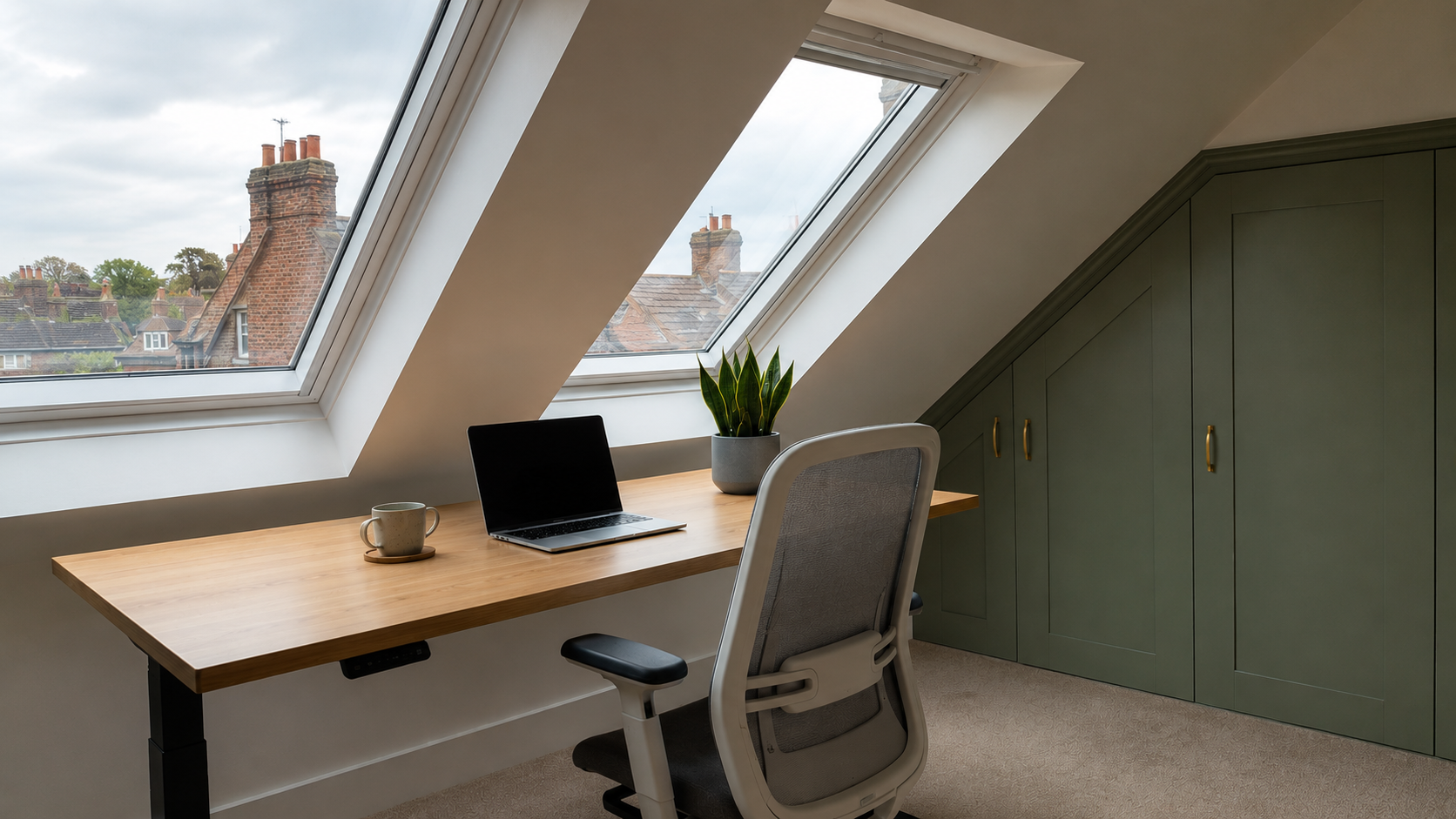
According to the Office for National Statistics, 40% of UK workers now work remotely at least part of the week - and in Battersea, where the Elizabeth line now connects Battersea Power Station directly to Bond Street in eleven minutes and Paddington in seven, the hybrid-working calculation has shifted considerably (ONS, 2025). SW11 homeowners have access to one of London's best-connected transport nodes: the Elizabeth line for the West End and Heathrow, Clapham Junction for Waterloo and the Overground, Queenstown Road for Victoria. The commute has been solved. The workspace, for most households in the Victorian terraces running off Northcote Road and Lavender Hill, has not.
Battersea's period homes were built for a different kind of daily life - and the loft void sitting above the top floor of most SW11 terraces has never been put to serious use. A loft home office changes that without reassigning a bedroom, annexing the garden, or compromising the floor plan that made the house worth buying in the first place. This guide covers the full picture for SW11 homeowners: structural suitability, Wandsworth's planning rules and how conservation area designations affect different streets, what the build involves at each stage, what it costs in the SW11 market, and what a finished conversion adds to your property's value.
Want to Know What Your Battersea Loft Can Deliver? Buildaway offers free, no-obligation loft assessments across Battersea, SW11, and surrounding areas. One survey. One team. One clear result.
TL;DR:
Converting an unused loft in Battersea into a home office typically costs between £32,000 and £70,000, depending on conversion type. It can add up to 20% to your property value, with an ROI of 60–75% (UK Home Improvement Index, 2025). Planning requirements in SW11 vary by street - some qualify under Permitted Development, others require full London Borough of Wandsworth consent. The build runs 6–10 weeks from survey to handover once consents are in place.
Is Your Battersea Loft Suitable for a Home Office?
SW11's housing stock is dominated by Victorian and Edwardian terraces - particularly in the streets running off Northcote Road, around Latchmere Road, and throughout the Broomwood and Nightingale areas. These are tall, well-proportioned period homes with steep roof pitches that create loft voids considerably more generous than their floor plan suggests from street level. Further toward Battersea Power Station and Nine Elms, the mix shifts toward purpose-built mansion blocks and newer developments - neither of which offers an individual loft space for conversion. This guide focuses on the terrace and semi-detached stock where conversion is viable. Three structural criteria must be confirmed before any plans are drawn.
1. Head Height
The working minimum at the ridge is 2.2 metres - the central spine of the roof where the desk and main workspace will sit. Building Regulations (Approved Document K) set a minimum of 2.0 metres above the staircase. SW11's Victorian terraces off Northcote Road, Sugden Road, and Shuttleworth Road routinely measure between 2.4 and 2.6 metres at the ridge - among the strongest structural starting points of any postcode in this series. The steeper the original roof pitch, the more usable floor area a conversion yields once the joists are in.
2. Floor Joist Capacity
Victorian and Edwardian properties across SW11 have ceiling joists in the loft - not floor joists. These are sized for the ceiling below, not for live and dead loads from an occupied room. A structural engineer inspects the existing members and specifies what reinforcement is required. In the overwhelming majority of Battersea period homes, new C24 floor joists are fitted alongside the originals as a standard part of any Building Regulations-compliant conversion. It is routine work.
3. Staircase Access
Building Regulations require a fixed permanent staircase for any habitable loft room. A retractable ladder - however neatly fitted - does not qualify. SW11's mid-terrace layouts typically have a first-floor landing that accommodates either a compact conventional staircase or, where the plan is tighter, an alternating-tread design that resolves access without meaningfully reducing the floor below.
Most Battersea loft conversions require floor joist reinforcement, a fixed staircase, and a minimum ridge height of 2.2 metres under Building Regulations (Approved Document K). The Victorian and Edwardian terraces across SW11 - off Northcote Road, Lavender Hill, and Latchmere Road - routinely exceed the 2.2m ridge threshold, making them structurally well-suited to loft home office conversion.
Do You Need Planning Permission for a Loft Home Office in Battersea?
This is the variable that most SW11 homeowners get wrong at the outset - and it is genuinely a street-by-street question rather than a blanket answer. London Borough of Wandsworth has designated several conservation areas across Battersea, each carrying Article 4 Directions that remove standard Permitted Development rights for loft alterations. Whether you need full planning consent depends on which side of a conservation area boundary your property sits.
Wandsworth's Conservation Areas in SW11
- Northcote Conservation Area - covering the streets around Northcote Road and much of the Battersea Rise area
- Battersea Village Conservation Area - around Battersea Church Road and the historic village core
- Broomwood Conservation Area - covering much of the Nightingale Lane area
- Latchmere Conservation Area - the streets around Latchmere Road toward Clapham Junction
Properties within any of these boundaries require a full planning application to London Borough of Wandsworth before a loft conversion can proceed. Properties outside all four designations can proceed under Permitted Development:
- Terraced houses (undesignated SW11 streets): up to 40m³ of additional roof volume
- Semi-detached and detached homes (undesignated): up to 50m³
- Materials must match the existing roof in type and appearance
- No raising of the existing ridge height
- Side-facing windows must not overlook a neighbouring garden at lower level
Check your conservation area status at the Planning Portal (gov.uk) and request a Lawful Development Certificate from Wandsworth if there is any uncertainty. Our guide on loft conversion planning in Battersea sets out the full boundary detail for each SW11 designation.
The planning approval picture is reassuring: nationally, 90% of householder applications were approved in Q3 2025 (Ministry of Housing, Communities & Local Government, 2025). Wandsworth conservation area applications using rear-facing Velux designs that preserve the front roofline consistently achieve consent. The designation adds time, not prohibitive risk.
Building Regulations approval applies regardless of whether planning consent is needed - covering structural performance, fire safety, insulation specification, and staircase compliance. Both must be correctly signed off for the conversion to be mortgageable, insurable, and legally sellable.
SW11 homeowners need to establish their conservation area status before proceeding. Properties within Wandsworth's Northcote, Battersea Village, Broomwood, or Latchmere conservation areas require full planning consent; those outside can proceed under Permitted Development. Where planning is needed, 90% of householder applications were approved nationally in Q3 2025 (MHCLG, 2025).
Not Sure Which Side of the Conservation Area Boundary Your SW11 Home Sits On? Our team maps this at every initial survey, before you commit to anything. Talk to Buildaway.
Step-by-Step: How a Battersea Loft Home Office Conversion Works
For properties outside conservation areas where PD applies, total project time from first survey to Building Control handover runs the standard 6–10 weeks. For conservation area properties requiring Wandsworth planning consent, allow 14–20 weeks in total - 8 to 10 weeks for the determination period, followed by the same 6–10 week construction phase. For a full week-by-week timeline, see our guide on how long a loft conversion takes in Battersea.
🔧 From a recent Buildaway project in SW11 (Sugden Road): We surveyed a 1901 Victorian mid-terrace and confirmed via the Wandsworth conservation area map that the property sat just outside the Northcote designation boundary - meaning Permitted Development applied. The existing ceiling joists were replaced with C24 floor joists throughout. Two south-facing Velux windows were installed, along with an alternating-tread staircase off the first-floor landing and a Cat6 ethernet socket wired back to the ground-floor router. No planning application was needed. Survey to Building Control handover: eight weeks. The homeowner, a marketing director commuting to the West End by Elizabeth line two days a week, now has 19 square metres of dedicated workspace at the top of the house.
One thing the Battersea planning picture makes genuinely important is the conservation area boundary check at the very first stage of a project. Streets within the same SW11 postcode can sit on opposite sides of a designation boundary - meaning one property needs planning consent and the neighbouring one does not. Getting this established at survey stage, before drawings are commissioned, avoids the cost and delay of submitting architectural work to the wrong process. It is the single most useful thing a Battersea homeowner can do before engaging a contractor.
A Battersea loft home office conversion follows a nine-stage sequence, with total duration ranging from 6 to 10 weeks (PD properties) to 14 to 20 weeks (conservation area properties requiring Wandsworth planning consent). Establishing conservation area status at the feasibility stage - before any drawings are produced - is the most impactful early decision for SW11 homeowners.
How Much Does a Loft Home Office Cost in Battersea?
Costs across SW11 sit 15–20% above the national average, consistent with Battersea's inner South-West London location and the labour market it draws from. The additional cost of a Wandsworth planning application - where required - adds a one-off professional fee to the front of the project rather than increasing the build cost itself. Here's a breakdown by conversion type mapped to SW11's actual housing stock. For full detail, see our loft conversion cost in Battersea guide.
| Conversion Type | Typical Battersea Cost | Best For |
|---|---|---|
| Velux / Rooflight | £32,000–£45,000 | Victorian terraces off Northcote Road, Lavender Hill, and Latchmere Road (SW11). Rear-facing only for conservation area properties. Clearest and fastest route to consent where planning is required. |
| Dormer | £45,000–£62,000 | Wider Victorian and Edwardian semis across SW11. Rear dormer adds full standing headroom and usable floor width. Requires sympathetic design for conservation area applications. |
| Hip-to-Gable | £52,000–£70,000 | Detached and end-of-terrace homes near Battersea Park and Clapham Common fringe. Maximum floor space gain. Typically combined with a rear dormer. |
Source: Checkatrade market data, 2025. Figures reflect SW11 labour, materials, and planning application costs where applicable.
The return on investment picture for Battersea is among the strongest in this series. A completed conversion adds up to 20% to property value in South-West London (UK Home Improvement Index, 2025). SW11 Victorian terraces regularly transact above £950,000 - meaning a 20% uplift represents a potential increase of £190,000 or more against a build spend of £35,000 to £50,000. Finish quality and market timing affect the real figure, but the underlying ratio makes Battersea one of the most financially compelling entries in this guide.
Loft home office conversions in Battersea SW11 typically cost between £32,000 (Velux, Victorian terrace) and £70,000 (Hip-to-Gable, larger semi or detached), with a 15–20% inner London premium. On SW11 property values, the potential 20% value uplift produces absolute returns that make Battersea one of the strongest ROI cases in this series (UK Home Improvement Index, 2025; Checkatrade, 2025).
Designing a Loft Home Office That Actually Works
Battersea's Victorian loft voids are excellent building material. The ridge heights are generous, the floor plans workable, and the steeper-pitched terraces off Northcote Road regularly yield 18 to 22 square metres once the floor is in. But the five design decisions that determine year-round usability apply here with full force - and two carry particular weight in the SW11 context.
Natural Light Direction
Rear-facing Velux windows are the planning-compliant choice for conservation area properties and, in the majority of SW11 terraces, the most practical one. Battersea's street grid runs in varied orientations, so which slope your rear roof faces depends on the specific road. South-facing rear slopes deliver the best natural working light year-round. East-facing rear slopes suit morning workers well - aligned with the rhythm of a standard working day. West-facing glazing creates the same persistent afternoon glare problem on video calls that appears in every period postcode in this series, and no standard blind solves it without eliminating most of the daylight at the same time.
Temperature Management
Victorian solid brick in SW11 loses heat faster in winter and absorbs it more readily in summer than cavity-wall construction. 100mm+ PIR rigid board in a warm roof configuration is the correct specification: it manages both temperature extremes in a single system and avoids the condensation risk at ceiling level that thinner or partial insulation approaches introduce in solid-brick period stock. A dedicated heating zone is equally necessary. Tying the loft to the main household thermostat creates a room that is consistently too warm when the rest of the house is comfortable, or too cold when it isn't.
Acoustics
In SW11's typical Victorian mid-terrace, the master bedroom sits directly below the loft void. A floating floor with acoustic underlay keeps your working hours - calls, movement, typing - from travelling down through the ceiling below. It is a consistent feature of well-specified SW11 conversions and consistently among the items homeowners are most satisfied with at the six-month review.
Connectivity
Solid Victorian brickwork and internal chimney stacks in Battersea's period terraces create reliable WiFi dead zones at loft height - the same pattern seen across every Victorian postcode in this series. A Cat6 ethernet cable routed during the build, while walls are open and cable paths are accessible, eliminates the problem at build cost. Retrofitting through Victorian solid plasterwork and timber floors once the project is complete is considerably more expensive and disruptive.
💡 Our observation across Battersea loft projects: The conservation area boundary question - determining whether planning is needed at all - is the single decision that most shapes total project duration in SW11. In projects where we confirmed PD status at survey stage and proceeded without a planning application, average time from survey to handover was eight weeks. In conservation area projects where planning was required, the average was seventeen weeks. Establishing this at the very first site visit is the most useful thing we do on a Battersea project.
Does a Loft Home Office Add Value to a Battersea Home?
In the SW11 market the answer is unambiguously yes - and the buyer profile here makes the financial case particularly clear. Battersea attracts professionals who have chosen to trade Chelsea and Fulham prices for period character and Battersea's own identity - Northcote Road's independent market, Battersea Park, and now the Elizabeth line connection that has reshaped the commuting equation for the western part of the postcode. For this buyer, a top-floor workspace on its own floor is not a cosmetic feature - it solves a real daily problem that the alternative properties they're considering cannot.
A loft conversion adds up to 20% to property value in South-West London (UK Home Improvement Index, 2025). Over 35% of UK homeowners planning upgrades in 2025 cited WFH requirements as their primary driver (Houzz UK, 2025). And 62% of UK employees say they perform better working from home (CIPD, 2025) - the workspace question is now embedded in how Battersea buyers evaluate a property before making an offer.
For SW11 specifically, the Elizabeth line has introduced a new buyer cohort: professionals who can now reach Paddington in seven minutes and Bond Street in eleven, who previously ruled out Battersea on commute grounds. These buyers are often arriving from flats and are purchasing a house in SW11 precisely for the space and the period character - a finished top-floor office is a feature that speaks directly to the way they intend to live in the property.
Before any value uplift is recognised at sale: Building Regulations sign-off from London Borough of Wandsworth Building Control must be in place for the room to count as habitable floor area in any RICS valuation or mortgage survey. Work completed without BCO sign-off creates legal complications during conveyancing. Buildaway manages full compliance on every SW11 project. For the full financial analysis, see our guide on whether a loft conversion is still a smart investment in 2026 in Battersea.
The Bottom Line for Battersea Homeowners
A Battersea loft home office is a strong project on almost every metric - excellent period loft stock, compelling ROI at SW11 property values, and a buyer market that actively searches for dedicated workspace. The one step that distinguishes Battersea from simpler postcodes is the conservation area check, which must happen before any drawings are produced. After that, the process is the same well-defined sequence. In order of priority:
- Check Conservation Area Status First: Establish whether your SW11 street requires Wandsworth planning consent or qualifies under PD - before engaging an architect or contractor.
- Velux or Rear Dormer: Rear-facing designs satisfy Wandsworth's conservation guidelines consistently. Match the type to your ridge height and floor area goal (2.2m ridge minimum).
- Warm Roof Insulation: 100mm+ PIR rigid board - non-negotiable in Victorian solid-brick period stock.
- Cat6 Ethernet: Routed during the build from ground-floor router to loft. Victorian brickwork makes post-completion retrofits expensive.
- Acoustic Flooring: Floating floor with acoustic underlay where the master bedroom sits directly below the loft void.
Budget £32,000–£45,000 for a Velux conversion or £45,000–£62,000 for a rear dormer, and allow 8 to 10 additional weeks for Wandsworth planning consent where your street requires it. Confirm your Building Regulations compliance with London Borough of Wandsworth Building Control (The Town Hall, Wandsworth High Street, SW18 2PU) before work begins.