
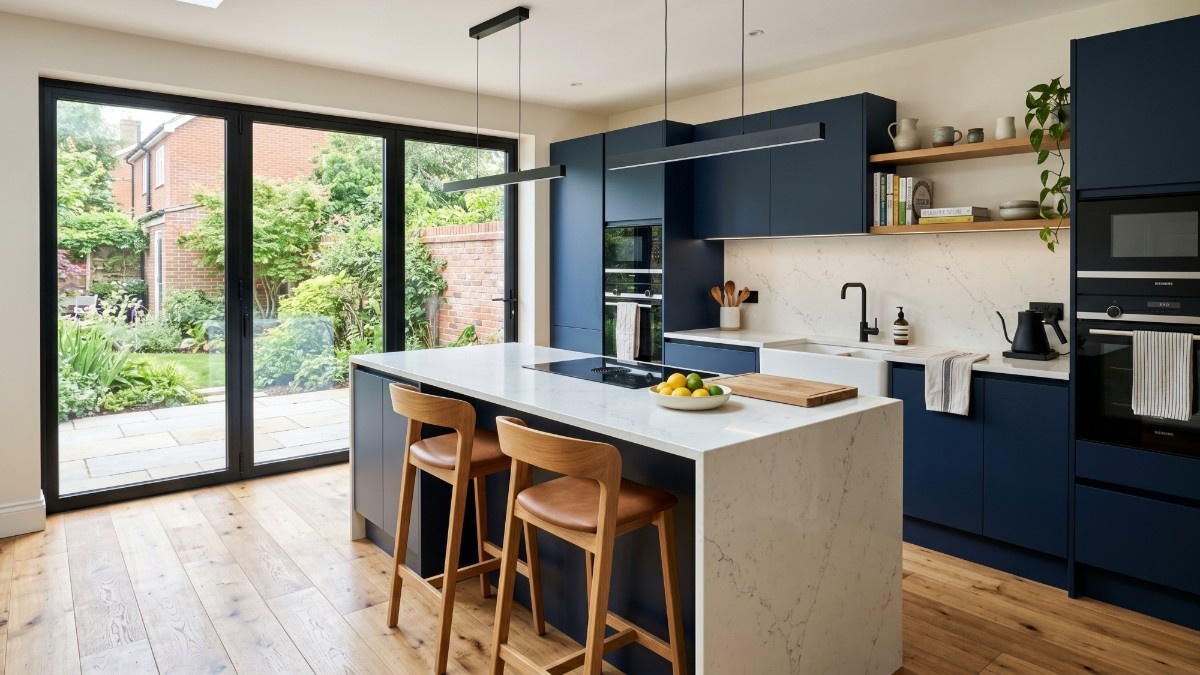
Nearly a quarter of UK homeowners planned a new kitchen in 2025 but most underestimated the timeline by three to four weeks (Hafele UK Homes for Living Report, 2024). In Leyton where E10 carries a dense concentration of late-Victorian and Edwardian terraces around Leyton High Road, Vicarage Road, and Oliver Road, a broad band of 1930s semi-detached homes spreading through Colworth Road and Dawlish Road toward Leytonstone, and a further layer of post-war properties around the Cathall Road corridor the gap between what homeowners expect and what the programme actually delivers is one we encounter consistently across east London.
Search any renovation forum and you'll find timelines ranging from "four weeks" to "six months." Both are real. Neither is useful unless you know which category your Leyton property falls into and what the E10-specific variables mean for your schedule.
This guide covers every stage honestly. By the end, you'll know exactly how long your kitchen renovation will take in Leyton and what to do now to keep delays off the programme.
See our full service: Buildaway kitchen fitters in Leyton
Key Takeaways
A standard kitchen renovation in Leyton takes 6–12 weeks from your first consultation to handover roughly 1–2 weeks for design sign-off, 2–4 weeks to order and receive materials, and 4–8 weeks on-site. The Victorian and Edwardian terraces around Leyton High Road and Vicarage Road typically run in the upper half of that range. The 1930s semis across Colworth Road and Dawlish Road sit more reliably in the middle. Post-war properties on the Cathall Road side tend to be the most predictable, though they carry their own first-fix variables. Get a free, no-obligation timeline from Buildaway.
Want to skip the guesswork? Get your free Buildaway timeline estimate →
The Short Answer: How Long Does a Kitchen Renovation Take?
Every kitchen renovation falls into one of three tiers, each with a very different total duration. The on-site build phase demolition, first fix, fitting, and finishing is only one of them. Design sign-off and material ordering typically double the overall project length before a single unit goes in.
| Project Type | On-site duration | Full timeline (inc. planning) |
|---|---|---|
| Cosmetic refresh (doors, worktops, splashback) | 2–5 days | 2–4 weeks |
| Standard renovation (new units, electrics, plumbing) | 4–8 weeks | 8–12 weeks |
| Major renovation (structural, open-plan, extension) | 8–16 weeks | 4–6 months |
A standard UK kitchen refit runs 3–8 weeks for the build phase alone, with planning, lead times, and approvals adding substantial time upfront (Kitchling, 2025). That's the number to anchor your planning around not the "four weeks" figure that circulates on renovation forums and routinely sets the wrong expectation.
A standard kitchen renovation covering new cabinets, worktops, and appliances with adjusted plumbing and electrical work typically takes 4–8 weeks on-site and 8–12 weeks in total once design, ordering, and lead times are factored in (Kitchling, 2025). In Leyton, where Victorian and Edwardian terraces make up the bulk of the most-renovated housing in E10, projects in the older stock around Leyton High Road and the Leyton Conservation Area regularly run toward the upper half of that range.
Buildaway manages every stage from initial design through to final snagging under one point of contact nothing slips between trades while you wait for an update.
Read more: How much does a kitchen renovation cost in Leyton?
Stage by Stage: What Actually Happens and When
The chart below shows how a standard and a major Leyton kitchen renovation typically develop across twelve weeks. Review this before you commit to a start date.
Stage 1 Design and Planning (1–4 Weeks)
More projects lose time here than at any other stage not on-site, but before the first tradesperson arrives. Agreeing a layout, confirming cabinet finishes, locking appliance specifications, and returning signed drawings can take one week with clear preferences in place, or up to four weeks when decisions keep drifting. The message Buildaway gives every Leyton client from the first meeting: every week spent revising in design is a week added directly to your handover date, because fabrication cannot start until drawings are signed off.
In Leyton's Victorian and Edwardian terraces where kitchens are typically arranged in a long back-to-back format with a rear return, and where original features sometimes constrain where services can realistically run design sign-off requires a degree of care that a modern flat layout doesn't. The strongest designers arrive with two or three concrete layout options and full elevations from the first session, not an open-ended process that drifts across multiple rounds of revision.
Stage 2 Ordering and Lead Times (2–4 Weeks)
Material lead times are the most consistently underestimated element of any kitchen project. Standard UK cabinetry arrives in two to four weeks from regional suppliers. Semi-bespoke or bespoke cabinetry increasingly the choice in Leyton's larger Victorian terraces as the area attracts a more design-conscious buyer runs six to ten weeks. High-specification German kitchen ranges or hand-painted British units carry lead times of twelve to sixteen weeks (Checkatrade, 2025).
A Which? survey of UK Trusted Traders in 2025 found most kitchen fitters already booked two to three months ahead one was committed more than five months in advance. The practical conclusion on every Leyton project: order materials the moment your budget is confirmed, not after demolition has started.
Stage 3 On-Site Build Phases (4–8 Weeks)
This is what homeowners picture when they imagine the renovation. In practice it moves through seven sequential sub-phases, each entirely dependent on the previous one being complete.
Demolition and prep runs one to three days in a standard Leyton kitchen typically at the faster end in the 1930s semis of Colworth Road and Dawlish Road, and more variable in the Victorian terraces around Oliver Road and Vicarage Road where original structural elements surface behind first finishes. First fix plumbing runs, structural adjustments, and electrical rewiring takes three to five days and must be fully complete before plastering begins. Plastering and drying adds up to a week; walls must cure fully before units are fixed or the finish will move. Unit installation takes two to four days once all surfaces are properly set. Then comes the item that sets your finish date: worktop templating, fabrication, and installation. Stone and composite worktops can only be measured accurately once cabinets are fixed in their final position. Fabrication runs seven to fourteen days. Installation follows. Three weeks from template to fitted worktop is the standard expectation. Second fix sink, taps, appliances, and gas connection takes two to three days. Tiling, splashback, silicone, and snagging closes out at two to four days.
From our project records: Buildaway's last twelve completed kitchen renovations in Leyton averaged 7.4 weeks from sign-off to handover. The two longest both in Victorian mid-terraces on Oliver Road in E10 reached ten weeks, largely because cast-iron drainage stacks concealed inside the rear party walls required rerouting before the new kitchen layouts could be properly set out. The fastest was a full refresh in a post-war mid-terrace on the Cathall Road side of E10, completed in nine working days on-site.
What Makes Leyton Kitchen Renovations Take Longer?
Leyton is one of east London's most clearly defined postcodes in terms of housing character. E10 runs from the Victorian and Edwardian terrace streets clustered around Leyton High Road, Vicarage Road, and the parish church of St Mary the Virgin the historic core of the area through a broad inter-war belt of 1930s semi-detached homes that developed rapidly across Colworth Road, Dawlish Road, and Abbots Park Road as the Central line drove suburban expansion eastward. A further layer of post-war and 1960s–70s housing fills in the streets around Cathall Road and the Harrow Road corridor toward Leytonstone.
Each era of build carries different renovation variables, and the difference between a Victorian Oliver Road terrace and a 1960s Cathall Road house is significant enough to move the total project duration by two to three weeks.
Victorian and Edwardian terrace factor Leyton High Road and Vicarage Road area: The late-Victorian and Edwardian terraces concentrated in the streets around Leyton High Road, Vicarage Road, Oliver Road, and Newport Road run 15–20% longer than modern builds of equivalent footprint (Checkatrade, 2025). Demolition day in these properties consistently surfaces rear additions with undocumented drainage routes built during later decades without plans, original cast-iron soil stacks inside rear party walls, and lath-and-plaster walls in the ground-floor rear room where plasterboard was assumed. Suspended timber ground floors standard in all pre-1914 E10 terraces sit above service voids that only reveal their contents when the boards come up on first-fix day. Something unexpected surfaces on the large majority of first-fix days in Leyton's Victorian and Edwardian stock.
Leyton Conservation Area: The Leyton Conservation Area covers the historic core of the area broadly, the streets around St Mary's Church on Church Road, sections of Leyton High Road, and the Victorian terrace streets in the immediate vicinity. The London Borough of Waltham Forest administers the Conservation Area designation, and any external alteration within the boundary a new extraction duct through a rear wall, a replacement window, or a structural opening that affects the building's character may require Conservation Area Consent. Planning applications in London average eight to thirteen weeks to determine (Ministry of Housing, Communities & Local Government, 2025). If your kitchen design involves any external penetration and your property sits within the Leyton Conservation Area, raise the consent question before drawings go anywhere near fabrication.
Inter-war semis on Colworth Road and Dawlish Road: The 1930s semi-detached stock running through the middle belt of E10 carries the most predictable renovation profile in the postcode. These properties are straighter to plan around than the Victorian terraces but they carry their own consistent variables. Back additions built onto the original semi footprint at various points since the 1940s frequently contain drainage runs and service connections that aren't on any drawing. Chimney alcoves built into the original kitchen or the adjoining reception room standard in 1930s semis across east London are present in the majority of Colworth Road and Dawlish Road properties, and a significant proportion conceal an original redundant flue or a service run that wasn't accounted for in the layout. Suspended timber ground floors are again standard in this era, hiding service voids that only surface on first-fix day.
Post-war and 1960s–70s stock near Cathall Road: The post-war properties on the Cathall Road side of E10 generally carry the most predictable first-fix profile in Leyton. No suspended floor voids, no lath-and-plaster walls, and service runs that while not always well-documented are easier to trace than in pre-war construction. That said, properties of this era often used non-standard boiler and heating configurations that don't lend themselves to modern kitchen layouts without replumbing, and older electrical installations in 1960s–70s properties routinely need partial rewiring before a modern kitchen circuit can be safely installed. Budget for an electrical inspection before demolition begins on any E10 property built before 1980.
Waltham Forest planning and access logistics: Leyton sits within the London Borough of Waltham Forest. The narrower terrace streets around Oliver Road, Newport Road, and the streets running off Leyton High Road carry access constraints for skip placement and large material deliveries stone worktop slabs and full kitchen unit packs require pre-confirmed access on these streets. A skip permit from Waltham Forest Council is required on any public road in E10. Confirming delivery logistics before the start date is set avoids the last-minute adjustments that quietly cost a day or two of progress. Logistics constraints can add up to three weeks on constrained London projects (Checkatrade, 2025).
Labour availability: The FMB/CIOB 2025 State of Trade Survey found 61% of UK construction firms affected by skilled trade shortages. In Leyton, where renovation activity has grown significantly since the area gained wider popularity through the Olympic legacy years, quality kitchen fitters are consistently stretched. Booking eight to twelve weeks ahead is not over-cautious it's the minimum to secure the people you want.
Cormac's note: In the Victorian terraces off Oliver Road and around Vicarage Road in E10, the variable that consistently catches projects out is the same one we see across the Victorian terrace belt throughout east London the rear party wall. Every Victorian terrace in this part of Leyton was originally drained through cast-iron stacks that run through the rear party wall cavity rather than the floor. Any kitchen layout that pushes the sink or the dishwasher close to that rear wall which is almost every layout will encounter that stack. We identify its position during the initial site survey and build the rerouting into the programme before the drawings go to fabrication. Flagging it early means a known cost and a managed extra day, not a mid-project surprise.
The 5 Most Common Causes of Kitchen Renovation Delays
One industry study found that 85% of kitchen renovations take longer than planned (180 Kitchens, 2025). In Leyton, where Victorian terraces, 1930s semis, and post-war properties sit side by side and each carry a different structural profile, that figure tracks closely with what we see in our own records. The more useful question is which causes are within your control and which simply need contingency built into the schedule.
1. Late design changes after fabrication begins (~35%): Once cabinet carcasses and doors enter production, changing a colour, a handle, or an internal configuration adds two to four weeks of re-manufacturing delay. On bespoke or semi-bespoke cabinetry increasingly the choice in Leyton's Victorian terraces as the area continues to attract design-conscious buyers that window can extend to six weeks. Lock every detail before production drawings are signed: handle finish, hinge direction, bin size, appliance cutout dimensions, drawer inserts. After that point, the specification is fixed.
2. Material and appliance delivery failures (~25%): A worktop slab arrives damaged and needs re-cutting to order. An integrated oven model is discontinued partway through the project. A tile batch from the same supplier is a slightly different shade to the original. Getting written delivery confirmations from every supplier before demolition day, not after removes the majority of this risk from the programme entirely.
3. Hidden structural issues on demolition day (~20%): This variable cannot be designed away only planned for. A 10–20% contingency on both budget and timeline is the standard benchmark for London's pre-war housing stock (Mimar, 2025). In Leyton's Victorian and Edwardian terraces, something unexpected surfaces on a significant proportion of first-fix days. In the 1930s semis, the rate is lower but the chimney alcove variable means it's never reliably zero. In the post-war stock near Cathall Road, the profile is different but electrical and heating plant variables introduce their own equivalent surprises.
4. Trade scheduling gaps (~12%): When one trade finishes on a Thursday and the next isn't free until Tuesday of the following week, four working days of on-site progress disappear with nothing happening. A single-contractor model where all trades are booked, managed, and sequenced by one point of contact on a shared programme eliminates the large majority of these gaps before they open up.
5. Permit and sign-off delays (~8%): Waltham Forest Council skip permits on E10 streets, LABC sign-offs on gas or electrical installations, Conservation Area Consent applications for properties within the Leyton Conservation Area, or Lawful Development Certificates for external alterations. Each carries a fixed process duration that cannot be shortened once it's started. All of them are entirely manageable but only when they're identified at the design stage and initiated before demolition begins.
Late design changes specification decisions made after cabinet fabrication has already started account for approximately 35% of kitchen renovation overruns across residential projects (Buildaway project data, 2026). In Leyton's Victorian back-return terraces, where the narrow rear addition format typically requires at least one bespoke unit configuration to make full use of the space, a single late revision to a tall larder unit or a corner solution triggers a full re-manufacturing cycle two to four weeks on standard product, up to six weeks on semi-bespoke finishes. Lock every detail before drawings are approved.
How to Prepare Your Home (and Life) for the Renovation
A well-prepared property keeps trades on rhythm from the first morning. One that isn't ready when contractors arrive loses momentum that is difficult to recover before handover.
Set up a temporary kitchen before demolition. A microwave, a portable induction hob, a kettle, and a fridge will carry you through the full build. Budget between £200 and £500 for second-hand or rented equipment (Better Homes Studio, 2025). In Leyton's Victorian terraces, the front reception room typically handles temporary kitchen duty without significantly disrupting the rest of the house. In the 1930s semis with larger ground floors, a dining room corner works well. Expect one to two weeks of limited sink access at the height of the first-fix phase.
Build a contingency buffer before the first payment leaves your account. A 10–20% reserve on both budget and timeline is the accepted standard for pre-war London housing stock (Mimar, 2025). If you're planning a £24,000 kitchen, keep £2,400–£4,800 in reserve. If your target is ten weeks, allow mentally for twelve. Contingency you don't spend is a good outcome. Contingency you didn't set aside is a problem that typically arrives at the worst possible point in the project.
Confirm every specification detail before signing production drawings. Handle finish, hinge direction, bin configuration, appliance brand and model, worktop edge profile, tile grout colour all of it must be agreed and recorded before fabrication starts. The most common late change on Leyton's Victorian terrace projects? A homeowner switching from a contemporary flat-slab door to a shaker profile after the original specification has already gone to production. Switching at that point restarts the manufacturing clock, with a two to four week penalty on standard product and up to six weeks on painted finishes.
Protect your floors and seal adjoining rooms before day one. Leyton's Victorian and Edwardian terraces often carry original timber floors in hallways and reception rooms, along with decorative tiling at the front entrance. Confirm that site protection is explicitly included in your contractor's scope before works begin don't assume it's covered.
Stay contactable for quick decisions during the first week on-site. Socket positions, hinge swing directions, extractor vent routing questions that take five minutes on-site and can take days to undo if left unresolved. Keep your mornings available for a brief check-in with the site lead throughout the first week of the build.
Buildaway walks you through every one of these preparation steps before any work begins. Book your free, no-obligation quote →
Read more: Common kitchen renovation mistakes
When Should You Start Planning? Booking Lead Times for Leyton
The practical rule: begin planning three to four months before you want a finished kitchen. For structural or open-plan work rear extensions, wall removals, or any project involving external changes within the Leyton Conservation Area allow five to six months minimum.
Why that far ahead? Quality kitchen fitters across Leyton and east London are consistently booked two to three months in advance (Which?, 2025). Add bespoke material lead times of four to sixteen weeks and the arithmetic leaves no slack. A September finish needs planning underway by April or May at the latest not July.
On timing your Leyton kitchen renovation: Late summer August through early October historically sees fewer competing renovation projects across inner east London than the pre-Christmas surge, which begins pushing fitter availability hard from October onwards. If you start planning in May or June and target an August on-site start, you'll typically find your preferred tradespeople accessible and material suppliers less stretched than they are in the final quarter of the year. Projects commissioned in October for a November or December handover in Leyton almost always involve compromises on fitter availability, on material selection, or on both. Demand for kitchen renovations in E10 has grown notably since the Olympic legacy period, and the best east London fitters are no longer easy to secure at short notice.
The highest-rated Leyton kitchen fitters those with strong records on Checkatrade and Houzz are rarely available with fewer than eight weeks' notice. For properties within the Leyton Conservation Area, Victorian terrace renovations involving rear party wall work on Oliver Road or Vicarage Road, or any project with Conservation Area Consent implications, ten to twelve weeks of planning lead time is the safer minimum.
Buildaway's free, no-obligation quote includes a realistic start date for your E10 property and a slot hold so your decision isn't made under time pressure when the moment arrives.
Read more: How bathroom renovation timelines compare
Conclusion: Your Leyton Kitchen Renovation, Planned Properly
A kitchen renovation in Leyton is one of the most effective improvements you can make to an E10 property and one of the easiest to underestimate on time. Here's the honest summary:
- Standard renovation: 4–8 weeks on-site; 8–12 weeks total including design and ordering
- Major or structural renovation: 8–16 weeks on-site; 4–6 months total
- Victorian and Edwardian terraces around Leyton High Road, Oliver Road, and Vicarage Road run 15–20% longer than modern builds rear party wall drainage stacks and suspended floor voids are the most consistent reasons
- 1930s semis across Colworth Road and Dawlish Road are more predictable but still carry chimney alcove and back addition variables worth building contingency for
- Post-war properties near Cathall Road run the most predictably but should have an electrical inspection before demolition begins if built before 1980
- Book your kitchen fitter 8–12 weeks before your target start date earlier for Conservation Area projects or Victorian terrace work in the Oliver Road and Vicarage Road area
- Set aside a 10–20% contingency on both budget and timeline; in Leyton's pre-war housing stock it's not pessimism it's accurate planning from day one
- The biggest delays are preventable: lock your full specification before fabrication begins, order materials as soon as budget is confirmed, and use a contractor who coordinates all trades under one programme
Buildaway works across Leyton and east London from the Victorian terraces around Leyton High Road to the 1930s semis of Colworth Road and the post-war stock near Cathall Road. We know the London Borough of Waltham Forest's planning process, the Conservation Area requirements in the historic core of E10, and the structural variables that make period Leyton kitchens a different kind of project to a straightforward modern refit.
Planning a kitchen renovation in Leyton? Buildaway offers a free, no-obligation quote with a clear timeline estimate tailored to your E10 property and its specific variables. One quote. One point of contact. One clear process. Get your free Buildaway quote →
See our full service: Buildaway kitchen fitters in Leyton