
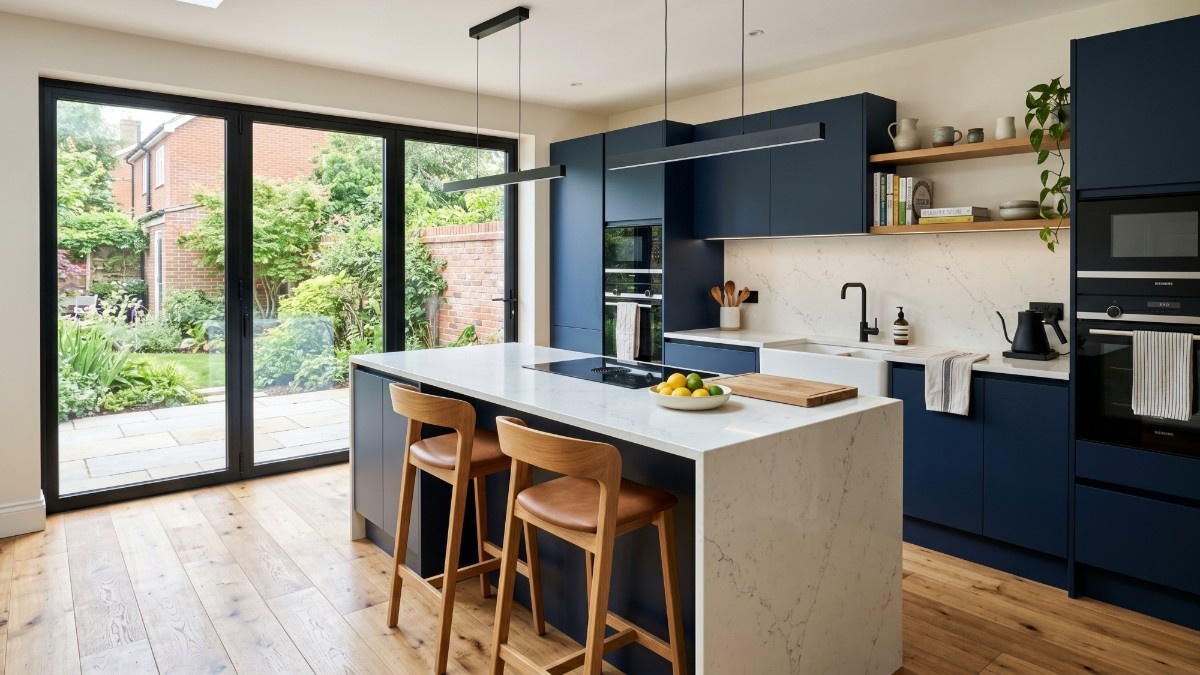
Nearly a quarter of UK homeowners planned a new kitchen in 2025 but most underestimated the timeline by three to four weeks (Hafele UK Homes for Living Report, 2024). In Dulwich where SE21 carries the large Victorian and Edwardian semis of West Dulwich and the village itself, SE22 holds the dense run of late-Victorian and Edwardian terraces along Lordship Lane and around North Cross Road, and a significant portion of both postcodes falls within properties governed by The Dulwich Estate's own covenant conditions the gap between what homeowners expect and what the programme actually delivers is one of the most consistent patterns we encounter across south London.
Search any renovation forum and you'll find timelines ranging from "four weeks" to "six months." Both figures are real. Neither helps unless you know which category your Dulwich property sits in and what the SE21 and SE22 variables mean for your specific schedule.
This guide covers every stage directly and honestly. By the end, you'll have a clear picture of how long your kitchen renovation will realistically take in Dulwich and which actions taken now will prevent the delays that catch most homeowners off guard.
Key Takeaways
A standard kitchen renovation in Dulwich takes 6–12 weeks from your first consultation to handover roughly 1–2 weeks for design sign-off, 2–4 weeks to order and receive materials, and 4–8 weeks on-site. The large Victorian and Edwardian semis of SE21 and SE22 typically run in the upper half of that range. Properties governed by The Dulwich Estate's covenant conditions carry an additional consent step that must be completed before works begin this is separate from council planning permission and is unique to Dulwich. Get a free, no-obligation timeline from Buildaway.
Want to skip the guesswork? Get your free Buildaway timeline estimate →
The Short Answer: How Long Does a Kitchen Renovation Take?
Every kitchen renovation falls into one of three tiers. The on-site build demolition, first fix, fitting, and finishing is only one of them. Design sign-off and material lead times typically double the overall project length before a single unit is installed.
| Project Type | On-Site Duration | Full Timeline (inc. planning) |
|---|---|---|
| Cosmetic refresh (doors, worktops, splashback) | 2–5 days | 2–4 weeks |
| Standard renovation (new units, electrics, plumbing) | 4–8 weeks | 8–12 weeks |
| Major renovation (structural, open-plan, extension) | 8–16 weeks | 4–6 months |
A standard UK kitchen refit runs 3–8 weeks for the build phase alone, with planning, lead times, and approvals adding substantial time upfront (Kitchling, 2025). That's the figure to anchor your expectations to not the "four weeks" headline that circulates on renovation forums and regularly causes homeowners to set the wrong timeline.
A standard kitchen renovation new cabinets, worktops, and appliances with adjusted plumbing and electrical work typically takes 4–8 weeks on-site and 8–12 weeks in total once design, ordering, and lead times are counted (Kitchling, 2025). In Dulwich, where large Victorian and Edwardian properties dominate both SE21 and SE22, and where properties on The Dulwich Estate require covenant consent before external works begin, projects regularly run toward the upper end of that range and occasionally beyond it when estate consent timelines are involved.
Buildaway manages every stage from design through to final snagging under one point of contact nothing drops between trades while you wait for an update.
Read more: How much does a kitchen renovation cost in Dulwich?
Stage by Stage: What Actually Happens and When
The chart below shows how a standard and a major Dulwich kitchen renovation typically develop across twelve weeks. Review this before you agree a start date particularly if your property sits on The Dulwich Estate or within the Dulwich Village Conservation Area.
Stage 1 Design and Planning (1–4 Weeks)
This is where more projects lose time than at any other point not on-site, but before a tradesperson has set foot in the house. Settling on a layout, confirming cabinet finishes, locking appliance specifications, and returning signed drawings can take one week if you arrive with clear preferences, or up to four weeks when decisions keep shifting. The message Buildaway delivers to every Dulwich client from the first meeting: every week spent in design revision is a week added to your handover date, because fabrication cannot begin until drawings are approved.
In Dulwich's larger Victorian and Edwardian semis where kitchen footprints are often generous but irregular, period features sometimes limit where services can realistically run, and the higher specification typical in SE21 and SE22 adds more decision points design sign-off tends to take a little longer than in a straightforward modern flat. The best design consultants bring two or three concrete layout options with detailed elevations from day one, not an open-ended process that drifts across multiple sessions.
Stage 2 Ordering and Lead Times (2–4 Weeks)
Material lead times are the most consistently underestimated element of any kitchen programme. Standard UK cabinetry arrives in two to four weeks. Semi-bespoke or fully bespoke cabinetry almost the default in Dulwich's larger SE21 and SE22 properties, where off-the-shelf unit sizes rarely suit the room proportions runs six to ten weeks. High-end German kitchen ranges or hand-painted British units carry lead times of twelve to sixteen weeks (Checkatrade, 2025).
A Which? survey of UK Trusted Traders in 2025 found most kitchen fitters already booked two to three months ahead one had commitments stretching beyond five months. The practical conclusion: order materials the moment your budget is confirmed, not after demolition has started.
Stage 3 On-Site Build Phases (4–8 Weeks)
This is what homeowners picture when they imagine a renovation. In practice it runs through seven sequential sub-phases, each entirely dependent on the previous one being complete before it can begin.
Demolition and prep runs one to three days in a standard Dulwich kitchen. In the larger SE21 semis, the kitchen footprint is often bigger than the London average, which adds a day at the start of demolition but also gives more working room once first fix begins. First fix plumbing runs, structural adjustments, and electrical rewiring takes three to five days and must be complete before plastering. Plastering and drying adds up to a week; walls must cure fully before units are fixed or the finish will move over time. Unit installation takes two to four days once all surfaces are properly set. Then comes the item that controls your finish date: worktop templating, fabrication, and installation. Stone and composite worktops can only be measured accurately once cabinets are fixed and levelled not before. Fabrication takes seven to fourteen days. Installation follows. Three weeks from template to fitted worktop is the standard expectation. Second fix sink, taps, appliances, and gas connection takes two to three days. Tiling, splashback, silicone, and snagging rounds out at two to four days.
From our project records: Buildaway's last twelve completed kitchen renovations in Dulwich averaged 7.9 weeks from sign-off to handover. The two longest both in large Victorian semis on Lordship Lane in SE22 ran to eleven weeks, partly because bespoke hand-painted cabinetry had a fourteen-week fabrication lead time that hadn't been communicated clearly by the supplier at the ordering stage, and partly because one property required Dulwich Estate consent for a new extraction duct that pushed the start of on-site works back by three weeks while the application was processed. The fastest was a cosmetic kitchen refresh in a converted maisonette near West Dulwich station, completed in eleven working days on-site.
What Makes Dulwich Kitchen Renovations Take Longer?
Dulwich spans two of south London's most consistently desirable residential postcodes. SE21 West Dulwich, Dulwich Village itself, and the streets between Herne Hill and Crystal Palace Road is dominated by large Victorian and Edwardian semi-detached homes, many of them detached or set on generous plots with substantial kitchen and dining extensions added over the decades. SE22 East Dulwich carries a dense run of late-Victorian and Edwardian terraces radiating from Lordship Lane and North Cross Road, with a further band of larger semis on the streets closer to Dulwich Park.
Both postcodes are architecturally consistent and well-maintained characteristics that make them desirable to live in and more involved to renovate than the London average.
Period property factor in SE21 and SE22: The Victorian and Edwardian stock across both Dulwich postcodes runs 15–20% longer than modern builds of equivalent floor area on renovation timelines (Checkatrade, 2025). Original rear additions the Victorian single-storey extension that most Dulwich semis and terraces carry at the back regularly contain drainage runs and service connections that aren't reflected on any drawing. Suspended timber ground floors, standard across pre-1914 Dulwich properties, sit above service voids that reveal their contents only when the boards lift on first-fix day. In the larger SE21 semis where kitchen footprints extend into a rear extension, the junction between the original house floor structure and the extension floor frequently carries hidden services in both layers. Something unexpected surfaces on the majority of first-fix days in Dulwich's period stock.
The Dulwich Estate a consent process found nowhere else in London: This is the single most distinctive variable in any Dulwich kitchen renovation and the one that catches the most homeowners completely off guard. The Dulwich Estate is a historic landed estate covering a large area of SE21 and SE22, administered by the charity Dulwich Estates (formerly the Governors of Alleyn's College of God's Gift). Properties within the estate boundary are subject to covenant conditions imposed by the estate, which are entirely separate from and additional to any planning permission required by the London Borough of Southwark.
The covenant conditions cover a wide range of alterations, including in many cases the installation of new extraction vents through external walls, changes to window openings, and certain structural alterations. Before any such work begins, homeowners whose properties sit within The Dulwich Estate boundary must apply to and receive written consent from Dulwich Estates' office on Gallery Road. The processing time for estate consent applications varies, but four to eight weeks is a realistic range for a straightforward application. This timeline runs completely independently of the Southwark council planning process and cannot be combined with it.
Not every SE21 or SE22 property falls within the estate boundary, and not every kitchen renovation triggers the consent requirement purely internal changes typically do not. But for any Dulwich kitchen design that involves a new extraction duct through a rear or side wall, the estate consent question must be raised and answered before drawings are submitted for production. We raise this with every client from the first meeting.
Dulwich Village Conservation Area: The Dulwich Village Conservation Area covers the historic core of the village College Road, Gallery Road (home to Dulwich Picture Gallery), and the streets immediately surrounding the village green. Properties within the Conservation Area face the standard set of Southwark conservation area requirements for external alterations, in addition to any applicable Dulwich Estate covenant conditions. For properties in the village core, both processes may need to run simultaneously and the longer of the two determines the programme.
Dulwich Picture Gallery and listed building proximity: Dulwich Picture Gallery on Gallery Road is Grade I listed and the oldest public art gallery in England. Properties on Gallery Road and those immediately adjacent to the gallery's grounds sit close to a designated heritage asset of the highest significance. While this rarely directly affects a kitchen renovation the gallery's setting protections relate primarily to external massing and appearance it reinforces the need to check consent requirements for any external alteration, however minor it appears.
Higher specification and longer material lead times: Dulwich homeowners consistently specify kitchens at the upper end of the market hand-painted cabinetry from quality British makers, engineered stone worktops, integrated premium appliances, and bespoke storage solutions designed around the proportions of Victorian and Edwardian rooms. Each of these choices extends material lead times beyond what standard cabinetry carries. Hand-painted British cabinetry runs ten to fourteen weeks from order confirmation to delivery. Bespoke stone worktop fabrication from specialist suppliers carries its own extended timeline. In Dulwich, Stage 2 of the programme routinely runs at the longer end of the 2–6 week range.
Access on SE21 and SE22 streets: The wider roads of West Dulwich and around Dulwich Park are manageable for skips and large material deliveries. The narrower terrace streets of East Dulwich particularly the side streets off Lordship Lane and around North Cross Road carry access constraints for skip placement and stone slab deliveries. A skip permit from the London Borough of Southwark is required on any public road in SE15–SE22. Confirming delivery access for your specific street before the start date is set avoids last-minute logistics problems.
Labour availability: The FMB/CIOB 2025 State of Trade Survey found 61% of UK construction firms affected by skilled trade shortages. In Dulwich, where the higher-specification projects demand tradespeople with proven period property and bespoke installation experience, booking ten to twelve weeks ahead is the minimum to secure the people whose work meets the standard the properties deserve.
Cormac's note: The Dulwich Estate consent process is the variable that surprises Dulwich clients more than any structural discovery on first-fix day. We see it consistently: a homeowner has confirmed their budget, chosen their cabinetry, and is ready to start and then discovers that the extraction duct running through the rear wall requires written estate consent that takes six weeks to receive. We cover this on the first site visit for every Dulwich property, because finding it at design sign-off rather than demolition day is the difference between a minor schedule adjustment and a full programme restart.
The 5 Most Common Causes of Kitchen Renovation Delays
One industry study found 85% of kitchen renovations take longer than planned (180 Kitchens, 2025). In Dulwich, where high-specification bespoke cabinetry, period property structural variables, and The Dulwich Estate's consent process all sit on the same project timeline, that figure is consistent with what we see in our own records. The more useful question is which causes are in your control and how you structure your planning to address each one before it hits the programme.
1. Late design changes after fabrication begins (~35%): Once hand-painted cabinet doors enter production the choice in most Dulwich projects changing a colour, a profile, or an internal configuration adds six to eight weeks of re-manufacturing time, not two to four. That's double the overrun of a standard cabinetry change, because bespoke British painted finishes are produced in batches to order with longer cycle times. Lock every detail before production drawings are signed: paint colour reference, door profile, handle position, bin configuration, appliance cutout dimensions, drawer inserts. After sign-off, the specification does not change.
2. Material and appliance delivery failures (~25%): A stone worktop slab arrives with a vein fracture and needs re-cutting. An integrated appliance model is discontinued mid-order. A paint colour batch is matched slightly differently by the supplier's current production run. Getting written delivery confirmations from every supplier cabinetry, worktops, appliances, tiles before demolition day removes most of this risk from the programme entirely.
3. Hidden structural issues on demolition day (~20%): This cannot be fully designed away only planned for. A 10–20% contingency on both budget and timeline is the standard benchmark for period London housing stock (Mimar, 2025). In Dulwich's Victorian and Edwardian semis, with their rear additions and suspended timber floors, something unexpected surfaces on the majority of first-fix days. In the larger SE21 properties where original and extension floor structures meet, the rate is higher still.
4. Trade scheduling gaps (~12%): When one trade finishes on a Thursday and the next isn't available until the following Tuesday, four working days of progress disappear with nothing on-site. A single-contractor model one point of contact managing and sequencing all trades on a shared forward programme eliminates the large majority of these gaps before they form.
5. Permit and consent delays (~8%): In Dulwich, this category carries more weight than in most other south London postcodes because it includes two separate consent processes rather than one Dulwich Estate covenant consent and, where applicable, London Borough of Southwark Conservation Area Consent. LABC sign-offs on gas or electrical installations add a third layer. None of these can be accelerated once triggered. All of them are manageable but only when they're identified in the design stage and initiated immediately.
Late design changes specification revisions made after fabrication has started account for approximately 35% of kitchen renovation overruns across residential projects (Buildaway project data, 2026). In Dulwich, where hand-painted bespoke cabinetry is the standard specification rather than the exception, the re-manufacturing cycle on a single late colour or profile change runs six to eight weeks not the two to four weeks typical of off-the-shelf products. Locking every detail before production drawings are approved is not optional; it's what keeps an otherwise well-planned project on schedule.
How to Prepare Your Home (and Life) for the Renovation
A well-prepared Dulwich property keeps the programme moving from day one. One that isn't ready when the first contractor arrives loses momentum that is very difficult to recover fully before handover.
Set up a temporary kitchen before demolition day. A microwave, a portable induction hob, a kettle, and a fridge covers everything you need to see through a six to twelve week build. Budget between £200 and £500 for second-hand or rented equipment (Better Homes Studio, 2025). Dulwich's larger SE21 and SE22 semis almost always have a dining room or a rear utility area that functions well as a temporary kitchen without significantly disrupting the rest of the house.
Build a financial and programme buffer before the project starts. A 10–20% contingency on both budget and timeline is standard practice for period south London housing (Mimar, 2025). If you're planning a £35,000 kitchen, keep £3,500–£7,000 in reserve. If your target timeline is ten weeks, plan mentally for twelve. Contingency you don't spend is a welcome outcome. Contingency you didn't plan for and then urgently need is a very different outcome and in Dulwich, where bespoke re-orders are expensive and slow, it matters more than in most.
Confirm Dulwich Estate consent requirements before anything else. Before a layout is drawn, before a cabinet is specified, before a deposit is paid find out whether your SE21 or SE22 property is within The Dulwich Estate boundary and whether your planned kitchen alteration triggers the estate's consent process. Your property's title register will confirm whether estate covenants apply. If they do, initiate the consent application through Dulwich Estates' Gallery Road office at the earliest possible opportunity. This single step taken early is the most effective thing you can do to protect your overall programme.
Lock every specification detail before you sign production drawings. Paint colour, door profile, handle position, bin configuration, appliance model, worktop finish, tile grout colour every item must be agreed and recorded before production begins. In Dulwich, the most common late change is a homeowner switching from a contemporary handleless specification to a traditional shaker door after the original doors are already in production. Switching at that point restarts the manufacturing clock with a six to eight week penalty. Treat the specification as fixed from the moment you approve drawings.
Keep your mornings available for site decisions in the first week. Socket landing positions, hinge directions, extractor vent angles these questions take minutes to resolve on-site and potentially days to undo if they're left unanswered. Stay reachable for a brief morning check-in with the site lead throughout the first week of the build.
Buildaway walks every Dulwich client through all of these steps before any work begins. Book your free, no-obligation quote →
Read more: Common kitchen renovation mistakes in Dulwich
When Should You Start Planning? Booking Lead Times for Dulwich
The practical rule for Dulwich: begin planning **four to five months** before you want a completed kitchen. This is a month or two longer than the three to four months advised for standard south London locations and the reason is The Dulwich Estate. If your property is on the estate and your design involves any external alteration, the estate consent application must complete before on-site work begins. That process can run four to eight weeks on its own, stacked on top of the two to three months already needed for fitter availability and material lead times.
For structural or open-plan work wall removals, rear extensions, any project requiring both estate consent and Southwark Conservation Area Consent allow five to six months minimum from the start of planning.
Quality kitchen fitters across Dulwich and inner south London are consistently booked two to three months in advance (Which?, 2025). Add ten to fourteen weeks for hand-painted bespoke cabinetry lead times and the arithmetic leaves no room for a late start.
On timing your Dulwich kitchen renovation: Late summer August through early October is historically the calmest window for renovation projects across inner south London, before the pre-Christmas booking surge that pushes fitter availability hard from October onwards. If you begin planning in March or April and target an August on-site start, you'll typically find your preferred tradespeople accessible and your bespoke cabinetry supplier with a manageable order book. Starting in September or October for a December finish in Dulwich is not realistic for a full renovation the lead times simply don't allow it.
The highest-rated Dulwich kitchen fitters those with strong records on Checkatrade and Houzz are rarely available with fewer than ten weeks' notice. For estate consent applications, Conservation Area projects, or the larger SE21 detached and semi-detached properties on Gallery Road and College Road, twelve to fourteen weeks of planning lead time before your target on-site start is the realistic minimum.
Buildaway's free, no-obligation quote includes a realistic start date for your SE21 or SE22 property, a clear summary of any estate or conservation area consent steps that apply, and a slot hold so your decision isn't made under time pressure.
Read more: How bathroom renovation timelines compare in Dulwich
Conclusion: Your Dulwich Kitchen Renovation, Planned Properly
A kitchen renovation in Dulwich is one of the most rewarding investments you can make in an SE21 or SE22 property and one of the easiest to underestimate on time. Here's the honest summary:
- Standard renovation: 4–8 weeks on-site; 8–12 weeks total including design and ordering
- Major or structural renovation: 8–16 weeks on-site; 4–6 months total
- Victorian and Edwardian semis across SE21 and SE22 routinely run 15–20% longer than modern builds rear additions, suspended timber floors, and period service runs are the consistent reasons
- The Dulwich Estate consent process is unique to SE21 and SE22 it applies to a large proportion of properties in both postcodes and must be initiated before any external alteration begins; confirm your estate status and start the application before drawings are finalised
- Hand-painted bespoke cabinetry the standard specification in Dulwich carries ten to fourteen week lead times; plan your ordering timeline accordingly
- Book your kitchen fitter 10–12 weeks before your target start date earlier for estate consent projects, Conservation Area applications, or the larger SE21 semis
- Set aside a 10–20% contingency on both budget and timeline; in Dulwich's period housing with higher-specification finishes, the financial and time cost of an unplanned change is higher than almost anywhere else in south London
- The biggest delays are preventable: confirm estate consent requirements from day one, lock your specification before fabrication starts, order materials the moment budget is confirmed, and work with a contractor who manages all trades under one coordinated programme
Buildaway works across Dulwich and south London from the large Victorian semis of West Dulwich to the Edwardian terraces of East Dulwich's Lordship Lane. We know The Dulwich Estate's consent process, the London Borough of Southwark's planning requirements, the bespoke material suppliers that serve the SE21 and SE22 market, and the structural variables that make period Dulwich kitchens a different kind of project to a straightforward modern refit.
Planning a kitchen renovation in Dulwich? Buildaway offers a free, no-obligation quote with a clear timeline estimate tailored to your home and postcode. One quote. One point of contact. One clear process. Get your free Buildaway quote →