
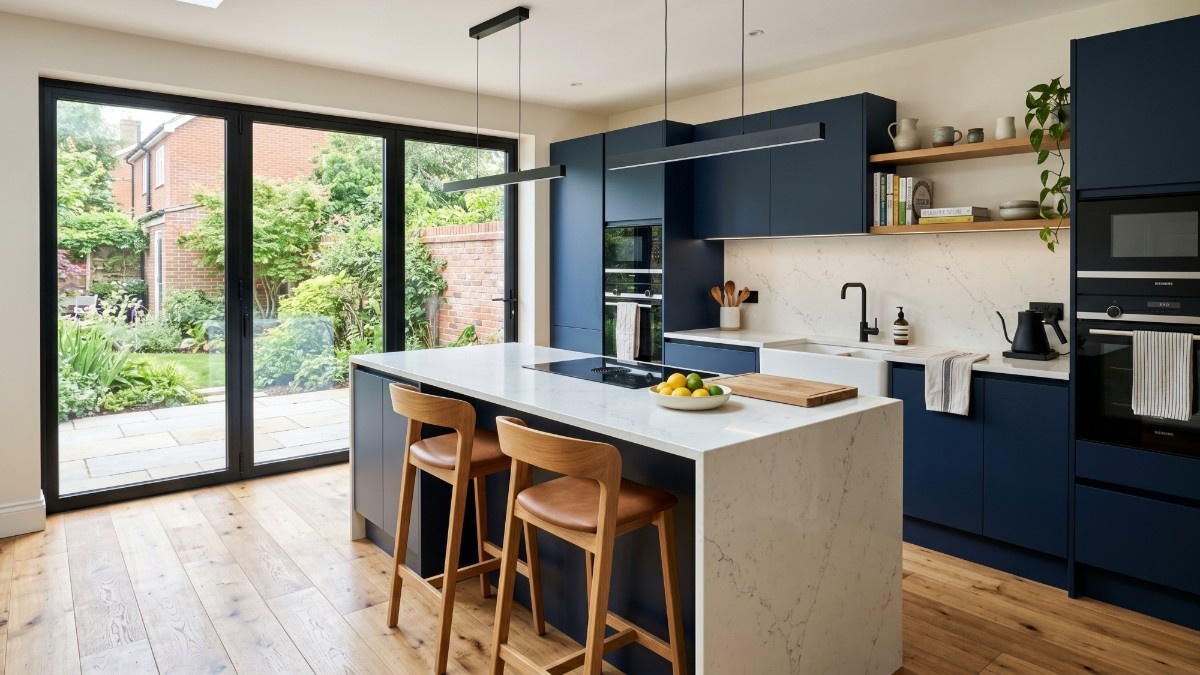
Nearly a quarter of UK homeowners planned a new kitchen in 2025 but most of them underestimated the timeline by three to four weeks (Hafele UK Homes for Living Report, 2024). In Bexleyheath where a large share of homes are 1930s semi-detached builds across Barnehurst, Blendon, and Upton in DA6 and DA7, with Victorian and Edwardian terraces surviving around the old Broadway area and East Wickham the gap between expectation and reality is a recurring story.
Search online and you'll find renovation timelines ranging from "four weeks" to "six months." Both figures can be accurate, depending on the project. Neither is useful unless you understand which category your Bexleyheath property falls into and what the DA6 and DA7 variables mean for your schedule.
This guide breaks every stage down honestly. By the end, you'll know how long your kitchen renovation will realistically take in Bexleyheath and what you can do now to avoid the delays that catch out most homeowners.
Key Takeaways
A standard kitchen renovation in Bexleyheath takes 3-4 weeks from your first consultation to handover roughly 3–5 days for design sign-off, 1–2 weeks to order and receive materials, and 1–2 weeks on-site. The 1930s semis across Barnehurst, Blendon, and Upton (DA6–DA7) typically run in the middle of that range. Victorian properties near Bexleyheath Broadway and the streets around Danson Park run 15–20% longer due to structural and pipework variables. Get a free, no-obligation timeline from Buildaway.
Want to skip the guesswork? Get your free Buildaway timeline estimate →
The Short Answer: How Long Does a Kitchen Renovation Take?
A kitchen renovation in the UK falls into one of three tiers, each carrying a very different total duration. The on-site build phase demolition, first fix, fitting, and finishing is only part of the timeline. Design sign-off and material ordering routinely double the overall project length before a single unit goes in.
| Project Type | On-Site Duration | Full Timeline (inc. planning) |
|---|---|---|
| Cosmetic refresh (doors, worktops, splashback) | 2–5 days | 1–2 weeks |
| Standard renovation (new units, electrics, plumbing) | 1–2 weeks | 3–4 weeks |
| Major renovation (structural, open-plan, extension) | 3–5 weeks | 6–8 weeks |
A typical UK kitchen refit runs 1–3 weeks for the build phase, with planning, lead times, and approvals adding some time upfront (Kitchling, 2025). Most projects complete within a month from start to finish.
A standard kitchen renovation covering new cabinets, worktops, and appliances with adjusted plumbing and electrical work typically takes 1–2 weeks on-site and 3–4 weeks in total once design, ordering, and lead times are included (Kitchling, 2025). In Bexleyheath, where the inter-war semi-detached stock of DA6 and DA7 makes up the majority of homes, projects run reliably within that range with older Victorian-era properties around the Broadway and East Wickham adding time for structural variables.
Buildaway manages every stage from design through to final snagging under one point of contact which means nothing gets lost between trades while you wait for a reply.
Read more: How much does a kitchen renovation cost in Bexleyheath?
Stage by Stage: What Actually Happens and When
The chart below shows how a standard and a major Bexleyheath kitchen renovation typically unfold across twelve weeks. Read this before you confirm any start date.
Stage 1 Design and Planning (3–5 Days)
More time is lost here than at any other point and it's entirely preventable. Choosing a layout, confirming cabinet finishes, locking in appliance models, and getting signed drawings back from your designer can take one week if you arrive with clear preferences or four weeks if decisions drift and revisions pile up. The brief Buildaway gives every Bexleyheath client at the start: every week spent in decision-making is a week added to your finish date, because fabrication cannot start until the drawings are signed off.
A good design process offers two or three concrete layout options with elevations from the outset. Decisions made in days, not weeks, keep everything downstream moving on time.
Stage 2 Ordering and Lead Times (1–2 Weeks)
Material ordering is where schedules quietly collapse on almost every project. Standard UK cabinetry from local suppliers arrives in two to four weeks. Semi-bespoke or fully bespoke cabinetry increasingly common in Bexleyheath's larger DA6 and DA7 semis runs six to ten weeks. High-end German kitchen ranges or hand-painted British units can carry lead times of twelve to sixteen weeks (Checkatrade, 2025).
A Which? survey of UK Trusted Traders in 2025 found that most kitchen fitters were already booked two to three months ahead one had bookings stretching beyond five months. The practical conclusion: confirm materials and get them on order the moment your budget is signed off, not after demolition has started.
Stage 3 On-Site Build Phases (1–2 Weeks)
This is the phase homeowners picture when they imagine the renovation. In practice it runs through seven sequential sub-phases, each of which depends on the previous one being complete.
Demolition and prep takes one to three days in a standard Bexleyheath kitchen typically smooth in the post-war semis of Barnehurst and Upton, occasionally longer in the older Victorian stock near the Broadway where unexpected structural elements surface behind first finishes. First fix new plumbing runs, structural adjustments, and electrical rewiring runs three to five days and must be complete before plastering begins. Plastering and drying can add up to a week; walls need full curing before units go in or the finish will shift. Unit installation takes two to four days once all surfaces are set. Then comes the longest single item on the critical path: worktop templating, fabrication, and installation. Stone or composite worktops can only be measured once cabinets are fixed and level. Fabrication runs seven to fourteen days. Installation follows. Three weeks in total from template to fitted worktop is the standard expectation. Second fix sink, taps, appliances, gas connection takes two to three days. Tiling, splashback, silicone, and snagging closes out at two to four days.
From our project records: Buildaway's last twelve completed kitchen renovations in Bexleyheath averaged around 4 weeks from sign-off to handover. The two longest both in Victorian terraces near East Wickham in DA7 took slightly longer, largely because original cast-iron soil stacks were built inside the kitchen walls and needed rerouting before the new layout could be framed. The fastest was a cosmetic refresh in a 1960s detached house in Blendon, completed in nine days on-site.
What Makes Bexleyheath Kitchen Renovations Take Longer?
Bexleyheath has one of the most clearly defined housing profiles in outer south-east London. DA6 and DA7 are overwhelmingly inter-war in character 1920s and 1930s semi-detached builds that went up rapidly as the area expanded with the Bexleyheath railway line and the development of the Barnehurst Estate. The streets around Barnehurst Road, Mayplace Road East, Bexley Road, and Upton Road are almost uniformly 1930s semi-detached. Older Victorian and Edwardian stock survives around Bexleyheath Broadway, East Wickham, and the streets closest to Danson Park. A smaller number of post-war and 1960s–80s builds fill in the remaining gaps across DA7.
Victorian and older stock near Danson Park and the Broadway: Properties in the streets between Bexleyheath Broadway and Danson Park including sections of Danson Road and the older terraces around East Wickham run 15–20% longer than their 1930s neighbours (Checkatrade, 2025). Lath-and-plaster walls where plasterboard was assumed, original lead pipework, and structural joinery embedded in the kitchen layout are the most consistent causes. Danson House, the Grade I listed Palladian mansion within Danson Park, sits nearby but the residential streets adjacent to the park itself are not subject to listed building controls and rarely require planning consent for internal kitchen works.
London logistics in DA6–DA7: Bexleyheath's residential streets vary considerably in terms of access. The wider roads off Barnehurst Road and Upton Road are manageable for skips and large material deliveries. Tighter streets near the Broadway and around the older East Wickham terraces require a skip permit from the London Borough of Bexley and can present delivery constraints for stone worktop slabs and large kitchen unit packs. Waste removal logistics can add meaningful time to constrained London projects (Checkatrade, 2025) worth confirming access arrangements with your contractor before fixing a start date.
Labour availability: The FMB/CIOB 2025 State of Trade Survey found 61% of construction firms affected by skilled trade shortages. In Bexleyheath, booking a quality kitchen fitter eight to twelve weeks ahead is not over-cautious it is the standard lead time for the fitters you actually want.
Cormac's note: In the 1930s semis across Barnehurst and Blendon, the most consistently underestimated variable is the back addition. Almost every DA6 semi has one and almost every one contains services that weren't accounted for in the original quote. Old drainage runs, redundant gas supplies from pre-central heating era, and steel lintels where timber was expected are the regulars. We survey for these before any drawings go in, and we build the contingency into the programme upfront. No mid-project conversations you weren't prepared for.
The 5 Most Common Causes of Kitchen Renovation Delays
One industry study found that 85% of kitchen renovations take longer than planned (180 Kitchens, 2025). That figure doesn't surprise anyone who's been through the process. What's less often discussed is why it happens and how much of it you can actually control.
1. Late design changes after fabrication begins (~35%): Once cabinet carcasses and doors enter production, changing a colour, handle, or internal configuration adds two to four weeks of re-manufacturing delay. The fix is always the same: agree every detail handle position, bin size, drawer inserts, appliance cutouts before you sign production drawings. After that, the specification does not change.
2. Material and appliance delivery failures (~25%): A worktop slab cracks in transit and needs re-cutting. An integrated oven model goes discontinued mid-order. A tile run doesn't match the showroom sample shade-for-shade. Getting written delivery confirmations from every supplier before demolition begins not afterwards removes most of this from the equation.
3. Hidden structural issues on demolition day (~20%): This is the variable no contractor can fully eliminate only prepare you for. A 10–20% contingency on both budget and timeline is standard practice for outer London's inter-war and older housing stock (Mimar, 2025). In Bexleyheath's pre-war semis, something unexpected turns up on a meaningful proportion of first-fix days.
4. Trade scheduling gaps (~12%): When one trade finishes on a Thursday and the next isn't free until the Tuesday after, you lose four days of progress with no-one on-site. A single-contractor model where all trades are scheduled and managed by one point of contact on a shared programme eliminates most of these gaps before they form.
5. Permit and sign-off delays (~8%): London Borough of Bexley skip permits, LABC sign-offs on gas or electrical installations, Lawful Development Certificates for external changes, or in the rare cases near Red House listed building notifications. All of these are manageable. None of them can be accelerated once the relevant process has opened.
Late design changes specification decisions made after cabinet fabrication has started account for roughly 35% of kitchen renovation overruns across residential projects (Buildaway project data, 2026). In Bexleyheath's 1930s semi-detached stock, where integrated storage and larder units are commonly built into the kitchen layout from the outset, changing a bin configuration or a tall unit position mid-order triggers the full re-manufacturing timeline two to four weeks on a standard specification, longer on bespoke finishes.
How to Prepare Your Home (and Life) for the Renovation
A well-prepared site on day one keeps trades moving and prevents time from draining away in the first week. Properties that aren't ready before the first contractor arrives rarely recover the lost rhythm.
Set up a temporary kitchen before demolition. A microwave, a portable induction hob, a kettle, a fridge, and somewhere to rinse a mug that's all you genuinely need to get through the works. Budget between £200 and £500 to source or rent these items (Better Homes Studio, 2025). In most Bexleyheath semis, the dining room or the rear utility area handles temporary kitchen duty without much disruption to the rest of the house.
Build a financial and time buffer from the start. A 10–20% contingency on both cost and schedule is the standard benchmark for pre-war London housing stock (Mimar, 2025). If you're planning a £28,000 kitchen, hold £2,800–£5,600 in reserve. If your target is ten weeks, plan mentally for twelve. Contingency you don't spend is a welcome surprise. Contingency you didn't budget is a problem.
Lock every specification before you approve the production drawings. This is the step most homeowners skip and the most costly one to overlook. Handle finish, hinge direction, bin size, appliance brand and model, worktop edge profile every one of these must be agreed and recorded before drawings are approved. Once you sign off, treat the spec as fixed.
Protect your floors and seal adjoining rooms. A tidy site means trades can start working without spending thirty minutes clearing dust sheets and moving furniture out of the way. Confirm that site protection is part of your contractor's standard scope before they arrive.
Stay contactable during the first week on-site. Small decisions socket positions, hinge swing directions, extractor vent routing take a few minutes to answer and can prevent several days of rework if they're resolved quickly. Keep your mornings free for a five-minute check-in with the site lead for the first week.
Buildaway walks you through every one of these steps before we swing a hammer. Book your free, no-obligation quote →
Read more: Common kitchen renovation mistakes in Bexleyheath
When Should You Start Planning? Booking Lead Times for Bexleyheath
The honest rule of thumb: begin planning three to four months before you want a finished kitchen. For structural projects rear extensions, open-plan reconfigurations, or anything affecting the external envelope allow five to six months minimum.
Why? Quality kitchen fitters across Bexleyheath and south-east London are consistently booked two to three months in advance (Which?, 2025). Add four to sixteen weeks for bespoke material lead times and the numbers compound fast. A September finish needs planning to begin in April or May at the latest not in July.
On timing your Bexleyheath kitchen renovation: Late summer and early autumn August through October typically see fewer competing renovation projects across outer south-east London than the pre-Christmas push, which runs from October onwards and stretches fitter availability hard. Starting your planning in May or June for an August on-site date usually means your preferred trades are available and material suppliers are less stretched. Projects commissioned in October for a November or December handover almost always involve compromises on fitter choice, specification, or both.
The highest-rated Bexleyheath kitchen fitters those with strong track records on Checkatrade and Houzz rarely have availability with less than eight weeks' notice. For older Victorian properties near the Broadway or Danson Park, or any project with external alteration implications near Red House, ten to twelve weeks of planning lead time is a safer minimum.
Buildaway's free, no-obligation quote includes a realistic start date for your DA6 or DA7 property and a slot hold so your decision isn't being made under time pressure. One quote. One point of contact. One clear process.
Read more: How bathroom renovation timelines compare in Bexleyheath
Conclusion: Your Bexleyheath Kitchen Renovation, Planned Properly
A kitchen renovation in Bexleyheath is one of the most impactful home improvements you can make and one of the easiest to underestimate on time. Here's the honest summary:
- Standard renovation: 1–2 weeks on-site; 3–4 weeks total including design and ordering
- Major or structural renovation: 3–5 weeks on-site; 6–8 weeks total
- 1930s semis across DA6 and DA7 Barnehurst, Blendon, Upton, Barnehurst Road run consistently in the middle of the standard range; allow for back addition and suspended floor variables
- Victorian terraces near Bexleyheath Broadway and East Wickham routinely add 15–20% to project duration budget and timeline should reflect this
- Book your kitchen fitter 8–12 weeks before your target start date earlier for structural or older-stock projects
- Set aside a 10–20% contingency on both budget and timeline; in Bexleyheath's pre-war housing stock it isn't pessimism it's accurate planning
- The biggest delays are preventable: lock your specification before fabrication begins, order materials as soon as budget is confirmed, and use a contractor who manages all trades under one programme
Buildaway works across Bexleyheath and south-east London from the 1930s semis of Barnehurst and Blendon to the Victorian terraces around East Wickham and the Broadway. We know the local housing stock, the London Borough of Bexley's planning process, and the logistics that trip up projects on DA6 and DA7's tighter residential streets.
Planning a kitchen renovation in Bexleyheath? Buildaway offers a free, no-obligation quote with a clear timeline estimate tailored to your home and postcode. One quote. One point of contact. One clear process. Get your free Buildaway quote →
See our full service: Buildaway Bexleyheath kitchen renovation service