
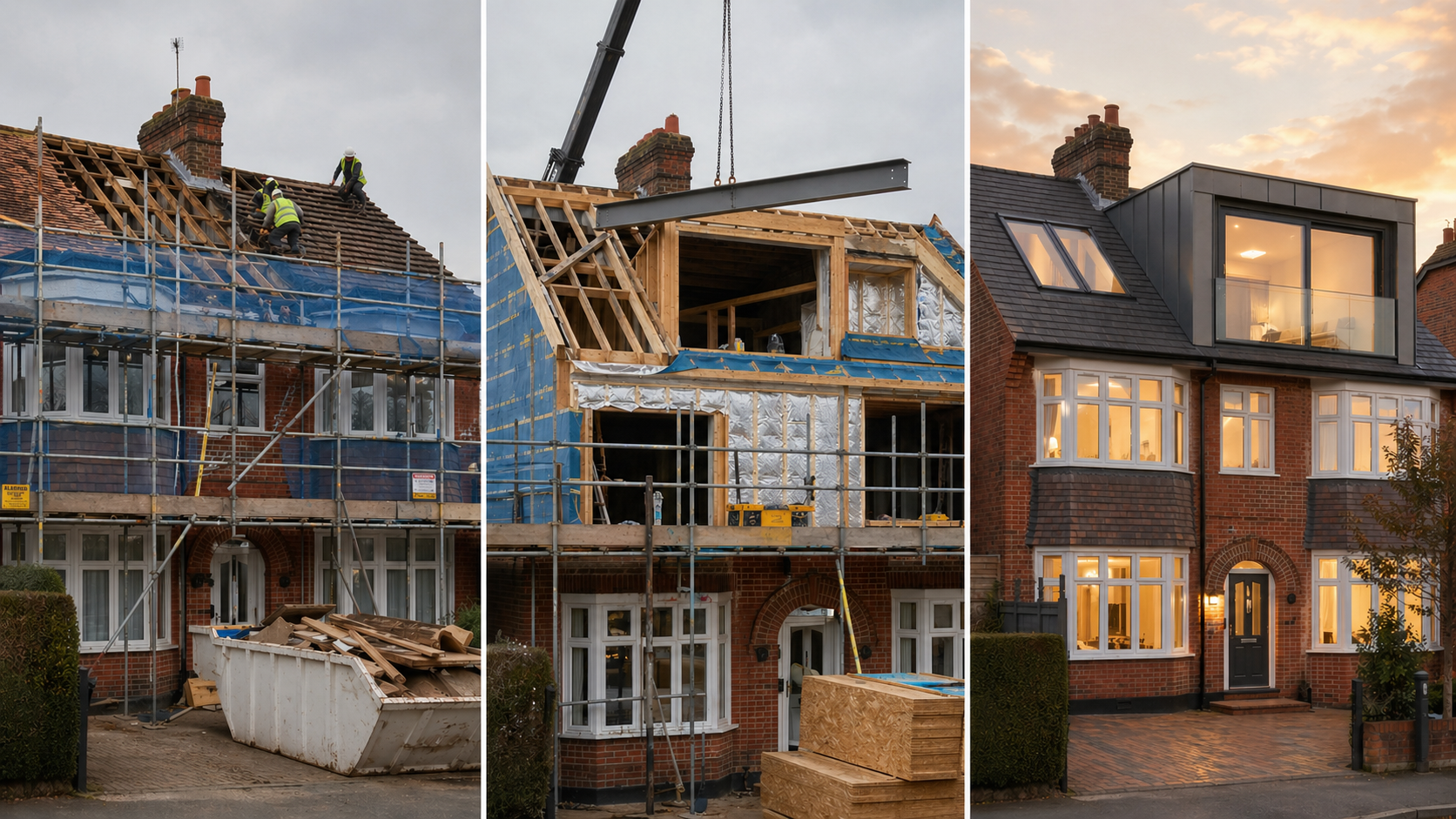
Drive past one of the wide residential roads running off Sidcup High Street or along the quieter avenues near Lamorbey Park, and you'll spot a scaffolded house more often than you might expect. When it's a neighbour's turn, the first question is always the same: how long is that actually going to take? It's what every Sidcup homeowner wants to know and it's routinely the most underestimated figure in any initial quote conversation.
Most on-site loft conversions in Sidcup take 6–10 weeks to build. But the genuine end-to-end journey from picking up the phone to book a survey through to holding your completion certificate sits closer to 3–5 months when design, Bexley Council planning approvals, and building regulations are all accounted for. The pre-build period is where most of the calendar slippage happens, and almost no one explains it at the start.
This guide does exactly that. Whether your property is a 1930s semi in DA14, a post-war detached near Foots Cray, or a Victorian terrace close to Sidcup station, here's what to expect at every stage week by week.
How much does a loft conversion cost in Sidcup? → Full cost guide
TL;DR: A standard dormer loft conversion in Sidcup takes 6–8 weeks on-site. Velux-only conversions complete in as little as 4 weeks. Mansard builds run 10–14 weeks. Add 8–16 weeks upfront for design, Bexley Council decisions, and building regulations sign-off, and the full realistic timeline is 3–5 months. (Sources: Bexley Council Planning Portal, Nationwide House Price Index, 2026)
How Long Does a Loft Conversion Take in Sidcup? The Honest Numbers
On-site build times for loft conversions in Sidcup span 4 to 14 weeks, with the conversion type being the primary driver. Sidcup's housing stock shapes the options available. The area is predominantly made up of inter-war and 1930s semis particularly throughout DA14 around Longlands and Blackfen Road and these properties have hipped roof profiles that make hip-to-gable conversions a natural fit. There are also pockets of older Victorian stock near the station, where rear dormers are the more typical choice.
According to a 2024 Checkatrade Home Improvement Report, loft conversion enquiries across South East London rose by more than 25% year-on-year. In a DA14 postcode where moving to a larger home carries significant stamp duty and estate agent costs, converting upward has become an increasingly attractive alternative.
Here's how the main conversion types compare for Sidcup properties:
For Sidcup's dominant housing type the 1930s semi the hip-to-gable conversion is the most popular choice. That classic hipped roofline, common on roads throughout Longlands, Blackfen, and Halfway Street, is ideally suited to this conversion and delivers the most usable floor space. Budget 8–10 weeks for the build phase. Rear dormers, more common on the older terraced and Victorian stock nearer the High Street, sit in the 6–8 week band.
The build phase, though, is only half the story.
Why Your Total Timeline Runs Longer Than the Build: The Pre-Build Phase
Most Sidcup homeowners are surprised to discover the build is actually the shorter portion of the overall timeline. Before scaffolding goes up and your crew arrives, every project works through three distinct pre-build stages design, planning, and building regulations and that window alone takes 6–16 weeks depending on your property type and specific planning circumstances.
Here's what each stage involves:
Design and structural survey (weeks 1–3): A specialist architect or loft conversion designer surveys your loft, measures up, and produces the technical drawings. A structural engineer then provides load calculations. Allow 2–4 weeks for this stage in full.
Permitted Development or full planning permission? The majority of Sidcup loft conversions qualify under Permitted Development rights, meaning no formal planning application is needed. Volume limits are 40m³ for terraced properties and 50m³ for semi-detached and detached homes (gov.uk Planning Portal, 2026). Even where PD applies, a Lawful Development Certificate (LDC) is strongly recommended it takes 6–8 weeks from Bexley Council and is essential protection at the point of sale.
Where a full planning application is required, Bexley Council targets an 8-week decision for standard applications, with more complex cases running longer.
Essential for Sidcup homeowners: Sidcup sits within the London Borough of Bexley, which administers planning and building control separately from neighbouring Bromley. Bexley has designated conservation areas across the borough including the Lamorbey Conservation Area around Lamorbey Park, and the Sidcup Place Conservation Area adjacent to the historic parkland. If your property falls within a conservation area, full planning permission is required regardless of the conversion's volume. Check your specific address at bexley.gov.uk/planning before making any assumptions about Permitted Development eligibility.
Building regulations: Your builder submits a Full Plans application to Bexley Council's Building Control team or an approved private inspector. Initial plan review typically takes 3–5 weeks (bexley.gov.uk, 2026). Building Control inspections then run alongside the build at structural and fire-safety milestones.
Planning permission for a loft conversion in Sidcup → Full planning guide
Week 1: Pre-Build Setup (Quiet from the Street Not Quiet on Site)
To anyone walking past, Week 1 looks like the quiet before the build. In reality it's one of the busiest coordination weeks of the whole project. Scaffolding is typically erected on Day 1 or 2 on Sidcup's wider residential roads this is generally uncomplicated, though deliveries on narrower side streets near the High Street occasionally need to be planned more carefully.
Materials arrive and are staged across this week: structural steels, timber joists, insulation boards, and roofing materials. Your contractor forms a secured access point in the roof a controlled opening that lets materials move between the roof level and loft interior without cutting through your living space below. Everything at this stage remains above the ceiling line.
Your pre-Week 1 checklist:
- Empty the loft completely everything from old suitcases and boxes to any loose insulation rolls
- Lay dust sheets over furniture in the rooms directly below the build zone
- Confirm skip placement and materials delivery timing with your contractor (a road permit may be needed for skips on certain Sidcup streets)
- Give immediate neighbours a heads-up before work starts it makes a meaningful difference on close-set residential roads
Weeks 2–4: Structural Work and Shell (The Loudest Phase)
Weeks 2–4 are where the build announces itself. Structural steels go in, floor joists are upgraded, and the new dormer or gable structure begins to appear above the existing roofline. It's the noisiest phase but it stays above the ceiling line and well clear of the habitable rooms below.
Week 2 Structural work:
- Existing floor joists assessed and upgraded, or a new structural floor installed from scratch
- Steel RSJ beams inserted to manage load transfer (the specifications vary depending on your property 1930s semis in DA14 typically carry relatively straightforward roof structures, but chimney stacks and original party-wall arrangements still need careful engineering)
- Roof partially opened where the dormer or new gable will sit
Week 3 Dormer or gable frame:
- Timber frame of the dormer or extended gable constructed and fixed
- Roof profile formed flat-roof for a standard rear dormer, pitched extension for hip-to-gable
- Roof made temporarily weatherproof at the end of each working day standard practice regardless of season
Week 4 Weatherproofing and windows:
- Dormer cladding applied matching roof tile, slate, or standing-seam zinc depending on your property's character and any conservation area requirements from Bexley Council
- Windows and Velux units installed and fully sealed
- Roof made permanently watertight this triggers the next Building Control inspection
Hip-to-gable note for DA14 semis: This is a structurally more involved conversion than a straight rear dormer. The existing hipped end is dismantled and a new gable wall built in its place, with the ridge extended to match. Budget an extra 1–2 weeks on the structural phase compared to a rear dormer plan for Weeks 2–5 rather than 2–4. The extra time is well spent: the resulting volume is substantially larger.
Weeks 5–6: First Fix The Build Moves Indoors
With the shell watertight, your team's focus shifts fully inside. The sharp impact noise of structural work gives way to the steadier activity of insulation, boarding, and first-fix services. For the household living below, this is a noticeably more comfortable phase.
What first fix involves:
- Thermal insulation installed to roof, walls, and floor must comply with Building Regulations Part L (standards updated in 2026 to tighten thermal performance requirements)
- Internal stud partition walls formed, defining the room layout and any en-suite zone
- First fix electrics: all cabling routed and run before any boarding begins
- First fix plumbing if the conversion includes an en-suite bathroom this adds approximately 3–5 working days to the phase
- Fire separation work throughout the building: mains-wired interlinked smoke alarms required on every floor under Part B of the Building Regulations
Building Control mid-build inspection: Bexley Council's Building Control team schedules an inspection at this stage. Structural drawings should be readily available on-site. Bexley Council, like many London boroughs, now accommodates remote video inspections for lower-risk elements such as insulation fit and joist spacing reducing delays from scheduling on-site visits (bexley.gov.uk Building Control, 2026).
Weeks 7–9: Staircase, Plastering, and Second Fix
The staircase goes in during this window, and it's the one day of the entire build where the rest of the house is meaningfully disrupted. The landing ceiling is opened just enough to lower the staircase assembly in and fix it access to the first-floor landing is restricted for most of that working day. After that, disruption to the household drops sharply.
Once the staircase is secured and signed off, the remaining second-fix work moves at a good pace:
Week 7–8 Plastering:
Plasterboard is fixed to all walls and ceilings, followed by a finish skim coat. This is
where the space transforms suddenly there's a room rather than a timber frame. Allow 3–5
full days for the plaster to cure before any decoration begins. Painting onto wet plaster is
one of the most common causes of surface cracking that homeowners later attribute to the
build; the fix is simply patience.
Week 8–9 Second fix:
- Sockets, switches, and light fittings connected and tested by your Part P electrician
- En-suite bathroom fixtures installed where included
- Floor covering fitted carpet, engineered wood, or LVT (your preference should be confirmed with Buildaway before this week, not during it)
- Joinery completed: skirtings, architraves, door linings, eaves storage if specified
Including an en-suite adds roughly 3–5 working days to this phase. It's worth building in from the start. Nationwide's 2026 House Price Index research found that a loft conversion delivering a double bedroom and bathroom can lift a three-bedroom property's value by up to 24% a return that stacks up particularly well against the cost of moving in London's South East.
Week 9–10: Final Inspection and Your Completion Certificate
The final Building Control inspection is the last formal sign-off before your loft room is legally habitable. In Sidcup, this is carried out by either Bexley Council's Building Control team or a private approved inspector Buildaway coordinates this throughout the project on your behalf.
What the inspector examines at final stage:
- Structural integrity of the new floor, roof, and any partition walls
- Fire safety compliance: door specifications, smoke alarm positions and interconnection, fire separation between floors
- Staircase compliance head height clearance, rise and going dimensions, handrail specification
- Thermal insulation values confirming Part L compliance
- Electrical installation certificate issued by your Part P registered electrician
On sign-off, the inspector issues a completion certificate. This is a document you need to keep safely not just for peace of mind, but because your solicitor will ask for it at the point of sale and your mortgage lender may require it if you remortgage after the work is complete.
Most Sidcup homeowners decorate after handover either themselves or through a local decorator. Buildaway can point you towards trusted decorators in DA14 and DA15 if that's helpful.
Want a timeline built around your specific Sidcup
property?
Buildaway offers a free, no-obligation loft survey across Sidcup, Blackfen, Foots Cray,
Longlands, and the surrounding DA14 and DA15 postcodes. One quote. One point of contact.
One clear programme. Book your free loft survey
→
Can You Stay at Home During a Loft Conversion in Sidcup?
Yes for the overwhelming majority of Sidcup loft conversions. The build is designed to be lived around. Weeks 2–4 are the noisiest, but structural work stays above the ceiling line and doesn't touch your living spaces. The one moment that genuinely disrupts the household is staircase installation day but that's typically wrapped up within a single working day.
Good preparation takes the stress out of it. Clear the loft before the crew arrives, put dust sheets down in the rooms below the build zone, and agree your contractor's working hours from the start. Most Sidcup contractors work 8am–5pm Monday to Friday, with limited Saturday working on residential streets.
The Key Takeaways for Sidcup Homeowners
Getting a loft conversion right in Sidcup comes down to realistic expectations and early planning. Here's what matters most:
- On-site build time is 6–10 weeks for the majority of DA14 and DA15 property types. Hip-to-gable conversions on Sidcup's 1930s semis sit toward the upper end. Total project time including pre-build is 3–5 months.
- Sidcup is in the London Borough of Bexley all planning applications, LDCs, and building control submissions go to Bexley Council, not Bromley. Getting this right from the start saves weeks of misdirected paperwork.
- The pre-build phase is where timelines drift not through negligence, but because council approvals run to statutory timetables that can't be accelerated. Start earlier than feels necessary.
- Conservation area boundaries in Bexley are worth checking properties near Lamorbey Park and Sidcup Place may require full planning permission rather than proceeding under PD.
- Include the en-suite from day one. Nationwide's 2026 data shows a bedroom-plus-bathroom loft conversion adds up to 24% to a three-bedroom property's value the extra 3–5 days' build time is one of the best-value decisions you can make.
- The completion certificate is a legal requirement, not optional paperwork. Your solicitor needs it on sale and your lender may ask for it on remortgage.
Buildaway's free loft survey covers Sidcup, Blackfen, Foots Cray, and Longlands across the DA14 and DA15 postcodes as well as the neighbouring areas of Chislehurst, New Eltham, and Bexley.