
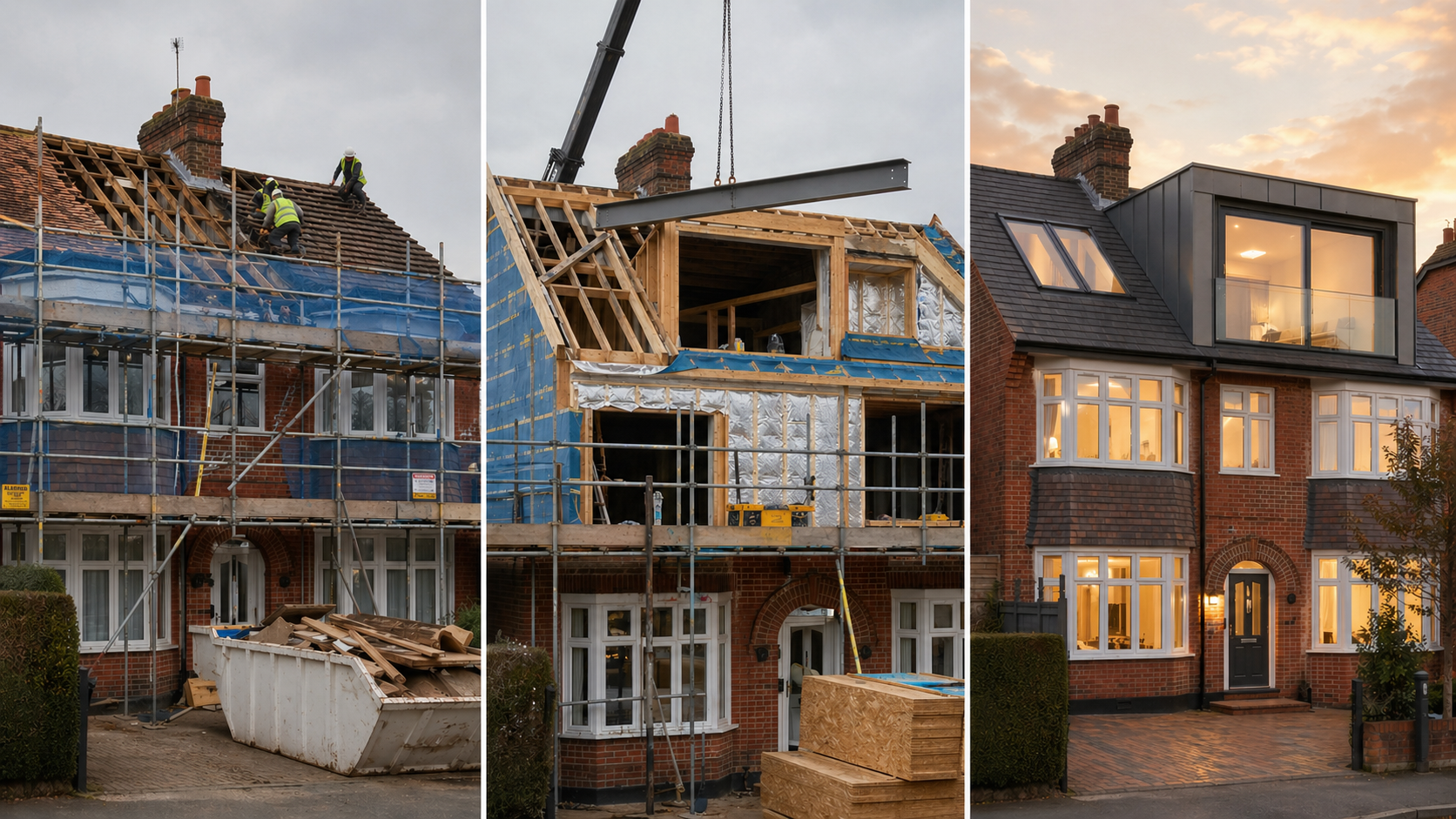
You've driven past a neighbour's house near Priory Gardens or along one of Petts Wood's tree-lined roads and clocked the scaffolding and immediately started wondering how long that would eat into your own routine. It's probably the single most common question Orpington homeowners ask before committing to a loft conversion. And it's also one of the most consistently underestimated answers in the industry.
Most on-site loft conversions in Orpington take 6–10 weeks to build. But the complete journey from that first phone call through to holding your completion certificate runs closer to 3–5 months once you account for architectural drawings, Bromley Council approvals, and building regulations sign-off. The pre-build window is where homeowners are caught off guard, not because anything's going wrong, but because the process simply isn't explained at the outset.
This guide puts that right. Whether you're in a 1930s semi in BR5 or a detached property out towards Chelsfield in BR6, here's a clear, week-by-week account of what happens and when.
How much does a loft conversion cost in Orpington? → Full cost guide
TL;DR: A standard dormer loft conversion in Orpington takes 6–8 weeks on-site. Velux conversions can complete in 4–5 weeks. Mansard builds run 10–14 weeks. Add 8–16 weeks upfront for design, Bromley Council decisions, and building regulations, and the full project spans 3–5 months from start to sign-off. (Sources: Bromley Council Planning Portal, Nationwide House Price Index, 2026)
How Long Does a Loft Conversion Take in Orpington? The Realistic Numbers
The on-site build time for a loft conversion in Orpington ranges from 4 to 14 weeks depending on the conversion type and your property's existing structure. According to a 2026 Checkatrade Home Improvement Report, loft conversion enquiries across South East London and outer borough areas rose by over 28% year-on-year with Orpington and the BR5/BR6 postcodes among the fastest-growing areas for conversion activity.
Here's how the main conversion types compare across Orpington's diverse housing stock:
The most common conversion for Orpington's 1930s semis across BR5 the rear dormer sits in the 6–8 week bracket. If you're on a detached plot out towards Chelsfield or Green Street Green in BR6 and you're considering a hip-to-gable, budget for 8–10 weeks on-site.
What the chart can't show you is the pre-build window. That's where your calendar takes the real hit.
Why the Total Project Timeline Extends Well Beyond the Build
Bromley Council planning decisions for standard loft conversion applications in Orpington typically take eight weeks from submission, according to bromley.gov.uk. Under Permitted Development, a Lawful Development Certificate takes six to eight weeks. Either route, pre-build approvals account for roughly two months before a single structural change is made.
Here's the part that catches most people out: the on-site build is the shorter half of the story. Before your contractor even sets up a scaffold tower, your project will move through an architectural design phase, planning or PD confirmation, and building regulations submission. That combined pre-build window runs anywhere from 6 to 16 weeks, depending on where your Orpington property sits and whether planning permission is required.
Here's what each stage actually involves:
Design and structural survey (weeks 1–3): An architect or loft specialist visits, surveys the space, takes measurements, and produces architectural drawings alongside structural engineer calculations. Expect 2–4 weeks for this phase.
Permitted Development or full planning permission? The majority of Orpington loft conversions proceed under Permitted Development rights meaning no formal planning application is required. The volume thresholds are 40m³ for terraced properties and 50m³ for semi-detached and detached homes (gov.uk Planning Portal, 2026). Even when proceeding under PD, a Lawful Development Certificate (LDC) is strongly recommended it takes 6–8 weeks from Bromley Council and is invaluable when you come to sell.
Where full planning permission is needed, Bromley Council has an 8-week statutory decision period, though contested or complex applications can run longer.
Important for Orpington homeowners: While Orpington has fewer designated conservation areas than central Bromley, parts of Petts Wood and Knoll (BR5) and certain streets in Chelsfield (BR6) carry conservation area status or are adjacent to listed buildings both of which trigger the need for full planning permission regardless of your conversion's volume. Bromley has also issued Article 4 Directions in specific zones removing Permitted Development rights for roof alterations. Verify your address at bromley.gov.uk/planning/permitted-development before assuming PD applies.
Building regulations: Your contractor submits a Full Plans application to Bromley Council Building Control or an approved private inspector. Initial review typically takes 3–5 weeks (bromley.gov.uk, 2026). Building Control then runs alongside the active build, with inspectors attending at key structural and fire safety milestones.
Planning permission for a loft conversion in Orpington → Full planning guide
Week 1: Pre-Build Preparation More Progress Than It Looks
From the pavement, Week 1 doesn't look like much is happening. But behind the scenes, it's one of the most logistically active points in the project. Scaffolding goes up typically on Day 1 or 2 changing the look and feel of your property almost immediately. Structural steels, timber, and insulation boards are delivered and staged, often on the same day or the next.
Your contractor will create a controlled access point in the roof a temporary opening that lets materials and tradespeople move between the outside and the roof void without disrupting the rest of the house. At this stage, everything happens above the ceiling line. The rooms you live in remain untouched.
What should be done before Week 1 starts:
- Empty the loft entirely every box, roll of old insulation, stored item
- Cover furniture in the rooms directly below the build zone with dust sheets
- Confirm the skip location and materials delivery schedule with your contractor
- Give your immediate neighbours advance notice particularly relevant on Orpington's closely-packed 1930s terraces around Knoll Road and the streets near St Mary Cray
Personal Experience: On BR5 projects near Petts Wood station, we regularly find that the original 1930s roof void contains compressed rockwool insulation that needs removing and disposing of before structural work can begin. Flagging this in the initial survey prevents a half-day delay at the start of Week 2.
Weeks 2–4: Structural and Shell Work The Noisy Phase
A standard rear dormer loft conversion in Orpington takes six to eight weeks on-site, based on industry data and Bromley Council's building control requirements. The structural phase running through weeks two to four is the noisiest and most weather-sensitive stage, covering steel beam installation, floor strengthening, and construction of the dormer shell.
Weeks 2 through 4 are when neighbours know the project is underway. Structural steels go in, the existing floor structure is reinforced, and for dormer conversions, the dormer box takes shape. It's loud and there will be some dust, but it stays contained to the upper portion of the house.
Week 2 Structural work:
- Existing floor joists assessed and strengthened, or a new structural floor installed
- Steel RSJ beams inserted where load redistribution is required Orpington's mix of 1930s semis and post-war detached properties in BR5 and BR6 often needs this, particularly where original timber is undersized
- For dormer builds, the roof is partially opened at this stage
Week 3 Dormer shell construction:
- Timber dormer frame built and positioned
- Dormer roof formed flat or pitched depending on design
- Roof made temporarily weathertight at the end of each working day Orpington's exposed position on the southern edge of Greater London means rain is a real operational consideration, especially between October and March
Week 4 Weatherproofing and glazing:
- Dormer exterior clad in matching tiles, EPDM flat roof finish, or render, depending on your planning conditions
- Windows and Velux units installed and sealed
- Roof certified fully watertight this triggers the first formal Building Control inspection
Detached property note: Many BR6 properties in Chelsfield, Farnborough, and Green Street Green have hipped roofs. A hip-to-gable conversion is structurally more complex than a straight rear dormer the hip-end is demolished and a new gable wall constructed. Budget Weeks 2–5 for the structural phase rather than 2–4, adding approximately 1–2 weeks to this stage.
Types of loft conversion suitable for Orpington homes → Loft conversion types guide
Weeks 5–6: First Fix Work Moves to the Interior
Once the shell is watertight, the build moves inside. This is noticeably quieter for the household most activity is confined to the new loft space.
What happens during first fix:
- Insulation installed to roof, walls, and floor, meeting Building Regulations Part L thermal standards updated under 2026 revisions
- Internal stud partition walls marked out and built
- First fix electrics: cable routes run throughout the space before any boarding begins
- First fix plumbing if an en-suite is part of the design this adds around 3–5 working days to this phase
- Fire safety work: mains-wired interlinked smoke alarms required throughout the property under Part B of the Building Regulations
Building Control inspection: Bromley's Building Control team carries out a mid-build inspection at first fix stage. Keep structural drawings on-site and accessible. Bromley Building Control now accommodates video inspections for lower-risk elements such as insulation checks and joist spacing verification, which can reduce visit scheduling time (bromley.gov.uk Building Control, 2026).
Unique Insight: Fire door compliance is one of the most frequently overlooked costs in Orpington loft conversions. Part B of the Building Regulations requires fire-rated doors on every habitable room on the floors beneath the new loft space. Many of Orpington's 1960s and 1970s properties in BR5 particularly on estates around Ramsden and Goddington have original hollow-core internal doors that don't meet current fire standards. Budget for replacements. This isn't discretionary it's a Building Control requirement that will be flagged at the first fix inspection.
Weeks 7–9: Staircase, Plastering, and Second Fix
The staircase day is the one that tends to cause the most disruption inside the house. A section of the existing landing ceiling is opened up, and the new staircase is lowered in and secured. It's generally a single working day, but first-floor access will be restricted during the installation.
Once the staircase is in, second fix moves at pace:
Weeks 7–8 Plastering:
Plasterboard is fixed across walls and ceiling. A skim coat follows, and the space suddenly
reads as a proper room rather than a construction zone. Allow 3–5 days of drying time before
any decoration starts this is non-negotiable. Painting over plaster that hasn't fully dried
causes cracking and patchy finishes that are hard to fix later.
Weeks 8–9 Second fix:
- Sockets, switches, and light fittings wired and tested
- En-suite bathroom fixtures fitted if included in the spec
- Floor covering installed carpet, engineered timber, or LVT. Tell us your preference before second fix week, not during it
- Joinery completed: skirtings, door linings, any fitted eaves storage units or wardrobes
Worth noting: adding an en-suite bathroom extends second fix by 3–5 working days. That said, Nationwide's 2026 House Price Index research found that a loft conversion adding a double bedroom and bathroom can increase a three-bedroom home's value by up to 24% (Nationwide House Price Index, 2026). Given what property prices look like across Orpington and Petts Wood, those extra few days pay back quickly.
Weeks 9–10: Final Inspection and Your Completion Certificate
Under UK Building Regulations, all residential loft conversions require a final inspection by Bromley Council Building Control or an approved private inspector before the space is legally habitable. The resulting completion certificate is a legal document required during property sales and remortgaging, confirming the conversion meets all structural, fire safety, and insulation standards. (Source: bromley.gov.uk/building-control, 2026)
The final Building Control inspection is what converts your new room from a building site into a legal, habitable space. In Orpington, this is conducted by Bromley Council Building Control or a private approved inspector Buildaway coordinates this on your behalf as part of the standard service.
What the inspector covers:
- Structural integrity of the new floor and roof structure
- Fire safety: fire door specifications, smoke alarm positions and interconnection, fire separation between floors
- Staircase compliance head height, rise and going, handrail and balustrade requirements
- Insulation values meeting Part L 2026 standards
- Electrical installation certificate from a Part P registered electrician
Once the inspector is satisfied, they issue a completion certificate. File it somewhere safe alongside your mortgage documents. Conveyancers will request it during any future sale, and mortgage lenders often require it if you remortgage after completion of the works.
From that point, the space is yours to use. Most homeowners paint and decorate after handover either themselves or through a decorator. Buildaway can recommend trusted local decorators covering the Orpington area if needed.
Want a timeline that's specific to your Orpington
property?
Buildaway offers a free, no-obligation loft survey across Orpington, Petts Wood,
Chelsfield, Farnborough, and the surrounding BR5 and BR6 postcodes. One fixed quote. One
point of contact. A process you'll understand from day one. Book your free loft survey →
Can You Live in Your Home During a Loft Conversion in Orpington?
In almost every case, yes. Loft conversions are designed around the homeowner remaining in residence throughout. The structural phase Weeks 2 through 4 is the loudest period, but it stays above your ceiling line. The single most disruptive day tends to be when the new staircase goes in, requiring a section of your first-floor landing ceiling to be opened. That's typically completed within one working day.
Good preparation is the difference between a manageable build and a stressful one. Clear the loft before Week 1 begins, protect the rooms below with dust sheets, and agree working hours with your contractor at the outset. Most Orpington builders operate Monday to Friday, 8am to 5pm, with weekend working kept to a minimum in residential streets.
The Key Takeaways for Orpington Homeowners
A loft conversion in Orpington is a well-trodden process for the right contractor but understanding the timeline upfront prevents the frustration that comes from unexpected waits. Here's what to take away:
- The build itself runs 6–10 weeks for most BR5 and BR6 property types. The full project, including pre-build, is 3–5 months.
- Start earlier than you think you need to. Planning approvals and building regulations have fixed timescales you can't compress them.
- Conservation areas and Article 4 Directions affect Orpington too particularly in Petts Wood and Chelsfield. Check before assuming Permitted Development applies.
- An en-suite is worth the extra time. Nationwide's 2026 data shows up to a 24% property value uplift from a bedroom-and-bathroom loft conversion and Orpington's commuter market rewards that kind of usable space.
- Your completion certificate is a legal document. It's required by conveyancers when you sell and by mortgage lenders if you remortgage after the build. Don't skip the final inspection.
Ready to understand what the timeline looks like for your specific property? Buildaway's free loft survey covers all of Orpington's BR5 and BR6 postcodes including Petts Wood, Chelsfield, Farnborough, Green Street Green, St Mary Cray, and Goddington.