
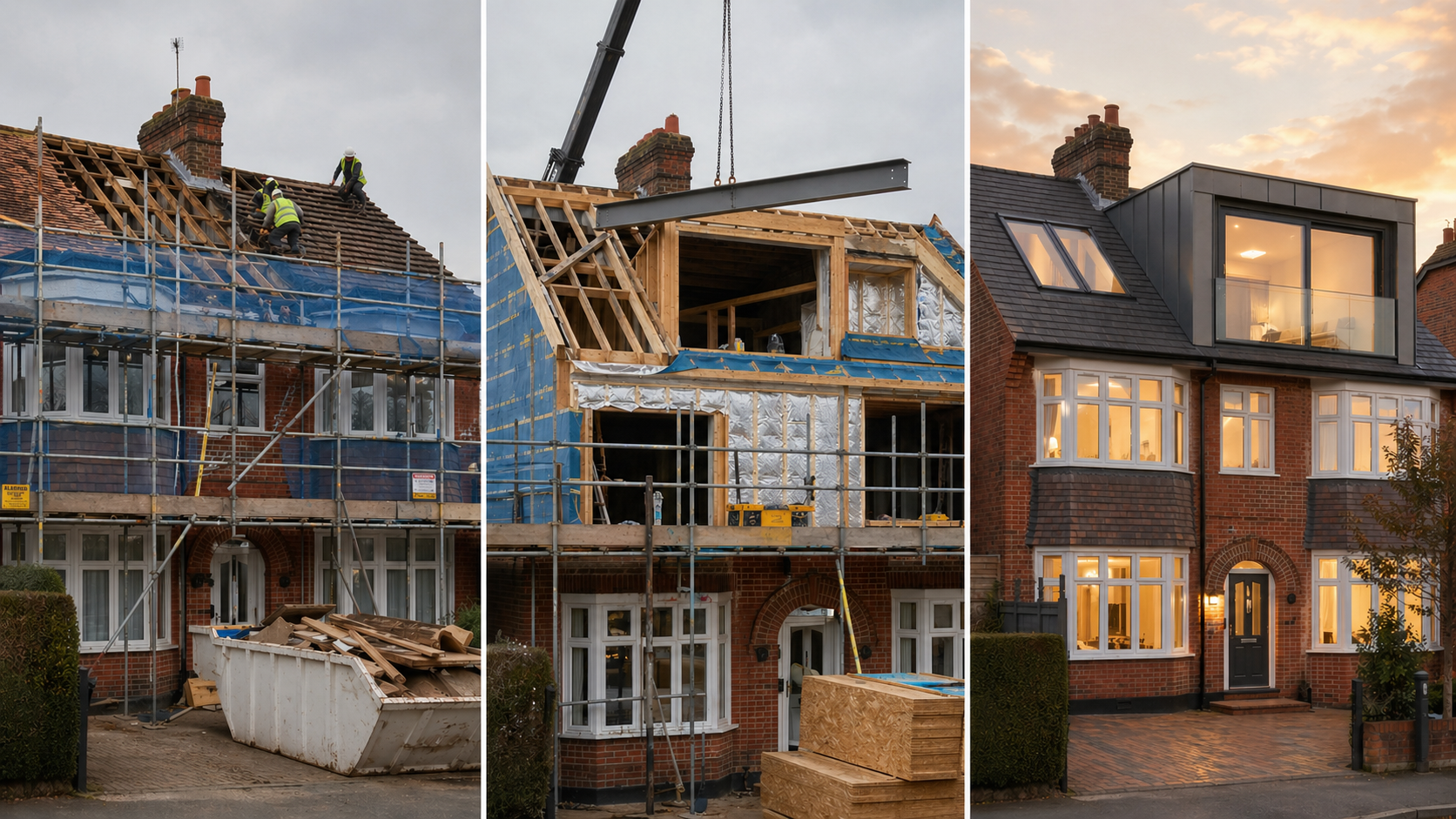
You've walked past scaffolding on one of the wide Victorian streets behind Clapham Common or noticed a new dormer appearing above the roofline along the roads off Abbeville Road, and the thought's stayed with you: how long is this actually going to take when it's my house? It's the first question almost every Clapham homeowner asks and one of the ones that gets the vaguest answers in return.
On-site, most loft conversions in Clapham take 6–10 weeks to build. The full project from your first survey through to the completion certificate runs closer to 3–5 months once design, Lambeth Council approvals, and building regulations sign-off are all properly accounted for. The weeks that tend to frustrate people most aren't the build weeks they're the quieter pre-build phase that most contractors are too optimistic about when they first describe the timeline.
This guide sets it all out clearly. Whether you own a wide-fronted Victorian terrace in SW4 or a later Edwardian house in Clapham Park, here's a precise, phase-by-phase account of how the project unfolds.
How much a loft conversion costs in Clapham → loft conversion cost guide
TL;DR: A standard dormer loft conversion in Clapham takes 6–8 weeks on-site. Velux conversions typically wrap up in around 4 weeks. Mansard builds run 10–14 weeks. Add 8–16 weeks upfront for design, Lambeth Council decisions, and building regulations, and the full project sits between 3 and 5 months total. (Sources: Lambeth Council Planning Portal, Nationwide House Price Index, 2025)
How Long Does a Loft Conversion Take in Clapham? The Realistic Breakdown
On-site build time in Clapham ranges from 4 to 14 weeks depending on the conversion type and the specifics of your property. Demand across South London has grown considerably a 2024 Checkatrade Home Improvement Report recorded a 25%-plus rise in loft conversion enquiries across the South East and Clapham homeowners, who have seen the borough's property values climb steeply over the past two decades, are now asking much sharper questions about what a realistic project schedule involves before they sign anything.
Here's how the main conversion types compare for Clapham properties:
The most common conversion across Clapham's Victorian terrace stock in SW4 the rear dormer sits in the 6–8 week on-site window. Properties on the wider roads around Clapham Common North Side or in Clapham Park with hip-end roofs opting for hip-to-gable will land closer to 8–10 weeks. Neither of those figures includes the pre-build phase which is where the real schedule weight accumulates.
Why the Total Timeline Is Longer Than the Build: The Pre-Build Phase
The build is genuinely the shorter half of the project. Before a joist is touched or a scaffold pole goes up, you work through design, planning, and building regulations a pre-build phase that typically runs between 6 and 16 weeks within the London Borough of Lambeth, depending on your property type and specific location within the borough.
Here's how that time splits out:
Design and structural survey (weeks 1–3): An architect or conversion specialist surveys the loft, takes detailed measurements, and produces technical drawings and structural calculations. From instruction to completed drawings, this typically takes 2–4 weeks.
Permitted Development or full planning permission? Most Clapham loft conversions proceed under Permitted Development rights the volume thresholds are 40m³ for terraced homes and 50m³ for semi-detached and detached properties (gov.uk Planning Portal, 2025). Even where PD clearly applies, a Lawful Development Certificate from Lambeth Council is strongly recommended. It takes 6–8 weeks and is the document your conveyancer will expect when you sell.
Where full planning permission is required, Lambeth Council targets an 8-week decision, with more complex or objected applications running longer.
Important for Clapham homeowners: The London Borough of Lambeth contains a significant number of conservation areas across its residential streets. In Clapham specifically, the Clapham Old Town Conservation Area covers the historic streets around the Old Town and Rectory Grove, and the Clapham Common North Side Conservation Area includes some of the most sought-after streets in SW4. Properties within these areas require full planning permission regardless of conversion size. Lambeth has also applied Article 4 Directions in several parts of the borough, withdrawing specific Permitted Development rights for roof alterations in designated streets. Always verify your exact address at lambeth.gov.uk/planning before assuming PD applies to your home.
Building regulations: Your builder submits a Full Plans application to Lambeth Council's Building Control team or a licensed private inspector. Initial plan review takes 3–5 weeks (lambeth.gov.uk, 2025). Building Control then runs in parallel with the build, with site visits at agreed structural and fire-safety milestones throughout.
Planning permission for a loft conversion in Clapham → loft conversion planning permission guide
Week 1: Pre-Build Preparation (Busier Behind the Scenes Than It Looks)
Week 1 is deceptively quiet from outside. Scaffolding goes up typically Day 1 or Day 2 and that's the most visible indication that something is happening. Behind it, materials arrive and are staged: structural steels, timber, insulation boards all positioned for the build that follows.
Your contractor opens a controlled access point in the roof structure a route for materials and workers that keeps the household below largely undisturbed. All activity at this stage is above the ceiling line. First floor and ground floor rooms carry on as normal throughout.
What to sort before Week 1 starts:
- Empty the loft completely boxes, stored items, loose insulation everything must be cleared before the crew arrives on Day 1
- Dust-sheet furniture in the room directly below the work zone
- Confirm delivery timing and skip placement with your contractor before the start date
- Tell your immediate neighbours work is beginning on the densely terraced streets around Clapham North and the roads off Clapham High Street, a brief advance notice goes a long way
Weeks 2–4: Structural and Shell Work (The Loud Phase)
This is the phase you and your neighbours will notice most. Structural steels go in, the floor is strengthened, and the dormer shell begins to emerge above the roofline. The noise is significant but concentrated. It stays above the ceiling line throughout the floors below are unaffected.
Week 2 Structural works:
- Existing floor joists strengthened or a new structural floor installed where loading requires it
- RSJ steel beams set to manage load transfer at key structural points (Clapham's Victorian terraces many built in the 1870s and 1880s as the borough expanded rapidly south of the river frequently carry narrower original joists than their Edwardian counterparts, meaning supplementary steelwork is common in SW4)
- Roof structure opened at the dormer aperture position
Week 3 Dormer shell:
- Timber dormer frame constructed, levelled, and plumbed
- Flat or pitched dormer roof formed to match the conversion specification
- Roof made temporarily weathertight at close of play each day a critical discipline across autumn and winter in SW4
Week 4 Weatherproofing and glazing:
- Dormer cladding applied: zinc, clay tiles, or plain render (heritage-sensitive finishes are regularly required on properties in or adjacent to the Clapham Old Town and Clapham Common North Side conservation areas, to satisfy Lambeth's planning conditions)
- Windows and Velux units installed and fully sealed
- Roof made permanently watertight the milestone that triggers the next scheduled Building Control visit
Hip-end roof note: Properties in Clapham Park or on the wider roads off Clapham South with hip-end roofs opting for hip-to-gable should plan an extra 1–2 weeks in the structural phase. Removing the hip and constructing a new gable wall is a more structurally involved operation than a standard rear dormer. Budget Weeks 2–5 for structural works rather than 2–4.
Types of loft conversion suitable for Clapham homes → loft conversion types guide
Weeks 5–6: First Fix Work Moves Inside
Once the shell is sealed and weathertight, everything moves inside the new space. The change is noticeable immediately the noise level drops considerably, dust is far less of an issue downstairs, and the household finds its rhythm again. All work is now contained within the loft above.
What happens during first fix:
- Insulation fitted to roof slopes, stud walls, and the floor deck to comply with Building Regulations Part L thermal performance standards were raised again under 2025 revisions
- Internal stud partition walls built and squared off
- First fix electrics run: cables chased and routed before any plasterboard goes on
- First fix plumbing where an en-suite is part of the specification (adds approximately 3–5 days to this phase)
- Fire separation installed Part B of the Building Regulations requires mains-wired, interlinked smoke alarms throughout the entire property, not just in the new loft room
Building Control inspection: Lambeth Council's Building Control team carries out a mid-build inspection at first fix to check insulation, joist sizing, and fire separation. Keep structural drawings on-site and accessible. Lambeth, in line with most London boroughs, now accepts video inspections for lower-risk elements such as insulation and joist spacing, which reduces on-site visit delays during busy periods.
Weeks 7–9: Staircase, Plastering and Second Fix
Staircase day is the most disruptive single day of the entire build and also the point at which the conversion stops being an abstract idea and becomes a real room. Your contractor opens the existing landing ceiling, lowers the new flight in from above, and connects it to the floor structure below. The first-floor landing is out of use for most of that day. The following morning, everything is accessible.
With the staircase fitted and the room connected, second fix moves through at a steady pace:
Weeks 7–8 Plastering:
Plasterboard is fixed to walls and ceiling across the new space. A skim coat follows and
within days the room stops looking like a shell and starts looking like somewhere you'd
actually want to be. Leave 3–5 full days for the plaster to dry before any decoration
starts. Painting onto under-dried plaster is one of the most consistent causes of visible
cracking that emerges in the months after handover.
Weeks 8–9 Second fix:
- Sockets, switches, and light fittings wired, positioned, and tested by the Part P registered electrician
- En-suite bathroom fixtures installed where specified factoring in the 3–5 working days this adds to the phase
- Floor covering laid: confirm your preference (engineered hardwood, LVT, carpet) with Buildaway well before second fix week to avoid supply delays at a critical stage
- Joinery completed: skirting boards, architraves, door linings, fitted eaves storage or wardrobes as specified
The case for including an en-suite in Clapham is particularly strong. Nationwide's 2025 House Price Index research found that a bedroom-and-bathroom loft conversion can increase a three-bedroom property's value by up to 24% (Nationwide House Price Index, 2025). In SW4 where average property values have risen sharply over the past two decades, and where buyer competition for family-sized homes remains fierce a well-specified loft conversion with bathroom adds both serious usability and a measurable premium at sale. Three to five extra build days is a minimal cost against that kind of return.
Weeks 9–10: Final Inspection and Completion Certificate
The final Building Control inspection is the last formal milestone before the new room can legally be occupied. In Clapham, this is carried out by either Lambeth Council's Building Control team or a private approved inspector Buildaway manages this on your behalf so it doesn't create a delay at the end of the project.
What the final inspection covers:
- Structural integrity of the new floor and roof construction
- Fire safety: fire door grades, smoke alarm positioning, interconnection between floors, and fire separation compliance
- Staircase specification minimum head height, rise, going, and handrail checked against Approved Document K
- Thermal insulation performance (Part L compliance)
- Electrical installation certificate from the Part P registered electrician
On successful completion, the inspector issues a completion certificate. File it with your property documents. Your conveyancer will need it when you sell, and your mortgage lender may ask for it if you remortgage after the works.
Decoration happens after handover either by the homeowner directly or through a local decorator. Buildaway can recommend experienced decorators in the Clapham and Lambeth area.
Want to know what the timeline looks like for your
specific Clapham property?
Buildaway offers a free, no-obligation loft survey across Clapham, Abbeville Village,
Clapham Old Town, Clapham Park and the surrounding SW4 postcode. One quote. One point of
contact. One clear process. Book your free loft survey
→
Can You Stay at Home During a Loft Conversion in Clapham?
Yes in almost all cases. Loft conversions are specifically designed to be live-in builds. Weeks 2–4 are the loudest, but noise is confined entirely to above the ceiling line. The one moment in the project that genuinely disrupts the household is staircase installation day, when the landing ceiling is opened and that's a single working day.
Good preparation beforehand makes the difference between a manageable build and a stressful one. Clear the loft before Week 1, put dust sheets over furniture in the rooms below, and agree working hours with your contractor before the start. Most Clapham builders operate 8am to 5pm on weekdays. Given the density of residential streets across SW4 particularly around Clapham Manor Street, Rectory Grove, and the roads off the Common weekend and evening working is typically restricted and should be confirmed upfront.
The Key Takeaways for Clapham Homeowners
A loft conversion in Clapham is a well-understood process when the full picture is clear from the outset. Here's what to hold onto:
- The on-site build is 6–10 weeks for the most common property types in SW4. The full project from first survey to completion certificate takes 3–5 months.
- The pre-build phase is where time accumulates invisibly Lambeth Council's planning approvals and building regulations operate on fixed statutory timescales that don't respond to urgency. Starting earlier than feels necessary is the only reliable buffer.
- Conservation areas are a real consideration in SW4 Clapham Old Town and Clapham Common North Side are live designations. Confirm your planning position with Lambeth before making any assumptions about Permitted Development.
- Include the en-suite. Nationwide's 2025 data shows a bedroom-and-bathroom conversion adds up to 24% in value. In Clapham's competitive SW4 market, that uplift is genuinely significant.
- The completion certificate is not optional. Your conveyancer will require it at sale. Your mortgage lender may need it after works. Treat the final inspection as a project deliverable from day one.
Ready to find out exactly what the timeline looks like for your Clapham property? Buildaway's free loft survey covers all of SW4 including Clapham Common, Clapham Old Town, Abbeville Village, Clapham Manor, Clapham North, Clapham Park, and the streets around Clapham High Street.