
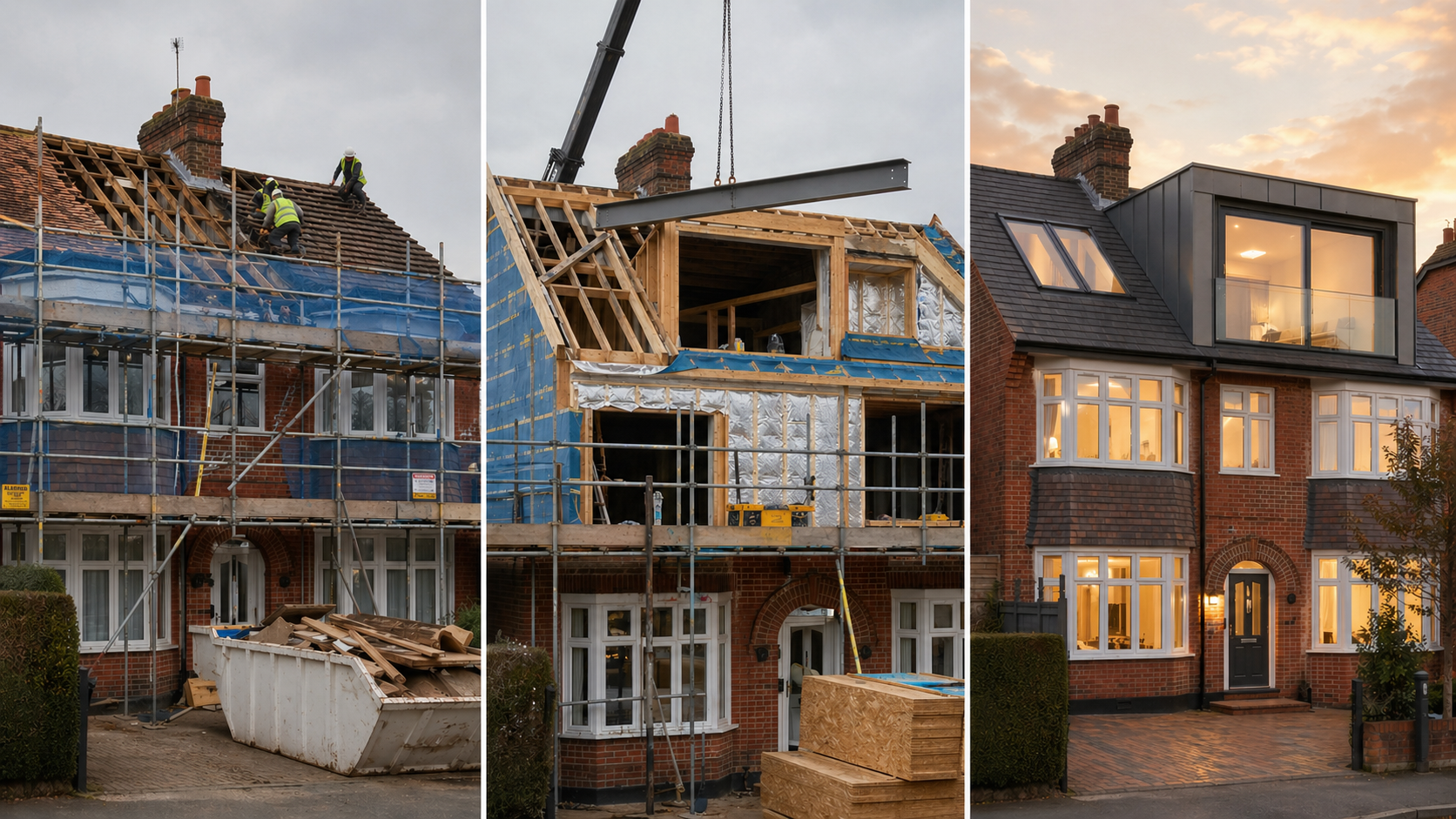
You've walked past Hall Place or driven along the North Cray Road and spotted scaffolding brackets on a neighbour's roof, and the thought's crossed your mind: how long would that actually sit on my house? It's the question Bexley homeowners raise before almost everything else - and it's one that deserves a straight answer rather than a vague ballpark.
Most on-site loft conversions in Bexley take 6–10 weeks to build. But the total journey - from your first phone call with a contractor through to a completion certificate in hand - is closer to 3–5 months once architectural design, Bexley Council approvals, and building regulations sign-off are factored in. The space between those two figures is what catches people off guard. It's not a sign of delays or problems; it's simply a process that very few contractors take the time to explain at the outset.
This guide explains every stage, every week. Whether you're in a period cottage near Old Bexley village in DA5, an inter-war semi near Upton Road, or a detached property out towards Joydens Wood, here's what happens - and when.
How much does a loft conversion cost in Bexley? → Full cost guide
TL;DR: A standard dormer loft conversion in Bexley takes 6–8 weeks on-site. Velux conversions complete in 4–5 weeks. Mansard builds run 10–14 weeks. Add 8–16 weeks upfront for design, Bexley Council decisions, and building regulations - and the full project runs 3–5 months start to finish. (Sources: Bexley Council Planning Portal, Nationwide House Price Index, 2026)
How Long Does a Loft Conversion Take in Bexley? What the Numbers Actually Mean
The on-site construction window for a Bexley loft conversion spans 4 to 14 weeks, determined by which type of conversion is being built and the condition of your existing roof structure. According to a 2026 Checkatrade Home Improvement Report, loft conversion enquiries across outer South East London rose by more than 28% year-on-year - and DA5 has seen some of the strongest growth in conversion interest among Bexley's residential postcodes.
Here's how each conversion type compares across Bexley's varied housing stock:
The most widely requested conversion for Bexley's inter-war semis in DA5 - a rear dormer - falls in the 6–8 week bracket. If you're on a detached hipped-roof property near North Cray or Joydens Wood and considering a hip-to-gable, plan for 8–10 weeks on-site.
The chart shows build time only. What it can't show is everything that needs to happen before a brick is moved - and that's the phase where most homeowners lose weeks they hadn't planned for.
Why Your Full Project Calendar Runs Much Longer Than the Build
The most common misconception about loft conversions is that the build is the bulk of the project. It isn't. Before your contractor ever disturbs the roof felt, your project moves through architectural design, planning confirmation, and building regulations submission - a combined pre-build phase of 6 to 16 weeks depending on your Bexley property's type and location.
Here's what each element actually involves:
Design and structural survey (weeks 1–3): An architect or conversion specialist visits your property, assesses the loft void, and produces a full set of architectural drawings along with structural engineer calculations. This typically takes 2–4 weeks, including any iterations on layout or structural approach.
Permitted Development or full planning permission? Most loft conversions in Bexley proceed under Permitted Development rights, meaning no formal planning application is required. The PD volume allowances are 40m³ for terraced properties and 50m³ for semi-detached and detached homes (gov.uk Planning Portal, 2026). Even when PD is clearly the route, obtaining a Lawful Development Certificate (LDC) from Bexley Council is strongly advised - it takes 6–8 weeks and safeguards your position at the point of sale.
Where a full planning application is needed, Bexley Council works to an 8-week statutory decision period from the date a valid application is received, with contested cases occasionally running beyond that.
Critical note for Bexley homeowners: Bexley village and its immediate surroundings sit within the Old Bexley Conservation Area, one of the borough's most carefully managed heritage zones. Properties within it - including many of the period cottages and Victorian semis along Church Road, the High Street, and Albert Road - require full planning permission for any loft conversion, regardless of volume. The conservation area boundary is tighter than many homeowners assume. Always verify your address at bexley.gov.uk/planning before drawing any conclusions about PD eligibility. Bexley Council has also applied Article 4 Directions in specific streets beyond the conservation area, removing PD rights for roof alterations in those zones.
Building regulations: Your contractor submits a Full Plans application to Bexley Council Building Control or an approved private inspector before construction starts. Initial plan checking takes 3–5 weeks (bexley.gov.uk, 2026). Building Control then runs in parallel with the active build, with inspectors attending at key milestones.
Planning permission for a loft conversion in Bexley → Full planning guide
Week 1: Pre-Build Setup - More Activity Than It Looks
Week 1 tends to look quiet from the outside. The scaffold going up on Day 1 or 2 is the most visible moment, but beneath it a significant amount of project logistics is being locked in. Materials are staged: structural steels arrive, timber is stacked, insulation boards are positioned ready for the build sequence.
Your contractor creates a controlled access point in the roof structure - a temporary opening sized to allow materials and operatives to move freely between the roof void and scaffold without passing through your living space. At this stage, everything is confined to above your ceiling line. The rooms you live in remain completely undisturbed.
What needs to be in place before Week 1 starts:
- The entire loft cleared - not partially tidied, but completely empty, including old insulation, stored boxes, and anything else occupying the void
- Dust sheets laid over furniture in the rooms directly beneath the build zone
- Skip location and materials delivery schedule confirmed with your contractor
- Neighbouring households notified ahead of time - particularly relevant in Bexley village and on the tighter residential streets around Blendon Road and Bexley High Street where parking and access can be constrained
Weeks 2–4: Structural and Shell Work - The Noisiest Stretch
Weeks 2 to 4 are when the project announces itself to the street. Steel goes in, the floor structure is reinforced, and for dormer builds the dormer box is constructed above the existing roofline. It's the noisiest phase by a considerable margin, but the disruption is structurally contained - it stays above your ceiling.
Week 2 - Structural work:
- Existing floor joists assessed and strengthened, or an entirely new structural floor installed
- Steel RSJ beams positioned to redistribute roof loads - common on Bexley's inter-war stock in DA5, where original ceiling joists were frequently under-specified for the loads a habitable loft room introduces
- Roof partially opened for dormer builds at this stage
Week 3 - Dormer shell construction:
- Timber dormer frame built, squared, and set in position
- Dormer roof formed - flat or pitched depending on the design and any planning conditions
- Roof made temporarily weathertight at the close of each working day - Bexley's position in the Cray valley means overnight rain is a consistent planning assumption, particularly between September and April
Week 4 - Weatherproofing and glazing:
- Dormer exterior finished in matching tiles, EPDM flat roof membrane, or render - within the Old Bexley Conservation Area, Bexley Council planners will specify materials that respect the existing street character
- Windows and Velux units installed and sealed into the frame
- Roof declared fully weathertight - this is the sign-off point that triggers the next Building Control inspection visit
North Cray and Joydens Wood note: The larger detached and executive-style properties in North Cray, Joydens Wood, and along the fringes of DA5 often have traditional hipped roofs rather than the gabled rear elevations found on semis. A hip-to-gable conversion - requiring the hip-end to be demolished and a new gable wall built - adds 1–2 weeks to the structural phase. Budget Weeks 2–5 for structural work on these properties, rather than the 2–4 window for a standard rear dormer.
Weeks 5–6: First Fix - Construction Moves Inside
With the shell watertight, all activity moves into the new interior space. This is meaningfully quieter for the household - the majority of work is now contained within the loft level itself.
What first fix involves:
- Insulation installed to roof slopes, walls, and new floor to meet Building Regulations Part L standards (revised under 2026 updates)
- Internal stud partition walls constructed to define the room layout - bedroom, landing, and en-suite zones
- First fix electrics: all cable routes run throughout the space before any plasterboard goes up
- First fix plumbing if the specification includes an en-suite - adds roughly 3–5 working days to this phase
- Fire safety installation: mains-wired interlinked smoke alarms fitted throughout the property as required under Part B of the Building Regulations
Building Control inspection: Bexley Council Building Control carries out a formal inspection at this stage. Ensure your structural drawings and engineer's calculations are on-site and immediately accessible. Bexley Council now facilitates video inspections for lower-risk checks such as insulation installation and joist spacing verification, reducing the turnaround time between inspection bookings and visits (bexley.gov.uk Building Control, 2026).
Weeks 7–9: Staircase, Plastering, and Second Fix
Staircase day is the moment that most occupants genuinely feel the build. A section of the existing first-floor landing ceiling is opened up, and the new staircase is lowered in and fixed. First-floor access is limited for the duration of that working day. It's the most intrusive single moment of the entire project - but it's also the one that marks the clearest turning point from construction site to new room.
After the staircase is secured, the second fix phase moves at pace:
Weeks 7–8 - Plastering:
Plasterboard is fixed to walls and ceiling. A skim coat follows, and within a few days the
raw construction shell reads as a proper room. Allow 3–5 full days of drying time before
decoration of any kind begins. Applying paint or wall coverings to plaster that hasn't fully
dried always results in cracking and patchy adhesion - it's a shortcut that costs more time
to fix than it saves.
Weeks 8–9 - Second fix:
- Electrical outlets, light fittings, and switches tested and connected
- En-suite bathroom fully plumbed and fitted if included
- Floor covering installed - carpet, engineered timber, or LVT; confirm your choice before second fix starts so materials can be ordered and on-site when needed
- Joinery completed: skirting boards, door linings, fitted eaves storage, any wardrobes
Second fix for an en-suite adds 3–5 working days to this phase - but it's an addition that pays back handsomely. Nationwide's 2026 House Price Index research found that a loft conversion adding a double bedroom and bathroom can lift a three-bedroom property's value by up to 24% (Nationwide House Price Index, 2026). In Bexley's village character setting with its strong appeal to upsizing families, that kind of space premium is real and quantifiable.
Weeks 9–10: Final Inspection and Your Completion Certificate
The final Building Control inspection is what makes your new room officially habitable. In Bexley, this is carried out by Bexley Council Building Control or a private approved inspector - Buildaway manages the scheduling and coordination as part of the standard close-out process.
What the final inspection covers:
- Structural integrity of the new floor deck, roof, and load-bearing elements
- Fire safety compliance: fire door ratings, smoke alarm locations and interconnection wiring, floor-to-floor compartmentation
- Staircase dimensions - head height clearance, rise and going, handrail and balustrade compliance
- Insulation performance values confirming Part L 2026 compliance
- Electrical installation certificate from a Part P registered electrician
Once the inspector is satisfied, a completion certificate is issued. Keep it with your property deeds - not in a drawer you'll forget. Conveyancers request it at the point of sale without exception, and remortgaging after a loft conversion often triggers the same request from your lender.
From that point, the space is yours to furnish and use. Most Bexley homeowners choose to decorate after formal handover - either personally or through a decorator. Buildaway maintains relationships with trusted local decorators covering the DA5 area and can provide introductions if helpful.
Want a timeline built around your specific Bexley
property?
Buildaway offers a free, no-obligation loft survey across Bexley, Old Bexley, Blendon,
North Cray, Joydens Wood, and the wider DA5 postcode. One honest quote. One point of
contact from survey to sign-off. Book your free loft
survey →
Can You Stay in Your Home During a Loft Conversion in Bexley?
In almost every case, yes. Loft conversions are planned and managed as live-in builds, and the vast majority of Bexley homeowners remain in the property throughout. The structural phase - Weeks 2 through 4 - is the noisiest period, but all activity sits above your ceiling line and outside your living space. The single most disruptive day is staircase installation, when your landing ceiling is temporarily opened. That work is typically completed within one working day.
Preparation is the most effective thing you can do to manage the experience. Empty the loft completely before Week 1, cover the rooms below, and agree working hours with your contractor before scaffolding day. Most contractors in Bexley operate Monday to Friday, 8am to 5pm, with weekend working kept to a minimum out of respect for residential neighbours - particularly in the quieter streets around Bexley village.
The Key Takeaways for Bexley Homeowners
A loft conversion in Bexley is a well-established process - but the homeowners who have the smoothest experience are the ones who understood the full timeline before they started. Here's what to keep in mind:
- The build runs 6–10 weeks across most DA5 property types. The full project, pre-build included, is 3–5 months.
- The Old Bexley Conservation Area changes the rules significantly. If your address falls within it - even partly - you need full planning permission, not just PD. Check first, plan accordingly.
- Start earlier than feels necessary. Council decision periods and building regulations review have fixed statutory timescales that can't be shortened. Getting into the queue early is the single most effective way to control your overall project calendar.
- An en-suite earns its place in the programme. The 3–5 day addition to second fix is small relative to the 24% value uplift Nationwide's 2026 data records for a bedroom-and-bathroom conversion in this type of market.
- Don't underestimate the completion certificate. It's not a formality - it's a legal document your conveyancer and mortgage lender will ask for. The final inspection is the step that makes everything else official.
Buildaway surveys the full DA5 postcode area - Bexley village, Old Bexley, Blendon, North Cray, Joydens Wood, and the surrounding streets. Book a free loft survey and we'll give you a realistic, property-specific timeline from the first visit.