
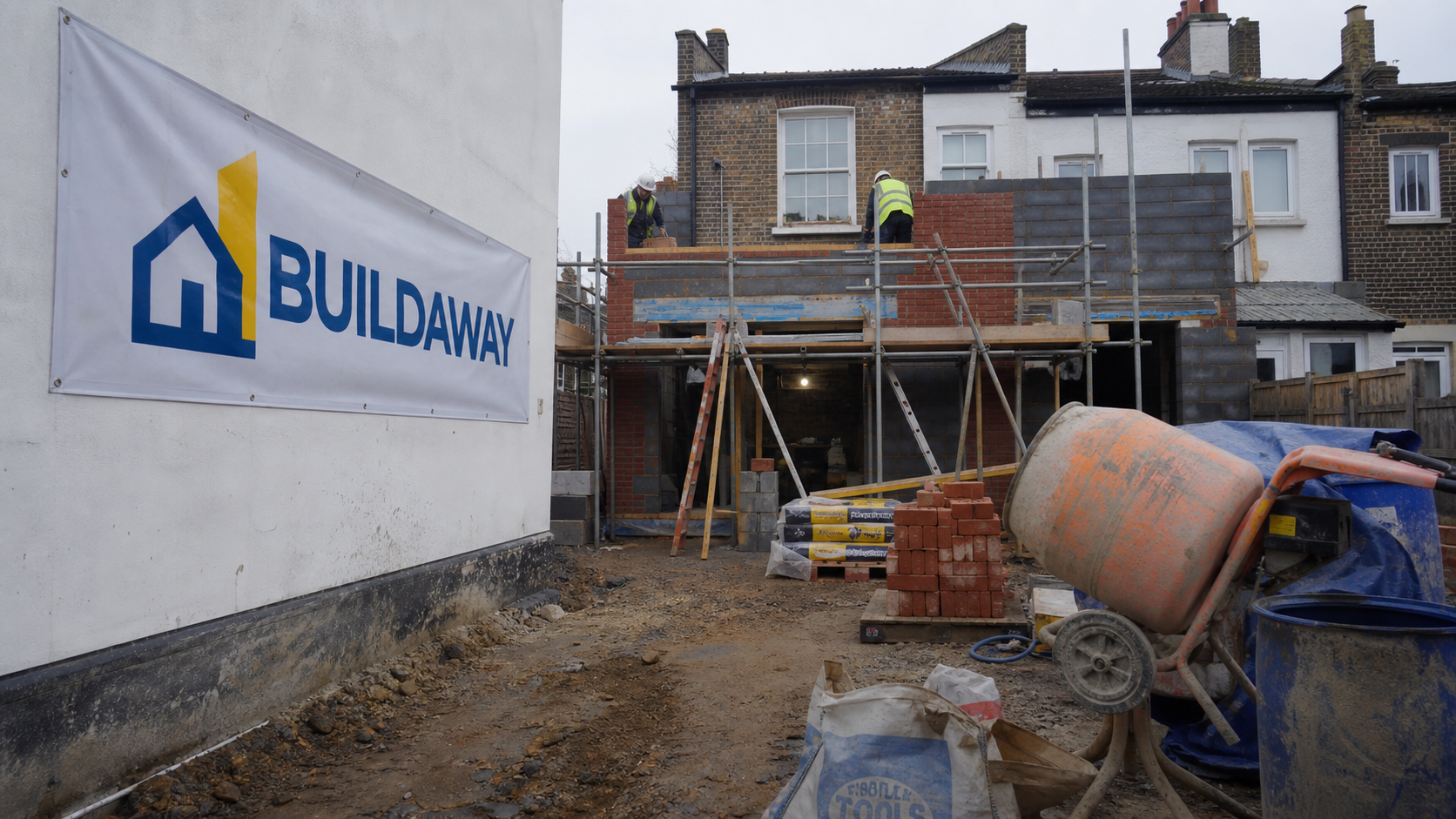
Orpington sits at the outer edge of Greater London, where suburban streets give way to Green Belt countryside and a planning framework that is considerably more layered than the postcode suggests. BR5 and BR6 together cover one of the widest planning spectrums in South East London from straightforward 1930s semis in Poverest and St Paul's Cray to Green Belt properties in Chelsfield, Pratts Bottom, and Green Street Green where extension possibilities face real national policy constraints.
Add the Orpington Priory Conservation Area centred on a Grade II* listed medieval building the Broomhill and Chelsfield village designations, Bromley Council's Article 4 Directions across 16 wards, and the archaeological sensitivity around Fordcroft and the Crofton Roman Villa corridor in BR6, and you have a planning environment that rewards homeowners who do their homework before they even consider briefing an architect.
This guide breaks the full extension timeline down phase by phase from first design meeting to final Building Control sign-off with the Orpington-specific figures that matter for BR5 and BR6 properties. Because the planning context in Orpington isn't just about conservation areas. It's about Green Belt boundaries, heritage settings, and a postcode split that creates genuinely different planning profiles on opposite sides of the same town.
TL;DR: A standard single-storey rear extension in Orpington takes 6–10 months from first consultation to completion roughly 4–6 weeks of design, up to 8 weeks for Bromley Council's planning decision, plus 12–16 weeks of construction. Green Belt properties in BR6, and projects within Bromley's 47 conservation areas, typically add 3–5 months to the total. The most expensive mistake in Orpington? Assuming your BR6 property sits outside the Green Belt without checking.
Key Takeaways
- Single-storey rear extensions in Orpington: 6–10 months total from consultation to handover for non-Green Belt properties
- Bromley Council targets an 8-week decision from validation for householder planning applications (bromley.gov.uk)
- Bromley has 47 conservation areas the Orpington Priory, Broomhill, Chelsfield, and Farnborough Village designations all cover parts of BR5 and BR6
- Green Belt restrictions apply to substantial parts of BR6, including Chelsfield, Pratts Bottom, and Green Street Green extensions here face a higher planning bar than anywhere else in this guide
- Party wall obligations on Orpington's densely packed post-war and inter-war semis are a routine pre-construction complication disputed notices can push timelines back by 2–3 months
What's the Full Timeline for a Home Extension in Orpington?
Orpington's housing stock is more varied than most parts of South East London. The post-war semis and terraces across St Paul's Cray and Poverest in BR5 have a different planning profile to the larger detached Victorian and Edwardian houses along Chislehurst Road and Sevenoaks Road in BR6. And both are entirely different again from the rural and semi-rural properties in Chelsfield and Pratts Bottom, where Green Belt policy shapes what's achievable before a planning officer has even looked at the drawings.
For most non-Green Belt Orpington homes, a standard single-storey rear extension runs between 6 and 10 months from first consultation to handover. Green Belt projects, or those requiring full planning permission because of conservation area constraints, should add three to five months to that range. A double-storey build on any Orpington property adds further time on top.
The construction phase is always shorter than the pre-build period feels. Planning permission, structural engineering, party wall matters, and Building Regulations approval all sit in the programme before a spade goes in and most Orpington homeowners, particularly those in BR6, underestimate how many of those pre-build steps are affected by local designations they weren't initially aware of.
Here's how those months divide across the seven main phases:
For reference: A standard single-storey rear extension on a non-Green Belt Orpington property, including all pre-build phases, typically takes 6–10 months from first consultation to final sign-off. The build phase alone runs 12–16 weeks. Properties within Bromley's 47 conservation areas, under Article 4 Directions, or within or adjacent to the Green Belt should add at least 4–8 weeks to the planning stage. (Sources: Bromley Council, Checkatrade)
Before committing to a timeline, the cost picture matters too. See our guide on how much does a home extension cost in Orpington? → Full cost guide for a realistic budget across all project types in BR5 and BR6.
Phase 1 Design, Feasibility & Planning Prep (3–6 Weeks)
This phase is longer in Orpington than in most other parts of South East London particularly for BR6 properties because there are more fundamental questions to answer before an architect can meaningfully start drawing. Is the property in the Green Belt? Is it within or adjacent to a conservation area? Does it fall within an archaeological sensitivity zone near the Crofton Roman Villa corridor or the Fordcroft site off Poverest Road? Each of those questions affects the design approach, the documentation required, and ultimately the planning route.
What actually happens in this phase
Your architect carries out a measured survey, develops concept drawings, and produces the planning drawings Bromley Council needs to assess your application. A clean rear extension on a standard BR5 semi away from any designation might get through design in three to four weeks. A BR6 project near the Green Belt boundary or one that needs a Green Belt assessment, a Design and Access Statement for a conservation area, or a heritage impact note for the Orpington Priory setting will run to six to eight weeks minimum.
Bromley Council offers a paid pre-application advice service. For Green Belt or conservation area projects in Orpington it's genuinely valuable a planning officer's steer before you commit to detailed drawings is always cheaper than redesigning after a refusal. The Priory Conservation Area Statement SPG (2002) sets out clear officer expectations for properties in that part of the town centre, and reading it before your architect starts can save weeks of revision.
The Bromley planning context as it applies to Orpington specifically
⚠ Orpington-Specific Planning Alert Two
Separate Risks:
The Green Belt. Large areas of BR6 including Chelsfield, Pratts
Bottom, and Green Street Green sit in the Metropolitan Green Belt. Here, extensions
must not result in "disproportionate additions" (typically capped at 50% of the original
volume). A project that is permitted development elsewhere often requires full planning
and a Green Belt case statement here. Always verify your property's status on Bromley's
planning map.
Conservation areas and heritage settings. Orpington contains several of
Bromley’s 47 conservation areas, including the Orpington Priory, Broomhill, and
Chelsfield designations. These areas, alongside Article 4 Directions across 16 wards, significantly restrict
permitted development rights particularly for upward extensions. If your property is
in or near these heritage settings, expect a higher level of planning scrutiny and
additional documentation requirements.
The householder planning application fee is £258 as of 2025 (GOV.UK Planning Portal). That's the submission fee only your architect's time for drawings, heritage statements, and Green Belt case documentation is on top.
Unsure whether your project needs full planning permission or qualifies for the permitted development route? Our guide on planning permission for a home extension in Orpington → Full planning guide covers the thresholds for BR5 and BR6 in detail.
Not sure about your Orpington property's
planning position?
Buildaway's team can advise before you commit to
anything.
Phase 2 Bromley Council Planning Permission (8–13 Weeks)
Once your application is submitted, Bromley Council validates it a process that takes one to two weeks and checks all required documents are present before the formal eight-week clock starts. The practical window from submission to decision letter is therefore ten to twelve weeks for most Orpington householder applications. Conservation area applications near the Priory or Broomhill designations, and Green Belt applications that need more detailed officer assessment, regularly push to thirteen weeks.
Around 97% of Bromley applications are decided under delegated officer authority rather than at a public committee which makes outcomes relatively predictable when submissions are thorough, well-documented, and clearly responsive to local policy. The 3% that go to committee are almost always the contested cases: applications in conservation areas where local objection has been sustained, or Green Belt cases where the principle of development needs member-level consideration.
How the Bromley planning process works for Orpington
- Validation (1–2 weeks): Bromley checks all documents are present and correct before officially registering the application plans, elevations, site plan, fee, and any supporting statements required by the designation.
- Neighbour consultation (21 days): A statutory requirement. Adjacent owners are formally notified and have the right to submit observations.
- Planning officer assessment: The officer reviews the proposal against Bromley's Local Plan including Policy 6 on residential extensions, Policy 41–43 on heritage and conservation areas, and the Green Belt policies that apply to BR6 alongside any applicable heritage guidance.
- Decision (target 8 weeks from validation): Delegated officer decisions are the norm. Well-prepared, policy-compliant applications consistently achieve decisions within this window.
Bromley Council targets 8 weeks from validation to issue a decision on standard householder applications, with validation itself taking 1–2 weeks from submission. Properties in or adjacent to the Green Belt in BR6, or within one of Bromley's 47 conservation areas including the Orpington Priory and Broomhill designations, should allow 10–13 weeks from submission to decision. Around 97% of Bromley planning applications are decided under delegated officer authority. (Source: London Borough of Bromley)
The permitted development route and its Green Belt limits
Rear extensions within permitted development limits 3 metres deep for attached houses, 4 metres deep for detached require only Prior Approval, which must be decided within 42 days under the Town and Country Planning Order. That's a meaningful time saving versus a full application.
But two things limit the permitted development route in Orpington more than in most other locations. First, Green Belt properties: PD rights exist in the Green Belt for extensions, but the 50% volume cap on total enlargements above the original dwelling applies strictly, and any extension that would take cumulative additions above that threshold needs full planning permission under Green Belt policy. Second, Bromley Council's Article 4 Directions across 16 wards which include wards covering parts of the Orpington area remove certain upward extension PD rights. Always confirm on Bromley's planning portal before designing to the PD route.
Phase 3 Building Regulations, Party Walls & Pre-Construction (4–8 Weeks)
A planning approval or a Prior Approval confirmation is not your signal to start on site. Building Regulations approval and, where applicable, Party Wall matters both sit between your decision notice and the first day of groundworks.
Building Regulations approval covers structural and safety compliance: foundations, steelwork, insulation, fire separation, drainage. Your builder and structural engineer submit drawings to Bromley Building Control (or an approved inspector), and approval typically takes four to eight weeks. Projects in outer BR6 particularly where ground conditions vary more than the standard London clay profile closer to the M25 sometimes require more detailed foundation surveys, which can extend the structural engineering phase.
The Party Wall Act applies whenever an extension is within 3 metres of a neighbouring foundation. On the post-war semis across Poverest, St Paul's Cray, and the residential streets between Orpington Station and Ramsden Estate, that means almost every rear extension triggers a party wall obligation with at least one neighbour. You're legally required to serve notice at least two months before construction starts.
From Cormac Hegarty, Director &
Founder:
"The split between BR5 and BR6 creates two genuinely different types of project in
Orpington. In BR5 Poverest, St Paul's Cray, St Mary Cray it's mostly standard
semi-detached work with party wall obligations as the primary pre-construction risk. In
BR6, particularly towards Chelsfield and Pratts Bottom, the Green Belt status changes
everything. We had an enquiry from a homeowner on a lane off Bucks Cross Road who had
already spent money on architect drawings before discovering their property sat inside
the Green Belt boundary. The design had to be substantially reworked. Confirming your
Green Belt status takes ten minutes on the planning portal and can save months of wasted
work."
When a neighbour consents, you're on schedule. When a neighbour appoints their own surveyor their legal right add another four to eight weeks and surveyor costs on both sides.
According to RICS guidance on the Party Wall Act, disputed party wall notices are among the most common causes of pre-construction delays on London domestic projects. On the densely plotted post-war streets of BR5, this is a recurring reality rather than an occasional exception.
Phase 4 Construction: What Gets Built and When (12–24 Weeks)
Once the pre-build phase is complete planning approved, Building Regulations submitted, party wall notices served and agreed the on-site build begins. From groundworks to snagging, the construction phase takes between 12 and 24 weeks depending on the scale of the project.
- Groundworks & foundations (Weeks 1–3): Excavation, concrete pouring, drainage connections. Ground conditions in BR6 particularly towards the chalk and greensand geology of the Orpington/Chelsfield ridge can differ from the London clay profile found across BR5 and inner South East London. Unusual ground conditions occasionally require additional investigation before foundation works can proceed, adding time to this stage.
- Structure goes up (Weeks 4–7): Blockwork or timber frame, structural steelwork where required, roof structure, and external walls. The extension takes visible shape.
- Weathertight (Weeks 8–10): Roof covering, windows, and external doors installed. Internal trades can progress regardless of weather once this milestone is hit.
- First fix (Weeks 11–13): Electrical wiring, plumbing pipework, and central heating runs installed before plastering begins. Getting service routes right before the walls close avoids expensive remedial work later.
- Plaster, insulation & second fix (Weeks 14–15): Walls and ceilings completed. Skirtings, sockets, switches, kitchen units, and bathroom fittings where applicable.
- Decoration & snagging (Weeks 15–16): Final paint, tiling, and a Building Control inspection to confirm formal sign-off.
For a standard single-storey rear extension on an Orpington residential property, the on-site construction phase typically runs 12–16 weeks. A double-storey extension extends this to 18–24 weeks. Ground conditions across BR6 where chalk and greensand geology differs from the clay profile further north can occasionally extend the groundworks stage. (Source: Checkatrade; Buildaway project experience)
Choosing between single and double storey? The cost and timeline difference is significant. See our comparison of single storey vs double storey extension for the full breakdown.
What Actually Delays an Orpington Home Extension?
Four causes account for most overruns on Orpington projects specifically. Three of them are shared with other South East London locations. The fourth Green Belt miscalculation is almost unique to Orpington among the locations Buildaway works across.
Green Belt status misunderstood. This is the Orpington-specific delay that has no parallel elsewhere in our coverage area. Homeowners in parts of BR6 particularly those in the more rural stretches between Chelsfield village, Pratts Bottom, and the Farnborough area regularly assume their property is simply "suburban" when it actually sits within the Green Belt boundary. In the Green Belt, any extension that takes cumulative additions above 50% of the original dwelling's volume requires full planning permission and must pass a Green Belt policy test under the National Planning Policy Framework. An architect briefed without this knowledge produces drawings that can't be submitted without substantial revision.
Orpington Priory and conservation area documentation. The Orpington Priory Conservation Area covering the historic core of the town around Church Hill and the Grade II* listed Priory itself requires a Design and Access Statement that demonstrates how an extension responds to the character of the area. The Broomhill Conservation Area, west of the town centre, and the Chelsfield village designation in outer BR6 both carry similar documentation requirements. Missing these at submission adds two to three weeks to the validation stage, minimum.
From our Orpington projects: The postcode split between BR5 and BR6 creates two very different project profiles. In BR5, the planning risks are broadly similar to other inner South East London locations conservation area checks, Article 4 Direction verification, party wall planning. In BR6, the Green Belt is the first question we ask on every enquiry. We've seen homeowners invest significantly in architect fees and even pre-application advice before someone confirms they're within the Green Belt boundary. A ten-minute check on Bromley's interactive planning map at the outset of any BR6 project is non-negotiable.
Article 4 Direction surprises in Orpington wards. Bromley's Article 4 Directions across 16 wards which remove the upward extension permitted development rights that many homeowners assume they have cover wards that include parts of the BR5 and BR6 residential areas. Homeowners who brief an architect on the permitted development route without confirming their ward's Article 4 status routinely find their design assumptions incorrect. Always check Bromley's planning portal before committing to a design based on PD.
Party wall disputes on BR5's post-war semis. The post-war and inter-war semi-detached stock across Poverest, St Paul's Cray, and St Mary Cray sits close to neighbouring foundations. Most rear extensions trigger party wall obligations on one or both sides. The majority of neighbours consent but when one appoints their own surveyor, the timeline extends by two to three months and costs rise on both sides of the fence.
Four issues drive the majority of timeline overruns on Orpington home extensions: Green Belt status misunderstood in BR6, conservation area documentation requirements for the Priory and Broomhill designations, Article 4 Directions removing assumed PD rights, and party wall disputes on densely plotted BR5 semis. Bromley has 47 conservation areas and Article 4 Directions across 16 wards. (Source: London Borough of Bromley; National Planning Policy Framework)
One point of contact. One clear
process.
Buildaway handles planning, Green Belt assessments, party wall
coordination, structural engineering, and the full build across Orpington.
When Is the Best Time to Start an Orpington Home Extension?
The timing principle that applies across South East London applies in Orpington too with one additional consideration for BR6 properties specifically. Start your design and planning in September or October, submit your application in November, receive a decision in January or February, and begin groundworks in March or April.
Spring groundworks are the most reliable window across the whole of this part of London. But in outer BR6 particularly on the chalk-based ground towards Chelsfield and the North Downs fringe winter groundworks carry additional risk beyond simple waterlogging. The chalk and greensand geology that characterises much of the outer Orpington area can be challenging to excavate and distract in cold, wet conditions in ways that don't apply to the London clay belt further north. A March start is a genuine advantage here, not just a preference.
There's also the availability argument that applies everywhere in South East London. Good builders fill their spring and summer books six to ten weeks in advance. Starting your planning process in autumn gives you a confirmed builder and a confirmed start date before the spring surge pushes reputable contractors' availability into summer.
Putting It All Together
A home extension in Orpington involves more initial groundwork than most homeowners anticipate especially in BR6, where the Green Belt, heritage settings, and conservation area designations can each independently change the planning route. But it's manageable when the right questions are asked at the start rather than halfway through the design process.
- Single-storey rear extension in Orpington (non-Green Belt): 6–10 months total from first consultation to handover
- Green Belt project in BR6: Add 3–5 months full planning required, higher bar, longer officer assessment
- Double-storey extension: 9–14 months greater structural complexity, longer planning scrutiny near conservation areas
- Conservation area or Priory setting: Add 4–6 weeks to planning prep and allow 10–13 weeks for a decision
- Party wall obligations: Serve the notice early disputed notices add 2–3 months to the pre-construction phase
- Best start time: Design in autumn, submit in November, break ground in spring
At Buildaway, every Orpington project runs with a single point of contact one person who coordinates your architect, Green Belt assessment, structural engineer, Building Control, and on-site team from first consultation to final handover.
Once you understand the timeline, the cost is the next piece of the picture. See our full breakdown of home extension cost in Orpington for a realistic budget across BR5 and BR6 extension types.