
Search "how long does a home extension take" and you'll find answers ranging from a few months to well over a year all technically defensible, none particularly helpful if you're trying to plan building work on a specific property in Bexleyheath. Generic timelines assume generic properties in generic planning environments. Bexleyheath is neither.
The borough of Bexley sits at the edge of London where the housing stock shifts perceptibly more space, more detached and semi-detached properties, more interwar and post-war development, and a planning authority that operates differently from the inner London boroughs. Understanding how Bexley Council handles extension applications, where the conservation area network sits in DA6 and DA7, and why the area's predominantly interwar semi-detached stock creates specific party wall and structural considerations is what separates a well-planned project from one that runs two months over before a brick is laid.
This guide covers the full Bexleyheath timeline phase by phase from the first design meeting to Building Control sign-off with the specific local figures that matter for your project.
See our guide on how much a home extension costs in Bexleyheath → Full cost breakdown for a detailed look at what to budget at each stage.
TL;DR: A standard single-storey rear extension in Bexleyheath takes 6–10 months total from first consultation to completion roughly 4–6 weeks of design, up to 8 weeks for Bexley Council's planning decision, and 12–16 weeks of construction. Projects near the Bexleyheath Town Centre Conservation Area or affected by local planning constraints typically run 3–4 months longer. Confirming your planning position before briefing an architect is the single most time-efficient thing you can do at the start. (Sources: Bexley Council, Checkatrade)
Key Takeaways
- Single-storey rear extensions in Bexleyheath: 6–10 months total from consultation to handover
- Bexley Council targets an 8-week decision from validation for standard householder planning applications (bexley.gov.uk)
- The Bexleyheath Town Centre Conservation Area and the Red House Conservation Area covering William Morris's former home on Red House Lane are the two key planning designations in DA6 that affect extension timelines
- Party wall obligations are a near-constant consideration on Bexleyheath's interwar semi-detached streets, and serve as one of the most common sources of pre-construction delay in this postcode
- Starting design in September or October puts you on track to break ground in spring the most reliable construction window in outer South East London
What's the Full Timeline for a Home Extension in Bexleyheath?
For most Bexleyheath properties the interwar semis that dominate the residential streets off Broadway and along the roads between Bexleyheath and Welling stations, the larger Edwardian houses near Red House Lane, and the post-war detached stock in the quieter DA7 streets a standard single-storey rear extension runs between 6 and 10 months from first consultation to handover. A double-storey build adds three to five months on top of that.
The construction phase is only one portion of the full project timeline. Planning applications, structural calculations, party wall obligations, and building regulations approval all sit in the calendar before groundworks begin. Most Bexleyheath homeowners underestimate this pre-build period by around two months often because the conversation with a builder has covered the construction duration without addressing everything that precedes it.
Here's how those months distribute across the seven main project phases:
A standard single-storey rear extension in Bexleyheath, covering all pre-build phases, typically takes 6–10 months from first consultation to final sign-off. The build phase alone runs 12–16 weeks. Properties near designated conservation areas in DA6 should allow at least 3–4 additional weeks in the planning stage. (Sources: Bexley Council, Checkatrade)
Phase 1 Design, Feasibility & Planning Prep (3–6 Weeks)
This phase runs from your first conversation with an architect to the moment your planning application is formally submitted and it nearly always takes longer than homeowners in Bexleyheath anticipate, particularly when a conservation designation or permitted development ambiguity is involved.
What actually happens in this phase
Your architect will carry out a measured survey of the property, develop concept drawings, and produce the planning documents Bexley Council needs to assess your application. A straightforward rear extension on a standard interwar semi in DA6 in a location free from conservation area restrictions can move through this phase in three to four weeks. A project near the Bexleyheath Town Centre Conservation Area, or one involving the Red House Conservation Area off Red House Lane, will need five to six weeks and will require a Heritage Statement and Design and Access Statement before Bexley will validate the application.
Bexley Council offers a pre-application advice service. For projects where the planning position involves conservation area proximity or any ambiguity about PD rights, using it upfront is a more cost-effective approach than finding out mid-assessment that a fundamental aspect of the design needs revision. A planning officer's early steer on scale, materials, or roof form can prevent the kind of request for further information that adds three to four weeks to an otherwise straightforward application.
The Bexleyheath planning context you need to understand
⚠ Bexleyheath-Specific Planning Alert: The Bexleyheath Town Centre Conservation Area covers the historic core around Broadway, Market Place, and the surrounding residential streets a zone that developed around the original planned town centre laid out in the 19th century. Properties within or immediately adjacent to this area require full planning permission for extensions affecting any visible elevation, with design proposals expected to reflect the character and materials of the original building. Separately, the Red House Conservation Area centred on Red House Lane and the pre-Raphaelite house built for William Morris in 1860, now a National Trust property covers a defined cluster of streets in DA6 where the historic character of the area carries significant planning weight. If your property sits near either designation, your extension design is subject to heightened scrutiny from Bexley's planning team.
Beyond conservation area coverage, Bexley Council has powers to issue Article 4 Directions that can remove or restrict permitted development rights in specific locations. Unlike boroughs with widespread Article 4 application across many wards, Bexley's use is more targeted but it is worth checking your specific address at bexley.gov.uk/planning before assuming standard PD thresholds apply to your project. Extension designs produced on the basis of PD entitlements that don't actually exist at the specific address are among the most avoidable causes of pre-submission delay.
The householder planning application fee for a standard extension is £206 as of 2025 (national rate, confirmed by Bexley Council). Your architect's preparation time for drawings and documentation is separate and additional to this fee.
See our full guide on planning permission for a home extension in Bexleyheath → full planning guide for DA6 and DA7 properties for more details.
Not certain whether your Bexleyheath extension needs full planning permission or qualifies for the permitted development route? Buildaway's team can confirm your planning position for your specific address before you commit to a design brief.
Get Your Free No-Obligation Quote →Phase 2 Bexley Council Planning Permission (8–12 Weeks)
Once your application is submitted, Bexley Council targets a decision within eight weeks from the date the application is validated not the date you submitted it online. Validation is Bexley's internal check that all required documents are present, correctly formatted, and complete. That process takes one to two weeks after submission.
In practice, budget nine to eleven weeks between submission and a decision letter for a standard householder application in DA6 or DA7. Applications involving conservation area properties or those requiring Heritage Statements can push to twelve weeks depending on caseload and the depth of the design review required.
How the Bexley planning process works
- Validation (1–2 weeks): Bexley checks all documents are complete and correctly submitted before registering the application formally. Missing a required Heritage Statement, submitting plans at the wrong scale, or omitting a drainage drawing resets this clock.
- Neighbour consultation (21 days): Statutory requirement adjacent owners and occupiers are formally notified and can submit comments during the consultation period. Bexleyheath's wider plot spacings on interwar and post-war stock generally mean lower objection volumes than in denser Victorian terrace postcodes, though individual objections still carry weight in the officer's assessment.
- Planning officer assessment: The officer reviews the proposal against Bexley's Local Development Framework policies on residential extensions, any applicable conservation area appraisal, and the relationship of the proposed extension to surrounding properties and the street scene.
- Decision: The majority of Bexley householder applications are decided under delegated officer authority rather than at a full planning committee, making outcomes more predictable when the application is complete and the design rationale is clearly set out.
Bexley Council targets 8 weeks from validation to decision for standard householder applications, with validation adding 1–2 weeks from submission. Conservation area applications in DA6 particularly near Bexleyheath Town Centre and Red House Lane should allow up to 12 weeks from submission to decision. (Source: London Borough of Bexley)
The permitted development route in Bexleyheath
If your rear extension falls within PD volume limits 3 metres deep for an attached house, 4 metres deep for a detached property Prior Approval applies rather than a full planning application. The statutory decision deadline is 42 days under the Town and Country Planning (General Permitted Development) (England) Order, which is a material time saving compared with the full planning route.
The caveats are worth knowing in Bexleyheath. Conservation area status in DA6 affects PD rights for visible external alterations. Any Article 4 Direction coverage at your specific address may restrict certain PD categories. Verify both before designing around Prior Approval.
Phase 3 Building Regulations, Party Walls & Pre-Construction (4–8 Weeks)
A planning approval letter doesn't mean you can start work. Two further processes sit between approval and the first day on site and both can lengthen the programme considerably if they're not started promptly.
Building Regulations approval covers the structural and safety compliance side of the project: foundation design, structural steelwork specifications, insulation values, fire separation, drainage connections, and ventilation. Your builder and structural engineer submit Full Plans drawings to Bexley Building Control or a licensed approved inspector. Initial plan approval typically takes four to eight weeks depending on the complexity of the structural design and current application volumes.
The Party Wall Act is one of the most consistently underestimated elements of the pre-construction phase on Bexleyheath projects. The interwar semi-detached houses that line the residential streets off Broadway, Manor Road, Upton Road, and the roads between Bexleyheath and Barnehurst stations are precisely the property type where party wall obligations arise most frequently. Any extension coming within 3 metres of a neighbour's foundation or directly involving a shared wall triggers a legal requirement to serve a Party Wall Notice at least two months before construction begins.
From Cormac Hegarty, Director &
Founder:
"The semi-detached interwar housing in Bexleyheath creates an almost universal party
wall situation for rear extensions. On a project off Upton Road last year, we checked
the party wall position during the initial site survey well before planning submission
and identified that both the rear boundary and the shared flank wall were within the
notice threshold. We served the notices the day planning approval arrived. The build
started on programme. The homeowners who come to us having already received planning but
not yet considered their party wall obligations face a mandatory two-month wait before
groundworks can begin, regardless of how quickly they want to move. In Bexleyheath, this
is a near-certainty on semi-detached stock, not an edge case."
When a neighbour agrees to the notice, a Party Wall Award is documented and construction proceeds. When they appoint their own party wall surveyor which happens more often than most homeowners expect the programme extends by four to eight weeks and costs rise on both sides. RICS guidance on the Party Wall Act identifies disputed notices as one of the leading causes of pre-construction delay on London domestic projects. On Bexleyheath's densely occupied semi-detached streets, it's a routine planning consideration, not a theoretical risk.
Phase 4 Construction: What Gets Built and When (12–24 Weeks)
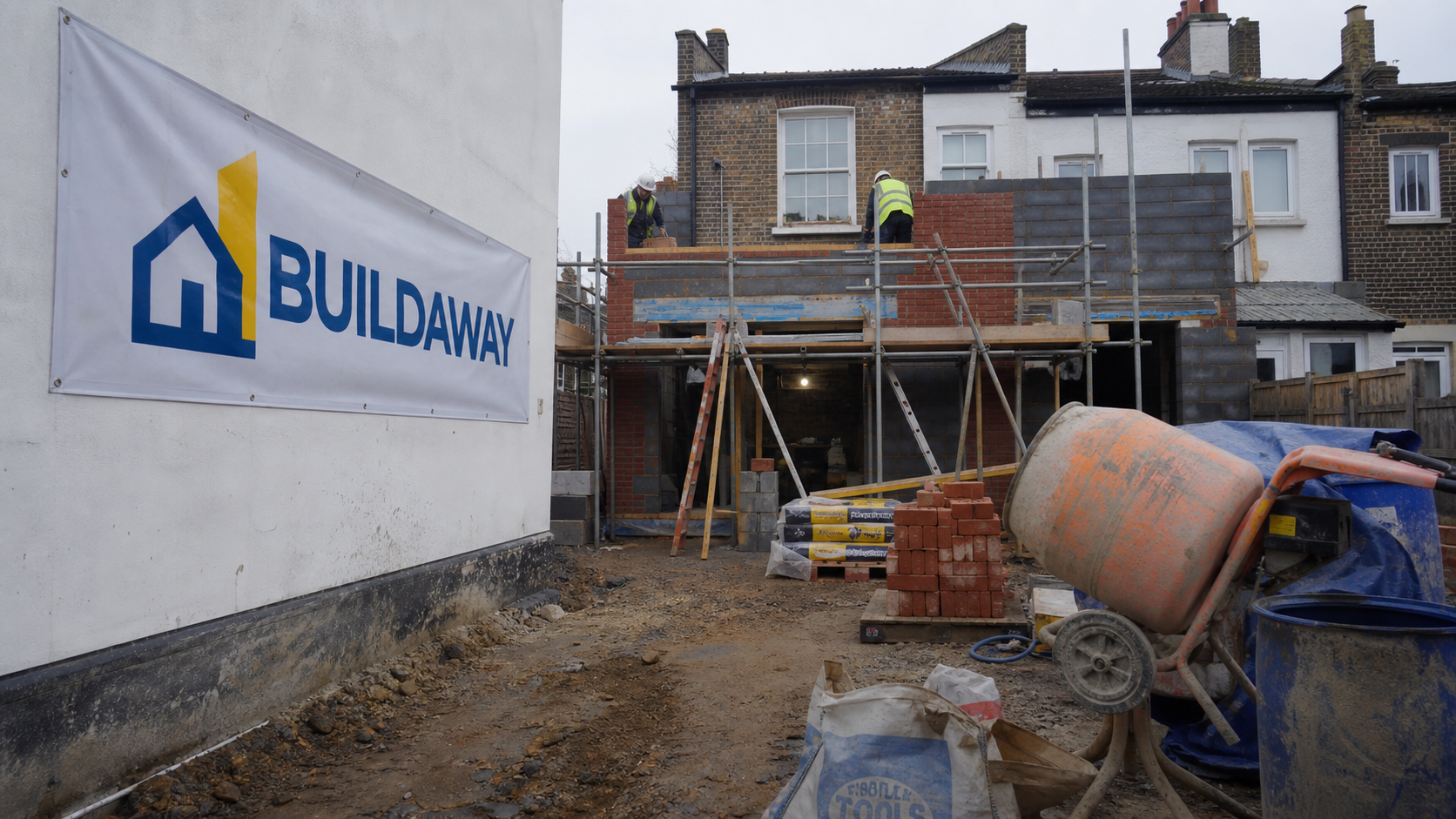
This is where the project becomes visible. Construction runs from groundworks through to snagging and, depending on the scale and type of extension, takes between 12 and 24 weeks once work starts on site.
The build moves through sequential stages with clear milestones:
- Groundworks and foundations (Weeks 1–3): Excavation, concrete strip or raft foundations, and drainage connections. One practical advantage that Bexleyheath's interwar and post-war housing stock often offers over inner London terraces is better rear access side gates, wider plots, and occasional rear lane access in some streets make plant and materials movement more straightforward. That said, Bexleyheath's underlying Thames Estuary clay geology remains susceptible to waterlogging in winter months, and groundworks started in December or January carry weather risk that spring starts avoid.
- Structure goes up (Weeks 4–7): Blockwork walls, structural steelwork where the design requires it, roof structure, and external finishes. For interwar semis in DA6, the structure phase is generally efficient the original builds are well-understood and the structural requirements of a standard rear extension are rarely complicated by the type of Victorian-era irregular foundations that affect older inner London stock.
- Weathertight milestone (Weeks 8–10): Roof covering, external windows, and doors installed and sealed. This milestone marks the transition from weather-dependent to weather-independent working, and it's the moment internal trades can begin proper fit-out work.
- First fix (Weeks 11–13): Electrical wiring, plumbing pipework, and central heating runs all installed before plaster is applied. Routing services correctly at this stage avoids expensive retrospective work once walls and ceilings are finished.
- Plastering, insulation and second fix (Weeks 14–15): Wall and ceiling finishes applied. Skirtings, sockets, switches, and kitchen or bathroom fittings installed where the brief includes them.
- Decoration and snagging (Weeks 15–16): Final finishes, tiling, decoration, and the Building Control final inspection sign-off.
For a standard single-storey rear extension on a Bexleyheath residential property, the on-site construction phase typically runs 12–16 weeks. A double-storey extension extends this to 18–24 weeks. The groundworks phase is the most weather-dependent clay subsoil in DA6 and DA7 can become waterlogged through the winter months, and this is the stage where a spring start provides the clearest advantage. (Source: Checkatrade; Buildaway project experience)
See our comparison of single storey vs double storey extension in Bexleyheath for the full breakdown.
What Actually Delays a Bexleyheath Home Extension?
Most extensions encounter some form of delay. In Bexleyheath, four causes account for the large majority of programme overruns and every one of them can be substantially reduced with planning that starts before the architect is briefed.
Party wall notices served too late. This is far and away the most common cause of pre-construction delay on DA6 and DA7 extension projects. Bexleyheath's dominant housing form the interwar semi-detached almost universally triggers party wall obligations on a rear extension. The legal notice period is two months minimum, and that clock doesn't start until the notice is served. Homeowners who finish the planning process and then begin party wall discussions are starting a mandatory two-month countdown at the point they most want to be moving forward. Identifying party wall obligations at the survey stage and serving the notice the moment planning approval arrives is the practice that keeps projects on schedule.
Conservation area requirements misread or missed. The Bexleyheath Town Centre Conservation Area and the Red House Conservation Area in DA6 both carry specific design requirements. Extensions in or near these areas that propose materials, proportions, or roof profiles not in keeping with the existing building character are flagged for amendment by Bexley's planning team. Submitting without a Heritage Statement where one is required, or submitting one that fails to engage with the relevant conservation area appraisal, typically results in a request for further information that adds three to four weeks to the decision period.
From our Bexleyheath projects:
"A pattern we see regularly on DA6 enquiries is homeowners who've done their initial
research, identified that their property isn't inside a named conservation area
boundary, and concluded that standard permitted development applies. What they've
sometimes missed is that 'adjacent to' a conservation area can trigger additional
scrutiny even where a property isn't formally within it and that Bexley's planning
officers apply a material test to extensions whose scale or appearance might affect the
setting of a designated area. On a recent project off Manor Road, the distinction
between 'outside the boundary but within the setting' added two weeks to the
pre-application stage but saved a much longer delay mid-assessment. It's the kind of
local knowledge that makes a significant practical difference."
Structural surprises on interwar semi-detached stock. While Bexleyheath's interwar housing generally offers cleaner structural conditions than Victorian terraces, the original builds varied in quality and specification across developers. Properties where the original rear ground-floor extension has already been built out common across DA6 and DA7 where 1970s and 1980s single-storey additions are widespread can require additional structural assessment before a new extension can be designed above or alongside the existing structure. A thorough pre-design survey identifies this before drawings are committed to, not during the build.
Late material and product decisions. Good builders covering DA6 and DA7 are typically booked six to ten weeks ahead during spring and summer. A window specification change, a revised roof light configuration, or a different bi-fold door model decided after the build has started doesn't just cause a visual amendment it stops the relevant trades while materials are sourced and reordered. Every material and product decision made before groundworks begin reduces the probability of a programme delay during the build itself.
The majority of overruns on Bexleyheath home extensions trace back to four causes: party wall notices served after planning rather than concurrent with it, conservation area documentation gaps at submission, structural conditions on extended interwar stock, and late product decisions during the build. (Source: Bexley Council planning guidance; Buildaway project experience)
One point of contact. One clear process. Buildaway handles planning checks, party wall coordination, structural engineering, and build management across Bexleyheath and the DA6 and DA7 postcodes.
Get Your Free No-Obligation Quote →When Is the Best Time to Start a Bexleyheath Home Extension?
The answer that works for most DA6 and DA7 homeowners: begin your design process in September or October, target a planning submission in November, receive your decision in January or February, and aim to start groundworks in March or April.
Spring gives Bexleyheath extension projects the most productive conditions. The clay subsoil underlying much of the DA6 and DA7 area drains and firms up through March, daylight hours extend meaningfully into the evening, and the dry season ahead gives the structure the best possible window to reach weathertight before autumn sets in. Starting groundworks in the depths of winter in what is often cold, waterlogged Thames Estuary clay adds risk to the phase of the project that most needs stable conditions.
There's also a practical contractor availability argument. Builders working across the outer South East London and North Kent fringe covering postcodes like DA6, DA7, DA14, and SE9 tend to book spring and summer slots months ahead. Beginning the design and planning process in the preceding autumn allows you to identify the right contractor and confirm a start date before the peak season schedule fills.
Putting It All Together
A Bexleyheath home extension is a straightforward undertaking when the full picture is understood from the outset. Here's the honest summary for DA6 and DA7 projects:
- Single-storey rear extension in Bexleyheath: 6–10 months total from first consultation to handover
- Double-storey extension: 9–14 months more structural complexity, longer planning process
- Conservation area proximity: Allow up to 12 weeks for a planning decision and add 3–4 weeks to your design preparation for Heritage Statement requirements
- Party wall obligations: Identify at survey stage, serve the notice the day planning approval arrives this single action protects the groundworks start date on almost every semi-detached project in DA6
- Best start time: Design in autumn, submit in November, break ground in spring
At Buildaway, every project in Bexleyheath runs with a single point of contact one person who coordinates your architect, structural engineer, building control, and on-site team from first enquiry to final sign-off. No managing multiple contractors. No gaps between project phases. A clear schedule and a project that finishes when it's planned to.
For the next step, see our full breakdown of home extension costs in Bexleyheath for a realistic budget picture across all extension types in DA6 and DA7.