
In 2026, the average property value in East Dulwich (SE22) stands at £732,000 — and across Lordship Lane, Calton Avenue, and the streets running off Barry Road, that figure represents years of capital growth sitting idle while children squeeze into shared rooms or the kitchen works overtime (HM Land Registry, 2026).
The reality is that most families don't have £60,000–£90,000 sitting in a savings account. So the right question isn't "can I afford to extend?" — it's "which finance route costs me the least, and what do I need to know about Dulwich specifically before I approach a lender?"
Related guide: How much a home extension costs in Dulwich
This guide covers every option — remortgage, further advance, second-charge mortgage, and personal loan — and maps each one to the specific property types and planning realities you'll face across SE21, SE22, and SE24. That includes the one detail most generic finance guides miss entirely: the dual approval system that applies to properties on the Dulwich Estate.
TL;DR:
A single-storey extension in Dulwich costs £35,000–£90,000 in 2026. With East Dulwich (SE22) property values averaging £732,000 (HM Land Registry, 2026), most homeowners carry substantial equity — enough to fund a strong rear or side-return extension through secured borrowing. Remortgaging at current 5-year fixed rates of 4.25–4.50% typically beats a personal loan by thousands. If you're mid-deal on a low rate, a further advance or second-charge mortgage is often the smarter call.
Why Are Dulwich Homeowners Choosing to Extend Rather Than Move?
The maths of moving in Dulwich have rarely looked worse — and in 2026, many families have done the numbers and walked away from the idea entirely.
Stamp duty on an £850,000 Dulwich property runs to roughly £32,500. Add estate agent fees of £10,000–£18,000, conveyancing costs of £2,000–£4,500, and the physical upheaval of removals and storage, and you're easily burning £47,000–£55,000 before you've touched a paintbrush in the new place. That's before the additional complication of leaving a school catchment area that may have taken years to secure.
An extension spends that same money differently. Extensions in South East London typically return £1.20–£1.50 for every £1 spent and add 10–20% to property value (RICS, 2025). On a £732,000 SE22 home, that translates to £73,200–£146,400 in added equity — money that stays with the property when you eventually sell, rather than disappearing into an agent's commission.
The school catchment effect deserves its own mention. Dulwich College, James Allen's Girls' School, and the cluster of outstanding state primaries in SE22 create a powerful incentive to stay put. Around 24% of UK homeowners who seriously considered moving in early 2026 chose to extend instead, citing disruption and transaction costs as the deciding factors (Quick Move Now, Q1 2026). In Dulwich, the school factor makes that figure feel conservative.
Cormac Hegarty, Director at Buildaway: "Dulwich families come to us having already decided not to move — the school question usually settles that long before the building conversation starts. What they need help with is navigating the finance options and, in many cases, understanding what the Dulwich Estate means for their project timeline and lender expectations."
Southwark's property market adds some relevant context too. The borough saw average prices fall 2.6% year-on-year to February 2026 — shallower than the wider London decline of 3.3% (ONS, Feb 2026), but still a softening. In a market that's retreating, selling and buying simultaneously means transacting at both ends of a falling market. Extending removes that risk entirely.
🔑 Citation capsule: A well-executed home extension in South East London typically returns £1.20–£1.50 for every £1 spent and adds 10–20% to property value, according to the Royal Institution of Chartered Surveyors (RICS, 2025). For the average SE22 homeowner at £732,000, this represents £73,200–£146,400 in added equity — a return that comfortably absorbs most financing costs, particularly for a rear or side-return extension.
How Much Does a Home Extension Actually Cost in Dulwich in 2026?
Getting your budget right before approaching any lender is non-negotiable. In London and the South East, extension costs run 20–40% above the national average — a gap that catches many SE22 homeowners off guard when they receive their first contractor quotes.
In 2026, single-storey extensions across the South East cost £2,800–£4,500 per m², compared to £2,000–£2,800 nationally (getestimateai.co.uk, March 2026; RICS BCIS, 2025). A 20m² rear extension on a typical SE22 Victorian terrace — the most common project type we see in the area — realistically runs £56,000–£90,000 once professional fees, building control, and a sensible contingency are included.
Dulwich has specific cost layers that don't apply in most other parts of London. For Victorian terraces along Lordship Lane and the roads running off it, a party wall surveyor is almost always required — budget £1,000–£2,500 per adjoining property. Planning fees start at £206 for householder applications. Building control runs £400–£2,000 depending on the scope of work.
Then there's the factor unique to this postcode: if your home falls within the Dulwich Estate, you'll need Estate consent in addition to Southwark Council planning permission. Estate approval involves its own architectural review process and associated fees — your architect needs to account for this in both the budget and the project timeline. Nationally, 87% of householder planning applications in England were approved in the year ending September 2025 (DLUHC, Dec 2025), but Estate covenant properties carry an additional layer of scrutiny that standard approval rates don't capture.
Underestimating your total project cost by £15,000–£20,000 mid-build is how homeowners end up scrambling for expensive short-term finance. Get a full cost picture first.
Related guide: Single vs Double Storey Extension Guide
🔑 Citation capsule: In Dulwich and the wider South East London market, single-storey home extensions cost £2,800–£4,500 per m² in 2026 — 20–40% above the UK national average. A standard 20m² rear extension in SE22 therefore runs £56,000–£90,000 in total project cost, including professional fees and contingency. Properties within the Dulwich Estate require dual consent from both Southwark Council and the Estate, which can extend project timelines by 4–6 weeks (RICS BCIS, 2025; getestimateai.co.uk, March 2026).
Should You Remortgage to Fund Your Dulwich Home Extension?
Remortgaging is the route most Dulwich homeowners reach for first — and when the timing lines up, it's usually the most cost-effective path to extension funding.
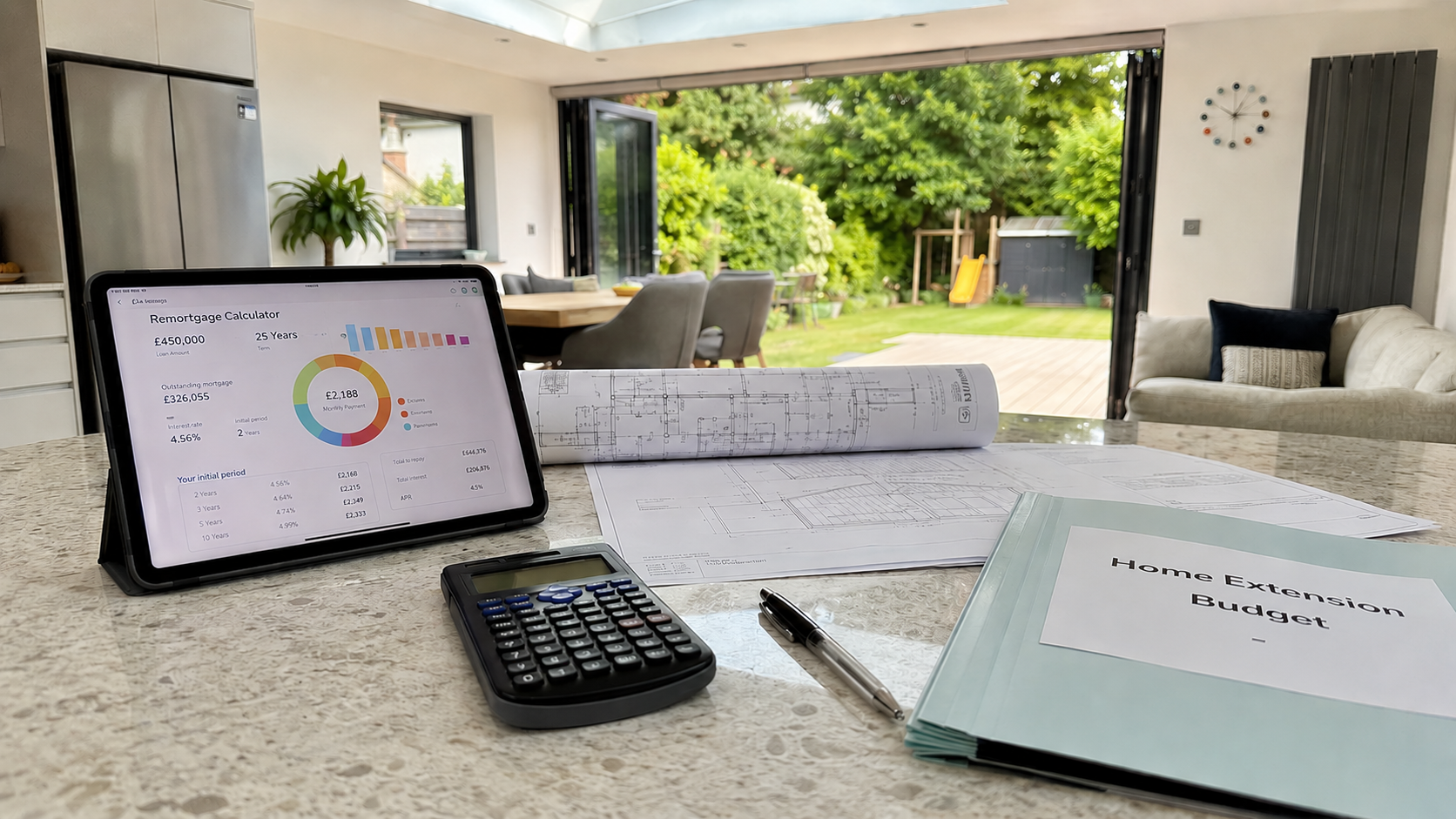
The mechanics are simple: you replace your existing mortgage with a larger one, and the difference between your old balance and the new loan amount is released as cash. In May 2026, competitive 5-year fixed rates sit at 4.25–4.50% at 60% LTV (MoneyfactsCompare, April 2026). Even at 75% LTV, these rates beat personal borrowing by a significant margin.
When does remortgaging make the most sense?
The best window is when your current fixed deal is ending or has already expired. UK Finance estimates around 1.8 million fixed-rate mortgages are due to expire in 2026 — many belonging to homeowners who locked in below 2% during 2021. If your fix is ending soon, you're remortgaging anyway. Doing it now lets you set a new rate and release extension funding in a single transaction.
The alternative — doing nothing — puts you on your lender's Standard Variable Rate (SVR), which currently averages 6.49–7.00% (HomeOwners Alliance, May 2026). On a £400,000 outstanding mortgage, that jump from 1.8% to SVR adds roughly £1,700 per month. Remortgaging at 4.25% and releasing £70,000 for a Dulwich extension can cost almost the same monthly as doing nothing and drifting onto SVR.
The Early Repayment Charge problem
Mid-deal homeowners face a more complex calculation. An ERC of 3% on a £350,000 mortgage is £10,500 — real money that needs to be weighed against the interest saving from switching. If you're more than 18 months from your deal end and sitting on a rate below 2%, a further advance or second-charge mortgage almost always works out cheaper than triggering the ERC.
💡 Our finding: Dulwich homeowners in SE22 have spent years accumulating equity as property values climbed — many now sitting at 40–50% LTV or lower, even after accounting for today's softer market. That position means access to lenders' best remortgage tiers, where the rate differential between 60% LTV and 75% LTV is often only 0.2–0.4%. Dulwich borrowers in this bracket frequently access rates that are genuinely competitive with any secured finance product on the market.
The 6-month rule: You can lock in a new remortgage rate up to 6 months before your deal expires — with no ERC and no obligation to switch early. If your current fix ends before November 2026, now is the optimal window to apply.
Related guide: Planning Permission for a Dulwich Home Extension
🔑 Citation capsule: In May 2026, competitive 5-year fixed remortgage rates sit at 4.25–4.50% at 60% LTV (MoneyfactsCompare, April 2026; Bank of England, May 2026). UK Finance projects that 1.8 million fixed-rate mortgages will expire in 2026, many held by homeowners who locked in below 2% — creating a primary window for SE21 and SE22 homeowners to remortgage for extension funding without paying an Early Repayment Charge.
What Is a Further Advance — and Is It Right for Your Dulwich Situation?
A further advance lets you borrow more money from your existing mortgage lender on top of your current loan — without breaking the deal, and without triggering any Early Repayment Charge. For Dulwich homeowners mid-way through a low fixed rate, it's frequently the most overlooked option and often the best one.
Here's why it works: if you're sitting on a 1.8% fix that runs until 2027 or 2028, remortgaging tears that deal up. A further advance leaves it completely intact. Your lender creates a separate borrowing facility — secured against the same property — at a current market rate, while your existing mortgage continues exactly as before.
What the process looks like:
Approval is typically faster than a full remortgage. Some lenders process further advances in as little as 2–4 weeks, and since you're already a customer with an established payment history, the underwriting process is less intensive. The rate will usually sit slightly above your existing mortgage rate, but considerably below a personal loan or credit facility.
The catch: not every lender offers further advances, and the amount they'll approve may be limited by their own internal LTV rules. If your lender won't play ball, a second-charge mortgage (see below) achieves the same outcome — keeping your existing deal untouched while adding a separate secured borrowing facility on top.
🏡 Buildaway tip: Homeowners in SE21 Dulwich Village — particularly around Court Lane and the roads near Dulwich Park — often carry exceptionally low LTV ratios due to the area's high property values. These sub-40% LTV positions frequently unlock the most competitive further advance rates from mainstream lenders. If your home is worth £1.2M and your outstanding mortgage is £300,000, you have substantial headroom — and lenders know it.
Always get a written decision in principle before committing to a build timeline. Good Dulwich extension contractors are booking weeks ahead. Confirmed finance should come before you sign any contract.
Related guide: How long a home extension takes in Dulwich
Option 3: Secured Loan (Second-Charge Mortgage) — When It Makes Sense for Dulwich Homeowners
A second-charge mortgage is a separate secured loan that sits behind your existing mortgage — it uses the same property as collateral but runs independently from your main deal. It's the right tool when the cost of breaking your current mortgage outweighs the benefit of remortgaging.
In 2026, second-charge rates typically run 4.5–7% depending on LTV and credit profile (Fox Davidson, Jan 2026; ResiQuote, April 2026). That's higher than the best remortgage deals, but the trade-off is clear: your existing mortgage rate stays exactly as it is. Combined LTV across both loans typically cannot exceed 75–85% with mainstream lenders.
This route fits your situation if:
- You're locked into a sub-2% fixed rate with a meaningful ERC still outstanding
- Your income has changed since your original mortgage application — perhaps you've moved to contracting or self-employment
- You need funds faster than a full remortgage typically allows
- Your existing lender won't offer a further advance at a rate that makes sense
Dulwich has a notably high concentration of self-employed professionals — architects, media workers, consultants, and freelancers are common in SE21 and SE22. Second-charge lenders assess income more flexibly than high-street remortgage underwriting, and that flexibility has real, practical value for this group.
One honest note: your home is collateral on both loans. If you can't service either, both are at risk. That's not a reason to avoid this route — it's a reason to get the numbers precise before you commit.
🔑 Citation capsule: A second-charge mortgage sits behind your existing deal and allows Dulwich homeowners to borrow against built-up property equity at rates of 4.5–7% in 2026, without disturbing the original mortgage rate. Combined LTV across both loans typically cannot exceed 75–85% with mainstream lenders — a threshold most SE22 homeowners are well positioned to meet given the area's high property values (Fox Davidson, January 2026; ResiQuote, April 2026).
When Does a Personal Loan Make Sense for a Dulwich Extension?
A personal loan has one clear advantage: speed and simplicity. No equity calculation, no property valuation, no solicitor. But the numbers only stack up for smaller projects.
In 2026, personal loan rates run 6–10% for borrowers with good credit, with the most competitive deals on amounts between £7,500–£25,000 (ResiQuote, April 2026). Repayment terms cap at 7 years, which pushes monthly payments higher than any mortgage-based route stretched over 20+ years.
The comparison: £25,000 over 5 years at 7% costs roughly £495/month, with total repayments of around £29,700 — £4,700 in interest. The same amount remortgaged at 4.25% over 20 years costs far less monthly, though total interest rises with the longer term.
When a personal loan is actually the right call for a Dulwich homeowner:
A utility room addition on the side of an SE22 flat, a garden office outbuilding under £20,000, or a kitchen reconfiguration that doesn't require structural extension work — these are the scenarios where a personal loan is clean, fast, and appropriate. It also keeps your property equity fully separate from your renovation decision, which some homeowners prefer.
What it's not suited for: the typical Dulwich rear extension. Single-storey projects here run £56,000–£90,000 — well above the £25,000 ceiling where personal loan rates become competitive. At that scale, secured finance wins on cost almost every time.
Which Finance Route Fits Your Dulwich Property — by Postcode?
The right route depends on your postcode as much as your credit profile. SE21 and SE22 are quite different markets — and even within them, the Dulwich Estate boundary creates a meaningful divide.
📊 Buildaway equity guide — Dulwich postcodes: Based on HM Land Registry and ONS data (April–May 2026), here's how much a homeowner at 75% LTV could typically access in additional finance, assuming a 50% LTV outstanding mortgage:
| Property Type | Area | Avg Value | Equity at 75% LTV* | Best Finance Route |
|---|---|---|---|---|
| Victorian terrace | SE22 (Lordship Lane, Barry Rd) | £620k–£800k | £155k–£200k | Remortgage or Further Advance |
| Edwardian semi-detached | SE22 (Calton Ave, Goose Green) | £700k–£900k | £175k–£225k | Further Advance or Remortgage |
| Arts & Crafts / detached | SE21 (West Dulwich, Turney Rd) | £800k–£1.2M | £200k–£300k | Second Charge (if mid-fix) |
| Georgian/period townhouse | SE21 (Court Lane, Dulwich Village) | £1.0M–£1.5M+ | £250k–£375k | Any route; remortgage most flexible |
| Dulwich Estate property | SE21 (Gallery Rd, College Rd) | £1.2M–£2M+ | £300k–£500k+ | Specialist broker essential |
*Assumes 50% LTV outstanding balance; figures indicative only. Always seek independent mortgage advice.
SE21 Dulwich Village and the Estate — a special case. Properties in and around Gallery Road, College Road, and the historic core of the Village carry some of the highest values in South East London — often exceeding £1.5M for a family home. The equity headroom is substantial, but there are two specific complications. First, Southwark has 48 conservation areas — one of the highest counts in London (pdassessment.co.uk, 2026) — and much of Dulwich Village falls within one. Second, Dulwich Estate properties carry the additional covenant approval layer on top. Some lenders insist on seeing both Southwark planning consent and Estate approval before releasing funds, since the dual restriction affects build viability and the property as security.
If you own in SE21 on or near the Estate, start both conversations — with the Estate office and with Southwark's planning team — before you approach any lender.
🔑 Citation capsule: Dulwich Village (SE21) properties on the Dulwich Estate require dual approval from both Southwark Council and the Dulwich Estate for any extension works — a requirement that affects how lenders assess the project and when they'll release funds. Southwark has 48 conservation areas, one of London's highest totals, meaning a significant proportion of SE21 and SE22 properties face restrictions on standard Permitted Development rights (Southwark Council, 2026; pdassessment.co.uk, 2026).