
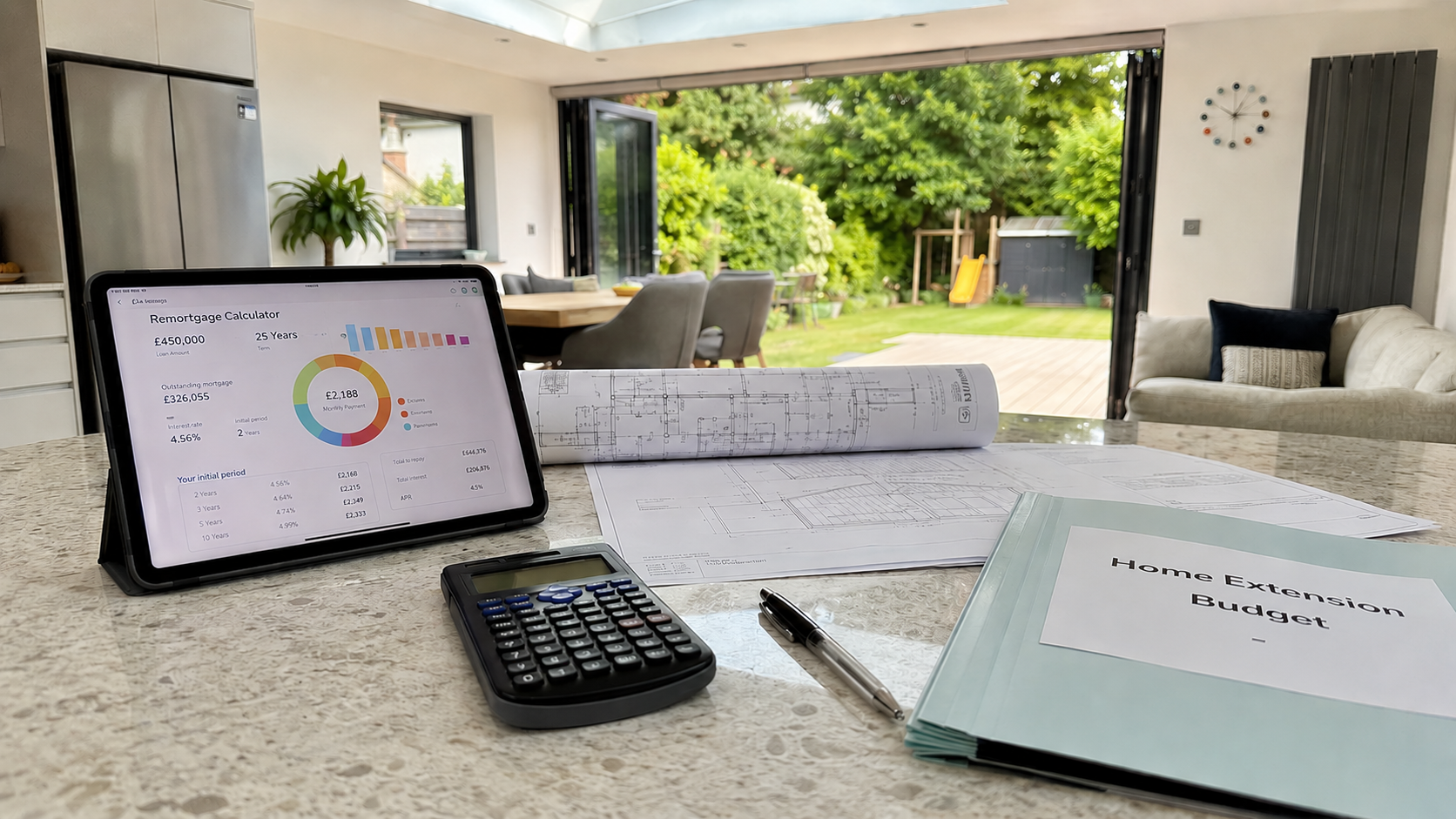
In February 2026, the average house price in Bromley reached £515,000 - and for homeowners across BR1, BR2, and BR7, that figure represents substantial equity sitting unused while the kids share rooms or the kitchen feels smaller every year (ONS / HM Land Registry, Feb 2026).
A single-storey extension in South East London now costs £35,000–£90,000. That's not money most families have sitting in a current account. So the question isn't really "can I afford to extend?" - it's "which finance route costs me the least, and when do I start?"
Related guide: How much a home extension costs in Bromley
This guide breaks down every option: remortgage, further advance, second-charge mortgage, and personal loan. More importantly, it maps each route to the specific property types found across Bromley - from Victorian terraces on Widmore Road in BR1 to conservation-area detached homes in BR7 Chislehurst.
TL;DR:
A single-storey extension in Bromley costs £35,000–£90,000 in 2026. With average house prices at £515,000 (ONS, Feb 2026), most BR1–BR7 homeowners hold enough equity to fund one. Remortgaging at today's 5-year fixed rates of 4.25–4.50% typically beats a personal loan by thousands. If you're mid-deal on a low rate, a further advance or second-charge mortgage often works out cheaper still.
Why Are Bromley Homeowners Choosing to Extend Rather Than Move?
The maths of moving have shifted - and they've shifted hard against it. Stamp duty on a £600,000 Bromley property now costs £22,500. Stack on estate agent fees (£9,000–£15,000), conveyancing (£2,000–£4,000), and removals, and you're looking at £35,000–£45,000 to move before you've even picked up a paintbrush.
An extension costs a similar amount upfront - but it adds value rather than burning it. Extensions across South East London typically return £1.20–£1.50 for every £1 spent, adding 10–20% to property value (RICS, 2025). On a £515,000 Bromley home, that's £51,500–£103,000 in added equity.
It's not just the numbers. Around 24% of UK homeowners who seriously considered moving in early 2026 chose to extend instead, citing moving costs and disruption as key factors (Quick Move Now, Q1 2026). In streets near Norman Park in BR2 and along the Shortlands roads, rear extensions have become a near-constant sight on planning portals.
Cormac Hegarty, Director at Buildaway: "The families we work with in Bromley - particularly around BR2 and BR7 - almost always come to us having already decided against moving. They've run the numbers. The conversation shifts quickly from 'should I extend?' to 'how do I pay for it?' - which is exactly where this guide starts."
Bromley's property market adds another dimension: local prices rose 1.2% year-on-year in the 12 months to February 2026, while the wider London average fell by 3.3% over the same period (ONS, Feb 2026). Equity is holding up here when it isn't elsewhere in the capital.
🔑 Citation capsule: A well-executed home extension in South East London typically returns £1.20–£1.50 for every £1 spent and adds 10–20% to property value, according to the Royal Institution of Chartered Surveyors (RICS, 2025). For the average Bromley homeowner at £515,000, this translates to £51,500–£103,000 in added equity - comfortably ahead of financing costs for most projects.
How Much Does a Home Extension Actually Cost in Bromley in 2026?
Before choosing a finance route, you need a realistic budget. Costs in London and the South East run 20–40% above the national average - a figure that catches many Bromley homeowners off guard.
In 2026, single-storey extensions in our area cost £2,800–£4,500 per m², compared to £2,000–£2,800 nationally (getestimateai.co.uk, March 2026; RICS BCIS, 2025). A 20m² rear extension - typical for a BR2 semi-detached - realistically runs £56,000–£90,000 once you include professional fees, building control, and contingency.
Don't forget the extras. Victorian terrace owners along London Road (BR1) almost always need a party wall surveyor - budget £1,000–£2,500 per neighbouring property. Planning fees start at £206 for householder applications. Building control runs £400–£2,000 depending on scope. Conservation area properties in BR7 Chislehurst may face additional heritage design requirements that push architect fees higher.
The good news: 87% of householder planning applications in England were granted in the year ending September 2025 (DLUHC, Dec 2025). Extensions are, for the most part, approved.
Knowing your total project cost before approaching a lender matters. Underestimating by £15,000 mid-project is how people end up on expensive bridging finance.
Related guide: Single vs Double Storey Extension Guide
🔑 Citation capsule: In London and the South East, single-storey home extensions cost £2,800–£4,500 per m² in 2026 - 20–40% above the UK national average. A typical 20m² rear extension in the Bromley area therefore runs £56,000–£90,000 in total project cost, including professional fees and contingency (RICS BCIS, 2025; getestimateai.co.uk, March 2026).
Should You Remortgage to Fund Your Bromley Home Extension?
Remortgaging is the financing method most Bromley homeowners reach for - and when the timing is right, it's often the most cost-effective option.
The idea is straightforward: you replace your existing mortgage with a new, larger one. The difference between your old balance and your new one is released as cash to fund the build. In May 2026, competitive 5-year fixed rates sit at 4.25–4.50% at 60% LTV (MoneyfactsCompare, April 2026). Even at 75% LTV, deals remain materially cheaper than personal borrowing.
When does remortgaging work best?
It works best when your current fixed rate is ending or has already ended. According to UK Finance, around 1.8 million fixed-rate mortgages are due to expire in 2026 - many were locked in at below 2% in 2021. If you're one of those homeowners, your deal is ending anyway. Remortgaging now lets you lock in a new rate and release extension funding at the same time.
Consider the alternative: doing nothing puts you on your lender's Standard Variable Rate (SVR), which currently averages 6.49–7.00% (HomeOwners Alliance, May 2026). For a £300,000 outstanding mortgage, moving from 1.8% to SVR adds around £1,500 per month. Remortgaging at 4.25% and releasing £60,000 for an extension can cost almost the same monthly as drifting onto SVR and doing nothing.
The Early Repayment Charge trap
If you're mid-deal, you'll need to weigh the ERC against the interest saving. Many homeowners on 1.5–2% deals from 2021 face ERCs of 1–5% of their outstanding balance. Paying a £6,000 ERC to remortgage at a rate that saves you £200 per month doesn't break even for 30 months. A further advance (Option 2) or second-charge mortgage (Option 3) is often smarter in this scenario.
💡 Our finding: Bromley's property market is outperforming wider London - values rose 1.2% year-on-year to February 2026 while the broader London average fell 3.3% (ONS, Feb 2026). This means Bromley homeowners are holding more equity than equivalent mortgagors elsewhere in the capital - giving them stronger LTV positions and access to better remortgage rates than the London average might suggest.
The 6-month rule: You can lock in a new remortgage rate up to 6 months before your current deal expires - with no ERC and no obligation to switch early. If your fix ends before November 2026, now is the right time to apply.
Remortgaging activity grew 13.7% in 2025 to 1.86 million refinancing loans, according to UK Finance. The market is busy; brokers are worth every penny.
Related guide: Planning Permission for a Bromley Home Extension
🔑 Citation capsule: In May 2026, the Bank of England base rate stands at 3.75%, with competitive 5-year fixed remortgage deals available at 4.25–4.50% at 60% LTV (MoneyfactsCompare, April 2026; Bank of England, May 2026). UK Finance estimates 1.8 million fixed-rate mortgages will expire in 2026, many held by homeowners who locked in below 2% - making this the primary window to remortgage for extension funding.
What Is a Further Advance - and Is It Right for Your Situation?
A further advance is borrowing additional money from your existing mortgage lender - on top of your current mortgage, without breaking the deal. It's the option that's most often overlooked, and for some Bromley homeowners it's the smartest move on the board.
Here's why it matters: if you've got a 1.8% fix running until 2027, remortgaging means losing that rate. A further advance lets you keep it. Your lender adds an extra loan - secured against the same property - at a current market rate, leaving your existing mortgage completely untouched.
What to expect:
The rate on a further advance is usually slightly higher than your existing mortgage rate, but considerably lower than a personal loan. Approval is typically faster than a full remortgage - some lenders process further advances in 2–4 weeks. The application is simpler too, since you're already a customer with an established relationship and payment history.
The catch: not every lender offers further advances, and the amount available may be capped. If your lender doesn't offer one - or their rate isn't competitive - a second-charge mortgage achieves the same outcome without touching your main deal.
🏡 Buildaway tip: Homeowners in BR2 - particularly along the Shortlands streets and Bromley Common - tend to hold lower LTV ratios thanks to the area's higher property values (average £723,250 in Bromley Common, per HM Land Registry, April 2026). That lower LTV often unlocks the most competitive further advance rates from mainstream lenders.
Always get a written decision in principle before committing to your build timeline. Most good builders in Bromley are booking several weeks ahead - confirmed finance should come before you sign contracts.
Related guide: How long a home extension takes in Bromley
Option 3: Secured Loan (Second-Charge Mortgage) - When It Makes Sense
A second-charge mortgage is a separate loan secured against your property - it sits behind your existing mortgage in the queue, but uses the same asset as collateral. It's the right tool when remortgaging would cost you more than it saves.
Rates in 2026 typically run 4.5–7% depending on your LTV and credit profile (Fox Davidson, Jan 2026; ResiQuote, April 2026). That's higher than the best remortgage deals, but the critical trade-off is clear: your existing mortgage stays exactly as it is. The combined LTV across both loans typically can't exceed 75–85% with mainstream lenders.
This route suits you if:
- You're locked into a low rate with a meaningful ERC still to run
- You're self-employed or a contractor, and specialist lenders are more flexible than high-street remortgage underwriting
- You need funds faster than a full remortgage allows
- Your income situation has changed since your original mortgage
Bromley's commuter belt - strong in finance, professional services, and contracting - means a significant proportion of homeowners fall into the self-employed bracket. Second-charge lenders often assess income differently, and that flexibility has real value.
One honest point: your home is collateral on both loans. If you can't service either, both are at risk. This isn't a reason to avoid the route - it's a reason to get the numbers right before you commit.
🔑 Citation capsule: A second-charge mortgage - also called a secured loan - sits behind your existing mortgage and allows Bromley homeowners to borrow against their property equity at rates of 4.5–7% in 2026, without disturbing their current mortgage deal. Combined LTV across both loans typically cannot exceed 75–85% (Fox Davidson, January 2026; ResiQuote, April 2026).
When Does a Personal Loan Make Sense for a Bromley Extension?
A personal loan is the simplest route to extension finance - no equity required, no valuation, no solicitor. But the maths only work at the lower end of the cost spectrum.
In 2026, personal loan rates run 6–10% for borrowers with good credit, with the best rates available on amounts between £7,500–£25,000 (ResiQuote, April 2026). Repayment terms are capped at 7 years, which means higher monthly payments than a mortgage-based route stretched over 20–25 years.
The maths: £25,000 over 5 years at 7% costs roughly £495/month, with total repayments of £29,700 - meaning you pay £4,700 in interest. Compare that to the same amount remortgaged at 4.25% over 20 years, and the monthly payment drops considerably, though the total interest paid rises due to the longer term.
When a personal loan makes sense for a Bromley homeowner:
For a small rear utility extension on a BR3 Beckenham terrace - budget around £15,000–£20,000 - a personal loan is quick, clean, and avoids the full administration of remortgaging. It's also the right call when you want to keep your property equity completely separate from your renovation decision.
What it's not right for: most Bromley extensions. Single-storey rear extensions here run £56,000–£90,000. At that level, a secured finance route almost always wins on cost.
Which Finance Route Fits Your Bromley Property - by Postcode?
This is the section no generic guide produces - and it's the one that matters most. The right finance route depends as much on your property type and postcode as it does on your credit score.
📊 Buildaway equity calculator - Bromley postcodes: Based on HM Land Registry and ONS data (April–May 2026), here's how much a homeowner at 75% LTV could typically borrow in additional financing, assuming a 50% LTV outstanding mortgage:
| Property Type | Area | Avg Value | Equity at 75% LTV* | Best Finance Route |
|---|---|---|---|---|
| Victorian terrace | BR1 (Bickley, London Rd) | £420k–£580k | £105k–£145k | Remortgage or Further Advance |
| 1930s semi-detached | BR2 (Shortlands, Norman Park) | £500k–£750k | £125k–£187k | Further Advance or Remortgage |
| Edwardian terrace | BR3 (Beckenham) | £450k–£650k | £112k–£162k | Second Charge (if mid-fix) |
| Detached/conservation | BR7 (Chislehurst) | £600k–£900k+ | £150k–£225k | Any route; remortgage most flexible |
| Smaller terrace/flat | BR1 1 (most affordable) | From £344k | From £86k | Personal loan for smaller projects |
*Assumes 50% LTV outstanding balance; figures indicative only. Always seek independent mortgage advice.
BR7 Chislehurst - a special case. Conservation area properties often command a premium - £600k–£900k+ is common - which means more equity headroom. But lenders sometimes require full planning permission before releasing funds in conservation areas, because design restrictions affect build viability. If you're in a BR7 conservation area, get your planning conversation with Bromley Council started before you approach a lender.
🔑 Citation capsule: The most suitable financing route for a Bromley home extension depends on both property type and postcode. Homeowners in BR2 - where average values reach £723,250 in Bromley Common (HM Land Registry, April 2026) - typically hold the most equity and qualify for the most competitive further advance and remortgage rates. Conservation area properties in BR7 Chislehurst often require planning approval before lenders will release funds.